
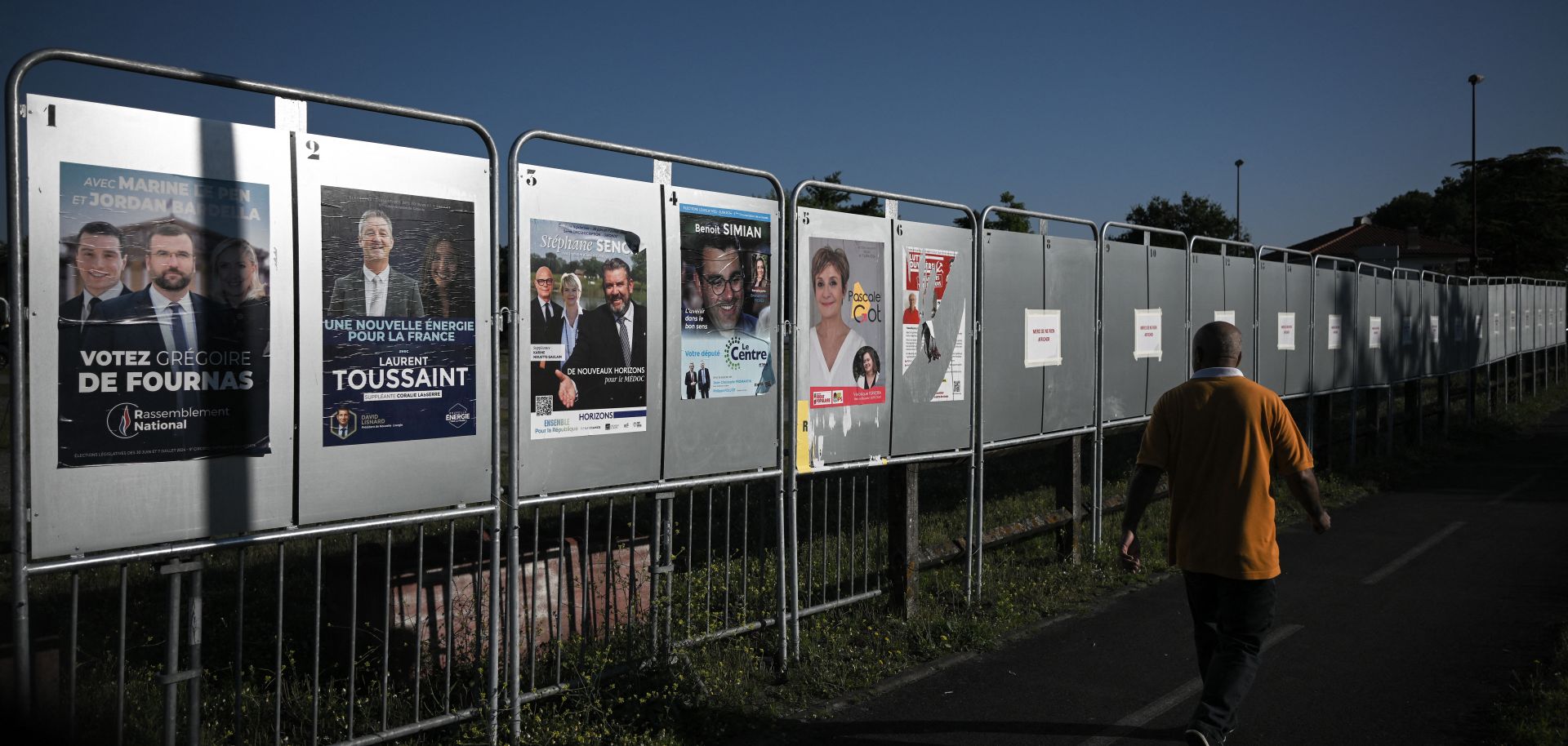
France's uncertain economic and political outlook and increasing financial constraints will weaken the country's influence on EU economic policy issues, as well as its ability and willingness to provide military and financial support to Ukraine. Following the poor performance of his centrist alliance in the June EU parliament elections, French President Emmanuel Macron called snap parliamentary elections for June 30 and July 7. Polls suggest that the far-right National Rally (RN) of Marine Le Pen will emerge as the largest political force in the National Assembly, but fall short of securing an absolute majority. If enough center-right lawmakers end up supporting the RN, the next prime minister will hail from the RN, with party leader Jordan Bardella being the most likely pick for the position. Centrist, pro-European President Macron will then govern France together with a eurosceptic, far-right prime minister under an arrangement known as cohabitation. If, alternatively, the left-wing alliance Nouveau Front Populaire (NFP) were to win and secure the premiership, persistent conflict between the government and the president would be equally likely and create political and policy uncertainty. Both an RN and an NFP government would increase financial risks, given that both have made extensive spending promises without necessarily outlining how they are planning to finance increased spending, even though the NFP has made clear its intention to raise taxes to fund parts of the planned expenditure increases. Should a hung parliament emerge from the elections, it could make deficit-financed spending increases less likely, but it would do little to advance much-needed fiscal consolidation and growth-enhancing structural reform during the remainder of Macron's second and final term as president. On the assumption that both an RN- and an NFP government would lead to higher deficit spending, this would be the least bad outcome, but not a great one, either.
- In the June 9 EU parliament elections, the far-right Rassemblement National (RN) won 30 out of 81 seats. Macron's centrist alliance won a mere 13 seats. While the RN won 7 seats, the centrists lost 10.
- The RN is projected to win 200-250 seats in the National Assembly, up from 88 seats previously, but well short of the 289 seats needed for an absolute majority. If some lawmakers from the right-wing Republican Party throw their support behind the RN, the far-right would control a majority in the National Assembly and would gain control of the government. According to recent polls, the left-wing alliance is projected to secure less than 30% of the vote while the far-right party is poised to secure over 30%; Macron's centrist alliance, meanwhile, is polling around 20%.
- An IPSOS poll conducted on June 19-20 shows that 25% of French voters trust the RN the most as far as economic policy is concerned, followed by 22% who trust the NFP and 20% who trust Macron's centrist alliance. Social and economic issues top French voter concerns, followed by immigration. The same poll puts the RN at 35.5%, the NFP at 29.5% and the centrist Ensemble Alliance at 19.5% in terms of first-round voting intentions.
France's financial position has worsened in the past decade, and even more in the past few years, and an uncertain political and policy outlook has increased investor nervousness. Last year, France's fiscal deficit reached 5.5% of GDP, overshooting its original target of 4.9% of GDP due to a shortfall of tax revenues and continued high post-COVID government expenditure. The outgoing government of Prime Minister Gabriel Attal was committed to reducing the deficit to 3% of GDP by 2027. This was always going to be ambitious in the context of modest economic growth. This deficit-cutting plan is now at risk, as the RN supports tax cuts and the lowering of the retirement age, as well as increased welfare spending. Similarly, the NFP has made significant spending pledges, but it also has proposed revenue increases (especially by taxing the rich and large corporations), even if these fall short of what is needed to fully finance increased expenditures. But even the mere failure to cut public spending will increase investor concerns and force France to pay a higher risk premium, translating into higher debt service in the medium term. A likely failure to commit to a strong, multi-year fiscal consolidation will keep risks high until France's 2027 presidential elections. To this end, what party controls a majority in the National Assembly is crucial, because the legislation setting spending and revenue targets must originate from the government. Notably, France's parliament (which comprises the National Assembly as the lower house and the Senate as the upper house) is not allowed to change the government-proposed overall revenue and expenditure targets. Amendments are permitted as long as they do not affect spending and revenue levels, but these are typically small and typically amount to less than 0.1% of the budget, according to the Organization for Economic Cooperation and Development. Whatever budget the French government proposes largely determines the targeted budget deficit for the fiscal year, even though the government itself can make adjustments of up to 2% of the budget without parliamentary approval. This means that it will be very important what party secures the premiership, given the parliament's limited ability to modify the budget.
- French government debt grew from 85% of GDP in 2010 to 110% of GDP in 2023, representing a major increase. Last year, the deficit reached 5.5% of GDP. Such a large deficit is incompatible with a stable debt-to-GDP ratio. The 2024 deficit target is 5.1% of GDP. Among the OECD countries, France has the highest level of government expenditure at around 58% of GDP. On May 31, international rating agency Standard & Poor's lowered France's sovereign credit rating from AA to AA-.
- French spreads over German government bonds, a measure of relative risk, have increased from around 50 basis points before the European Parliament elections to 75 basis points, after briefly reaching 80 basis points on June 14. This is not a dramatic increase and will not lead to any immediate financing difficulties, but it indicates growing investor wariness regarding the country's future economic and particularly fiscal policy.
- The RN supports tax cuts on electricity and fuel, as well as VAT reductions on basic food stuffs and household products. The far-right party has also expressed support for lowering the retirement age for certain workers, even though it appears to have backpedaled on this issue somewhat recently. According to the French consultancy Asteres, the costs of the RN's spending proposals would total around 4% of France's GDP. The party's proposed VAT cut on energy and petrol would alone cost the government 10-17 billion euros per year, while its proposal to repeal Macron's pension reform would cost another 12-13 billion euros. Further lowering the retirement for certain workers would cost an additional 1-2 billion euros going forward. The RN's plans to finance these measures are unclear. If such a spending increases were to be implemented within a short period, the risk of a financial crisis in the country would increase significantly.
- The left-wing NFP alliance has pledged to significantly increase social spending by, for example, raising public sector salaries and the minimum wage, and scaling back or even reversing Macron's pension reform. Some estimates put the costs of the alliance's proposed social spending increases at over 100 billion euros. The NFP plans to finance these measures through tax increases, including a wealth tax, inheritance tax and higher income and social taxes. But these proposed tax hikes appear to fall short of the alliance's proposed spending hikes, and raising taxes in an already high-taxation economy like France may negatively affect the country's medium-term economic growth.
A far-right or a far-left government would be more likely to pick fights with the European Commission over complying with EU rules that require France to commit to a multi-year fiscal consolidation. Macron's decision to call snap elections has reduced the likelihood of continued fiscal consolidation, while the risk of an even looser fiscal policy has increased. The outlook for structural reform in the next three years is poor under all three of the most likely election scenarios (i.e. a right-wing victory, a left-wing victory, and a hung parliament). Worse, if the RN makes good on some of its economic promises, budget deficits would increase as would interest rates. Against this backdrop, a clash with the European Commission would become inevitable. The commission would put France under the excessive deficit procedure, and if Paris then fails to comply with the necessary, rules-based deficit reduction target, Brussels could impose financial penalties. The more immediate impact of such a clash would be a very adverse reaction by investors, higher French interest rates and reduced capital investment. The negative market impact may then be magnified by the fact that the European Central Bank (ECB) would not be able to make use of its various stabilization tools. If it is in power, the RN might relish a moderate confrontation with the European Union to burnish its EU-skeptical credentials, even if it has an interest in avoiding a financial crisis. But if the far-right party also makes good on its spending pledges, a standoff with the European Commission would still spook markets. An announcement of additional spending worth 1-2% of GDP per year (relative to the current baseline) with no accompanying medium-term fiscal adjustment and little prospect of further EU financial support due to France's non-compliance with the bloc's fiscal rules might be enough to spike French interest rates to a level that causes an even more rapid increase in debt — a scenario that would quickly force the French government to reverse its spending proposals.
- Under its so-called excessive deficit procedure, the European Commission will demand that France reduce its deficit when EU member countries present their multi-annual budgets to the commission in the fall. If France's upcoming elections yield an RN- or NFP-led government, this would set the stage for a stand-off with the European Commission that would likely last for months, further adding to economic and financial uncertainty. The far-right RN party and the left-wing NPF alliance would be interested in avoiding broader financial volatility, but neither would likely implement a market-friendly deficit-reduction policy.
If the next government fails to reduce France's fiscal deficit or, even more problematically, if it fulfills campaign pledges to increase public spending, France's influence with respect to EU economic policy will further diminish. France, which is the eurozone's second-largest economy, has generally supported greater fiscal integration and financial risk sharing within the EU currency area. But as France's financial conditions continue to weaken, the financially stronger EU members will be even less inclined to agree to further financial-fiscal integration and risk sharing than before. France's voice on issues such as EU industrial policy and the proposed EU Capital Markets Union (CMU) will also diminish, not least because such issues would not be a priority for either a left-wing or a right-wing government in Paris. While the RN may be supportive of industrial policy in terms of creating national champions and will have fewer qualms about undermining the EU single market, it would be less inclined to coordinate industrial policy at the EU level, and both the European Commission and Germany would be less willing to go along with French proposals. The fact that the RN or the NFP and the next French president will not see eye-to-eye on many EU economic issues will also weaken France's position. If either comes to power, the RN and the NFP would focus on domestic policies and, if anything, remain far more skeptical of EU-level integration or policy coordination on political and ideological grounds. Under both a left-wing and right-wing government, France's relations with the European Union would deteriorate, as would its role as a reliable and predictable EU member.
- At the height of the COVID-19 crisis, the European Union issued common liabilities. The Next Generation EU (or European Union Recovery Instrument) is worth 750 billion euros and will operate from 2021-26. Fiscally conservative countries regard it as a one-off. French proposals to issue more common debt have already run into opposition from financially stronger countries. France's influence will weaken further, especially if a more risk-sharing-averse center-right government comes to power in Germany in 2025. EU industrial policy is being opposed by smaller and especially Northern European members who fear it might undermine the bloc's single market and disproportionately benefit France, Germany and Italy.
France's financial constraints and increased focus on domestic issues may weaken its support for Ukraine, which would strain France's relations with most Eastern European countries. Prioritizing domestic spending will limit the next government's willingness to provide support to Ukraine. As foreign and security policy will remain under the purview of the president, Macron will continue to promise support for the war-torn country. But politically, the far-right RN would be much less inclined to provide significant amounts of aid to Ukraine, while the NFP would also be reluctant to be seen as providing substantial financial resources to Kyiv. If the upcoming elections yield an RN- or NFP-led government, this means France's effective support for Ukraine would still weaken, or at least it will become more uncertain, as the government — not the president — controls spending. In addition, France's fiscal constraints will make it more difficult to raise defense spending. Politically, the RN and the NFP would be reluctant to be seen as providing substantial financial resources to Ukraine. France has thus far only provided relatively limited aid to Ukraine. A further reduction would weaken its standing in the eyes of Eastern European countries, who will continue to look primarily to the United States and secondarily to Germany to shore up support for Ukraine amid Russia's ongoing invasion.
- According to the Kiel Institute of Economics, since Russia's invasion began in early 2022, France has provided 11 billion euros worth of bilateral and EU aid to Ukraine, compared with the United Kingdom's 13 billion euros and Germany's 23 billion euros. In terms of specifically military aid, France has provided 2.7 billion euros of aid to Ukraine, compared with Germany's 10 billion euros. Economically much smaller Poland has provided more military aid to Ukraine than France (3 billion euros).
- French defense spending amounts to 2% of GDP (or $ 61 billion). By comparison, German defense spending has been a mere 1.3-1.5% of GDP in recent years. However, in 2023, German defense expenditure was 10% higher than France's in dollar terms ($68 billion vs $61 billion).
