
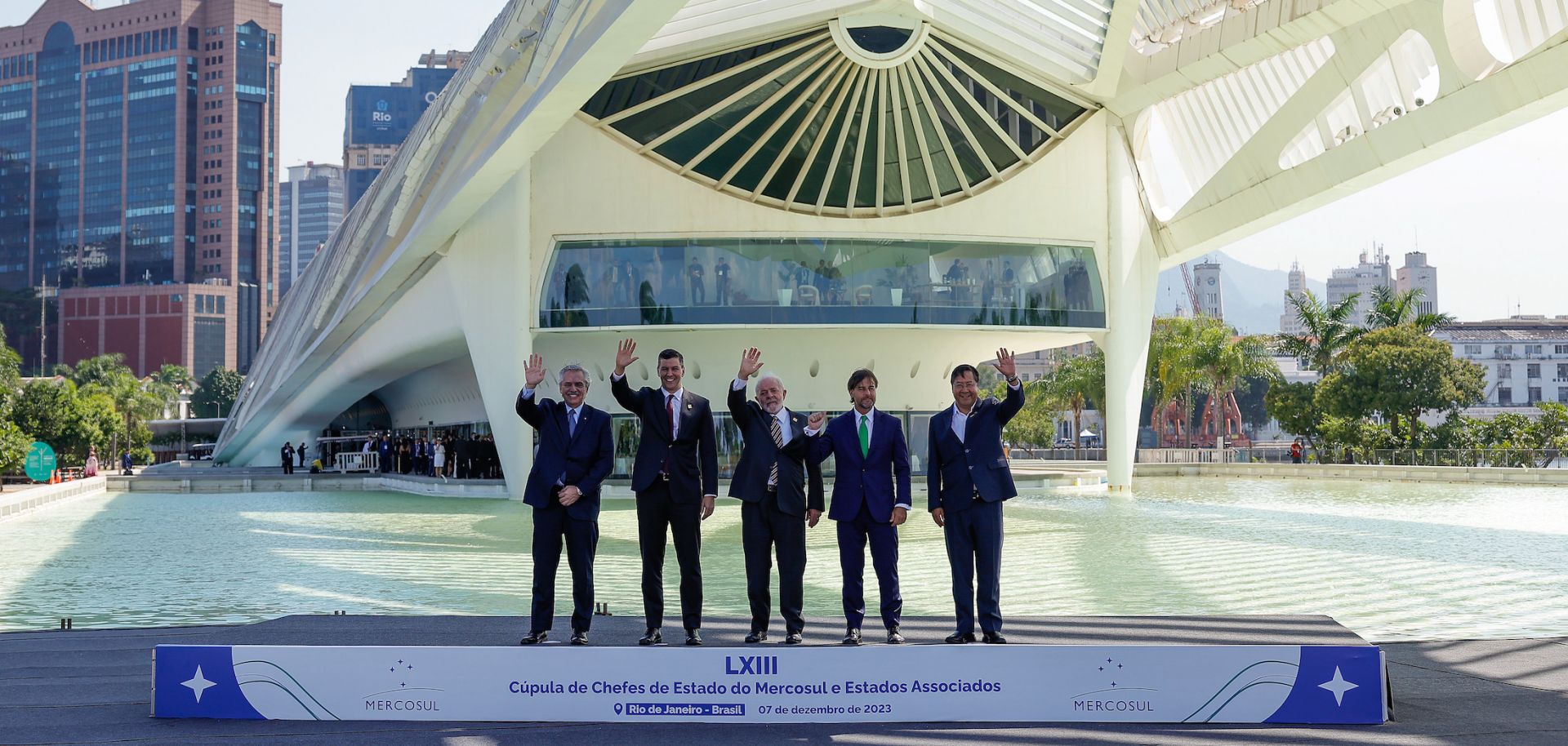
Given its small market, Bolivia's accession to Mercosur as a permanent member is unlikely to bring much in terms of economic gain to the South American trade bloc, and may result in internal disputes and challenges if Bolivia's political situation and environmental record worsen in the coming years. On Dec. 7, Brazilian President Luiz Inacio Lula da Silva signed Bolivia's ratification protocol at the Common Market of the South (Mercosur) leaders summit in Rio de Janeiro, formally welcoming the country into the trading bloc as a full member. Bolivia will gain access to all participation rights within the bloc and will have four years to gradually adopt and integrate Mercosur's trade regulations, such as Mercosur's Common Nomenclature, a coding system to harmonize the description of tradable goods, and its Common External Tariff.
- Before Bolivia's accession, Mercosur countries accounted for nearly 272 million people, representing a total market of $2.6 trillion. Bolivia has a population of roughly 12 million people and a GDP of roughly $40 billion.
- To accept a new permanent member into Mercosur, the parliaments of every current permanent member — which includes Argentina, Brazil, Uruguay, and Paraguay — must vote to ratify the decision, which their presidents must then sign as a final step. Brazil's Congress was the last to approve Bolivia's Mercosur bid, with the Senate voting to accept the accession measure on Nov. 28 after the Chamber of Deputies did so on Oct. 18.
- Associate members of Mercosur include Chile, Colombia, Ecuador, Guyana, Peru and Suriname. These non-voting members receive tariff reductions when trading with the bloc, but do not get free access to full members' markets.
Domestic political dynamics in Brazil had stalled Bolivia's accession to Mercosur for nearly a decade. But last year's election of left-wing Brazilian President Lula, who supports strengthening the bloc and currently holds Mercosur's six-month rotating presidency, finally cleared the way for Bolivia's admittance. Bolivia signed an Economic Complementation Agreement with Mercosur in 1996, and in 2006, the country submitted a formal request to begin the process for full membership in the bloc. The permanent members of Mercosur signed a protocol for Bolivia's accession in 2012, which was followed by a second protocol, known as the Brasilia Protocol, in 2015. However, at the time, Brazil was in the midst of political upheaval following the eruption of a corruption scandal known as ''Operation Car Wash.'' The scandal began in March 2014 as an investigation into money laundering and quickly ballooned into a massive, yearslong anti-corruption probe that implicated many of the country's politicians, including President Dilma Rousseff, who had signed the Brasilia Protocol. In addition to leading to Rousseff's impeachment in April 2016, the political crisis polarized and distracted Brazil's parliament, which forced it to focus its attention inward and away from issues involving international trade. Then came the 2018 election of former Brazilian President Jair Bolsonaro, who criticized Mercosur as being too restrictive, and whose incoming economic minister stated that the trade bloc was ''not a priority'' for the Bosonaro administration. In August 2019, Brazil's Congress tabled the ratification protocol for Bolivia's accession to Mercosur after then-Bolivian President Evo Morales criticized Bolsonaro's easing of firearms restrictions in Brazil. Bolsonaro's turbulent four-year term came to an end with the October 2022 election of left-wing candidate and former president Luiz Ignacio Lula da Silva, who pledged to ''personally'' work to shepherd the ratification through Brazil's conservative Congress. A long-standing advocate for regional economic integration, Lula has sought to strengthen Mercosur since re-taking office in January. In July, the Brazilian leader assumed Mercosur's six-month rotating presidency, which has since seen him spearhead a push to finalize free trade agreements with larger economies, like the European Union, and finally approve Bolivia's eight-year-old request to join the bloc.
- During his four years in office, Bolsonaro sought to grow Brazil's economy by lifting Mercosur restrictions that prevent member states from negotiating and signing bilateral free trade agreements.
The addition of Bolivia's small market will only moderately benefit trade between Mercosur members, while the country's political turbulence and poor environmental record may ultimately create more headaches for the bloc. While the Brazilian and Bolivian governments will present Bolivia's accession to Mercosur as a political victory, adding Bolivia will only increase the bloc's total GDP by 1.6% and its population by 4.5%. Bolivians' purchasing power is also markedly lower compared with consumers in the other four Mercosur countries. Bolivians' purchasing power is markedly lower compared with consumers in the other four Mercosur countries. If Mercosur can leverage its growing market to sign new free trade deals with larger economies such as the European Union, it could lead to the creation of supply chains traversing South America, enabling business growth and economic development. But Bolivia has faced political strife since the country ousted former President Evo Morales in 2019 and installed a right-wing government whose president was later arrested, which may make it harder for Mercosur to reach such agreements if political instability returns. And if Bolivia backslides on democratic norms in the future, the bloc may ultimately trigger its democracy clause to suspend Bolivia's membership. In addition, Bolivia has a poor environmental record; the country's primary forest loss rates increased by 32% between 2021 and 2022, driven largely by illegal logging and intensive soya farming. This may further impede Mercosur's ability to negotiate free trade deals with external partners like the European Union, which in 2019 stalled its negotiations with the South American bloc amid criticism of Brazil's deforestation activities in the Amazon rainforest. From Bolivia's standpoint, its accession to the bloc also comes with potential risks, as the country's new status as a permanent member will expose its underdeveloped industrial sector and service providers to increased competition from Brazil and Argentina.
- In 2022, GDP per capita in Bolivia was just $3,523. The next poorest country in the bloc, Paraguay, nearly doubles Bolivia's consumer power at $6,153. Brazil, Argentina and Uruguay are comparatively much wealthier than Bolivia, with GDP per capita estimated at $8,917, $13,686, and $20,795, respectively.
- Members of Brazil's Senate Foreign Relations Committee conditioned the vote for Bolivia's accession on the creation of a five-member commission that, within 180 days of ratification, will travel to Bolivia to investigate reports of political prisoners being held in the country. The commission will attempt to meet with former Bolivian President Jeanine Anez, who in May 2021, was sentenced to ten years in prison on charges of sedition, terrorism and conspiracy relating to former President Evo Morales' ouster in November 2019. The Human Rights Watch has criticized Anez's pre-trial detention and arrest as ''revenge justice.'' Morales, meanwhile, has announced that he will run for president again in 2025, raising the risks of further political strife in Bolivia.
- Mercosur's democratic clause has been triggered many times in recent years. Paraguay was suspended from Mercosur in 2012 following the impeachment of President Fernando Lugo (the country was reinstated in 2013); Venezuela was suspended indefinitely in 2017 following democratic decline and human rights concerns under President Nicolas Maduro. During her impeachment proceedings in 2016, then-Brazilian President Dilma Rousseff said she would appeal to Mercosur's democracy clause if there was a ''rupture'' of the democratic process, thus threatening to kick Brazil out of the trade bloc.
