
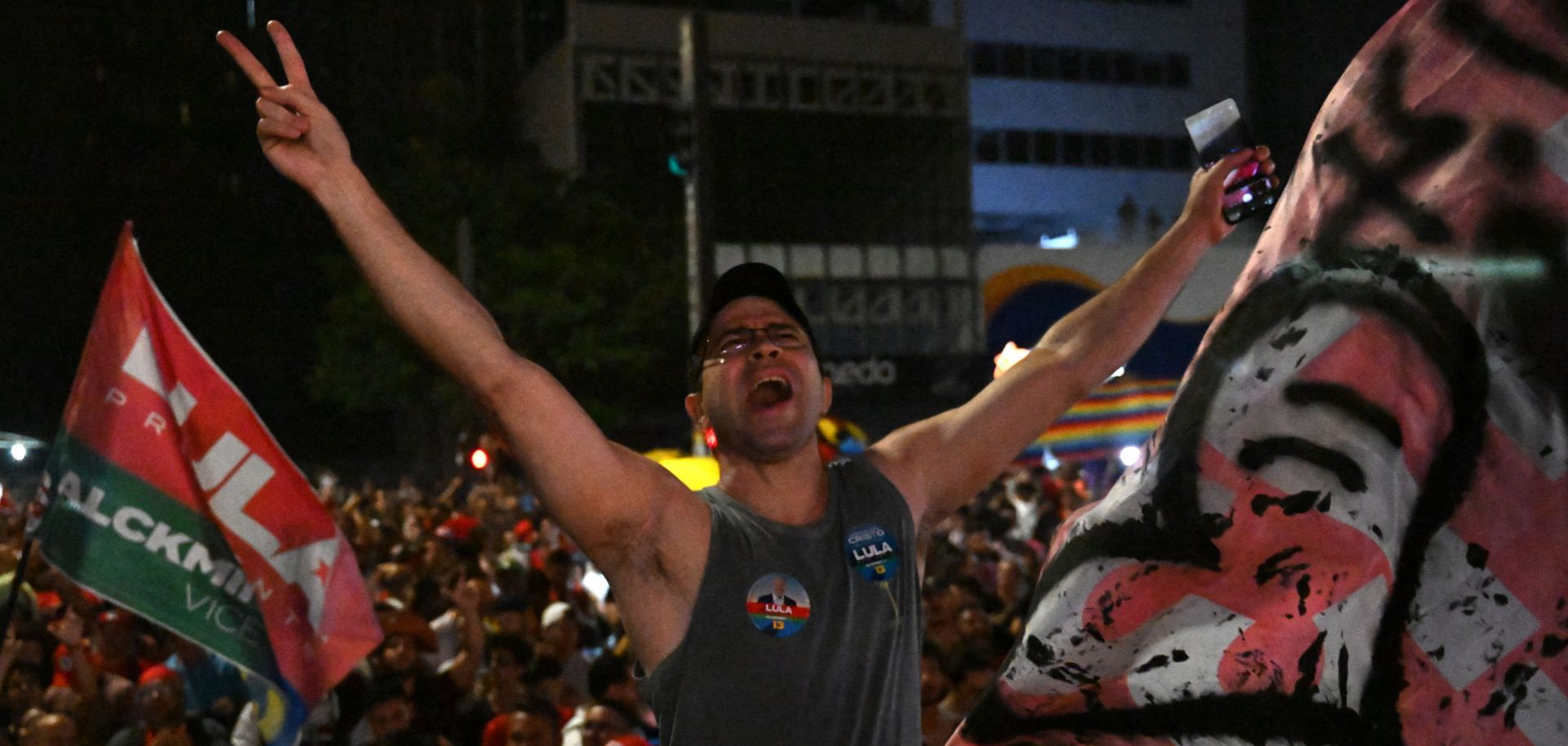
A supporter of Brazil's former left-wing president Luiz Inacio Lula da Silva celebrates on a street in Sao Paulo after da Silva was declared the winner of the country's presidential election on Oct. 30, 2022.
Brazil's political environment has become much more polarized and conservative in the 12 years since President-elect Luiz Ignacio Lula da Silva last held the position, which will constrain his ability to enact greater policy changes this time around — especially if current President Jair Bolsonaro emboldens his right-wing supporters by contesting da Silva's narrow electoral victory. On Oct. 30, left-wing candidate and former president Luiz Ignacio Lula da Silva won Brazil's hotly contested presidential runoff with 50.9% of the vote — narrowly beating out incumbent right-wing candidate Bolsonaro, who had repeatedly aired unfounded suspicions of voter fraud in the months leading up to the election. Da Silva, who also served as Brazil's president from 2003-2010, has given a victory speech and is slated to be sworn in for another presidential term on Jan. 1. Neither Bolsonaro nor his close advisers have yet to publicly concede or issue statements acknowledging the election results, though the outgoing president is expected to give a speech the evening of Oct. 31.
- The election was muddied by reports that the Federal Highway Police increased the number of routine vehicle searches by over 80%, causing massive traffic jams that may have made it more difficult for some voters to access polling sites..
- Da Silva's slim 1.8% margin of victory is the closest presidential election in Brazil's history. Polls early in the campaign showed da Silva beating Bolsonaro by 10-15 points. But the Bolsonaro administration was able to steadily chip away at the former president's lead by instituting a series of popular social spending measures in the weeks leading up to the vote.
- Da Silva served as a congressman for a decade before he was elected president in 2002 (and then re-elected in 2006). Over the course of his long political career, da Silva has shifted from a far-left populist to a center-left advocate for greater government intervention in the economy.
Bolsonaro may still contest the election results, potentially leading to disruptive right-wing demonstrations from his supporters. But without the backing of key military and political leaders, he's still highly unlikely to remain in power past da Silva's inauguration on Jan. 1. A peaceful transition of power remains possible if Bolsonaro concedes in the coming days, or if he quietly leaves the office on Jan. 1 without formally conceding. Either of these scenarios would probably see a moderate level of right-wing demonstrations and strikes, though such protests are unlikely to create significant economic disruptions. However, given his repeated allegations of voter fraud in the run-up to the polls, there are many ways in which Bolsonaro may contest the election results, including by claiming that the Superior Electoral Court and the broader judiciary rigged the vote against him. Emboldened by Bolsonaro's claims, right-wing protesters in this scenario would likely launch demonstrations in major cities and stage extended roadblocks on highways and thoroughfares. As Brazil's agricultural sector is heavily dependent on access to major highways to transfer goods from inland farming communities to ports, extended roadblocks have the potential to be highly disruptive to Brazil's economy. Nonetheless, Bolonsaro's lack of support from key leaders in the country's Congress and the military makes it highly unlikely that he'll be able to keep da Silva from taking office in January.
- In response to the election results, Bolsonaro supporters are currently blocking roads in at least 11 states across the country, including key agricultural thoroughfare route BR-163 in Mato Grosso state.
- After the Superior Electoral Court rejected a petition from Bolsonaro claiming irregularities in broadcasting the electoral advertisements in the country's northeast, the president told reporters on Oct. 26 that the decision demonstrates a "lack of a level playing field" in the presidential election and claimed that it "obviously interferes with the final vote tally" in the Oct. 30 runoff.
- Bolsonaro's most powerful ally in Congress, House Speaker Arthur Lira, stated that "the will of the majority expressed at the ballot box should never be contested" — a major signal that center-right politicians have accepted the results of the election. High-level generals in Brazil's armed forces have also made statements indicating they'd be unlikely to support any attempt by Bolsonaro to undemocratically extend his reign by claiming electoral fraud.
Opposition from the center- and far-right lawmakers in Congress will constrain da Silva's ability to implement his policy agenda once he takes office next year. But while this will mitigate the risk of unsustainable increases in social welfare spending, da Silva will still be able to unilaterally impose some environmental protections and sector-specific economic regulations that could impede Brazil's business environment. The results of the Oct. 30 election show that Brazil is highly politically divided, a fact reinforced by numerous violent incidents during the campaign. This will likely hinder da Silva's ability to pursue his legislative agenda, especially when considering that right-wing parties secured a simple majority — which is needed to pass most legislation — in the lower house of Brazil's Congress in the Oct. 2 general elections. This means that da Silva will likely have to garner support from his political opponents for some policy priorities, such as increasing social welfare spending, by guaranteeing public spending for localized projects. The constraints on implementing some of da Silva's more leftist policies may help ease market and investor concerns. However, da Silva will still be able to fulfill some of his campaign promises by enacting regulatory changes that don't require legislative approval. In particular, the new president could order the Brazilian state to halt the sale of assets, such as airports and onshore oil and gas projects. Da Silva will likely also be able to make significant headway toward decreasing Amazon rainforest deforestation by imposing harsher penalties for slash-and burn-techniques and increasing regulatory oversight of agricultural practices.
- Right-wing parties won 273 seats in Brazil's 513-seat Chamber of Deputies, with Bolsonaro's Liberal Party comprising only 99 of those seats.
- Da Silva announced on Oct. 31 that he would send a delegation to the United Nation's next climate summit in November, despite not yet being president. During the summit, the president-elect is expected to try to secure funding from other countries for his incoming administration's rainforest preservation efforts. He may also pledge to make Brazil's decarbonization efforts more aggressive.
