
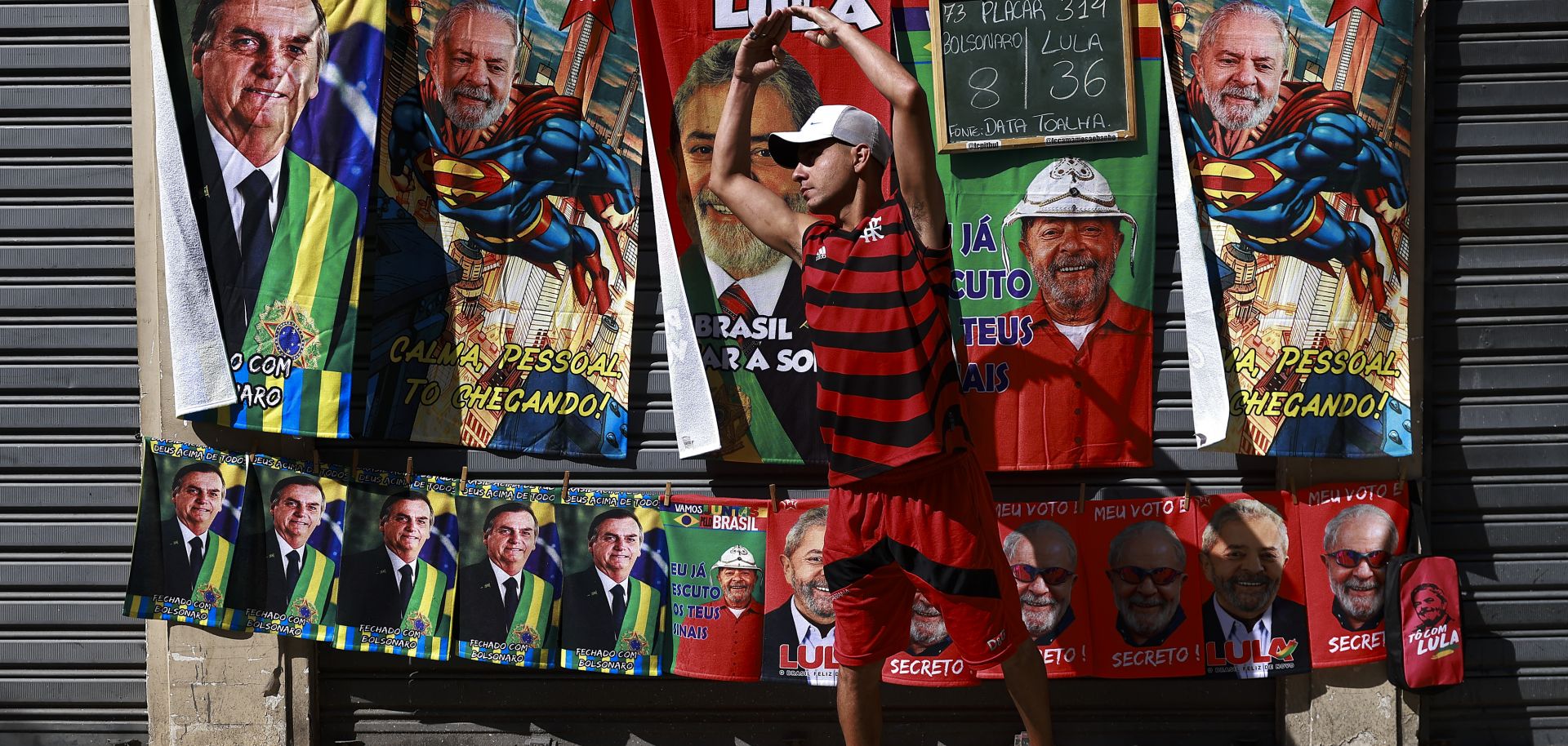
Street vendors offer towels depicting presidential candidates Lula Da Silva and Jair Bolsonaro on Sept. 24, 2022, in downtown Rio de Janeiro.
The immediate aftermath of Brazil's presidential election could see a significant escalation of social unrest and political instability in the improbable event that incumbent president Bolsonaro questions the result and large sectors of the military side with him. Brazil will hold general elections Oct. 2 to elect one-third of the country's Senate, all 513 members of the Chamber of Deputies and the president. In the likely case that no presidential candidate garners more than 50% of the vote, the top two candidates will face off in an Oct. 30 runoff. The main presidential candidates are former left-wing president Luiz Inacio Lula da Silva and current President Jair Bolsonaro. The presidential winner will be inaugurated Jan. 1, 2023.
- A Sept. 21-22 Datafolha poll showed former Brazilian President Luiz Inacio Lula da Silva leading incumbent President Jair Bolsonaro at 47% to 33% for the first round of the Oct. 2 presidential election. In a potential runoff scenario, da Silva is polling at 54% and Bolsonaro at 38%.
- A congressman for a decade before serving two terms as president from 2003 to 2010, da Silva has shifted over the course of his political career from far left populist to a center-left advocate for a greater state role in the economy.
- Bolsonaro has spent nearly three decades as a fringe congressman before running as a far-right disruptor of the system in the 2018 presidential election, which he won. As president, Bolsonaro has sought out increased privatization of publicly owned assets, but has also increased social spending.
Bolsonaro's charges against the country's electoral authority and widespread disinformation campaigns have led to a political environment ripe for him to contest the election results. Bolsonaro has repeatedly questioned the reliability of Brazil's electronic voting system, unsuccessfully demanding a return to a paper-ballot vote count due to concerns of fraudulent results. He has also feuded with Supreme Court Justice Alexandre de Moraes, the president of the Superior Electoral Court, and publicly accused the court of bias against him. Questions about the impartiality of the electoral system have been compounded by Bolsonaro supporters disseminating fake news primarily on Facebook, WhatsApp and Telegram. This has led many observers to suspect that Bolsonaro may be cultivating doubts around the validity of election results to bolster his ability to contest the results of the presidential election should da Silva win.
- Human rights group Global Witness found that Facebook approved advertisements that contained disinformation concerning Brazil's general election. Many of these advertisements were meant to help Bolsonaro's campaign.
In the case that da Silva wins in the first round by a comfortable margin, protests against the new president will probably be modest. Bolsonaro is unlikely to contest the election results if da Silva wins by a surprisingly large margin in the first round. But even in this scenario, right-wing groups are likely to stage sporadic demonstrations that are likely to continue during the early weeks of da Silva's tenure, primarily in large cities such as Sao Paulo, Rio de Janeiro and Brasilia. These demonstrations may see isolated episodes of street violence but are unlikely to lead to wider disruptions, especially if da Silva maintains high approval ratings in late 2022 and early 2023.
- Bolsonaro is likely to reach his ceiling in voter support in the Oct. 2 vote because polling indicates a majority of those who plan to vote against him classify his current presidency as "bad or terrible." This means that support for Bolsonaro is unlikely to rise by a significant margin should he qualify for a runoff.
Should Bolsonaro question the election's results, neither the military nor the judiciary is likely to support his claims, severely undercutting his chances of overturning the vote. Bolsonaro is particularly likely to contest the election results if he loses by a narrow margin in a runoff vote. Multiple audits by the Organization of American States have found no record of electoral fraud in Brazil. Meanwhile, high-level commanders in Brazil's armed forces have indicated that despite the close ties between Bolsonaro and the military, the armed forces would remain apolitical. Unlike in various Latin American dictatorships in the mid-20th century (including in Brazil, where the military carried out a coup in 1964) the international community will not tolerate the intervention of the military in Brazil's elections. Similarly, major players among Brazil's business elites have signaled opposition to such an intervention, likely over concerns of potential sanctions from the United States and European Union. All of these factors contribute to a high degree of opposition to a military-led intervention in October elections.
- Bolsonaro is an ex-army captain and has appointed both retired and active duty commanders to Cabinet positions, including ret. Gen. Joaquim Silva e Luna as Petrobras CEO and ret. Gen. Walter Braga Netto as vice president.
- A group of 39 U.S. lawmakers sent a letter to President Joe Biden Sept. 9 to make "unambiguously clear to President Bolsonaro, his government and the security forces that Brazil will find itself isolated from the US and the international community of democracies if there are any attempts to subvert the country's electoral process."
- The Brazilian Federation of Banks signed a letter read at an Aug. 11 rally urging that electoral authorities "have carried out our internationally respected elections with full security, efficiency, and integrity."
If Bolsonaro refuses to accept the results, Brazil could see security disruptions including large-scale right-wing demonstrations. In this scenario, despite support from the judiciary and the armed forces for the electoral system, small factions of local police forces and the military police (which tend to support Bolsonaro) could remain loyal to the defeated president. Operating under the mistaken assumption that the election results have been manipulated, small groups of lower level security forces may use outsize violence against pro-da Silva street celebrations. Beyond the immediate aftermath of the election, small subsets of police forces may disobey orders that they disagree with — especially concerning security operations against pro-Bolsonaro militias — which may compromise operations seeking to disrupt the militias. Widespread demonstrations can be expected should Bolsonaro contest the election results, with right-wing protesters in favor of Bolsonaro's efforts and left-wing activists rejecting them.
- Brazil has many paramilitary groups largely made up of corrupt personnel and former officials in the country's vast security apparatus, including local police forces, the federal military police and even local fire brigades. The militias tend to support Bolsonaro due to the president's time in the army. Many have alleged that the militias have ties to Bolsonaro's family and receive active support from political officials in exchange for helping them gain or keep office, though none have been formally substantiated.
In the unlikely case that Bolsonaro successfully remains in power despite an electoral defeat, severe domestic unrest and international sanctions are likely. A scenario in which Bolsonaro remains in the presidency after losing is unlikely because polls indicate a 10-point margin between the two candidates, reducing the credibility of allegations of a stolen election. If the margin of a da Silva win is slim (e.g., within three points), it would be more plausible for Bolsonaro, a significant number of his voters, and large sectors of the armed forces to claim that the election results were fraudulent. This scenario would require that the armed forces cast doubt upon the results — likely via an audit of the electoral system — and subsequently enforce a Bolsonaro win, which they are unlikely to do. This scenario would likely see several high-level officials on the Superior Electoral Court imprisoned and several days of widespread disruptive protests. Pro-Bolsonaro security forces would likely be instructed to quell demonstrations, leading to incidents of violent clashes between police and protesters. In this unlikely scenario, Brazil would see increased authoritarianism, such as shutting down opposition newspapers and imprisoning harsh critics of the government. The United States and the European Union would almost certainly initially respond by enforcing sector-specific sanctions, likely in areas of competition such as agricultural products.
- Citing anonymous sources, prominent newspaper Folha de Sao Paulo reported Sept. 12 that Brazil's Armed Forces would carry out a supervisory count of 385 electronic ballot boxes (out of roughly 500,000) during the Oct. 2 general election as a check. The country's Superior Electoral Court and Defense Ministry denied the claims later that day. The Brazilian Report subsequently reported that the Defense Ministry planned to carry out an independent audit of election results, citing anonymous sources.
