
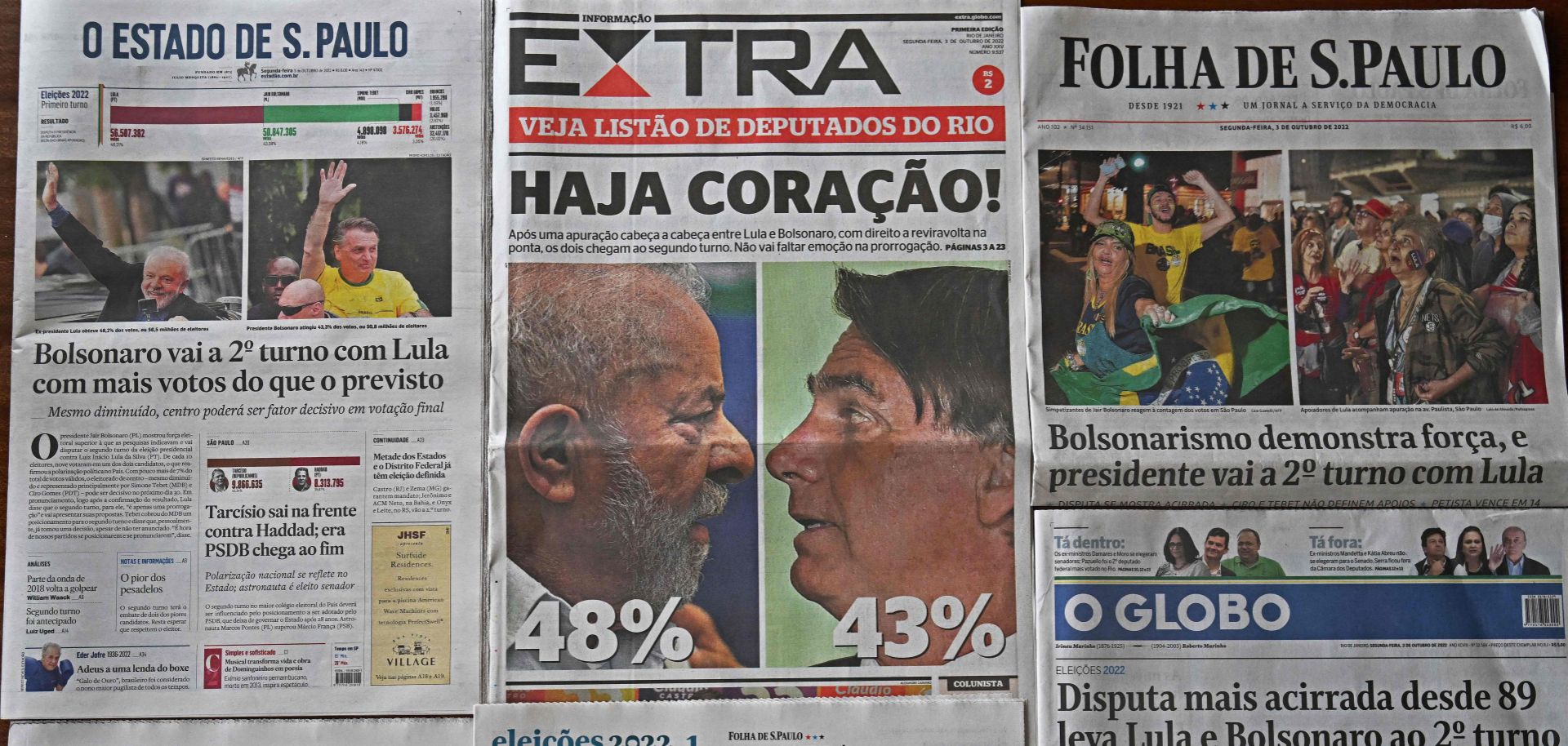
National newspapers report on the results of the legislative and presidential election, a day after the general vote in Brazil, on Oct. 3, 2022.
In Brazil, the outcome of the first round of the presidential election will likely raise the threat of politically-motivated violence in the coming weeks, while business-friendly parties' control of Congress will likely please markets and entice investors thereafter. Former Brazilian President Luiz Inacio Lula da Silva won 48.43% of the vote in the country's Oct. 2 general election, while incumbent President Jair Bolsonaro defied pre-election voting to receive 43.2% of the vote. Since neither candidate received more than 50% of the vote, da Silva and Bolsonaro will compete in a runoff election on Oct. 30 to decipher a final winner. In the concurrent legislative election held on Oct. 2, right-wing parties secured a simple majority in the lower house of Brazil's Congress, which is needed to pass most legislation, but fell just short of securing the two-thirds majority required to pass constitutional amendments.
- Right-wing parties won 273 seats in Brazil's 513-seat Chamber of Deputies, with Bolsonaro's Liberal Party comprising 99 of those seats. Control of 308 seats is needed to secure a two-thirds majority.
- Just over 20% of registered Brazilian voters abstained from casting a ballot on Oct. 2, marking one of the lowest turnouts for a general election that Brazil has seen in over two decades.
- Some of Brazil's most prominent opinion polls, including Datafolha, had projected that da Silva was 10 to 14 points ahead of Bolsonaro in the days leading up to the election. Some have cited far-right skepticism of polling agencies as a major factor in the discrepancy between pre-election polling and the Oct. 2 result.
Da Silva's lead in the Oct. 2 election, albeit slimmer than expected, still positions him to win the presidency. But the slim margin portends a politically turbulent (and potentially violent) few weeks in Brazil, as Bolsonaro ramps up his rhetorical attacks against da Silva and the country's electoral system in the lead-up to the Oct. 30 run-off. Da Silva remains the likely winner of the runoff vote, but the outcome of the Oct. 2 election has also shown that his lead over Bolsonaro is narrower than previously thought. This sets the stage for an even more competitive campaign over the coming month as the two candidates heighten their political attacks against one another — with likely fierce debates, as well as rowdy political rallies that draw record-breaking crowds. Within this context, there will be a greater risk of politically-motivated violence as impassioned supporters of Bolsonaro and da Silva are likely to clash with one another at rallies, protests and in daily life. Bolsonaro's stronger-than-expected performance also suggests that the Oct. 30 runoff will be decided by a close margin, giving him more fodder to allege fraud if da Silva wins. To gauge the likelihood of whether Bolsonaro will try to delegitimize a da Silva victory, it will be key to monitor whether he and his campaign team ramp up efforts to undermine Brazilians' faith in their country's electronic voting system and electoral institute in the coming weeks, which would create the conditions needed to contest the results of a runoff election.
- Despite not offering any evidence, Bolsonaro has claimed that the country's electronic voting system is prone to fraud and, in July 2021, pushed to reinstate a paper ballot system.
- According to a report published by Agencia Publica, Brazil has so far seen 75 incidents of politically-motivated violence during the 2022 campaign season, spanning from attacks against rallies to targeted assassinations.
Beyond the likely tumultuous presidential runoff, the right-wing's continued control of Congress could calm markets and improve investor confidence in Brazil by helping ensure the continuation of more fiscally conservative, business-friendly economic policies. If Bolsonaro defies odds and wins the runoff, a legislature dominated by his allies means that he will have the freedom to easily implement much of his domestic policy platform (including the possible privatizations of Eletrobras and parts of oil and gas conglomerate Petrobras), as well as his foreign policy priorities (like decreasing tariffs through the regional economic bloc, Mercosur). But in the more likely case that Bolsonoro fails to secure another term, Brazil's right-leaning Congress also ensures that a da Silva administration would have to moderate its leftist economic policies — specifically da Silva's aggressive tax and spending agenda. If he's elected president on Oct. 30, da Silva will likely only have the legislative support to enact the parts of his policy platform that overlap with conservative interests, such as increasing cash transfers through Bolsonaro's Auxilio Brasil program and eliminating the constitutionally-mandated spending cap (which would also require a constitutional amendment). This will help ease market and investor concerns by minimizing the risk of a da Silva victory resulting in extreme-leftist policies. More broadly, the likely continuation of right-leaning economic policies under Brazil's new Congress could also help encourage foreign firms to invest in new projects in the country by renewing political certainty in Brazil's transportation, energy, financial services and automotive industries, which have struggled to attract new foreign business since the COVID-19 pandemic. This potential for renewed investor confidence, however, could be threatened if the presidential runoff does not result in a smooth transition of power.
- On Oct. 3, Brazil's currency saw the largest single-day jump in four years, with the real rising 4.7% against the U.S. dollar. The country's Ibovespa index also rose 4.9%, further indicating that markets are pleased with the election results.
