
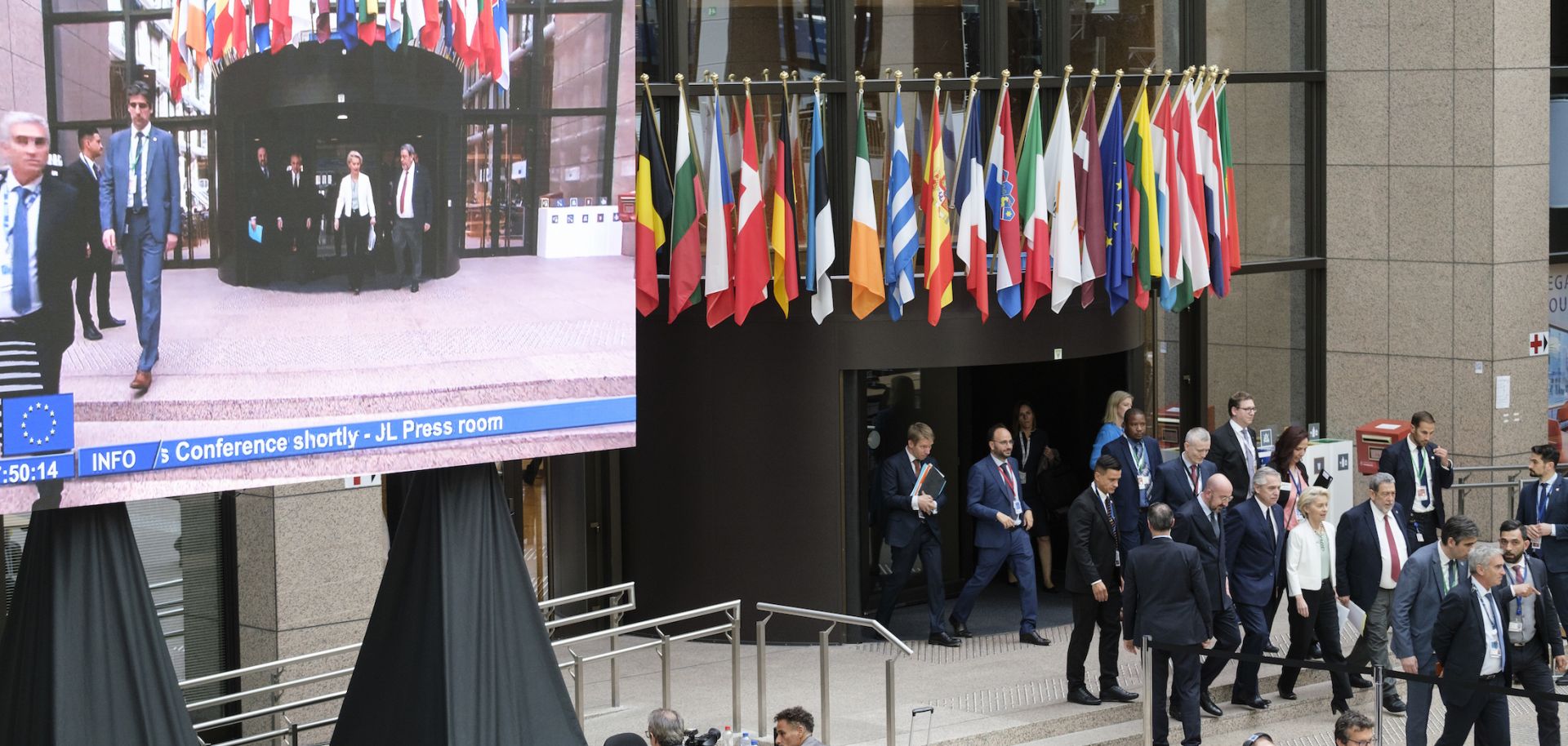
The European Union and the South American trade bloc Mercosur will continue negotiating their free trade agreement, but political calculations and protectionism will prevent them from reaching a near-term deal. While gathered at a July 17-18 summit between the European Union and the Community of Latin American and Caribbean States (CELAC), the members of Mercosur (Argentina, Brazil, Paraguay and Uruguay) restarted negotiations over a free trade agreement with the European Union. However, no technical discussions over the details of the stalled agreement took place, and negotiators failed to make significant progress. The ratification of the FTA would enable the European Union to further diversify its supply chains following Russia's invasion of Ukraine in February 2022, and it would enable Mercosur members to more easily export the products of their agriculturally-driven economies to the European market.
- After 20 years of negotiations, the European Union and Mercosur agreed in principle to an FTA in June 2019, though the details have yet to be finalized. Once the blocs agree to the FTA's final text, the 27 governments of the European Union, the four governments of Mercosur and the European Parliament must ratify it before the agreement enters into force. However, the blocs could implement certain parts of the FTA provisionally after Mercosur and the European Parliament ratify it, even if not all EU member states have done so.
- Spain is currently holding the six-month rotating presidency of the European Union, which means Madrid can introduce topics in the bloc's agenda. One of Spain's goals for its presidency is to facilitate the ratification of the EU-Mercosur trade deal.
Announcements following the summit indicate that Mercosur and the European Union will likely continue negotiations over the FTA in the coming weeks. On July 19, the day after the EU-CELAC summit ended, Brazilian President Luiz Inacio Lula da Silva said Mercosur will issue an FTA-related counter-proposal to demonstrate Mercosur countries' commitments to deforestation and other areas of sustainability. In theory, this counter-proposal will address some EU members' demands that Mercosur states more stringently combat deforestation before the FTA moves forward, which has been a significant sticking point in negotiations. Additionally, the European Investment Bank announced at the EU-CELAC summit that it would loan $800 million to climate action projects in Argentina, Brazil and Chile, the former two being Mercosur states, which could help the South American bloc follow through on any anti-deforestation commitments. Both sides' willingness to negotiate on this issue signals that more talks are forthcoming.
- The European Union cited former Brazilian President Jair Bolosnaro's environmental policies (which dramatically increased deforestation rates) as the main obstacles to the ratification of the EU-Mercosur FTA.
Regardless of any upcoming negotiations, the 2024 EU parliamentary elections will likely dissuade many EU member states from ratifying the agreement in the short term. Powerful farming lobbies and nationalist sentiment over locally-produced agriculture in countries such as France, Ireland, Poland and (to a lesser extent) Italy will likely make some EU states reluctant to ratify the FTA, as doing so would trigger significant inflows of South American agricultural products that would anger their constituencies. And even after the June 6-9, 2024, elections conclude, regional trends suggest a surge of populist right-leaning representatives will rise to power, which will likely result in a bloc-wide push for protectionist policies. As a result, EU leaders will continue to be susceptible to pressure from the far-right, making them unlikely to ratify the agreement as it was written in 2019. It is possible that EU member states would ratify a watered-down version of the FTA that stipulates stricter environmental tracing of South American products, higher sanitary standards and lower import quotas for items such as beef, but Mercosur countries would likely oppose these measures due to their own protectionist policies. And even if the blocs move forward with such an agreement, the new stipulations would likely require more negotiations over addendums, which further decreases the likelihood of a near-term deal.
- EU-wide farming lobby Copa-Cogeca has repeatedly denounced efforts to implement the 2019 FTA with Mercosur, stating that the agreements on sanitary and environmental standards would put EU farmers at a disadvantage and expose EU consumers to poor quality agricultural products.
- Several European countries with a long history of farming traditions perceive farmers and locally-produced agricultural products as a core element of national identity. Thus, the electorates of these countries would view the FTA with Mercosur as undermining the cultural richness of local farming traditions.
