
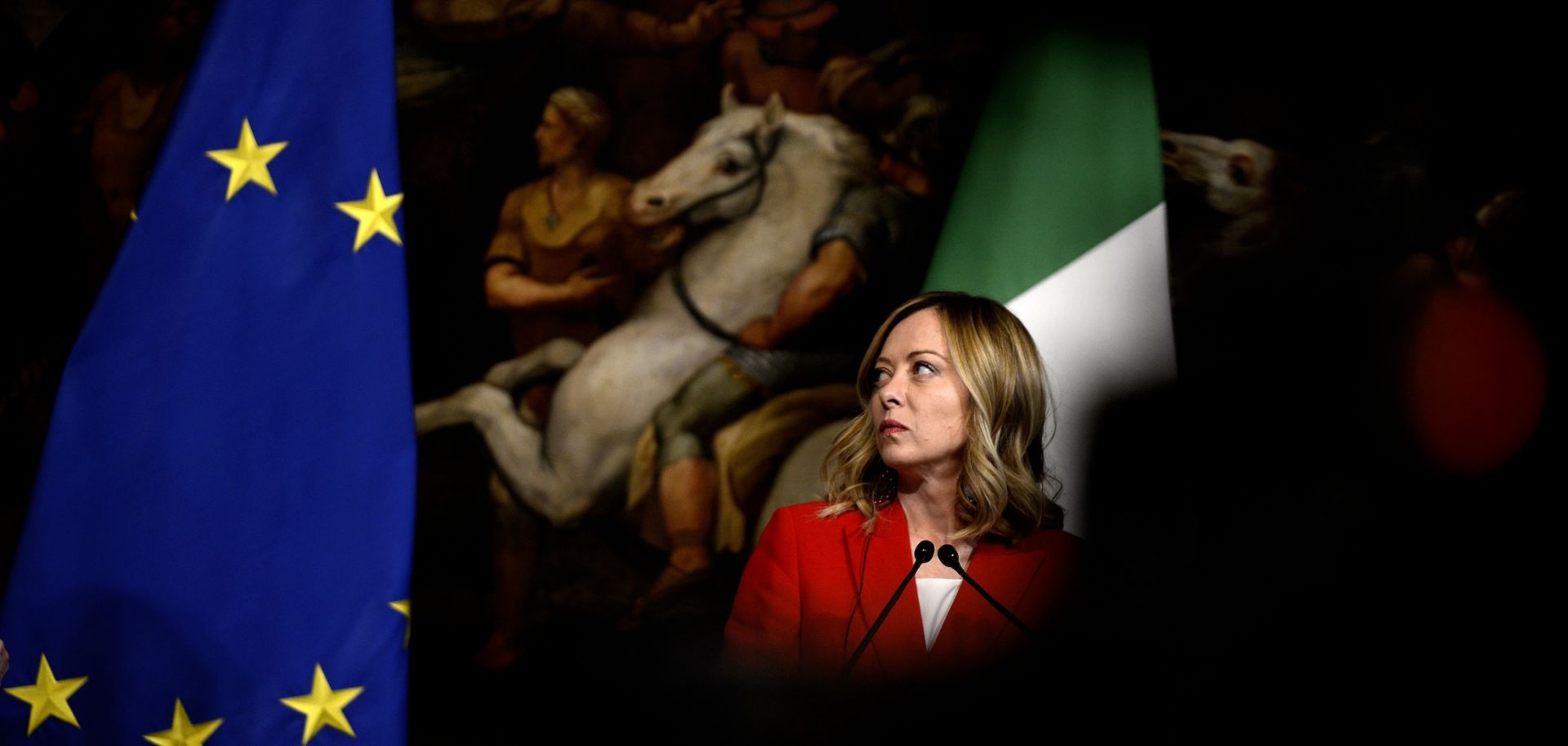
A strong result for Italian Prime Minister Giorgia Meloni's party in the upcoming European Parliament elections, along with her growing alignment with Brussels and mainstream European conservative parties, may help Italy gain greater influence in the European Union in the years ahead, but it could also lead to political turbulence in Rome and destabilize Meloni's coalition government. As of May 23, opinion polls for the European Parliament elections in June suggest that right-wing parties will make significant gains across several EU member states at the expense of left-wing and green parties. Italian Prime Minister Giorgia Meloni's Brothers of Italy party — a member of the far-right European Conservatives and Reformists Group (ECR) group in the European Parliament — is one such party. Brothers of Italy is polling at 28%, which would make it one of the largest parties in the European Parliament, potentially gaining as many as 27 seats in the 720-seat supranational assembly, compared with the six it currently holds. Polling also suggests that a strong electoral performance by Brothers of Italy could leave the ECR with up to 86 seats in the European Parliament, up from its current 62 seats.
- In addition to Brothers of Italy, the ECR group also includes parties such as Finland's Finns Party, Poland's Law and Justice, Spain's Vox and Sweden's Sweden Democrats. These parties, many of which have traditionally operated at the fringe of European politics, tend to be nationalistic, anti-immigration, socially conservative and economically protectionist (with some variations). Many of these elements feature prominently on the platform of the other far-right grouping in the European Parliament, the Identity and Democracy (ID) group, which includes parties such as Austria's Freedom Party, Belgium's Vlaams Belang, France's Rassemblement National, Germany's Alternative für Deutschland, Italy's Lega and the Netherland's Party for Freedom. However, many ECR parties have softened their anti-EU stances in recent years and, in terms of foreign policy, they tend to align more with mainstream parties by having pro-NATO, pro-Ukraine and anti-Russia stances.
- With 76 out of the 705 members of the European Parliament (720 starting after the 2024 elections), Italy is the third-most represented EU country in the legislature after Germany and France.
Meloni's right-wing coalition government has so far proven stable, relatively moderate in its policy choices and collaborative at the EU level, offering Brussels a potential influential partner as European politics shift to the right. Meloni took office in October 2022, as the head of Italy's most right-wing government since World War II. At the time, many feared Rome might take a path of euroscepticism, anti-Western stances and economically unsustainable policies in defiance of EU fiscal rules that would have put it on a collision course with Brussels. But such concerns have not materialized, as many of the radical stances that contributed to Meloni's political rise made way to pragmatism after she became prime minister. In fact, Meloni has largely remained on the path set by her predecessor Mario Draghi's unity government. Over the past two and a half years, her government has maintained a largely conservative fiscal policy, pursued post-pandemic economic reforms previously approved by Brussels, kept Rome closely aligned with NATO and supportive of Ukraine, and has proactively engaged with the European Union, even in politically sensitive areas like migration and climate change. Meloni's government has also sought to please its electorate by pursuing a conservative agenda in areas where external pressures are lower, such as on civil rights, while still avoiding excessively veering off established European norms to prevent a clash with Brussels. Moreover, on a personal level, Meloni has progressively built a close working relationship with European Commission President Ursula von der Leyen, helping Brussels to pass a divisive reform of the bloc's migration and asylum policy and convince Hungarian Prime Minister Viktor Orban to lift his veto on a 50 billion euro aid package for Ukraine in February. Against this backdrop, von der Leyen has indicated she would be open to collaborating with Meloni and her ECR group after the European Parliament elections, which could help the commission adjust to the increasing rightward shift in European politics.
Her Brothers of Italy party's likely strong performance in the European Parliament elections means Meloni will gain greater influence in the European Union. The ECR's expected gains in the upcoming EU elections will come at the expense of some parties within the current coalition of moderate parties, with center-left and liberal groups likely to lose a considerable share of seats in the next European Parliament. This means the ECR could play a key role in supporting the new majority, something that would give Meloni considerable influence within the next EU legislature. In the most likely scenario, despite gains from far-right parties, the current coalition formed by the Liberals, Socialists and Conservatives will likely manage to cobble together enough seats to repeat the same majority backing the current European Commission, though with an even narrower margin than in 2019. But in an alternative, still possible scenario, a larger-than-expected collapse of progressive political forces in the June election may force the EPP and the liberal Renew Europe group to form a right-wing alliance with the ECR, or with a significant number of lawmakers from the group (most of which consisting of lawmakers from Meloni's Brothers of Italy party) who either join the EPP or support the coalition on a case-to-case basis. This alliance would likely exclude overtly eurosceptic and illiberal parties such as Poland's Law and Justice and Hungary's Fidesz, giving Meloni's Brothers of Italy the role of kingmaker in electing a new European Commission and giving it much greater influence in setting the bloc's policy agenda.
- Von der Leyen would need Meloni's support as the Italian prime minister to secure a qualified majority among member states to propose Von der Leyen for a second term as European Commission president. To confirm her as the proposed candidate, Von der Leyen would then need the backing of Meloni's lawmakers in the European Parliament. Having been selected as the EPP's lead candidate, von der Leyen can already count on the support of 12 heads of government from the party, which means she will need the support of at least three more to be re-elected; Meloni would likely be one of them.
- In a scenario in which Brothers of Italy plays an important role in supporting the new European Parliament's majority, Meloni would likely distance herself from some of her current far-right eurosceptic allies to meet her new, more moderate partners' conditions for cooperation — namely, support for NATO, Ukraine, EU integration and the rule of law. Still, her Brothers of Italy party would exercise its newfound influence over EU policymaking by pushing for a more protectionist economic and industrial agenda, a considerably more conservative social agenda, and a less ambitious green agenda (especially when climate action comes at the expense of economic growth, business interests or energy security).
- Even under the scenario in which center-right and center-left forces retain their majority in the European Parliament, the lack of cohesion typical of alliances in the supranational legislature means support from opposition parties may become essential to pass certain contentious proposals put forth by the European Commission. Given the broader shift from left to right in the overall representation of parties in the European Parliament, as well as within the majority itself, right-wing parties like Meloni's Brothers of Italy could play a more influential role in controversial issues (such as those regarding climate change, migration and the economy), even while sitting in the opposition.
Increased influence within the European Union may grant Italy more flexibility in managing its precarious fiscal and economic situation, as well as a greater capacity to direct the bloc's policy toward Africa and on migration. Should Meloni gain a significant role in supporting the new majority in the European Parliament, she would likely leverage this to demand a major portfolio for Italy's EU commissioner, such as on competition or the EU single market, and perhaps an executive vice president position. Rome's increased influence over Brussels may translate into lower pressure on Italy to reduce its fiscal deficit and debt levels, and fully comply with the structural reforms and timelines for receiving EU post-pandemic recovery funds through 2026 (potentially with greater flexibility on renegotiating parts of the deal as needed). Additionally, Italy could gain a greater role in directing the bloc's policy toward Africa, seeking greater EU support on promoting and financing energy investment in Europe in line with Meloni's ''Mattei plan,'' while also pushing for more deals with non-EU countries to outsource migration management to countries outside the bloc.
- According to research by EU Matrix, Italy's influence in the current European Parliament is ''in the lower ranks'' because many Italian lawmakers belong to parties that are either in marginalized groups in the legislature (such as Italy's right-wing Lega party, which is part of the Identity and Democracy grouping) or are not affiliated with any group in the EU Parliament (such as Italy's 5-Star Movement). The situation may change after the June 6-9 elections, especially if the ECR plays a constructive role in the new majority.
- In January, Meloni unveiled her ''Mattei plan'' for Africa, an investment plan under which Italy will invest in energy, education, professional training, health, agriculture and water across several African countries.
At the same time, greater alignment between Meloni and Brussels may cause political turbulence in Italy that slows policymaking and opens the door to a government collapse in the future. While Meloni's government maintains a solid parliamentary majority, closer ties with the European Commission may reduce cohesion between the prime minister's Brothers of Italy party and its eurosceptic ally Lega, especially if the latter performs poorly in the June elections. A poor electoral performance by Lega would likely compel its leader Matteo Salvini to try to bolster his party's anti-establishment credentials by opposing certain government stances in alignment with Brussels (such as ratifying reforms to the European Stability Mechanism). Salvini would likely argue such stances go against Italy's national interest, potentially leading to disagreements between party leaders and destabilizing the ruling majority. At least for the foreseeable future, Lega will seek to avoid a government collapse, as Salvini currently oversees a portfolio of large investments in important public works (the completion of which he is hoping will revive his public standing). Thus, the most likely impact of such disagreements within the coalition would initially be to slow policymaking in some areas. However, over time, and if coalition disputes worsen, this instability could eventually lead to a premature government collapse in Rome, ultimately spoiling Meloni's plans to gain a leadership role within the European Union.
- As Minister of Infrastructure and Transport, Salvini is overseeing Italy's ambitious and controversial project to build a bridge across the Strait of Messina to link mainland Italy to Sicily, which he claims will inject 20 billion euros into the Italian economy and create more than 100,000 jobs, particularly in the south where he seeks to win back votes his Lega party has lost to Meloni's Brothers of Italy. However, safety and environmental concerns, as well as bureaucratic hurdles, have delayed the project and may prevent it from ever being completed — something that would remove a key incentive for Salvini to remain within the ruling coalition.
