
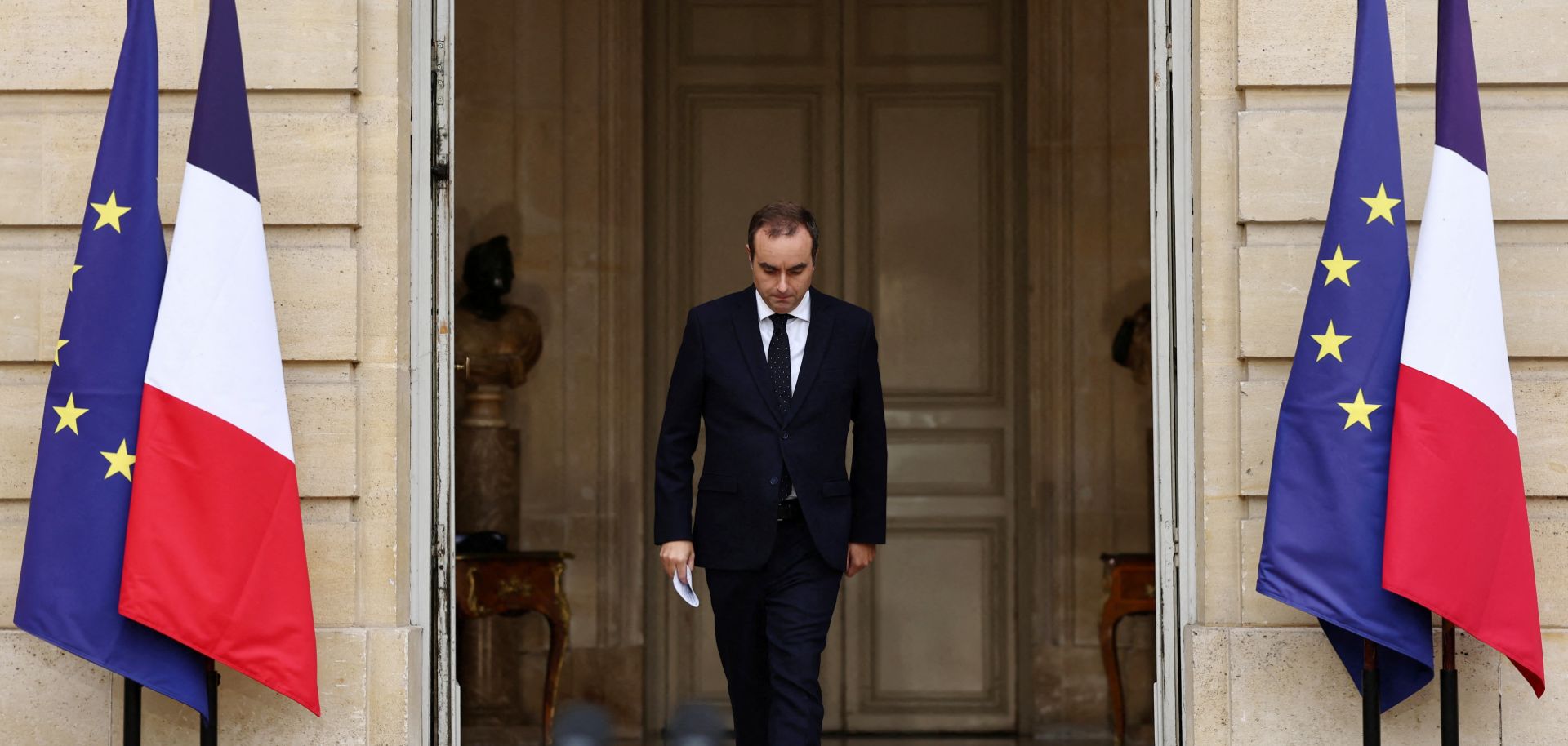
In France, the surprising resignation of the recently installed prime minister will plunge the country deeper into political paralysis, leaving President Emmanuel Macron with difficult options that are likely to prolong the gridlock, further unsettle financial markets and/or exacerbate social unrest. French Prime Minister Sebastien Lecornu resigned on Oct. 6, less than 13 hours after unveiling his new cabinet, marking the shortest tenure for a prime minister in France's Fifth Republic and the third to resign in under a year. Lecornu, who took office on Sept. 9, had spent weeks negotiating with political parties to form a viable government and explore ways to approve a budget for next year ahead of his general policy address to the National Assembly scheduled for Oct. 7. However, the cabinet announced on the evening of Oct. 5 drew immediate backlash from across the political spectrum, including opposition parties on both the left and right, as well as members of Lecornu's own centrist alliance, who criticized it as either too right-leaning or not right-leaning enough, raising doubts about its durability in an already fragmented parliament. In particular, Lecornu's allies in the center-right Republican party had reportedly signaled plans to withdraw their support, leaving the government with an even greater challenge to secure a working majority capable of surviving no-confidence votes and passing next year's budget. Following Lecornu's resignation, far-right and far-left parties urged President Macron to dissolve parliament, call for early elections and resign.
- Lecornu's appointment drew immediate widespread criticism, even before his short-lived government was formed, with both the left-wing bloc and the far-right National Rally warning of a swift no-confidence motion unless he broke with Macron's previous policies. But discontent also surfaced within Lecronu's already fragile governing alliance, as the Republicans demanded tighter immigration measures, a larger share of ministerial posts and clearer policy commitments before joining the coalition. When Lecornu unveiled his ministerial lineup on Oct. 5, it ignited a revolt within the Republicans party, as the cabinet was dominated by reappointments from Macron's previous governments and marked by the controversial return of former Economy Minister Bruno Le Maire, widely blamed for France's deteriorating public finances and viewed by many as a symbol of policy continuity rather than renewal. Just hours after the cabinet was announced, Interior Minister Bruno Retailleau publicly denounced it for failing to reflect the promised political ''break.''
- In June 2024, Macron decided to dissolve the National Assembly and call a snap election in a bid to break the political impasse that had stymied policymaking in the former government. But this backfired by producing an even more fragmented parliament split into three nearly equal blocs of left-wing, centrist and far-right parties, none holding a majority or willing to cooperate with one another. Overall, since the start of 2024, France has cycled through five prime ministers, with three appointed since the June elections alone. This underscores deepening political paralysis and mounting challenges to implement unpopular fiscal consolidation measures amid growing market unease over the country's fiscal outlook.
- France's public finances remain under severe pressure, with government debt at 113% of GDP in 2024 — well above the eurozone average of 88% and exceeded only by Greece and Italy. The fiscal deficit reached 5.8% of GDP in 2024 and, according to IMF projections, will decline only slightly to 5.5% in 2025 before hovering near 6% through the decade without major adjustments. On this trajectory, debt could rise to 128% of GDP by 2030. Fiscal consolidation efforts continue to falter amid persistent political deadlock in the fragmented National Assembly and weak economic growth (forecast at just 0.6% in 2025), deepening concerns over France's long-term fiscal sustainability and ability to meet debt obligations.
Appointing yet another prime minister would do little to resolve France's political deadlock, as any successor would face the same fractured parliament and fragile alliances that led to the downfall of Lecornu and his predecessors; this could compel Macron to resort to controversial constitutional mechanisms to pass a budget, which would only risk worsening France's already volatile political climate. Macron's first option to break the impasse would be to appoint yet another prime minister tasked with trying to negotiate and pass a budget through the National Assembly. However, finding someone capable of maintaining a workable majority within Macron's centrist bloc is becoming increasingly difficult, and any successor — including a technocrat or even a figure from the center-left — would face the same obstacles as Lecornu and his predecessors and would struggle to survive a no-confidence vote, let alone approve a budget. This would likely force any new prime minister to rely on controversial constitutional mechanisms like Article 49.3 to try and pass a budget without a vote in parliament. However, such a strategy would still not guarantee budget approval, as bypassing parliament through Article 49.3 would further heighten the risk of a government collapse by making it procedurally easier and by further incentivizing opposition political parties to unite in a no-confidence motion that, if successful, would topple the government and nullify the budget. Such a move would also deepen already strong public frustration and exacerbate anti-establishment sentiment in France, likely fuelling ongoing anti-austerity and anti-Macron protests and further boosting the electoral prospects of far-right and far-left parties in legislative and presidential elections. Should Macron still decide to go down this path and refuse to call for early elections, he could still seek to use other constitutional provisions to try and approve a budget without parliamentary approval, even if his new prime minister is ousted or resigns, by invoking Article 16 of the French Constitution, which grants the president exceptional powers in times of crisis. However, doing so would almost certainly further inflame France's already volatile sociopolitical climate.
- Lecornu's failed attempt to bridge France's widening political divide underscores the difficulty any successor would face in forming a stable majority. He had pledged to revisit parts of Macron's economic agenda to strike a compromise with opposition parties, particularly the center-left Socialists, in the hopes of securing a parliamentary majority to pass next year's budget. But the Socialists had put forward demands, including introducing a 2% wealth tax and undoing Macron's controversial 2023 pension reform. But the government was unlikely to accept these demands in full, and it would have risked alienating the center-right Republicans, whose backing was also needed to pass a budget. In fact, Republican criticism of Lecornu's new cabinet was likely pivotal in its collapse, illustrating how any shift toward one side risks alienating the other. With parties already maneuvering ahead of potential snap elections, cross-party cooperation will remain elusive, significantly complicating budget negotiations. Republican leader Bruno Retailleau has already ruled out ''endorsing a left-wing government and prime minister'' following Lecornu's resignation.
- Article 16 of the French Constitution allows the president to exercise exceptional powers during crises, including when ''the regular functioning of constitutional public authorities is interrupted,'' which could theoretically provide Macron grounds to invoke the article if France's failure to approve a budget by year-end results in mounting financial pressures and a looming government shutdown. This, however, would be a last-resort measure to prevent fiscal paralysis, given the major legal and political risks involved. For one, invoking Article 16 would likely deepen already severe social unrest, as many would view Macron as overstepping constitutional limits to undemocratically impose austerity measures. The Constitutional Council could also challenge the legitimacy of invoking Article 16, arguing that the conditions do not warrant such an emergency measure and deeming it an abuse of presidential authority. Even if Macron's use of Article 16 is initially upheld, the Constitutional Council and the presidents of both parliamentary chambers are required to review its necessity after 30 days, and could determine that the circumstances no longer justify its continuation, effectively revoking the powers. Misuse or perceived abuse of Article 16 could trigger impeachment proceedings against Macron under Article 68 of the French Constitution for ''failure to carry out his duties manifestly incompatible with the exercise of his mandate,'' potentially leading to his dismissal.
Mounting difficulties in forming another government are increasing the likelihood that Macron will dissolve the National Assembly and call early elections. But this would likely provide only a brief respite, as a new vote would either extend France's political paralysis or empower a radical government opposed to austerity measures — both scenarios that would deepen instability, erode investor confidence and keep pressure on French bonds and borrowing costs. Thus far, Macron has ruled out calling another snap legislative ballot for fear that his centrist bloc would suffer even more losses to far-right and far-left parties. However, Lecornu's resignation, the latest setback, may ultimately compel Macron to take this step due to the lack of alternatives to facilitate a functioning government with the current parliamentary makeup. A new vote may temporarily defuse ongoing anti-austerity protests. However, polling suggests it would once again yield a deeply fragmented parliament, prolonging or even worsening France's political paralysis and reproducing the same legislative gridlock that has hampered policymaking since 2022, with little prospect of a stable majority capable of passing a budget or advancing fiscal consolidation. Alternatively, early elections could produce an ideologically radical government led by the far right or, less likely, the far left that opposes austerity measures, unnerves markets and forces Macron into an uneasy cohabitation with an antagonistic prime minister — further undermining governance, fiscal policy continuity, and confidence in France's financial stability. Moreover, organizing elections and forming a government in time to pass a budget before year-end and prevent a government shutdown would be highly challenging. In this scenario, the likelihood of a temporary budget rollover into next year would thus increase significantly. But while this would provide short-term fiscal certainty and market relief, France's political and fiscal outlook would ultimately depend on the post-election balance in parliament. If no bloc secures enough seats to form a stable majority and approve a proper budget in 2026, uncertainty would persist and confidence in France's political and fiscal stability would weaken, keeping pressure on French bonds and borrowing costs. But if a radical government is elected that rejects fiscal constraint, it would also further erode investor confidence and sharply intensify market pressures, heightening the risk of a financial crisis.
- As of September 2025, polls indicate that an early legislative election would see the far-right National Rally capturing 32% of the vote in the first round, followed by the left-wing coalition New Popular Front with 25%. Macron's centrist coalition is projected to receive 15% of the vote, while the center-right alliance of Les Republicans and the Union of the Right and Centre is predicted to garner 12%. Although France's two-round electoral system means these figures would not directly translate into parliamentary seats, they strongly indicate the high probability of another fragmented parliament.
- A third option for Macron would be to resign, which would trigger an early presidential election (that would otherwise be scheduled for early 2027). This scenario would give the far-right and, to a lesser extent, the far-left a strong chance of winning the presidency. However, Macron is unlikely to take this step, preferring instead to exhaust all alternatives before prematurely ending his second and final term.
- Financial markets reacted sharply to Lecornu's sudden resignation, reflecting growing investor unease over France's deepening political paralysis. The CAC 40 fell nearly 2% on the news, led by steep losses in banking and utility stocks. Government bond yields also rose, with the 10-year rate climbing to 3.56%, while the euro slipped 0.6% against the dollar. Although risk spreads remain below levels seen before the previous French government's collapse, market tolerance is wearing thin. Without credible steps to address France's widening deficit, borrowing costs and spreads are likely to rise further.
