
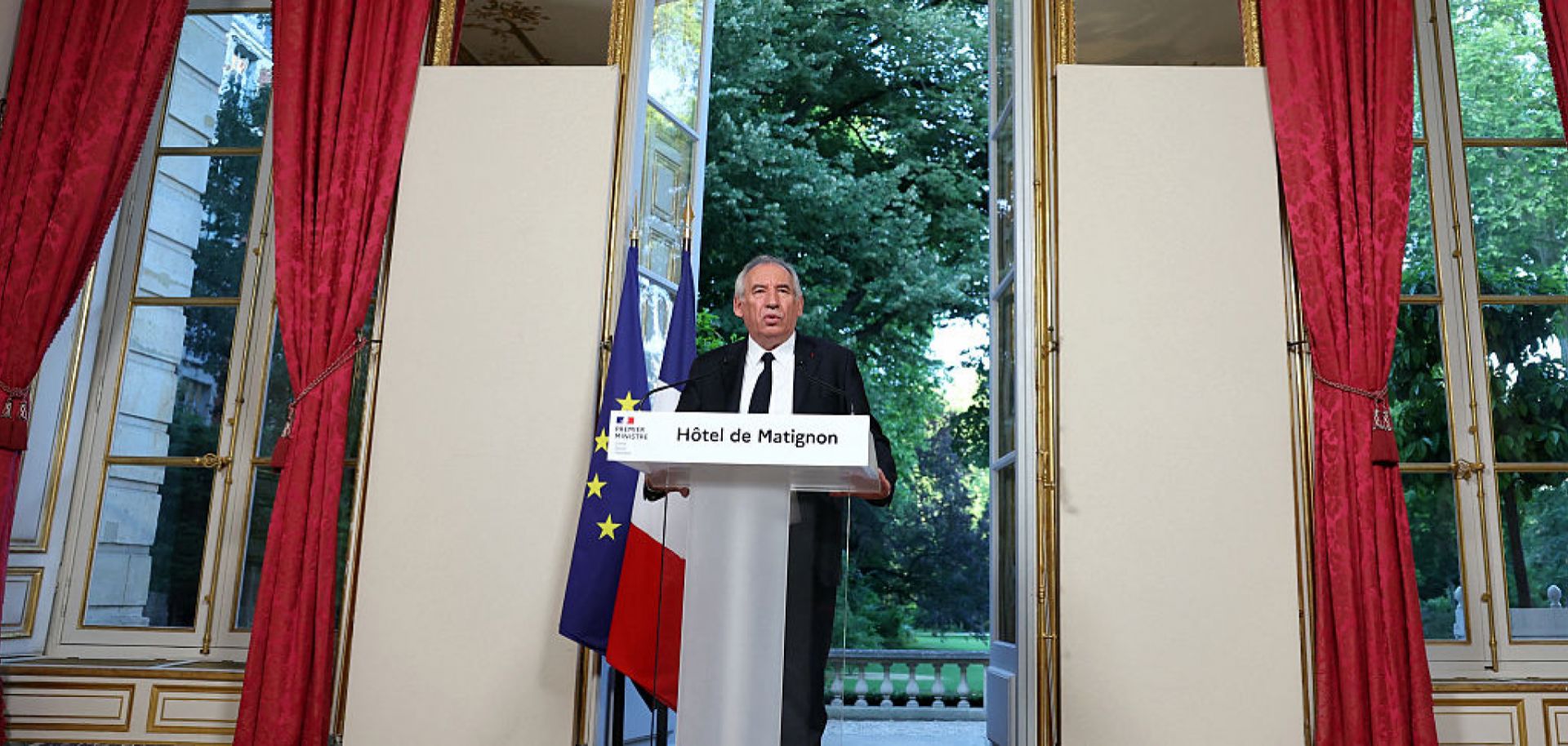
The collapse of France's pension reform negotiations could undermine Prime Minister Francois Bayrou's fragile minority government, increasing the risk of no-confidence votes, budgetary deadlock and potentially early elections at a time when the country is facing mounting pressure to rein in its growing deficit. On June 23, months-long negotiations between French unions and employer groups over potential amendments to President Emmanuel Macron's contested 2023 pensions reform collapsed. The talks focused on revising the law that gradually raises France's retirement age from 62 to 64, as part of a last-ditch attempt to ease tensions between the government, trade unions and opposition parties. Prime Minister Bayrou had tasked unions and employers with identifying compromise measures, including earlier retirement options for physically demanding jobs and greater recognition of maternity leave. However, employer groups reportedly opposed any changes that they argued would impose new costs and could threaten the financial balance of the system. With no deal reached, Boris Vallaud, head of the Socialist Party group in the National Assembly, announced on June 24 that his party will table a no-confidence motion against Prime Minister Bayrou (likely next week), while the far-left France Unbowed party had already pledged to submit its own motion against Bayrou next week. France's far-right National Rally, however, has not committed to supporting such efforts to oust the prime minister, with party leader Jordan Bardella stating on June 24 that the National Rally will wait to assess Bayrou's upcoming budget proposal, expected next month, before deciding how to proceed.
- Bayrou has called an emergency meeting for June 24 with representatives from moderate trade unions and employer groups in a last-ditch effort to salvage a compromise.
- Macron's 2023 pension reform, enacted without parliamentary approval via Article 49.3 of the French constitution (which allows governments to pass budgetary-related legislation without a vote), raised the legal retirement age from 62 to 64 in a bid to stabilize France's strained pension system. Macron defended the move on fiscal grounds, warning that inaction would undermine the long-term sustainability of public finances. The reform triggered months of mass protests and nationwide strikes, drawing fierce opposition from labor unions and a broad swath of political parties across the left and far right.
The collapse of France's pension talks comes amid growing pressure on Bayrou's fragile minority government to deliver politically painful fiscal consolidation measures. Bayrou launched the pension negotiations as part of a pledge he made to the Socialist Party, which (like other left-wing parties in France) opposes raising the retirement age, in exchange for the Socialists agreeing to abstain from a February no-confidence vote on the 2025 budget — a key factor in the minority government's survival and in securing the budget's passage. Revisiting the controversial pension reform was seen as essential to maintaining the Socialists' tacit support for the latest in a series of fragile French minority governments. Bayrou took office in December 2024 after his predecessor, former Prime Minister Michel Barnier, tried to use Article 49.3 of the French Constitution to push through a deficit-cutting budget, which prompted far-left and far-right parties to back a no-confidence motion that ultimately collapsed Barnier's minority government. This political instability stems from snap parliamentary elections in July 2024, which produced an even more fragmented National Assembly composed of three blocs of roughly equal size, none capable of forming a stable majority. The three-way split in the legislature has since severely constrained successive minority governments' ability to advance reforms, particularly as centrist lawmakers loyal to Macron also lost more seats in the 2024 ballot. The resulting deadlock has, in turn, complicated France's efforts to implement fiscal consolidation measures amid mounting pressure from financial markets and the European Union to bring France's widening fiscal deficit under control.
- France's budget deficit surged to 5.4% of GDP in 2024, prompting the European Commission to open an excessive deficit procedure in July for breaching the bloc's fiscal rules, though the procedure was suspended in June 2025 following France's "progress" on fiscal measures approved with the 2025 budget. Paris is now seeking to reduce its deficit to 4.6% of GDP next year, which will require having an additional 40 billion euros in savings for 2026. Meanwhile, the Bank of France projects the deficit will remain at 5.4% in 2025, citing slower growth among the reasons, with GDP expected to grow just 0.6% this year, down from 1.1% in 2024.
- Supported by a coalition of centrist and center-right parties, Bayrou's government holds just 212 of the 577 seats in the National Assembly — well short of the 289 required for a majority. Meanwhile, the left-wing New Popular Front controls 182 seats, and the far-right National Rally holds 143.
Failed pension reform talks will deepen political instability in France, likely resulting in more no-confidence votes and another stalemate over passing the budget that could result in early elections, further complicating deficit-reduction efforts critical to restoring investor confidence and complying with EU fiscal rules. Bayrou is expected to survive eventual no-confidence motions from the left over the failed pensions reform negotiations, as the far-right has so far signaled it will abstain from such votes — likely to preserve leverage ahead of budget negotiations in the summer, when it believes it will be better positioned to extract concessions from the government. The real test will come in mid-July, when Bayrou is expected to unveil 40 billion euros in new savings as part of the 2026 budget. The proposal, set to include painful spending cuts and limited tax hikes, will likely face strong opposition from both left and right. Even if Bayrou survives initial no-confidence motions over the failed pension negotiations, the collapse of pension reform talks will embolden unions and harden left-wing opposition to the upcoming budget, potentially forcing the government to rely on support from the far-right, while increasing the risk of political deadlock and fresh votes of no-confidence. Should Bayrou again resort to Article 49.3 to bypass the parliament in passing next year's budget, his chances of surviving another no-confidence vote would be significantly slimmer than in February, as this time he would likely lack the support of the Socialists. Backing a censure motion would be a political gamble for the Socialists, as it would risk resulting in an early election where the party might lose seats, given its currently weak polling numbers. But the Socialists may nonetheless calculate that Bayrou's government could still survive a no-confidence vote with far-right backing, thus enabling them to distance themselves from unpopular austerity measures without triggering early elections just yet. In case of government collapse, Macron — who will regain authority to dissolve the National Assembly in July — may consider calling early elections, especially if efforts to appoint a new prime minister or pass the 2026 budget fail. Still, given the high risk that a snap vote could just prolong or even exacerbate the current stalemate, Macron will likely first exhaust all remaining paths to secure budget approval before considering this option. While political instability will likely raise borrowing costs and weigh on French assets, a full-blown financial crisis remains unlikely thanks to a credible backstop from the European Central Bank and still-resilient investor confidence in France.
- If no pensions deal is reached, Bayrou will face the difficult choice of either sending the issue to parliament (where cross-party support could emerge to reverse the retirement age hike), or leaving the law unchanged (risking backlash from unions and opposition parties). He may try to add minor concessions to the 2026 budget bill, such as exemptions from the increased retirement age for those with physically demanding jobs. However, it is unclear whether this would satisfy opposition lawmakers, whose support is key for surviving no-confidence votes. By contrast, a last-minute compromise on pensions would require Bayrou to water down Macron's reform, further complicating efforts to pass a deficit-cutting budget and potentially forcing deeper cuts in other areas.
- Starting in July 2025, Macron will once again have the constitutional authority to dissolve the National Assembly and call early legislative elections — an option that becomes available one year after the last election. In April, Macron confirmed he had no intention of calling another snap election before the end of his term, dismissing media speculation about plans for another ballot "as early as this fall." However, a worsening of the legislative gridlock may leave him with little choice. In particular, failure to approve the 2026 budget and/or appoint another prime minister if a no-confidence vote successfully ousts Bayrou's government would increase pressure on Macron to break the deadlock through fresh elections (which otherwise would not be due until 2029).
- In the event that Macron again dissolves the National Assembly and triggers early legislative elections, recent opinion polls indicate the far-right National Rally would capture 33% of the vote in the first round, similar to its results in the 2024 legislative elections. Meanwhile, assuming a reconstitution of the left-wing New Popular Front alliance, left-wing parties would secure approximately 21% of the vote (down from 28% in 2024). Macron's bloc of centrist parties would capture about 16% (down from 20%), while the center-right Republican Party would secure around 10%, roughly in line with its score in 2024.
