
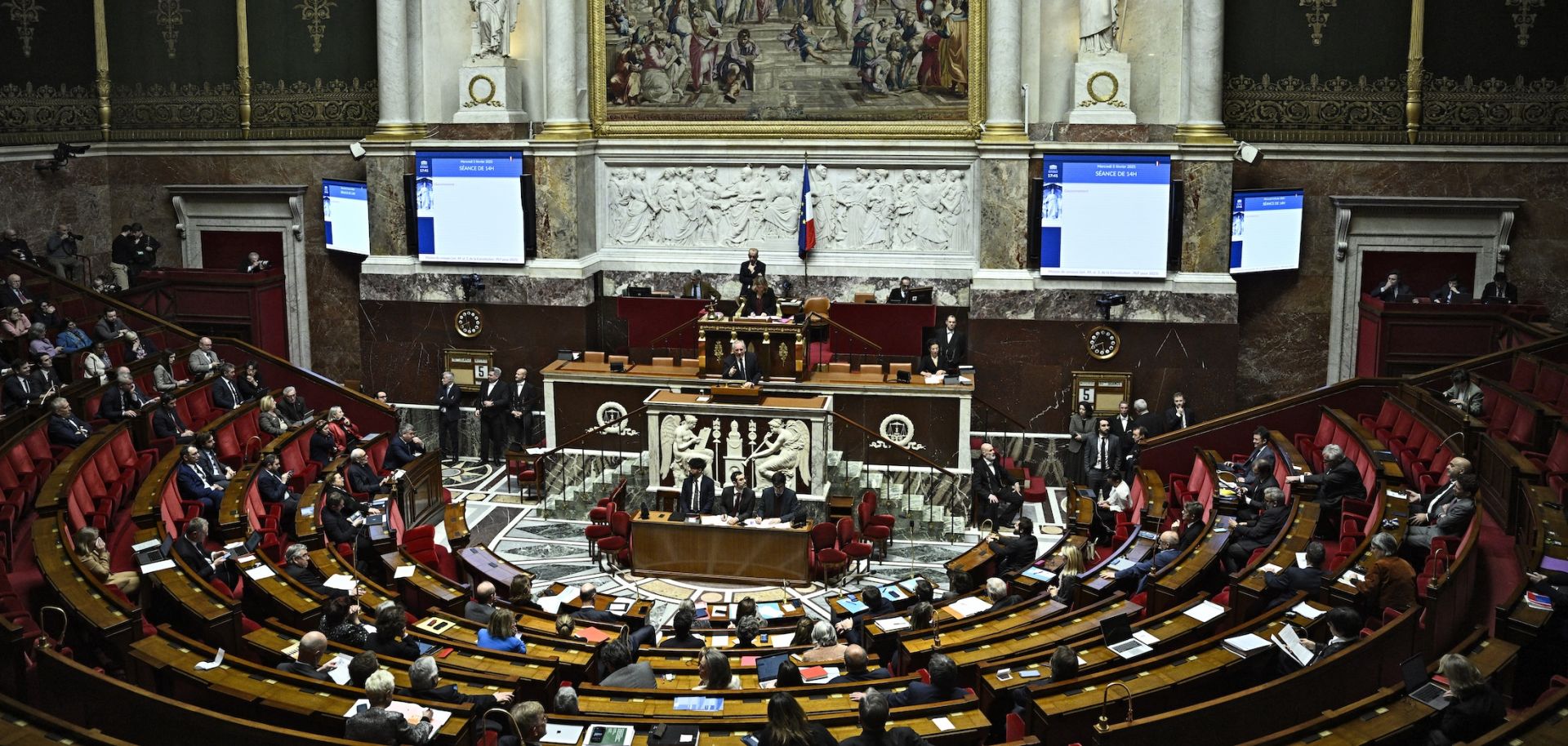
While the approval of France's 2025 budget prevents the collapse of the government and increases fiscal policy certainty in the short term, legislative gridlock, fiscal slippage and external risks will continue to threaten the country's economic and political stability in the medium and long term. Between Feb. 5 and Feb. 10, French Prime Minister Francois Bayrou survived a series of no-confidence motions that the far-left France Unbowed party triggered after Bayrou decided to pass a budget for 2025 and social spending bills without holding a vote in the National Assembly. The social security bills will now move to the upper house of parliament, with approval expected for Feb. 17 or 18. While another no-confidence motion against Bayrou will take place on Feb. 19 (this time connected to the prime minister's recent controversial remarks on immigration), it will probably also fail due to insufficient support.
- Without a majority in the National Assembly, Bayrou had to use Article 49.3 of the French constitution (which allows governments to pass legislation without a vote) several times to approve spending measures for 2025. The France Unbowed party called for no-confidence motions against Bayrou each time he used this constitutional tool, but Bayrou survived these motions because lawmakers from the far-right National Rally party and the Socialist Party abstained from the votes. In December, National Rally and the Socialist Party joined forces to oust former Prime Minister Michel Barnier in a no-confidence motion tabled by France Unbowed.
France has been grappling with political and financial instability amid successive minority governments' struggle to pass austerity budgets to reduce the country's growing deficit. France has faced pressure from financial markets and the European Union to reduce its fiscal deficit, a challenging task for any minority government operating in a highly divided National Assembly. This situation is the result of early parliamentary elections in July 2024, which produced a hung parliament made up of three blocs largely equal in size, none close to a majority or particularly interested in cooperating with one another. Since then, President Emmanuel Macron has appointed two centrist prime ministers: Barnier from the center-right Republicans party and Bayrou from Macron's own centrist camp, each of whom Macron tasked with reducing the country's deficit. Bayrou's current strategy is to pass less aggressive spending plans than those his predecessor proposed, in order to secure support from moderate lawmakers, especially in the Socialist Party. Indeed, while Barnier's original budget plans included 60 billion euros in combined tax hikes and spending cuts to take France's public-sector deficit to below 5% of GDP in 2025, Bayrou's plan includes 50 billion euros in fiscal consolidation to take the public deficit to 5.4% of GDP. Bayrou has also offered to renegotiate President Macron's controversial 2023 pensions reform, which center-left and left-wing lawmakers are very critical of.
- France's public debt rose from 97.4% of GDP in 2019 to an estimated 112% in 2024, and is projected to reach nearly 114% in 2025. Meanwhile, the country's fiscal deficit hit 6.1% of GDP in 2024, exceeding government targets due to a shortfall in tax revenues, increased spending and rising borrowing costs. In July 2024, the European Commission placed France, along with six other EU member states, under an ''excessive deficit procedure'' for violating the bloc's fiscal rules, which require member states to keep their public deficit below 3% of GDP. Under its medium-term fiscal adjustment plan, approved by the European Commission in January 2025, the French government has pledged to bring its deficit below the 3% threshold by 2029.
- The Socialist Party opposed Bayrou's budget at the committee level but secured concessions on health, education and pensions. In particular, Bayrou announced during his inaugural policy speech in the National Assembly on Jan. 14 that he would ''renegotiate'' Macron's pension reform with labor unions and opposition parties in the coming months. The pension reform, which gradually raises France's retirement age from 62 to 64, was also passed by using Article 49.3 in 2023, triggering months of mass anti-government protests and strikes in the country.
The approval of a budget for 2025 averts an immediate political crisis and offers short-term relief to markets, yet France's politics remain unstable and its medium-term fiscal policy direction is still uncertain. While the budget passed, concessions to opposition parties will slow down fiscal consolidation and prolong uncertainty about France's medium-term fiscal outlook. Additionally, France's recent track record of fiscal slippage, combined with low growth prospects — especially amid U.S. President Donald Trump's threatened tariff hikes against the European Union (and thus France) — could further complicate consolidation efforts. Meanwhile, political uncertainty remains high, and the legislative gridlock witnessed for the 2025 budget approval will likely resurface for the approval of the 2026 budget later this year. If the deadlock persists, the likelihood of another early legislative election in the second half of 2025 will increase. Macron would likely only hold an early election as a last resort, considering that the vote would probably yield another fragmented National Assembly, prolonging or potentially worsening instability.
- France's economic growth remains sluggish, with the Bank of France lowering its 2025 growth forecast from 1.2% to 0.9% in December, while the European Commission projects just 0.8% growth, partly due to the impact of fiscal tightening on economic activity. Moreover, significant downside risks persist, particularly from external factors, notably more protectionist U.S. trade policy under Trump, who has pledged to impose substantial tariffs on the European Union, potentially further dampening France's growth prospects.
- Under the French Constitution, another early parliamentary election can only be held after July 2025, at least one year after the previous vote.
