
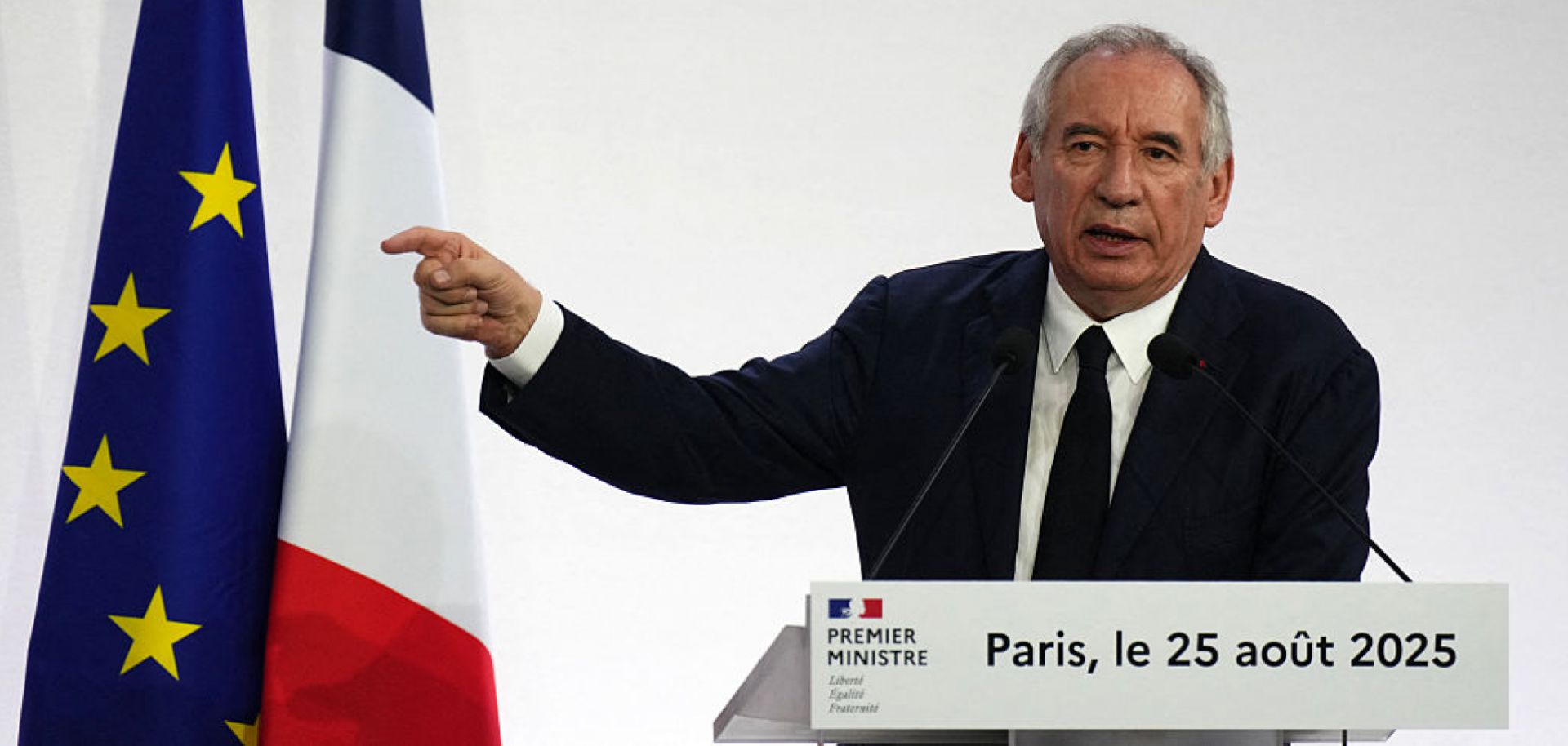
France's latest political crisis could force President Emmanuel Macron to either appoint another weak government or call early legislative elections, both of which would prolong political instability, fuel social unrest and heighten financial risks. On Aug. 25, French Prime Minister Francois Bayrou called for a confidence vote on Sept. 8, as his government is struggling to secure legislative support for its 2026 budget, which includes 43.8 billion euros in spending cuts and other controversial measures, such as eliminating two public holidays to boost economic activity. While Bayrou acknowledged the risks associated with the vote, he said that the measure was necessary for France, which he said was experiencing ''a moment of hesitation and turmoil'' that required ''clarification.'' The largest opposition forces in the National Assembly, the far-right National Rally and the far-left France Unbowed, as well as smaller parties like the Socialist Party, have all said they will not support Bayrou in the vote, portending a high risk of a defeat. French markets reacted negatively to the announcement of a confidence vote, with the French stock exchange opening in negative territory on Aug. 26 and the yield difference between French and German 10-year debt reaching its widest gap since April.
- In recent years, successive French governments have struggled to pass meaningful measures to reduce the country's fiscal deficit (which stood at 5.8% of GDP in 2024) due to the lack of a clear majority in parliament. This is problematic for France, given its public debt stands at around 113% of GDP and economic growth remains sluggish (the European Commission expects the French economy to expand by only 0.6% in 2025), raising concerns about whether Paris will be able to meet its debt obligations.
- Seeking to break the political deadlock and appoint a government committed to reducing the fiscal deficit, President Macron dissolved the National Assembly in June 2024 and called for an early legislative election in June and July, but this resulted in an even more fragmented legislature where Macron's centrist allies lack a majority. As a result, France has had three prime ministers over the past year, all of whom struggled to pass meaningful fiscal consolidation measures.
- France Unbowed leader Jean-Luc Melenchon said that his party will vote against Bayrou's government, and called for Macron to resign. National Rally leader Marine Le Pen wrote on X that her party will ''obviously'' vote against the government and called for the dissolution of the National Assembly. Boris Vallaud, the president of the Socialist group in the National Assembly, also said his party will vote against Bayrou.
In the likely case that Bayrou loses the confidence vote, Macron could appoint a new prime minister, but this would not end France's political gridlock. In the coming days, Bayrou will try to secure support from moderate lawmakers and the abstention of some of his rivals in order to survive the vote. However, in the likely case that Bayrou fails to gain enough parliamentary support and is ousted, Macron will have two main options. The first is to appoint yet another new prime minister with the goal of negotiating a budget with the National Assembly. But even if this premier offers concessions to the opposition, he or she would face the same constraints as Bayrou and his predecessors, which would likely force him or her to use their constitutional powers to pass a budget without a vote (as Bayrou did to pass the 2025 budget in February). While the approval of the 2026 budget would temporarily avert a worsening of France's financial problems, this strategy would still be risky, as passing a budget without a vote allows the opposition to trigger no-confidence votes against the premier and his or her budget. It would also lead to new rounds of anti-government protests and contribute to already strong anti-establishment sentiments in France, boosting the electoral prospects of the far right and the far left in the next legislative and presidential elections.
- On Aug. 26, French Finance Minister Eric Lombard said that there is a risk that the International Monetary Fund would need to intervene to protect the French economy if Bayrou loses the confidence motion. While Lombard's statement was probably meant to pressure opposition lawmakers into supporting Bayrou and was not really connected to an urgent need for a bailout, it did little to reassure financial markets at a time of uncertainty about the French economy. France has never requested an IMF program.
Macron's second option is to dissolve the National Assembly and call for an early legislative election, but this would likely produce another fragmented legislature. An early legislative vote would temporarily dilute the risk of large anti-government protests. However, polling indicates it would result in another fragmented National Assembly. This would likely only worsen France's political crisis, as Macron would once again struggle to appoint a prime minister capable of generating enough consensus to reduce the fiscal deficit. There is also a chance that the far right or, less likely, the far left secures a legislative majority, which would force Macron to share power with a prime minister with an antagonistic ideology, severely disrupting the policymaking process. Moreover, both the far right and the far left are critical of austerity measures, which means that a government by either camp would deepen market uncertainty about France and could result in a financial crisis. In a low-probability but high-risk scenario, Macron could resign, which would trigger an early presidential election (France's next presidential election is scheduled for early 2027). If this happens, the far right and, to a lesser extent, the far left would stand a good chance of winning the presidency. However, Macron would only resign as a last resort after exhausting all other options (such as appointing new prime ministers and holding an early legislative election).
- According to an Ifop survey released in June, if there is an early National Assembly election, the National Rally would receive 35% of the vote in the first round, followed by the far-left coalition New Popular Front (which included France Unbowed) with 21%. Macron's centrist coalition would end in the third position with 18%. France's legislative elections take place in two rounds, which means that these first round projections would not directly translate to seats in the National Assembly. Still, these numbers suggest that an early election would result in another fragmented legislature.
- While both the National Rally and France Unbowed have pledged to reduce France's fiscal deficit, their proposals to do so are likely to make markets nervous. The National Rally has pledged to reduce France's annual contribution to the European Union's budget and introduce a tax on imports from outside the bloc, which critics argue would be both insufficient and against EU rules. France Unbowed's platform calls for significant tax hikes on large corporations and high-income earners, as well as a massive increase in public spending on social services, public sector jobs and environmental initiatives — a combination that is unlikely to significantly reduce the deficit.
Regardless of Bayrou's fate, France's political crisis will persist, prolonging uncertainty about the country's future policy direction. Even if the current turmoil is resolved in the short term, long-term social and political trends point to a continued fragmentation of the French political system. Both the far right and the far left will remain strong, while the center will struggle to establish a clear identity capable of winning elections (and will need to find a new leader as Macron cannot be re-elected). This division into three groups of similar size will create recurring uncertainty at every election, whether legislative or presidential. Although France's two-round electoral system has traditionally blocked extremists from gaining power, the far right and, to a lesser extent, the far left are increasingly capable of overcoming these barriers, raising the likelihood that one could eventually capture the presidency or the premiership and end the traditional dominance of centrist forces. At the same time, continued ideological fragmentation will fuel recurring protests, strikes and anti-government movements, constraining any future government's ability to enact consistent fiscal or structural reforms. This will undermine France's capacity to address critical issues such as public debt, unemployment and social inequality. If this happens, investors would likely begin seeing France as a higher-risk environment, driving up borrowing costs and worsening its financial vulnerabilities. Finally, as a core EU member, France's instability would spill over into the European Union. While French presidents are in charge of foreign policy, domestic turbulence tends to weaken their influence abroad. An inward-looking France would struggle to lead the European Union on issues such as federal integration, defense cooperation and economic reform, and would weaken Europe's overall geopolitical posture.
- Bloquons tout (''Let's Block Everything''), a loosely organized citizen movement that emerged on social media in early 2025 to protest Bayrou's austerity budget, has called for widespread protests and strikes on Sept. 10. Although the movement is leaderless and composed of a heterogeneous mix of far-right supporters, far-left activists and other groups, its members all share strong anti-establishment and anti-austerity sentiments. Bloquons tout follows in a long tradition of French anti-establishment movements, some of which (such as the Yellow Vests) were able to organize large, disruptive nationwide protests between 2018 and 2020 that forced the government to make concessions. While left-wing political groups have expressed support for Bloquons tout, the far right and trade unions have been more cautious, suggesting that both political parties and unions are wary of losing influence to newer, less structured and more radical movements.
