
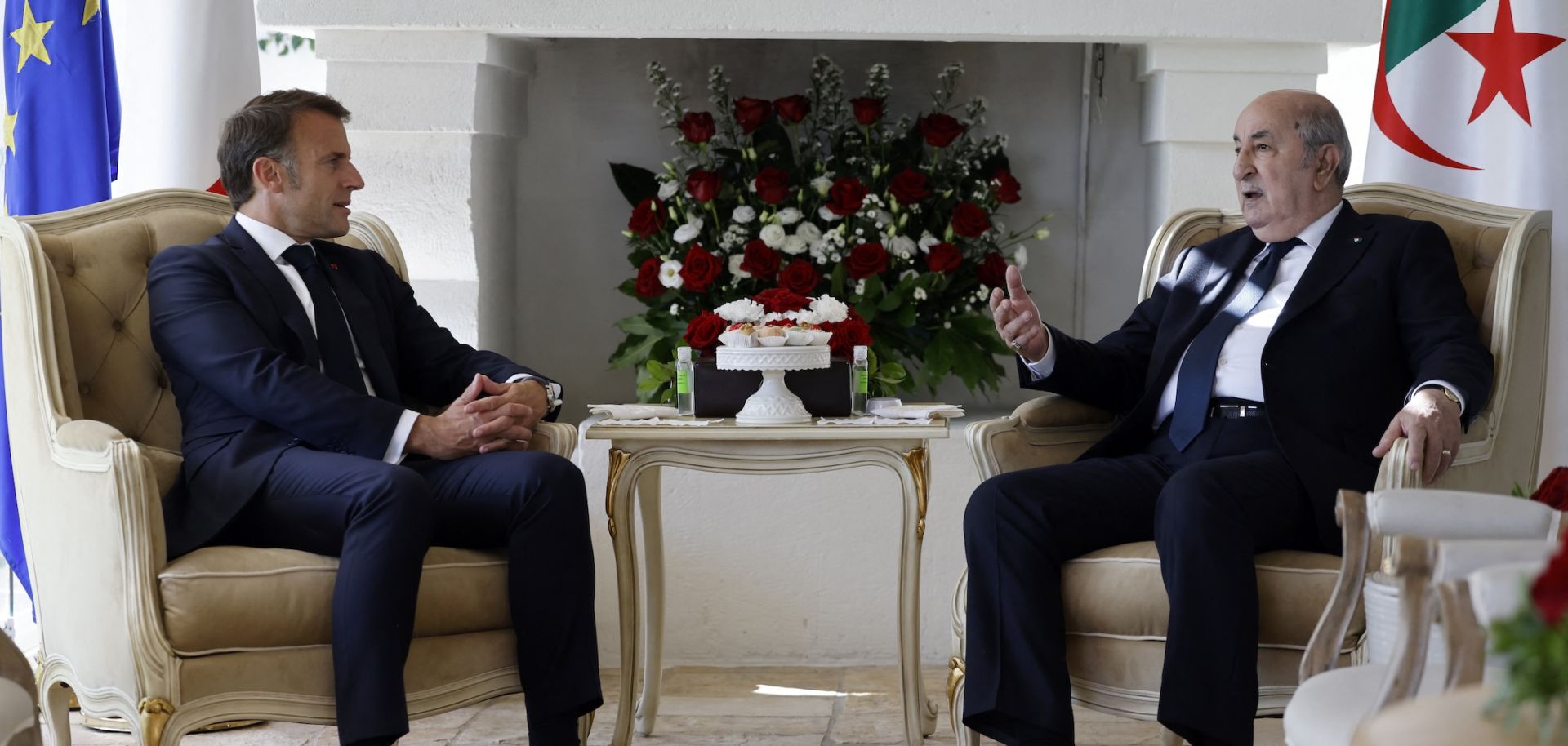
France's likely review of its 1968 migration pact with Algeria is unlikely to pressure the Algerian government to resume cooperation on deportations, especially since Paris is very unlikely to actually suspend or abolish the pact. Instead, the review — along with other French measures aimed at pressuring Algeria — is more likely to worsen tensions between the two countries, resulting in potential sanctions, curbed trade and stalled energy negotiations. On Feb. 26, French Prime Minister Francois Bayrou said France would reexamine its 1968 pact with Algeria that makes it easier for Algerians to migrate to France if Algeria did not resume cooperation with deportations, citing Algeria's failure to deport Algerians who have been given an Obligation to Leave French Territory (OQTF) order. Bayrou also said the French government would provide a list of Algerian nationals set for "emergency" repatriation under the OQTF designation, and gave Algiers four to six weeks to comply with the deportations. The Algerian government condemned Bayrou's announcement, calling it the latest "provocation" in "a long series of threats and harassment" from France. Tensions between the two countries were already high after France announced in July 2024 that it supported Morocco's sovereignty claims over the disputed Western Sahara region, where Algeria backs the Sahrawi-led separatist Polisario Front movement. But tensions over migration, in particular, worsened sharply after an Algerian national — whom the French government had tried to deport back to Algeria at least 10 times — killed one person and injured three more in Mulhouse, France, on Feb. 22. In protest of Algeria's ongoing failure to deport Algerians with the OQTF designation, France on Feb. 25 imposed entry and movement restrictions on some Algerian dignitaries, but noted the restrictions were reversible if Algiers resumed cooperation on deportations.
- Bayrou's announcement coincided with the president of the French Senate's visit to Algeria's neighboring rival Morocco and the disputed Western Sahara territory. In response to the visit, the upper house of Algeria's Parliament immediately suspended ties with the French Senate.
- France-Algeria relations have been plagued by historical grievances related to French colonial rule since Algeria's independence in 1962. A desire to address those grievances following the Algerian war of independence is partially what drove Paris to reach the 1968 migration pact with Algiers, which streamlines Algerians' immigration to France. As a result of the agreement, Algeria is now the country of origin for the largest proportion of immigrants in France. In 2023, 12.2% of immigrants living in France were born in Algeria, according to France's National Institute of Statistics and Economic Studies.
France-Algeria relations deteriorated after Paris recognized Morocco's sovereignty claims over Western Sahara in July 2024 and following violent incidents in France that stoked anti-Algerian sentiment amid broader pushback against immigration. In July 2024, French President Emmanuel Macron ended France's long-standing position on Western Sahara by recognizing Morocco's 2007 sovereignty claims over the territory. Previously, France had viewed the Moroccan plan as "serious and credible" but not as the sole path forward in the Western Sahara dispute. In response, Algeria denounced France's position, withdrew its ambassador from Paris, halted cooperation with France on deportations and, in October 2024, excluded France from wheat tenders. Other incidents, including Algeria's arrest and imprisonment of French-Algerian author Boualem Sansal on national security charges, have further strained relations. These diplomatic incidents came amid rising anti-Algerian sentiment in France that escalated following violent incidents involving Algerians and the arrest of several Algerian influencers for allegedly inciting violent acts and spreading anti-semitism. This anti-Algerian sentiment feeds into broader public discontent with immigration that has increased domestic pressure on Paris to control migration flows into the country.
- Spain recognized Morocco's sovereignty claims over Western Sahara in 2022, leading Algeria to suspend a 20-year friendship and cooperation treaty and sever all bilateral trade except for oil and gas exports. The Algerian government also threatened to break an energy contract if Spain transferred the gas to "a third destination," alluding to Morocco. After more than two years of tense bilateral relations between Spain and Algeria, ties have improved following Algeria's decision to end trade restrictions in November 2024, and cordial diplomatic visits have since resumed.
Algeria is very unlikely to cooperate in the repatriation of OQTF-designated Algerians, which means France will likely move forward with its review of the 1968 migration pact, even if its abolishment is unlikely. Algeria has closely linked its suspended cooperation over these deportations to its championing of the Western Sahara cause, which has significant domestic backing, not only because it recalls Algeria's anti-colonial fight but also because it is an extension of the broader Algeria-Morocco rivalry. As a result, France will likely follow through on its review of the 1968 migration pact, which will further stoke tensions between the two countries. Modifying the pact would require bilateral agreement, which is currently unlikely amid tense relations and Algeria's expected resistance. However, Algeria may eventually become more open to updates — after a warming of ties — as it has in the past. If France unilaterally suspends part or all of the pact, this would be a major escalation that would provoke a strong Algerian response and impact Macron's legacy on French-Algerian relations. Acknowledging this, Macron has stated that France will not unilaterally suspend or abolish the pact, diverging from the Bayrou government's stance.
Instead, France will likely take additional steps to pressure Algeria into cooperating on deportations, which could lead Algeria to curb bilateral trade and stall negotiations with French energy companies. As tensions rise, France will likely take additional steps to pressure Algeria to resume cooperation on deportations, potentially including financial sanctions on Air Algerie, one of Algeria's prominent airlines that has been used in deportation efforts and returns of OQTF-designated Algerians. France may also restrict the number of flights between the two countries. In a leaked French interior ministry memo, which government officials prepared in advance of a Feb. 26 immigration control meeting, France outlined several more steps the government could take, including visa restrictions on influential Algerian military and political personnel, strengthening maritime link controls, and summoning Algeria's consul generals. Reciprocally, Algeria may consider imposing trade restrictions on France and threaten to restrict key oil and gas exports, though Algeria would be less likely to follow through on the latter threat since energy exports are critical to Algeria's economy. Algerian trade restrictions on France with energy exemptions would largely be symbolic and have limited effects on Algeria's exports. Algeria could also curb imports from France, either formally or informally, which would raise consumer prices in Algeria and could cause short-term shortages of some products. These economic impacts could further stoke lower-income Algerians' frustration toward the Algerian government. Beyond trade retaliation, Algeria could slow-walk major business deals with French companies like French energy giant TotalEnergies to avoid domestic backlash amid sour bilateral relations. In their place, Algeria may increase efforts to diversify international oil and gas partners away from France.
- According to the Observatory of Economic Complexity, less than $500 million of $7.29 billion-worth of Algeria's exports to France in 2023 were non-energy exports. That same year, Algeria imported $4.6 billion worth of goods from France, which composed 11.6% of its annual imports. Imports varied, including significant quantities of cars and motor vehicles, medications, and wheat.
- In early 2024, Algerian state-owned energy company Sonatrach and France's TotalEnergies inked a deal to extend their energy cooperation through 2025. Through this agreement, Sonatrach will deliver two million tons of liquified natural gas to TotalEnergies at the port of Fos-sur-Mer, France. However, strained ties between the two countries will likely persist through at least mid-to-late 2025, overshadowing future negotiations.
