
Editor's Note: For geopolitically significant elections, RANE publishes detailed scenario analyses that outline potential outcomes of the vote and their various domestic and international implications. Our previous scenario analyses have covered elections in Germany, Canada, Australia, Poland, South Korea, Japan (twice), Guyana, Norway, Moldova, the Netherlands, Chile, Bangladesh and Denmark.
Peru will hold general elections on April 12, with a runoff on June 7 if no candidate obtains more than 50% of the vote. Peruvians will elect a president, two vice presidents, the 130 members of the Chamber of Deputies and, for the first time in over three decades, a 60-seat Senate, marking the return of a bicameral legislative system. The presidential race is characterized by severe political fragmentation, with a record 35 candidates vying for the top office. Leading candidates are polling in the low double digits, and many voters remain undecided, setting the stage for late swings in voter sentiment and an unpredictable outcome. The legislative election, meanwhile, will likely result in multiple center-right parties gaining most seats, especially since this year marks the end of a ban on immediate legislative reelection. Such an outcome would likely improve the governability conditions of a right-wing president but become an obstacle for a leftist or anti-establishment leader.
If a populist or outsider candidate (like Rafael Lopez Aliaga, a businessman and former Lima mayor from the Popular Renewal party or Carlos Alvarez, a former comedian from the Country for All) wins, it would trigger institutional friction, which, combined with the president's likely lack of congressional support, would increase political and regulatory uncertainty, as well as the likelihood of impeachment proceedings. On the security front, a populist president would likely resort to heavy-handed policies, including militarizing the fight against organized criminal groups, mass incarcerations and cooperation with the United States. If a right-wing or center-right candidate (like Keiko Fujimori, a politician from the Popular Force party and daughter of former president Alberto Fujimori) becomes president, they would likely resort to pork-barreling to secure governability conditions, which would increase corruption risks and likely fuel anti-government protests. Moreover, a right-wing government would prioritize macroeconomic orthodoxy and pro-business measures while pursuing a less confrontational security strategy. Lastly, a leftist or center-leftist president (such as Alfonso Lopez-Chau, an economist and founder of the Now Nation party) would aim to dismantle the liberal economic model implemented in the 1990s. That would translate into efforts to reverse privatizations, trade liberalization, deregulation and labor market flexibility while increasing social spending. The implementation of such a platform would highly likely face opposition from a center-right-dominated Congress, and the government's inability to deliver on its promises would fuel unrest and political instability risks.
An Anti-Establishment Outsider Wins
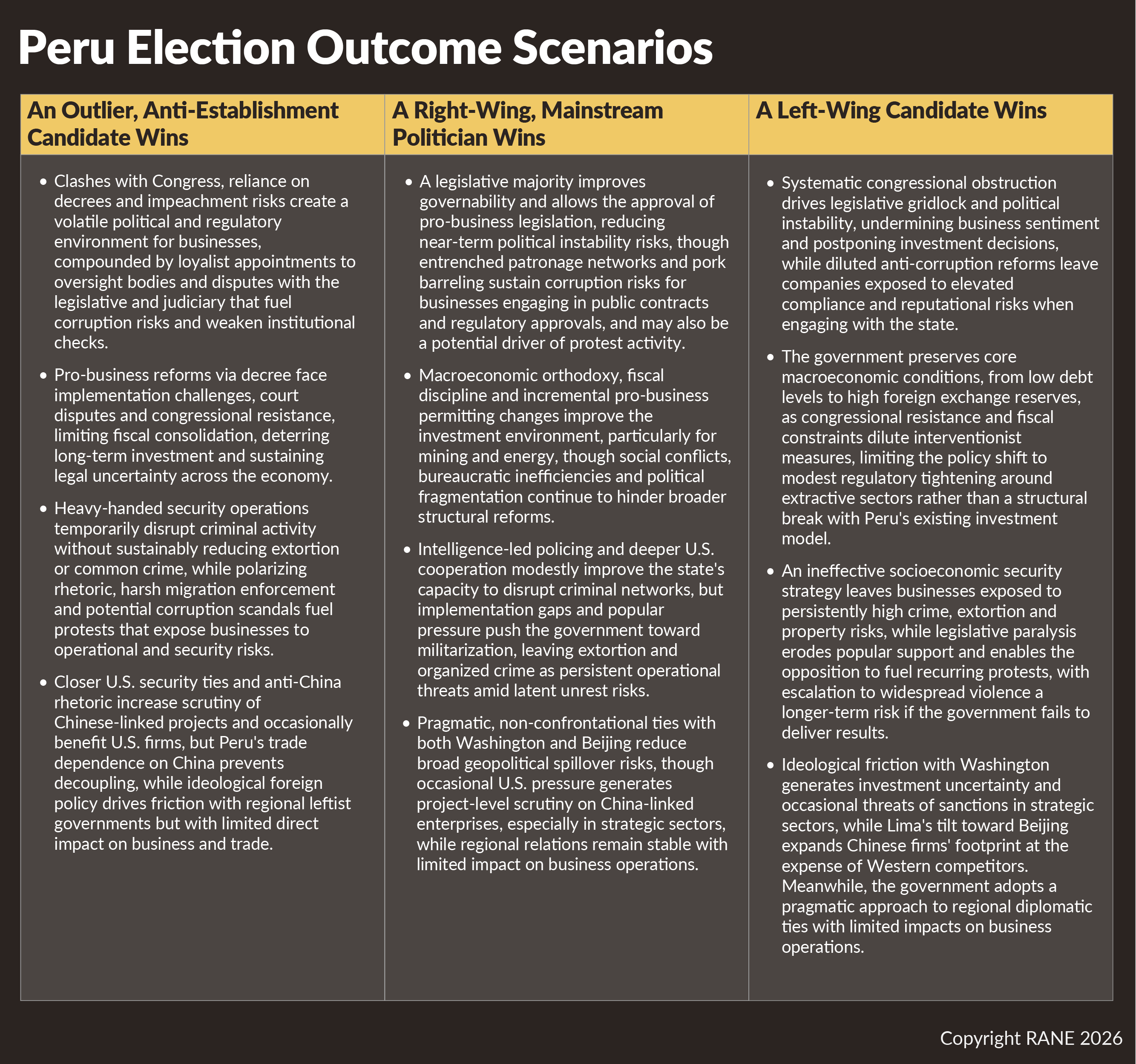
An anti-establishment outsider victory would lead to erratic policymaking and occasional crises between the president and other branches of government or oversight bodies. The new president would lack a structured bloc in Congress, forcing the government to rely on decrees to push its pro-market agenda. While outsider candidates have divergent platforms, the most competitive ones, according to polls, would likely push an economic platform mostly centered on privatizations, deregulation and private sector investment. Recurring clashes with legislators and oversight bodies would raise the probability of impeachment proceedings and political instability. Although the administration would seek to downsize the state, weak technical capacity and implementation challenges would constrain its ability to deliver on policy proposals, generating regulatory uncertainty and limiting its capacity to increase fiscal surpluses. On the security front, a militarized, heavy-handed approach to urban gangs, extortionists and transnational criminal networks would generate high-profile operations and marginally disrupt gangs' activities. But this strategy would ultimately fail to structurally reduce extortion and would also risk sparking retaliatory attacks from targeted criminal groups, sustaining high levels of violent crime. As the government links undocumented foreigners to crime, migration policy would tighten sharply, increasing compliance burdens in labor-intensive sectors. Polarization, corruption scandals and harsh enforcement of security and migration measures would fuel frequent protests and occasional violent unrest. Internationally, the administration would seek close alliance with the United States, especially on security cooperation, and adopt hostile rhetoric toward China, exposing Chinese-linked projects in Peru to heightened scrutiny and occasionally preferential treatment for U.S. firms. However, Peru-China trade would limit the government's intent and capacity to decouple.
Implications
- Weak party structures and limited legislative support result in recurring clashes between the president and Congress, raising the probability of legislative gridlock, political instability and, in an escalatory scenario, impeachment proceedings. Reliance on executive decrees to bypass legislative opposition also creates legal uncertainty and an unstable political and regulatory environment for businesses.
- The administration resorts to decrees to implement pro-investment and state-shrinking measures, including privatizations and deregulation. But its erratic policymaking style — combined with limited technical capacity, recurring clashes with Congress and court challenges — hinder implementation, deterring longer-term investment.
- The government seeks to reduce fiscal pressures through privatizations, cuts to inefficient state spending and a greater role for private capital in infrastructure and public services, which help support fiscal consolidation. However, implementation challenges limit the impact of these measures, while popular pressure to fund meaningful security or social initiatives prevents a significant improvement in Peru's fiscal position, thereby sustaining moderate-to-medium-term fiscal risks.
- The government issues decrees to accelerate project approvals, reduce permitting timelines and expand private sector participation, particularly through deregulation and bureaucracy reduction. However, in addition to legal uncertainty around the validity of presidential decrees, businesses also face pushback from local communities and environmentalists, leading to investment delays and operational disruptions stemming from occasional demonstrations.
- The government adopts a strongly pro-market approach, pushing to privatize or dismantle the state-owned Petroperu oil company, expand private participation and boost upstream and downstream projects. However, companies face erratic policymaking, weak institutional coordination and recurring political instability, as well as legal and contractual uncertainty, which limit investment opportunities and gas output, prolonging Peru's ongoing energy crisis.
- The government adopts an aggressive approach to fighting common crime and extortion, expanding military support for policing, increasing prison capacity and resorting to recurring states of emergencies. It prioritizes high-profile operations that temporarily disrupt criminal activity but fail to sustainably reduce extortion, homicide and gang penetration in transport, retail and logistics over time. As a result, businesses remain exposed to persistent operational and occasional personnel security risks stemming from criminals' activities and retaliatory actions.
- The government militarizes the country's borders, adopts harsher migration controls and conducts high-impact anti-gang operations, prioritizing repression over intelligence-driven strategies to appease popular discontent. But the impact of these efforts is undercut by the absence of structural reforms or coordinated efforts to dismantle gangs' financial networks and revenue streams. As a result, trafficking, extortion and cross-border crime remain pervasive in Peru, despite increased bilateral security cooperation with the United States
- The president's governance style — characterized by personalistic and erratic policymaking, confrontational rhetoric and the pursuit of harsh security measures — fuels polarization and drives frequent anti-government protests. Against this backdrop, corruption scandals, police repression or a continued failure to improve Peru's security situation could trigger general strikes or violent unrest, exposing firms to heightened operational and security risks.
- Despite a strong anti-corruption rhetoric, the president appoints loyalists to oversight bodies, curbing institutional checks, and occasionally uses investigations to target political rivals, undermining Peru's capacity to fight corruption. As a result, businesses face heightened compliance risks, especially when dealing with the government amid limited checks and balances and transparency mechanisms.
- Amid a rhetoric that connects crime to foreigners, the government adopts strict migration policies, expands deportations, implements border protection strategies and tightens customs procedures. Security authorities' harsh treatment of undocumented migrants and/or high-profile cases of police brutality trigger protests. Meanwhile, businesses in sectors reliant on migrant labor (i.e., construction, hospitality, retail and services) or cross-border trade (i.e., mining, agro-industry, textiles and logistics) encounter tighter labor-market controls, higher compliance burdens and occasional operational disruptions.
- The presidential administration establishes closer political and security ties with the United States, particularly through anti-crime cooperation, intelligence-sharing and a more openly anti-China posture. This occasionally translates into preferential access for U.S. companies in strategic sectors, such as mining, infrastructure and telecom and increased scrutiny over Chinese firms, especially in contracts with the government or state-owned enterprises.
- The president adopts more confrontational rhetoric toward China and publicly opposes or criticizes the presence of Chinese businesses in Peru, particularly around strategic sectors and their influence over the country's political and business establishments. As a result, Chinese-linked projects in strategic sectors face heightened scrutiny and occasional political opposition. But a rupture or significant deterioration of bilateral ties is unlikely, given Peru's economic dependence on Chinese trade and investment, which deters the government from undermining Chinese interests in Peru.
- An ideological and security-driven approach to foreign affairs leads to closer ties with other right-leaning governments in the region, including Argentina, Chile, Bolivia and El Salvador, as well as potentially Colombia if the opposition wins the May 2026 presidential election. This results in cooperation to fight transnational crime, including with U.S. support. The Peruvian government is also hostile toward the leftist autocracies in Venezuela, Cuba and Nicaragua, as well as the democratically elected left-wing governments in Brazil (assuming the current administration is reelected in October 2026) and Mexico. However, this firebrand rhetoric has a very limited impact on business decisions and regional trade, posing limited risks for companies.
A Right-Wing, Mainstream Candidate Wins
A center-right establishment president would deliver a somewhat predictable and business-friendly environment, even though political fragmentation, polarization and corruption would remain drivers for unrest and political instability over time. The administration would maintain orthodox macroeconomic policies, including fiscal discipline, central bank autonomy and openness to private sector capital. Pork barreling would secure support from a majority bloc in Congress, enabling the approval of pro-business legislation, particularly on permitting and sectoral mining incentives, thereby limiting legal uncertainty. However, party fragmentation, bureaucratic inefficiencies and social demands would still prevent broad structural overhauls. Opaque executive-legislative relations would also continue to fuel corruption risks and could trigger social unrest amid persistent popular dissatisfaction with the political establishment. On security, a combination of intelligence-led policing, prison reform and deeper U.S. and regional cooperation would modestly improve Peru's capacity to disrupt criminal networks, though extortion and organized crime would remain significant operational and security threats due to ongoing resource and structural constraints, like corruption. Migration policies would be tightened, but not enough to cause insurmountable labor disruptions for companies. The Peruvian government would seek to foster pragmatic, non-confrontational ties with both the United States and China, likely reducing broader geopolitical spillover risks for companies in Peru, though U.S. pressure may still occasionally prompt project-level scrutiny of Chinese-linked enterprises in strategic sectors.
Implications
- A structured congressional bloc ensures minimum governability, though polarization and party fragmentation remain drivers of institutional friction. Still, the administration passes pro-business legislation and anti-crime bills, limiting popular dissatisfaction and reducing the likelihood of a sudden change in government in the medium term. However, Peru's underlying structural issues limit the government's capacity to achieve significant and lasting improvements, sustaining latent political instability risks for businesses.
- The administration preserves Peru's orthodox macroeconomic framework, including fiscal discipline, central bank autonomy and a broadly open investment regime, reassuring markets and supporting business sentiment. Despite legislative fragmentation and political polarization limiting broad structural reforms, the government also advances incremental pro-business legislation, further improving the business environment.
- The government's focus on fiscal discipline helps stabilize investor confidence and contain debt and deficit risks. Although political pressures and social demands prevent a harsh fiscal adjustment, the government avoids major tax hikes or spending expansions, resulting in a broadly stable fiscal outlook with only gradual improvement, providing financial stability and helping attract private capital.
- The government prioritizes mining as a key driver of economic growth and secures support in Congress for legislation to streamline permitting and provide fiscal incentives for large-scale projects, further improving the investment outlook. While social conflicts and bureaucratic inefficiencies continue to delay some projects, a more predictable policy environment and closer alignment with the private sector reduce operational uncertainty, supporting a relatively favorable outlook for mining companies.
- In the energy sector, the government maintains existing market-friendly and orthodox legislation, supporting private investment and regulatory continuity while gradually restructuring Petroperu to improve its operational and financial sustainability without violating contracts. Although social conflict, permitting bottlenecks and political fragmentation continue to constrain the sector's expansion, a more predictable policy outlook helps attract investors and operators.
- Isolated anti-graft efforts fail to dismantle patronage networks, pork-barrelling and decades-long corruption practices within Peru's political establishment, thus preventing a significant improvement in governance standards. As a result, businesses remain exposed to bribery, influence peddling and reputational risks, particularly when engaging with public contracts and bureaucratic approvals, such as licensing and permitting.
- To combat crime, the administration strengthens intelligence-sharing within public security bodies and with other countries, adopts stricter border enforcement and prison controls to contain transnational criminal groups, and deepens security cooperation with the United States and regional partners. While these measures help improve Peru's capacity to disrupt some criminal networks, weak judicial institutions and corruption — along with organized crime's penetration of the country's economy through illicit activities and extortion — prevent a definitive reduction in crime levels, leaving businesses with somewhat lower but still persistent security risks.
- Greater policy predictability and reduced political instability initially deter anti-government demonstrations. But persistent social discontent — especially with the political establishment that the administration embodies — means various triggers, such as insecurity, violence, corruption and the economy, could quickly fuel anti-government mobilizations and strikes, disrupting business operations and sustaining moderate unrest risks.
- While the administration adopts a stricter approach to migration, the topic is not central in its security strategy, meaning raids or mass deportations are unlikely, limiting unrest risks and labor market disruptions. While businesses face stricter labor requirements, these are manageable, with operational disruptions in cross-border logistics mitigated by orderly policy implementation and streamlined bureaucratic procedures enabled by digitalization.
- The center-right administration maintains close, pragmatic ties with the United States but avoids openly taking sides between Washington and Beijing. While this helps mitigate geopolitical uncertainty, businesses are still occasionally exposed to regulatory shifts or project delays in strategic sectors stemming from U.S. pressure.
- The government adopts a pragmatic, economically driven approach to China, seeking to maintain trade and investment flows while occasionally pushing back against Chinese presence amid persistent U.S. pressure. Despite some high-profile cases and investigations into Chinese-led projects, there are few broad regulatory changes aimed at undermining Chinese interests in Peru, limiting the exposure of Chinese firms' projects to geopolitical disputes.
- The administration preserves pragmatic and broadly cooperative relations with Latin American governments across the political spectrum, prioritizing trade, migration management, security cooperation and diplomatic stability. Although ideological differences may occasionally cause friction with leftist governments, such as those in Mexico or Brazil, these are unlikely to escalate into full-blown crises. This, in turn, creates a relatively stable regional environment for businesses, with limited geopolitical spillover risks.
A Left-Wing Candidate Wins
A left-wing president would adopt interventionist economic policies, increasing the risk of market volatility and a deterioration in business sentiment, though congressional opposition would dilute radical proposals and prevent a significant departure from Peru's existing economic model. The new administration's economic platform would likely seek to expand public investment and social spending, increase regulatory oversight, raise taxes and implement stricter community and environmental requirements for strategic sectors, such as mining and energy. On security, the administration would focus on tackling the structural drivers of violence while avoiding a militarized or heavy-handed approach. Still, limited resources, corruption and organized crime's operational resilience would leave businesses exposed to high levels of gang activity and extortion. The administration's immigration policy would focus on regularizing undocumented foreigners, which could fuel popular opposition, especially if an economic slowdown occurs. Ideological friction with the U.S. President Donald Trump's right-wing administration would periodically escalate, generating financial volatility and investment uncertainty in strategic sectors. Meanwhile, ties between Lima and Beijing would deepen, enabling Chinese-linked projects to expand their footprint in Peru. Domestically, the president's inability to push their policy agenda through Congress would erode popular support, enabling the opposition to organize anti-government demonstrations that disrupt business operations in Lima and other large cities. Congressional opposition would also sustain the risk of an impeachment attempt or early elections throughout the president's five-year term, creating a politically unstable environment that compounds the regulatory and security challenges businesses would also face under a left-wing government.
Implications
- A center-left presidency faces systematic obstruction from a right-leaning and fragmented Congress, while a small support base results in legislative delays or policy paralysis, which could fuel institutional friction, raising the risk of impeachment attempts. Overall, businesses face persistent legislative gridlock and occasional episodes of political instability, which fuel uncertainty and undermine business sentiment, postponing investment decisions and reducing economic growth prospects.
- The administration likely preserves Peru's main macroeconomic features (such as a credible central bank, fiscal discipline, low public debt and strong foreign exchange reserves), while also pursuing a more active state role through higher public investment, social spending and selective intervention in strategic sectors like mining and oil/gas. However, opposition in Congress, business pressure and fiscal constraints temper these interventionist policies, translating to a modest leftward policy shift and occasional market volatility for businesses.
- The government expands public spending and investment, particularly in social services, increasing fiscal pressures in the short term. Still, congressional opposition, market constraints and Peru's fiscal rules prevent a sharp fiscal deterioration. As a result, business sentiment slightly worsens, but there is no acute capital flight.
- In the mining sector, the government increases regulatory oversight and seeks a greater state role, including potential tax adjustments or stricter environmental and community requirements, which raises costs for companies and results in project delays. However, congressional opposition and macroeconomic constraints limit the scope of resource nationalism, reducing the impact on existing operations or prospective investors.
- In the oil and gas sector, the administration increases state involvement and regulatory oversight. It also seeks to strengthen Petroperu, raise tax collection from upstream projects and tighten environmental and social requirements. But these efforts face legislative pushback, while broader fiscal constraints limit the scope for aggressive intervention. Businesses, in turn, face a somewhat more restrictive and politicized regulatory environment rather than rupture with the country's existing investment model.
- Anti-corruption reforms aimed at strengthening oversight bodies and internal accountability are diluted in Congress and only slightly improve Peru's governance and compliance environment. Companies engaging with state entities, including regulatory agencies and politicians, thus continue to face elevated corruption risks.
- To combat crime, the administration adopts a long-term strategy of tackling the socioeconomic drivers of violence via legislative changes to the country's legal and prison systems. It also announces an immediate increase in policing and funding for security operations, as it seeks to disrupt gangs' finances and boost security forces' capacity to target transnational criminal networks. The administration deliberately avoids framing organized crime as an exclusively migration-centered or militarized problem, and limits reliance on security cooperation with the United States. However, the efforts ultimately fail to dismantle transnational criminal groups due to limited resources, corruption and the criminals' growing capabilities, which fuels popular anger and protests and leave businesses exposed to high levels of crime and unrest risks.
- The administration's anti-establishment rhetoric and social policies initially help limit the risk of unrest. However, continued insecurity and occasional corruption scandals erode popular support over time, especially as legislative paralysis is likely to prevent the administration from delivering on its promises. This allows the opposition to organize recurring protests in major cities that disrupt business operations. While widespread violence is unlikely in the medium term, it remains a long-term risk if the new administration fails to deliver tangible results.
- As part of its prioritization of human rights, the administration preserves or expands legal options for regularizing and employing undocumented migrants. This fuels polarization, potentially prompting working-class Peruvians to protest and demand a stricter migration policy, especially if an economic slowdown increases unemployment.
- Peru-U.S. relations become strained due to ideological differences with the Trump administration. Lima seeks U.S. support for fighting crime, but refuses to let Washington conduct anti-drug trafficking operations within its borders, leading to frequent tensions. The two administrations also clash over investment and extractive policies, as well as Peru's relationship with China. This friction leads the United States to periodically threaten economic sanctions or unilateral military action against cartels.
- The administration prioritizes deepening ties with China over the United States, which enables Chinese businesses to expand across Peru (including in strategic sectors like mining, infrastructure and logistics) due to their capacity to outbid Western counterparts, creating obstacles for U.S. and Western companies operating in the country.
- The administration seeks closer engagement with other left-wing Latin American governments and restores Peru's diplomatic relations with Mexico. But the growing number of right-wing governments in the region ultimately forces Lima to adopt a more pragmatic foreign policy to avoid being isolated by its neighbors. This helps preserve trade and cross-border logistics, though ideological mistrust and divergence on security and migration policies limit room for regional cooperation. While occasional diplomatic tensions may arise, they are unlikely to cause major disruptions to business operations.
