
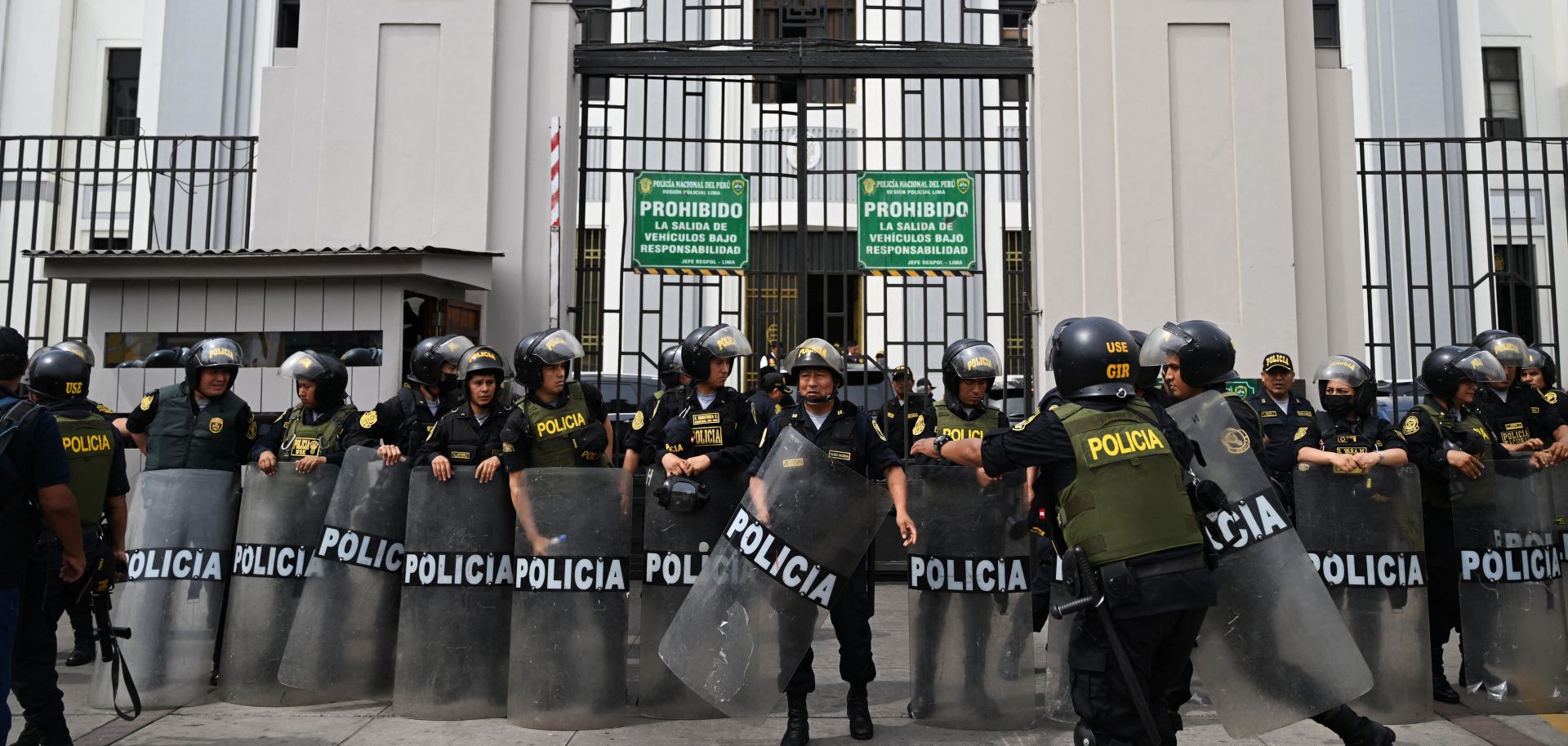
Police officers stand guard outside the Lima Prefecture, where Peruvian President Pedro Castillo was detained after he tried to dissolve Congress, in Lima on Dec. 7, 2022.
In Peru, the impeachment and arrest of President Pedro Castillo are unlikely to improve political stability and will probably also slow the country's economic growth by hindering public and private sector investment. Less than two years after taking office, Peru's president has been impeached and detained by authorities after he tried to dissolve Congress ahead of a scheduled vote to oust him. In a televised address broadcast on Dec. 7, Castillo announced plans to install a new emergency government that would rule by decree until the country's next congressional election. He also pledged to use the legislative hiatus to restructure Peru's judiciary and police institutions. In response to Castillo's shock announcement, lawmakers in Congress moved up their planned impeachment meeting from 3:00 pm to 12:30 pm local time, where they then swiftly voted to formally remove Castillo from power on the grounds of his ''moral incapacity.'' Shortly thereafter, the head of the country's army and police announced their support for Congress' decision and imprisoned Castillo. Vice President Dina Boluarte has since been sworn in as the country's new leader.
- Peru's constitution grants presidents the power to dissolve Congress, which former presidents Martin Vizcarra and Alberto Fujimori both did during their terms. But presidents cannot unilaterally enact the other changes Castillo announced; his plans to restructure the judicial system, in particular, directly violate Articles 45 and 46 of the country's constitution.
- Peruvian opposition lawmakers presented their third impeachment motion against Castillo on Nov. 29, arguing that the president's ongoing tax fraud investigations and controversial cabinet appointments showed that he lacked the ''moral capacity'' needed to remain in the position, per Peru's constitution.
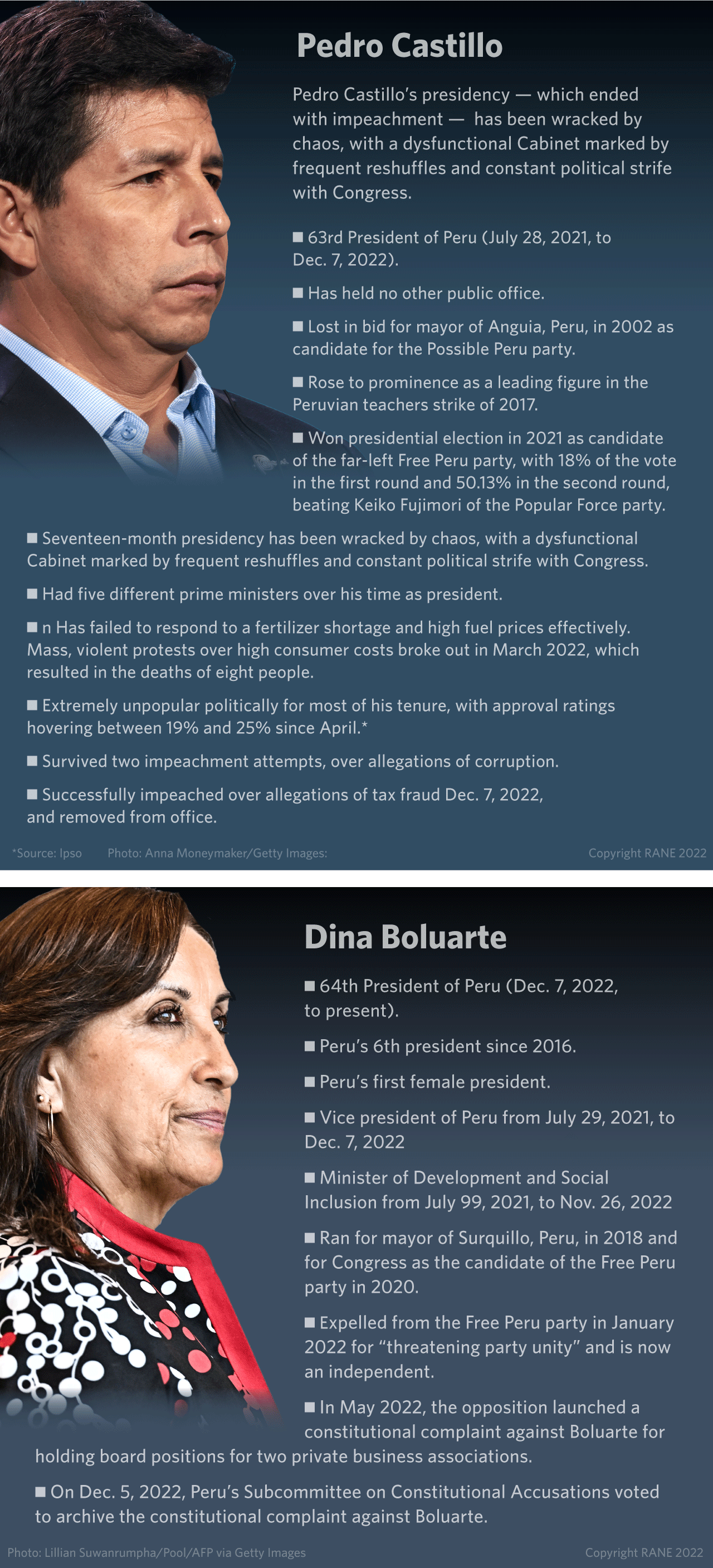
Boluarte will likely face similar difficulties as Castillo in building a coalition in Congress and defusing opposition threats to her administration. Boluarte will likely enjoy a brief period of political unity, as the former vice president was quick to voice her opposition to Castillo's moves. The majority of lawmakers from every political party in the National Assembly also voted to impeach Castillo. But this rally-around-the-flag effect will eventually dissipate, as opposition parties will almost certainly continue to reject Boluarte's leftist policies. Opposition parties may start questioning Boluarte's viability as president, building on previous allegations of conflict of interest against her. Additionally, Boluarte will likely find it difficult to build a unified cabinet as her former party and closest political ally Peru Libre has been internally divided over its ideology, which is nominally far-left but some members have become more centrist.
- Boluarte quickly denounced Castillo's Dec. 7 actions via her Twitter account and had distanced herself from the now-ousted president in recent weeks.
- In May 2022, opposition parties filed a constitutional complaint against Boluarte that sought to remove her as vice president and ban her from holding public office for 10 years, arguing that her board positions at two private business associations created a conflict of interest.
- Boluarte was expelled from Peru Libre in January for ''threatening party unity'' and is now an independent, though continues close ties with some members of the party.
Further political instability under Boluarte would likely see private investment in the country continue to dwindle and thwart public spending plans, slowing the country's economic growth. Peru — which is the world's second-largest copper exporter by volume — has historically enjoyed strong economic growth due to its mining sector, even during periods of political instability. But that trend has slowed since Castillo took office in July 2021 and ushered in a period of heightened government instability. Boluarte, who shares many of Castillo's economic priorities (including higher taxes on mining companies), will likely similarly struggle to increase public and private investments amid further political instability as Boluarte struggles to generate unity. In the public sphere, should Boluarte fail to maintain a unified cabinet, the subsequent turnover of high-level personnel would likely hinder her government's ability to effectively increase public spending on infrastructure projects and public-private partnerships. In the private sector, decreasing business confidence in Peru due to the ongoing political turmoil could further dampen investments in the country's natural gas and renewable energy sectors, which have struggled to generate private sector interest in recent years.
- Although Peru has not implemented a fiscal austerity program, government spending sits at just over 1% of GDP, down from 8.9% in 2020 due to an inability to effectively oversee and allocate government funding because of high turnover in cabinet positions. Castillo appointed an estimated 80 ministers during just the 17 months he was in office.
- Peru's central bank has had to revise GDP projections for 2022 from 3.6% down to 2.2%. The bank has also reported that its Business Confidence Index dipped below 40% in 2022 for the first time in several years, though the same measurement shows that businesses' profits are also increasing.
- From 2011 to 2022, Peru was the fastest-growing major economy in Latin America despite four former presidents being detained or wanted for corruption allegations.
