
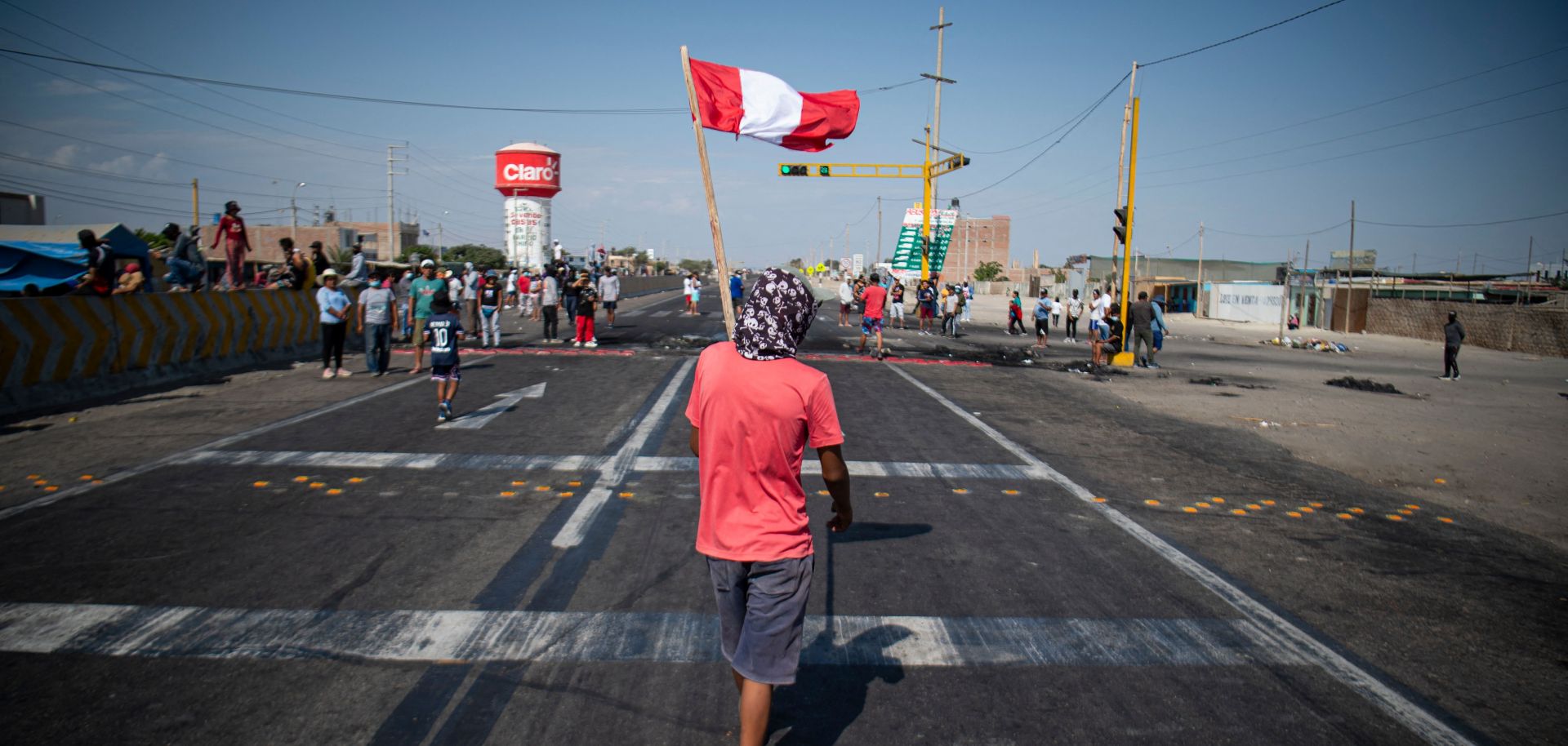
Demonstrators block a section of the Pan-American highway during a partial strike of cargo and passenger carriers in Ica, southern Peru, on April 4, 2022.
In Peru, mounting protests and anger over rising fuel and food prices will push the government to introduce subsidies, which it will likely seek to pay for by raising taxes on copper and other extractive industries. On April 3, Peruvian Finance Minister Oscar Graham announced a 90% reduction in the tax rate on fuels, as well as tax exemptions for products including chicken, eggs, flour and noodles, in an effort to reduce prices following days of disruptive strikes by farmer and truckers unions. Peru is a net food importer and receives its staples such as wheat, soy and corn from other countries in South America. Peru is also a net importer of both refined and crude oil, making it particularly vulnerable to global energy market shocks like the current price surge created by the ongoing Russia-Ukraine war.
- Truckers, public transport, taxi and bus transportation unions began a strike on April 1 to pressure the government to lower the price of gasoline and diesel. While the truckers' unions agreed to unblock the country's highways, most roads remain blocked in the metropolitan Lima area. On April 4, a broader swath of Peruvians — including stay-at-home mothers and members of Indigenous communities — took to the streets in Lima to join the protests against rising prices, chanting ''some days you eat and some days you don't.''
- Russia's Feb. 24 invasion of Ukraine and the West's subsequent sanctions campaign have exacerbated the uptick in global energy prices seen over the past year, causing prices to rise worldwide for a variety of essentials by increasing shipping and production costs. Amid these external shocks, Peru's government has struggled to contain rapid inflation within its own borders, with consumer prices increasing by 1.4% in March compared with the previous month, and 6.82% since the start of the year. According to the United Nations, food prices in the South American country also increased by 3.9% in February compared with the previous month, and 20.7% from a year earlier.
Growing social discontent could encourage the opposition to impeach President Pedro Castillo, portending a political crisis. High food and fuel prices will likely continue to spark both union and broader popular unrest, as households feel the increased pressure of higher living costs. If Castillo fails to introduce a price subsidy for fuels and food staples, opposition forces in Congress may reignite their efforts to impeach the president. A successful impeachment vote against Castillo would trigger an early presidential election and portend a transitional period with the interim government likely plagued by political analysis in the meantime.
- In the eight months since taking office, Castillo has already fended off two separate impeachment attempts, both instigated by the opposition Popular Accion Party.
- Peru's constitution allows Congress to impeach a sitting president with a majority vote for various reasons, including a vague clause that allows the legislature to declare the presidency vacant if the current occupant suffers from permanent ''physical or moral incapacity.'' Peru's Congress used this ''incapacity'' clause to impeach President Martin Vizcarra in 2020, arguing accusations that Vizcarra received bribes when he was governor of Moquegua demonstrated his moral turpitude.
To help finance food subsidies, Castillo's government will likely increase taxes on copper companies operating in Peru, which could deter foreign investment in the country's extractive industries. The Castillo administration will likely push for a subsidy on food staples in order to alleviate the economic burden on Peruvian consumers and, in turn, the risk of more widespread social unrest. To fund such subsidies, the Peruvian government may propose increasing the tax burden on foreign firms involved in the country's extractive industries — particularly copper mining, with global copper prices currently at near-record levels. While the government would need the support of a fragmented Congress to pass such legislation, it may be able to secure votes by promising only to tax profits instead of imposing a blanket tax, which is controversial among centrist lawmakers. But in the copper mining industry, where startup costs are already high, increased taxes could eventually lead companies to halt or slow operations if international commodity prices drop and make those operations unprofitable. By raising concerns about a lack of policy continuity and Peru's overall business climate, a tax hike in the mining industry could also reduce investor interest in other sectors of Peru's economy, including the country's budding oil and gas industry.
- Peru's Economy Minister Oscar Graham stated on April 1 that the government will seek to increase taxes on the ''excess profits'' of copper mining companies. Castillo campaigned on sweeping mining reforms. This included a blanket tax increase on copper mining companies, which conservative groups in Congress and industry groups have criticized.
- Global copper prices are currently trading at near-record levels of $10,000 per tonne. As Peru is the second-largest global producer of copper, companies with mining operations in the country are poised to make significant revenue gains in 2022.
- The Castillo administration is also seeking to reduce Peru's reliance on foreign energy imports by boosting domestic oil and energy production. As part of this push, Peru's former Energy and Mines Minister Eduardo Gonzalez traveled to Houston, Texas, in December to entice investors in the U.S. oil hub with offers to reportedly reopen drilling in locations in the Amazon.
