
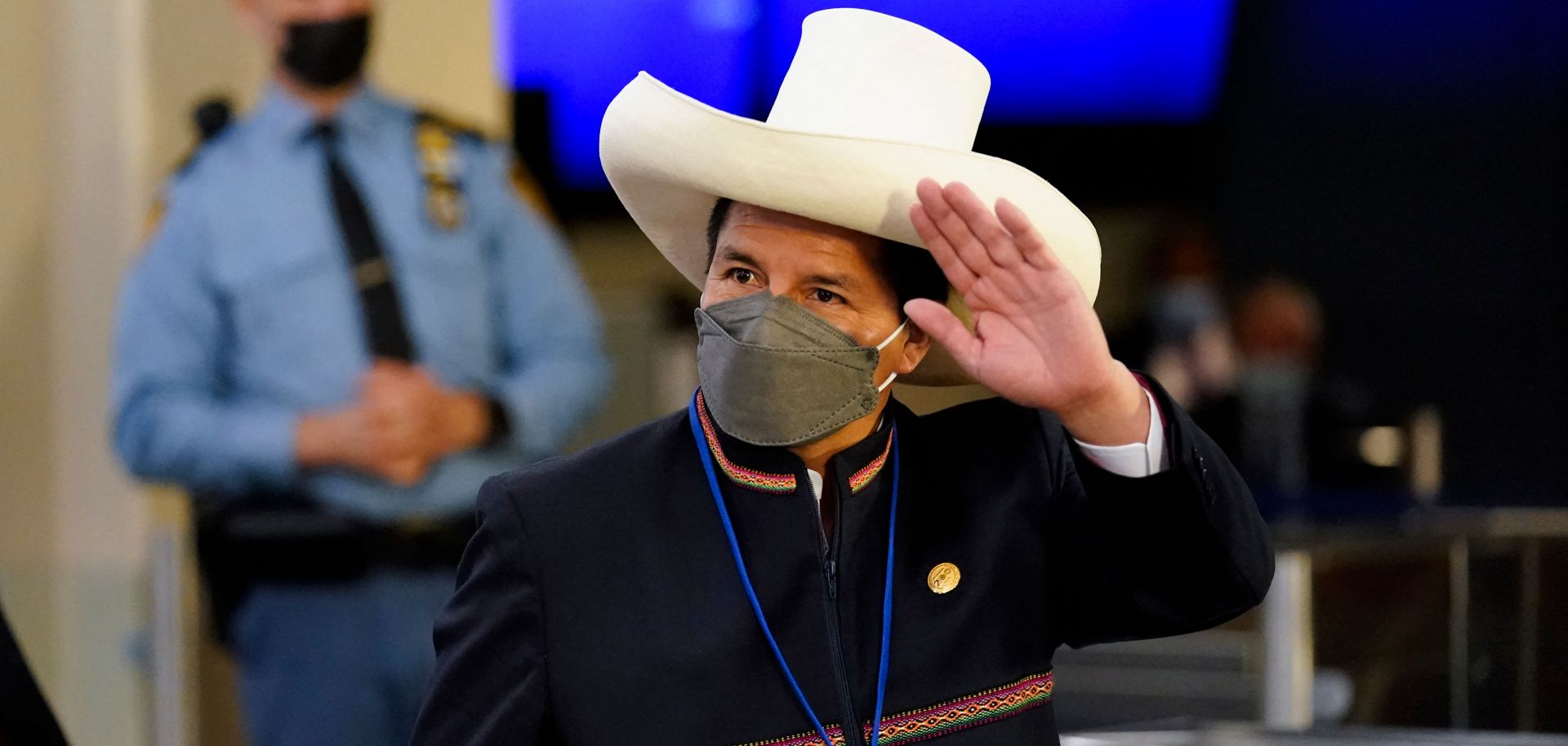
Peruvian President Pedro Castillo arrives at the 76th session of the U.N. General Assembly on Sept. 21, 2021, in New York.
Peruvian President Pedro Castillo’s move to appoint a more moderate prime minister and cabinet will increase political stability and investor confidence in the country. The removal of leftist officials, however, could trigger more disruptive actions against multinational organizations operating in Peru’s extractive industries. Mirtha Vasquez, the former head of Peru’s Congress, was sworn in as prime minister on Oct. 6, just hours after Castillo unexpectedly announced the resignation of her predecessor Guido Bellido (and, by association, his entire cabinet) after just two months in office. Castillo’s own Peru Libre party quickly denounced the shake-up, calling it “treason” in a recent press conference. But the decision to replace Bellido, who leads Peru Libre’s far-left faction, was widely supported by other centrist and opposition parties in Congress, and will likely temporarily shield Castillo from the threat of impeachment.
- Six new ministers were also appointed in the shake-up. This includes Eduardo Gonzalez Toro as Peru’s new Energy and Mining Minister, replacing Ivan Merino.
- The cabinet change comes shortly after Bellido made statements about nationalizing a consortium operating in the natural gas sector, which Castillo subsequently contradicted.
- Bellido’s nomination as prime minister was particularly controversial due to his alleged prior support of the terrorist group Shining Path.
The new cabinet will enable Castillo’s government to pursue more center-left policies and break his ties to the far-left political party Peru Libre. Since taking office in July, Castillo has continuously struggled to move toward a center-left platform without drawing the ire of the radicals in his Peru Libre party. The recent cabinet change represents a shift in the president’s strategy from supporting his party to informally breaking his association with Peru Libre. Vasquez is from a different political party, the Broad Front, which will likely widen Castillo’s support base in Peru’s divided Congress — making it easier for him to pass through legislation (though the center-right coalition will likely still block some of Castillo’s proposals.
- The far-left faction of Peru Libre has consistently undermined Castillo’s policy and personnel choices since the president took office. On several occasions, Bellido and other members of the faction have even made remarks on issues that directly contradict Castillo’s message.
- Peru’s Congress is made up of 11 different political parties, none of which have enough seats to unilaterally pass or reject legislation — forcing parties to rely heavily on coalitions and negotiations.
International capital markets will view the cabinet shake-up favorably. In addition to attracting more foreign investment, a continuation of center-leftist policy under Vasquez’s new cabinet will also likely lead to a further increase in the Peruvian sol’s value against the U.S. dollar. Negotiations with the natural gas Camisea consortium will likely test the ability of Vasquez’s new cabinet to carry out policy initiatives without inflaming political tensions.
- Following the announcement, the Peruvian sol rose 1.4% against the U.S. dollar on Oct. 7. But the sol is still considered to be undervalued by roughly 7%, according to the Institute of International Finance.
However, far-left indigenous groups are likely to be unhappy with the change, as many viewed Bellido as a strong advocate for indigenous rights. Bellido’s removal from office will likely anger indigenous Peruvians, who Castillo had promised to give a greater voice in the country’s economic development, as well as a greater share of profits from the country’s mining and energy industries. This will likely lead to a temporary increase in disruptive demonstrations against the country’s extractive industries, with indigenous groups staging strikes and demonstrations in an effort to receive increased monetary support from the companies that operate on or near their protected lands.
- On Oct. 5, a group of 200 indigenous Peruvians occupied a station of the Northern Peruvian pipeline, pumps out 200,000 barrels of oil per day.
- On Oct. 7, the Peruvian government began negotiations with the Camisea gas consortium, which is led by Argentine and South Korean companies and owns a significant portion of Peru’s natural gas projects. The Castillo administration will probably seek to alter agreements to better favor the state in other projects in the country’s hydroelectric and mining sectors as well.
