
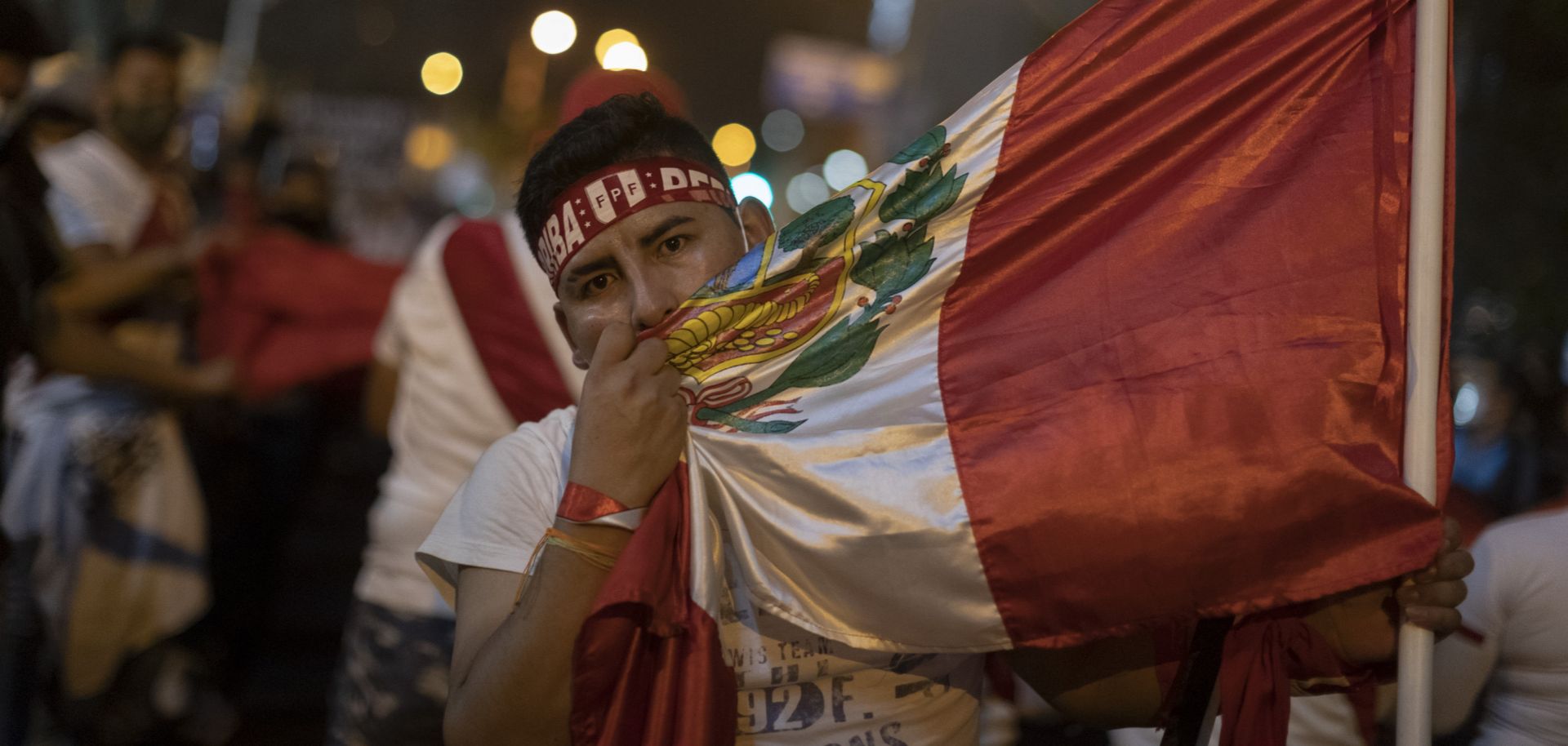
A supporter of ousted Peruvian President Martin Vizcarra embraces the country’s national flag during a protest in Lima, Peru, on Nov. 14, 2020.
The ousting of President Martin Vizcarra portends months of uncertainty in Peru, which will cast doubt on the country’s long-term political stability and future ability to attract the investment needed to grow its pandemic-rattled economy. Peru’s Congress overwhelmingly voted to remove Vizcarra on Nov. 9, igniting a political crisis that has since seen the exchange of three presidents in just one week.
- Vizcarra was accused of receiving bribes from a construction company when he was governor of the southern province of Moquegua, several years before becoming president.
- Peru’s Congress used an article of the country’s constitution that allows it to declare the presidency vacant if the current occupant suffers from permanent “physical or moral incapacity” — interpreting the wording as moral turpitude instead of mental incapacity, the preferred interpretation of many legal scholars.
- Upon Vizcarra’s removal, the then-head of Congress, Manuel Merino, became the new interim president.
The political mobilizations and protests that Vizcarra’s removal has sparked over the past week could very likely become a feature in Peru, at least until April 2021 general elections. News of Vizcarra's removal immediately drove crowds of angry Peruvians to take to the streets in Lima and elsewhere, affirming the former president’s popularity. On the evening of Nov. 14, two protesters were killed and nearly 100 were injured in violent clashes with police — creating another public uproar over the interim government’s handling of the crisis that forced Merino to step down on Nov. 15 after only five days in office.
- Opinion polls indicated that more than two-thirds of Peruvians were against Vizcarra’s removal five months before the planned presidential elections in April 2021.
- Several presidential contenders, as well as some of Vizcarra’s former cabinet members, called the removal a “constitutional coup” and questioned the new administration’s intention to call for elections, given that more than 60 members of Congress are also under different corruption investigations.
- On Nov. 19, Peru’s highest court is set to discuss whether the legislature’s move to oust Vizcarra was, in fact, constitutional.
- Following Merino’s resignation, Congress appointed a new interim president, Francisco Sagasti, on Nov. 16. But the length of Sagasti’s tenure will be dependent on the court decision on the constitutionality of Vizcarra’s removal.
- In recent days, some protestors have seemed to have turned their focus toward pushing for a new constitution in an effort to emulate Peru’s southern neighbor, Chile.
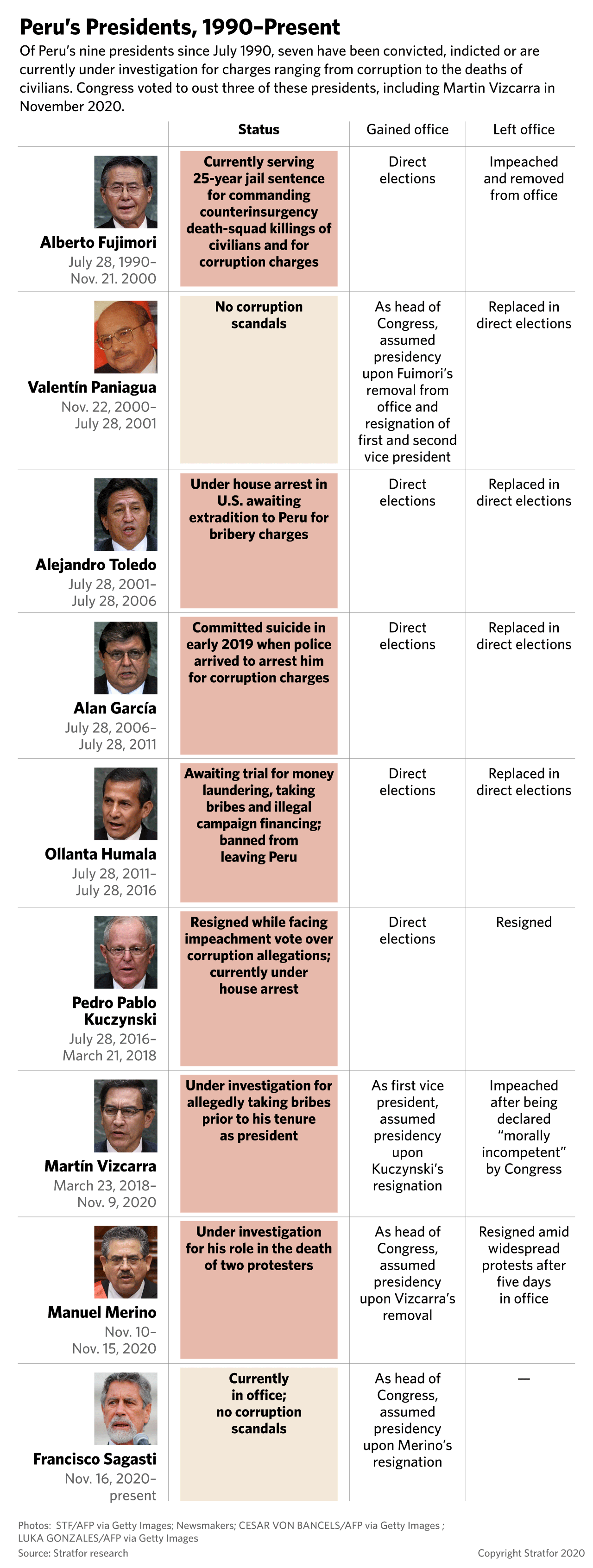
More broadly, Vizcarra’s ousting and the subsequent political crisis illustrates Peru’s long-standing governance issues and institutional weakness. Peru’s leaders have embarked on a vigorous fight against corruption in recent decades, which has resulted in the indictment, imprisonment or removal of seven of the country’s last eight presidents over accusations of impropriety. Peru’s presidents are popularly elected for a five-year term. But by using a controversial interpretation of the constitution to remove the head of the executive under fast-track motions, Peru’s legislature has created the equivalent of a no-confidence vote in parliamentary systems. This results in extremely weak presidents, especially if they lack a legislative majority like Vizcarra. With an unclear constitution and a very fragmented legislature, Peru’s current political setup will likely remain the same until a new president is elected in 2021.
- Former President Pedro Pablo Kuczynski resigned in 2018 before being subject to the same vacancy motion that ousted Vizcarra.
- Vizcarra himself survived previous impeachment attempts before his removal in November, including one as recently as September.
- Despite only serving as president for less than a week, Merino is also now under an investigation for his involvement in the deaths of the two demonstrators.
With an unclear constitution and a highly fragmented legislature, Peru’s current political setup will likely remain the same until a new president is elected in 2021. In the meantime, any interim government will continue to be weak and ineffective, which will ultimately pose long-term risks to the country’s economic stability. Beyond an initial adverse reaction in the markets, there are concerns that an interim government will have incentives to permanently extend the most popular (and costly) components of Peru’s economic stimulus program and implement measures that were opposed by Vizcarra’s administration. Such measures include pension funds withdrawals approved by Merino during his brief tenure as president, which risk significantly damaging Peru’s public financial health and medium-term economic recovery from the COVID-19 crisis. The new government headed by Sagasti, a former World Bank official, is expected to be far more financially responsible. But Sagasti’s appointment won’t keep the legislature from continuing to push for short-term populist measures.
- The exchange rate of Peru’s currency, the sol, against the U.S. dollar fell to an 18-year low in the aftermath of Vizcarra’s removal. The country’s bonds and stock market have also fallen sharply.
- The International Monetary Fund (IMF) expects Peru’s economy to shrink by 13.9 percent in 2020 due to the fallout from the COVID-19 pandemic, despite the government’s fiscal stimulus package equivalent to almost 9 percent of GDP. The IMF’s latest forecast projects Peru’s economy to grow by 7.3 percent in 2021, under the assumption of government and policy continuity.
- Congress supported a measure to allow individuals to make withdrawals from their retirement accounts (like Chile has done). The legislature has also supported a proposal to suspend government payments to fund public pensions — something that Vizcarra’s administration opposed as well.
The corruption scandals surrounding Peru’s presidents and the corresponding political uncertainty have already started to permeate into the economic realm. Peru has largely enjoyed high economic growth over the past 20 years. But this economic growth started slowing down after Vizcarra took office in 2018. According to the IMF, Peru’s pre-pandemic slowdown of the previous two years can be linked to pending reforms to Peru’s tax system and the interruption of many infrastructure projects that had been paused due to corruption scandals. The current political environment will make it hard for Sagasti’s interim government and any new government elected next year to push for the necessary reforms to shore up Peru’s public finances and long-term economic growth.
