
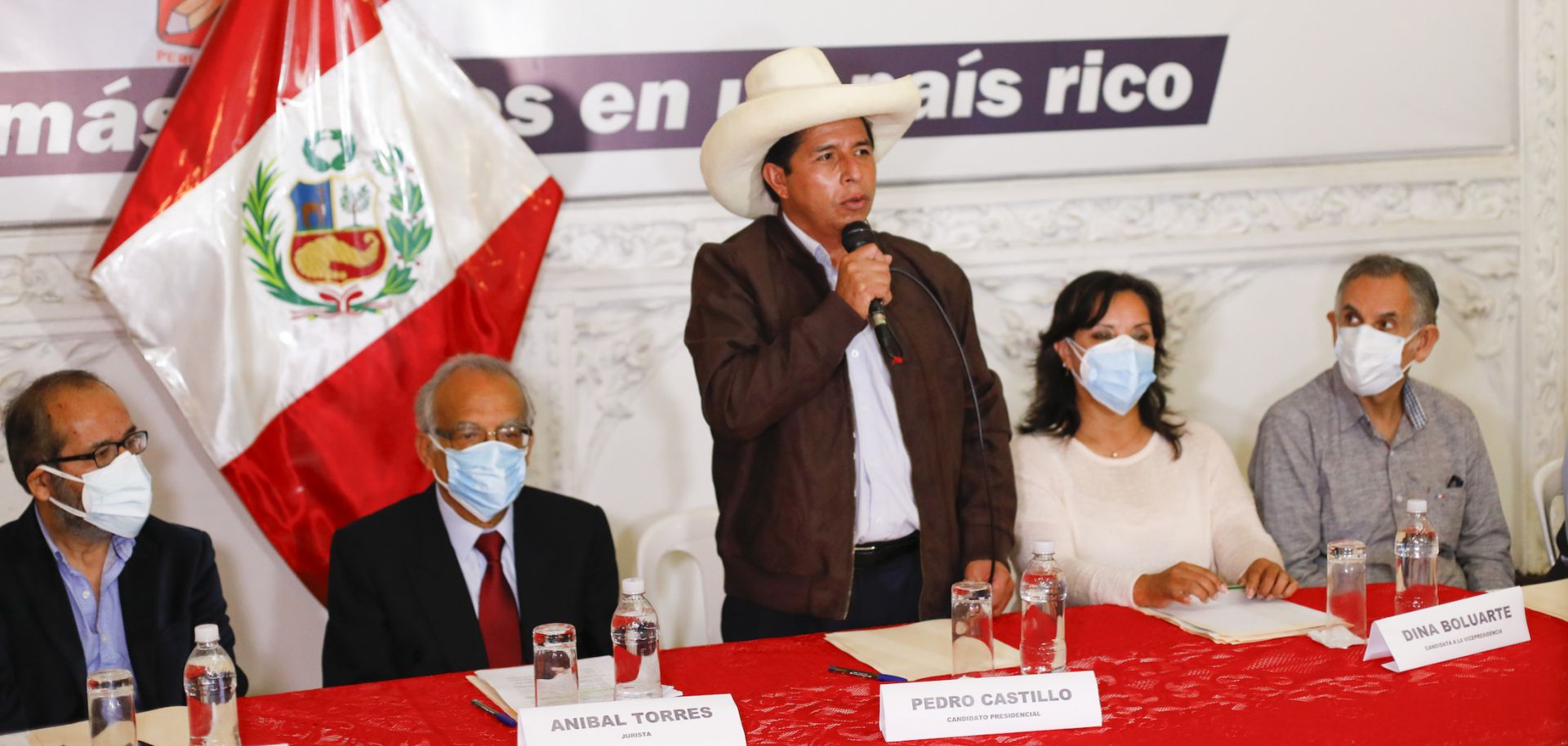
Peruvian presidential candidate Pedro Castillo speaks during a press conference in Lima on June 15, 2021.
Accusations of voter fraud, along with resistance from opposition parties and business elites, will likely undermine the administration of Peru’s presumed next president, leading to chronic political instability that could weaken the South American country’s business climate. Far-left candidate Pedro Castillo won Peru’s June 6 presidential run-off election by a slim margin of 44,816 votes. But his victory has yet to be made official due to fraud allegations launched by his conservative opponent, Keiko Fujimori, who is contesting roughly 200,000 ballots. While it has yet to make a final decision, Peru’s independent National Elections Jury (JNE) has already nullified several complaints brought by Fujimori’s legal team. And international and domestic observer bodies, including the U.S. State Department, have also found no evidence of voter fraud, proclaiming Peru’s June 6 election to be free and fair. Despite the controversy, Castillo is thus still expected to eventually be sworn in as Peru’s next president on July 28.
- Castillo won the presidency with 50.125% of the vote while Keiko Fujimori came in second with 49.875% of the vote.
- Fujimori has called into question the reliability of Peru’s two independent electoral bodies, the JNE and the National Office of Electoral Processes (ONPE), without providing evidence for her claims. No Peruvian presidential candidate in recent history has questioned the impartiality of independent electoral bodies.
- Amid pressure, Fujimori recently announced that she would respect the JNE’s decision and concede to Castillo should they find no evidence of voter fraud.
The election controversy sets the stage for increased tensions between the government and Peru’s business elite who fear Castillo will impose higher taxes and other anti-business policies. Fujimori will likely continue pushing to be proclaimed president, as it would make her immune to current money laundering charges she is being investigated for, which carry a lengthy prison sentence. Fujimori has a considerable amount of support from leaders in the private sector who are concerned by Castillo’s calls for a significant shift in the business and taxation climate in Peru, which hosts many international companies in the mining and hydrocarbons sectors. Fujimori is also particularly popular in urban areas like Lima, where she regularly holds rallies that see a healthy turnout. Castillo’s support, on the other hand, is strong among the indigenous populations of the country’s interior.
- Fujimori held rallies on June 12 and June 19 in the Peruvian capital of Lima to denounce the allegedly fraudulent presidential election. Each event drew in roughly a thousand supporters.
- Castillo campaigned on raising the corporate tax rate, halting government subsidies for investments and changing the Peruvian constitution to nationalize sectors of the country’s energy economies.
In addition to the fraud accusations, a fractured parliament will likely constrain Castillo’s ability to implement policy and create a constant risk of impeachment, resulting in frequent political uncertainty. Upon taking office, Castillo will face one of Peru’s most divided parliaments, which has the power to impeach him and where the majority of the 11 political parties with seats are also centrist or conservative. Castillo has no current corruption charges against him, but the parliament could still threaten to impeach him for any constitutional violations that lawmakers detect, as has happened with recent presidents. If Castillo is impeached, his base of indigenous voters would likely stage protests in and around mining projects, heightening security risks to companies operating in the country as well. But even if legislators don’t directly oust him, the divided parliament and the significant popularity of Fujimori’s Fuerza Popular party will still make it difficult for Castillo’s leftist administration to implement significant reforms. This policy unpredictability and a fragile political situation will, in turn, increase uncertainty for local and foreign businesses operating in Peru.
- Castillo’s party Peru Libre alone does not have enough seats in the parliament to block the 87 votes needed, out of 130, to impeach a sitting president.
- In 2016, Fujimori also facilitated a failed attempt to impeach former President Pedro Pablo Kuczynski after he narrowly beat her in the general election that year.
- The three most recent Peruvian presidents have been unable to complete their designated term due to the credible impeachment threat or actual impeachment from Congress.
