
Editor's Note: For significant elections, RANE publishes a series of scenario analyses focused on different outcomes of major elections, describing how an election outcome might unfold with implications for each potential outcome. In 2025 so far, we have profiled Germany, Canada, Australia, Poland, South Korea, Japan, Guyana, Norway and Moldova. We now profile the Netherlands.
Deep political fragmentation will likely complicate coalition building following the Dutch election on Oct. 29, forcing broad and ideologically unstable alliances and triggering a complex negotiation process that could leave the country without a cabinet for months.
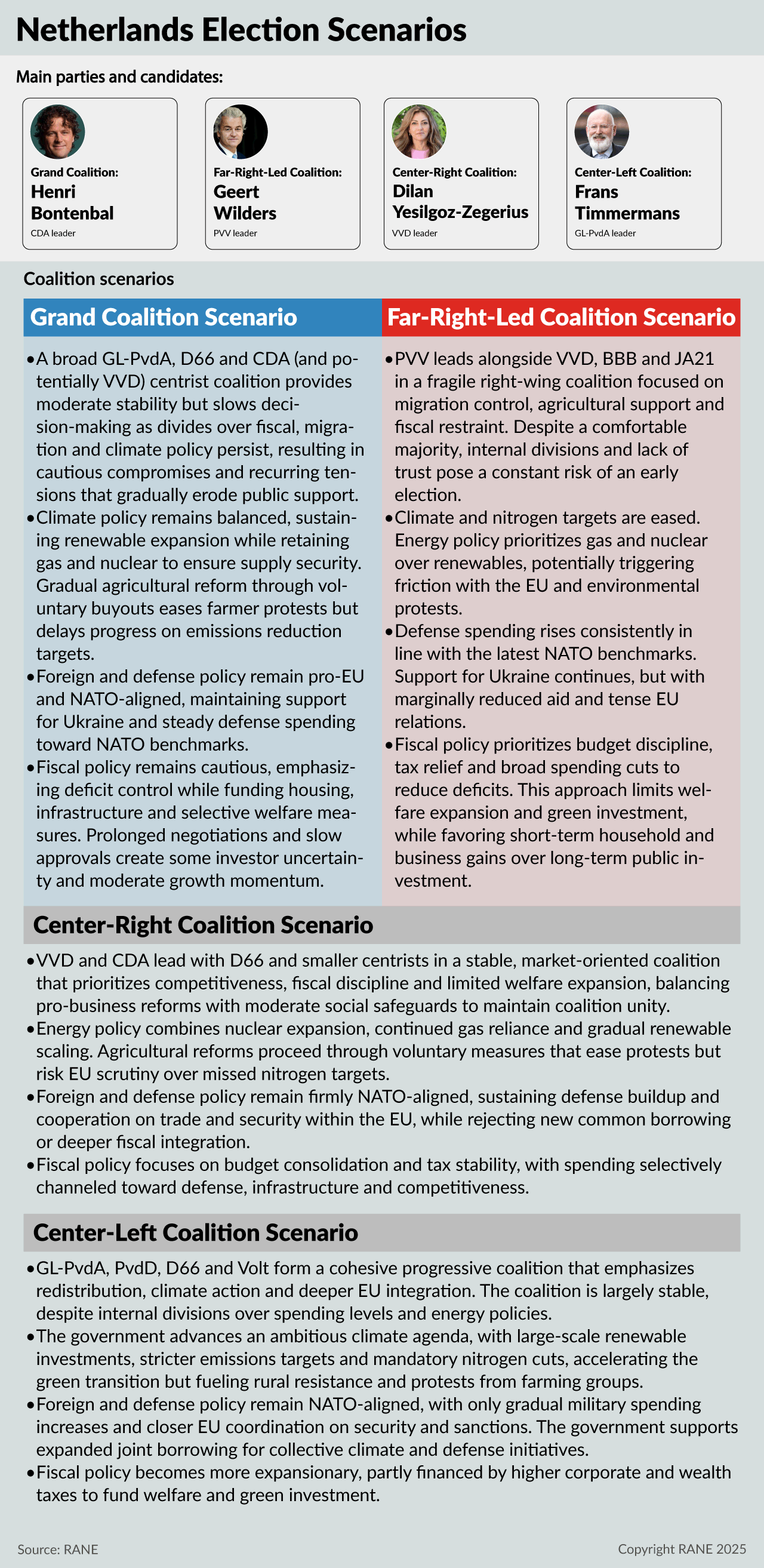
The first of the two most likely outcomes is a centrist coalition led by the center-left Green Left-Labour (GL-PvdA) alliance together with the centrist-liberal Democrats 66 (D66) and the center-right Christian Democratic Appeal (CDA), possibly joined by the center-right People's Party for Freedom and Democracy (VVD) or other smaller centrist parties. This alliance would span much of the political spectrum, aiming to govern through compromise, combining progressive climate and social investment policies with fiscal prudence and pro-European engagement. However, ideological differences over taxation, market intervention and migration would complicate policymaking, meaning such a coalition would struggle to maintain cohesion, limiting its capacity to advance an ambitious reform agenda or even survive the parliamentary term.
The second of the most likely outcomes is a far-right-led coalition headed by the Freedom Party (PVV), joined by the VVD, the right-wing Right Answer 2021 (JA21) and the populist agrarian Farmer-Citizen Movement (BBB) and potentially backed by the Christian Democratic Appeal (CDA), represents the other most likely outcome. This would mark an even sharper rightward shift in Dutch politics than the previous coalition (which included centrist parties), emphasizing migration control, law and order, euroskepticism and fiscal restraint. The PVV's dominance would drive confrontations with Brussels over climate mandates, migration quotas and budget contributions. Internal rifts between the VVD and CDA over economic management and democratic institutions would test the coalition's stability and durability. Although it would maintain NATO alignment and some level of support for Ukraine, relations with EU partners would become more strained. Such a government would likely prove unstable, facing both domestic protests and internal tensions.
Two further, highly unlikely, possibilities are a center-right-led coalition between the VVD, CDA and D66 or a center-left-led coalition with the GL-PvdA joined by progressive partners like D66, Volt and Party for the Animals (PvdD). Current polling and pre-electoral party positioning suggest neither side could achieve a stable majority without crossing ideological lines. As a result, the post-election landscape will likely produce a fragmented parliament where compromise-driven, ideologically uneasy coalitions struggle to govern effectively, prolonging uncertainty and constraining the Netherlands' capacity for coherent policymaking.
Centrist Grand Coalition
A coalition between the center-left GL-PvdA alliance, D66 and the CDA — potentially joined by the long-ruling center-right VVD or smaller centrist or progressive parties — forms a broad unity government spanning much of the political spectrum. Ideological differences slow and at times destabilize decision-making. Still, the coalition's breadth provides legitimacy in a fragmented political landscape while the shared determination to keep the far right out of power ensures a measure of stability. The coalition's economic and fiscal agenda blends GL-PvdA and D66's push for higher investment in housing and climate with the CDA's emphasis on fiscal prudence. All parties agree on boosting housing supply but disputes emerge over regulation, with GL-PvdA favoring stronger public control in housing and health care and CDA and D66 leaning toward regulated market mechanisms. Redistribution and wage increases advocated by GL-PvdA also clash with the more moderate fiscal approach of CDA and D66. Migration becomes a central fault line, as GL-PvdA and D66 push for more progressive policies in line with EU frameworks, while the CDA and VVD demand tighter enforcement and stricter integration requirements. Climate policy sets ambitious targets, but implementation advances cautiously, balancing renewable expansion with transitional reliance on gas and nuclear. The CDA and VVD are supportive of nuclear power but GL-PvdA pushes for a faster adoption of renewables. Agriculture policy and the pace of emissions reductions also remain flashpoints. On defense and foreign affairs, the coalition offers continuity, supporting NATO, the European Union, Ukraine's war effort, sanctions against Russia and EU rearmament.
Implications
- Compromise budgets seeking to keep deficits in check prioritize housing, climate-related infrastructure such as renewable energy expansion, flood protection and energy-efficiency upgrades and defense readiness while limiting welfare expansion, sustaining steady public investment. Slower budget approvals create fiscal uncertainty that delays project starts and complicates long-term planning for investors and contractors.
- The coalition adopts a pragmatic stance toward the European Union, softening the Netherlands' traditionally rigid opposition to higher budget contributions and common borrowing. While maintaining fiscal prudence, the government shows greater openness to compromise in negotiations on the 2028-2034 EU Budget and joint EU borrowing for specific purposes like defense with strict limits on duration, amount and oversight.
- The government pursues a pragmatic energy policy, retaining natural gas as a key transition fuel and expanding nuclear as part of its low-carbon mix to stabilize supply and power prices while scaling renewables. Continued investment in gas infrastructure and new nuclear capacity bolsters baseload reliability, mitigates intermittency risks and strengthens investor confidence for long-term financing in grid, storage and offshore wind expansion.
- The government upholds ambitious climate and sustainability commitments but slows implementation to protect industrial competitiveness, delaying stricter emissions measures and ESG enforcement while preserving regulatory predictability and continued investor interest in the long-term energy transition.
- The government phases in agricultural emissions cuts through compensation schemes and voluntary buyouts, easing farmer protests and political backlash but delaying progress toward nitrogen targets. The slower rollout stabilizes rural investment as well as food production and prices, yet coalition divisions over enforcement versus competitiveness sustain policy uncertainty and periodic political friction.
- The government tightens oversight of Chinese ownership and investment in sensitive sectors in line with Europe's broader economic security strategy and mounting U.S. pressure. These measures raise compliance costs and screening requirements for China-exposed suppliers but improve regulatory clarity and risk management for high-tech and defense manufacturers. However, retaliatory measures from Beijing still disrupt ASML's supply chains, export markets and the semiconductor industry's innovation capacity.
- The government adopts a balanced approach to implementing EU supply-chain sustainability directives, aiming to advance environmental and human rights standards without overburdening industry. Coupled with tightening export-control regimes, these measures heighten compliance demands and compel firms in high-tech and manufacturing sectors to restructure sourcing and logistics to ensure regulatory alignment and protect competitiveness in critical value chains.
- Agreeing on the need to expand housing supply and accelerate permitting, the coalition advances planning reform, greater use of public land and investment in affordable housing, shortening approval timelines and sustaining construction activity as well as demand for construction technologies, sustainable materials and logistics. However, divergent views on rent regulation, financing models and market intervention slow implementation and create uncertainty, tempering investor confidence and project delivery rates.
- The coalition steadily raises defense spending toward NATO benchmarks, prioritizing interoperability, munitions stockpiles, intelligence and air defense, creating a predictable multi-year procurement pipeline that strengthens European industrial coordination and expands opportunities for European and non-European defense companies. Ideological divisions persist, with center-right parties favoring faster budget increases and conventional buildup, while center-left partners stress efficiency and innovation to better balance other budgetary priorities like climate and social spending, resulting in slower negotiations and more selective allocations that somewhat moderate but do not meaningfully alter the overall spending trajectory.
- The coalition pursues a balanced migration approach, combining moderate tightening of asylum and enforcement rules — reflecting widespread public demand for stricter controls — with expanded skilled-worker programs to ease labor shortages and support integration. Sharp ideological divides between coalition partners over enforcement and deportations fuel internal friction, slow implementation and periodically destabilize the government.
- The government maintains stable and coordinated support for Ukraine within NATO and EU frameworks, ensuring continuity in military aid, training and financial assistance. Ongoing alignment with EU sanctions against Russia and transatlantic coordination on defense assistance reinforce policy coherence and diplomatic unity while sustaining demand for defense equipment and logistics linked to Ukraine's long-term recovery.
- Overall, significant ideological rifts over energy, climate, agriculture, migration and fiscal policy slow decision-making and policy implementation, extending timelines but limiting abrupt reversals. The coalition, despite recurring friction, largely manages to resolve disputes and avoid collapse. Repeated compromises erode public support for the government, weakening the ruling parties over time and fueling a steady rise in support for the far right, maintaining a risk of the government collapsing and early elections.
Far-Right-Led Coalition
The far-right PVV forms and leads a government with VVD, JA21 and BBB, potentially backed by CDA, producing a right-leaning cabinet focused on migration control, law and order, fiscal restraint and a socially conservative agenda. Migration dominates the agenda, with stricter asylum, deportation and integration rules only marginally tempered by VVD and CDA to limit legal risks and international backlash. Economic policy emphasizes tax relief for households and small- and medium-sized enterprises, deregulation in construction and industry and targeted support for farmers and energy-intensive firms. Spending restraint curbs welfare expansion and channels funds toward security and migration. On climate, the coalition scales back nitrogen reduction targets, land-use rules and green subsidies, while energy policy elevates natural gas, carbon capture and nuclear to safeguard affordability and supply, with emissions targets formally upheld but timelines eased. Housing policy centers on PVV proposals for rent freezes, tighter migrant housing rules and rapid social housing expansion, clashing with VVD and CDA preferences for a market-based approach. Foreign and security policy maintains strong NATO commitments and support for Ukraine, though bilateral aid levels to Kyiv decrease marginally. Defense spending rises in line with the alliance's new medium-term targets. EU relations turn more conflictual, with the Netherlands opposed to climate mandates, migration rules and budget contributions. Despite alignment on migration, divisions over EU relations, climate policy and the handling of democratic institutions and the level of state intervention into the economy — compounded by mistrust after the previous coalition's collapse — leave the government fragile and early elections a persistent risk.
Implications
- The government adopts a conservative fiscal stance, offsetting higher expenditures on household tax relief, defense, domestic security and migration enforcement by cutting social programs, health care, international aid, administrative spending and green subsidies to contain deficits and maintain fiscal discipline.
- The government adopts a more confrontational approach toward the European Union, demanding exemptions from agricultural, environmental and migration rules and opposing permanent joint borrowing mechanisms. It resists higher Dutch contributions to the EU budget and pushes back against proposed cuts to agricultural subsidies, hardening its position in upcoming negotiations over the 2028-2034 EU Budget. Although short of a full rupture with Brussels or disengagement from EU initiatives, frequent disputes over compliance and conditional funding create friction within the European Council, isolating the government from its traditional northern allies.
- Nuclear and natural gas are the pillars of the government's energy strategy. It accelerates new nuclear projects, including small modular reactors, and expands offshore gas extraction in the North Sea and rolls back renewable subsidies. This creates opportunities in the gas, nuclear and carbon capture industries and gradually lowers energy costs while easing grid strain from rapid renewable expansion. However, it also slows the green transition, weakens investor appetite in clean-tech sectors and fuels friction with Brussels.
- The government relaxes nitrogen and carbon reduction targets, scales back enforcement of environmental and sustainability regulations and slows approvals for green projects, lowering compliance costs for farmers and heavy industry while retaining formal emissions targets with extended timelines. The rollback provokes legal and political backlash, risks EU infringement procedures, weakens access to green funding and amplifies nongovernmental organization litigation pressure.
- The government intensifies scrutiny of Chinese ownership and technology transfers in critical sectors under pressure from NATO and the United States, acting largely unilaterally outside broader EU coordination mechanisms. Compliance oversight tightens for dual-use goods and semiconductor exports, but inconsistent enforcement and protectionist exceptions create uncertainty for high-tech and defense firms.
- Migration dominates the coalition's agenda. The government enforces tougher asylum rules, accelerates deportations, restricts family reunification and housing access for non-EU migrants and expands policing and border capacity. The crackdown aligns with strong public demand for control but strains administrative capacity, triggers legal and municipal frictions, creates tensions with Brussels and somewhat exacerbates labor shortages that sustain cost pressures in logistics, construction and care.
- On housing, the government prioritizes affordability through rent freezes, social-housing expansion and accelerated construction on public land while restricting migrant housing and tightening allocation rules for foreign residents. These conflicting goals slow delivery and weaken market functioning, as regulatory interventions deter investment and fuel tensions between more market-oriented and interventionist coalition partners over how to resolve persistent housing shortages.
- Defense spending rises steadily toward NATO's updated benchmarks, with procurement centered on munitions, intelligence, border surveillance and modernization of equipment. The government limits engagement in EU joint procurement programs and rejects proposals for expanded joint borrowing to fund collective European defense, slowing alignment with continental defense integration efforts.
- The government maintains strong support for Ukraine and alignment with EU and NATO sanctions against Russia, but adopts a more transactional approach, sustaining military and humanitarian assistance but reducing bilateral funding levels and emphasizing burden-sharing to balance domestic fiscal pressures.
- Despite broad alignment on migration and law and order, divisions between the PVV's populist leadership and its moderate coalition partners over EU relations, budget priorities and institutional checks fuel recurring crises, particularly given mistrust following the previous coalition government collapse. Persistent political volatility maintains a latent risk of early elections and creates policy uncertainty.
- The government's confrontational stance toward the European Union, rollback of environmental measures and polarizing social agenda increase reputational risks for the Netherlands, potentially affecting foreign investor confidence (particularly among ESG-focused investors) and weakening the country's influence in EU negotiations.
- Welfare cuts, watered-down climate initiatives, stricter migration rules and conservative social policies heighten the risk of social unrest. Protests by trade unions, minority groups and environmental activists become more frequent and disruptive. Tensions intensify around contentious migration measures and climate policy rollbacks, potentially triggering riots in urban areas with large minority populations and clashes between protesters, police and anti-immigration groups and disruptive climate demonstrations targeting government institutions and infrastructure projects.
Center-Right Coalition
The center-right Christian Democratic Appeal (CDA) and People's Party for Freedom and Democracy (VVD), supported by the centrist-liberal Democrats 66 (D66) and smaller centrist parties, form a market-oriented, mostly socially conservative coalition balanced by moderate policy concessions to progressive junior partners. Fiscal policy emphasizes budget discipline and debt reduction, with limited room for expanded welfare beyond targeted measures. Higher spending is directed toward defense, infrastructure and business incentives. Economic measures prioritize competitiveness through limited tax cuts, regulatory streamlining and reforms to accelerate housing and construction. Migration becomes a central element of the coalition's agenda, with stricter asylum rules, faster deportations and stronger border enforcement, although centrist partners moderate some measures while also pressing for balanced integration policies to avoid international backlash and excessive social fragmentation. Climate and energy transition policies advance more cautiously, combining support for renewables and efficiency with a slower phaseout of fossil fuels and greater support for nuclear power. Agricultural and rural interests are protected through only gradual reforms and emission reduction targets. Defense spending increases remain a priority, with the government remaining firmly committed to NATO targets, the transatlantic alliance, support for Ukraine and backing for EU defense integration, though the latter remains tempered by reluctance to pursue joint financing initiatives.
Implications
- Fiscal policy remains conservative, emphasizing budget discipline and deficit reduction while channeling selective spending into defense, infrastructure and competitiveness measures, supporting investor confidence but constraining welfare expansion and limiting fiscal space for public investment.
- The government pursues a balanced energy strategy. It combines expanded nuclear development and continued natural gas use with the gradual deployment of renewables and efficiency measures, ensuring reliable baseload capacity that helps strengthen energy security and stabilize power prices while maintaining regulatory stability and a credible decarbonization path, albeit on a slower phaseout timeline.
- Agricultural reform proceeds gradually through voluntary buyouts, compensation schemes and other incentives, somewhat easing farmer protests and social tensions in rural areas. Slower nitrogen reduction timelines risk renewed EU pressure over missed environmental targets and delays in meeting climate and sustainability commitments.
- Housing policy relies primarily on market-oriented reforms such as accelerated permitting, public-private partnerships and flexible zoning to boost supply and expand worker housing near logistics and industrial corridors, easing pressure on major projects. Additional supply remains limited by fiscal constraints and local resistance that still slow delivery and sustain price pressures.
- Migration policy tightens moderately, combining stricter border controls, faster asylum procedures and expanded skilled-worker programs to balance labor needs with political pressures to curb illegal migration. VVD and CDA favor tougher enforcement but D66 emphasizes integration and diversity, resulting in occasional tensions that risk slowing implementation and complicating asylum reform.
- The coalition maintains steady defense spending growth in line with NATO targets, emphasizing modernization, North Sea deterrence and industrial resilience through investments in intelligence, munitions and air defense. Continued skepticism toward EU defense bonds limits participation in and progress of joint financing initiatives.
- The government upholds full alignment with NATO and EU sanctions against Russia. It sustains consistent military, financial and humanitarian assistance to Ukraine.
- The government adopts a proactive approach to EU relations, supporting integration on defense and trade while maintaining fiscal conservatism by opposing higher Dutch contributions and new shared borrowing tools, positioning itself as a cooperative but financially cautious partner in Brussels.
- The government strengthens export controls on advanced technologies and sensitive components in coordination with EU and NATO partners, maintaining close alignment with U.S. restrictions on China. Implementation remains cautious and calibrated to protect key sectors — particularly semiconductors and precision machinery — from Chinese retaliation and preserve Dutch high-tech competitiveness.
- Despite occasional disputes over budget priorities, migration enforcement and agricultural regulation, driven by ideological differences among some of the coalition partners, the government remains stable, managing tensions through compromise and maintaining coherent policy direction without significant disruptions or risk of early elections.
Center-Left Coalition
GL-PvdA leads a left-leaning coalition alongside the D66 and smaller progressive parties like Volt and PvdD. The government agenda centers around advancing ambitious climate policies, redistribution, social justice and poverty reduction through a stronger social safety net and higher benefits. Economic and fiscal policy tilts toward greater public spending on welfare, housing and climate infrastructure, financed partly through tax increases on higher incomes and corporations. Limited disagreements emerge over the scale of state intervention. D66 in particular favors more market-driven innovation while GL-PvdA and other left-leaning parties support tighter regulation, subsidies and redistribution. Migration policy remains relatively open, emphasizing humanitarian protection and alignment with EU standards. On climate and energy, the coalition prioritizes major investment in renewables, hydrogen, grid upgrades, energy efficiency and electrification. Nuclear power is deprioritized but not abandoned. On agricultural reform, some parties demand radical changes but others prefer only a gradual transition to safeguard competitiveness. Left-leaning parties somewhat temper planned increases in military budgets but the government upholds NATO commitments, long-term spending targets and aid to Ukraine. Foreign policy emphasizes a pro-EU orientation and closer integration, including openness to additional common borrowing for climate and defense initiatives, though debate over deeper fiscal union persists.
Implications
- Fiscal policy grows increasingly expansionary. Higher taxes on corporations and high-income earners fund greater public spending on welfare, housing, health care, green subsidies and climate infrastructure. The approach boosts demand and supports social equity goals but raises fiscal deficits and public debt levels over time. Higher corporate taxes negatively impact private investment and competitiveness.
- The government significantly accelerates the energy transition through large-scale investment in renewables, hydrogen, grid upgrades and electrification while deprioritizing plans for additional nuclear capacity. The focus on wind, solar and storage expansion strengthens decarbonization momentum and green industrial activity but heightens fiscal pressures as well as challenges to grid stability and integration during the early transition phase.
- The coalition's renewables-first energy strategy deprioritizes but does not fully abandon nuclear power, reflecting divisions between D66, which seeks to keep future options open, and GL-PvdA and PvdD, which advocate a full phaseout. The Borssele plant, the Netherlands' only operational nuclear power plant, is likely to receive only a short-term extension pending stricter environmental and safety reviews. New reactor projects are delayed or replaced with feasibility studies, prolonging uncertainty over nuclear energy's long-term role in the Dutch power mix.
- Climate policy becomes more assertive, advancing stricter emissions standards, accelerated phaseout of fossil fuels and strengthened ESG rules' enforcement. This enhances the Netherlands' alignment with EU Green Deal objectives and environmental leadership but increases compliance costs for heavy industry and raises competitiveness concerns among importers and exporters of agricultural and energy-intensive goods.
- Agricultural reforms advance through mandatory emission-reduction targets, livestock limits and buyout programs to meet nitrogen goals. While the plan unlocks EU green funding and boosts innovation in sustainable farming, it provokes significant farmer protests and political backlash in rural areas.
- Housing policy expands state intervention through higher public investment, greater municipal control over development and stronger rent regulation. These measures accelerate affordable housing delivery and address social inequality but reduce private investor participation, risking slower overall supply growth once public funding peaks.
- Migration policy remains open and humanitarian-focused, easing labor shortages in key sectors and aligning with EU asylum frameworks. Administrative strain, capacity constraints in reception facilities and public discontent over local housing pressures generate recurring political friction, forcing periodic adjustments to maintain coalition cohesion and prevent social unrest.
- Defense spending continues to grow but at a slower pace. Budgets rise toward NATO benchmarks but focus on modernization, cybersecurity and EU cooperation rather than a large-scale conventional buildup in order to free up resources to be directed toward other spending priorities.
- The government embraces a strongly pro-EU agenda, backing deeper fiscal coordination and broader European integration while opening to the issuance of additional common borrowing for climate and defense initiatives. This stance strengthens cooperation with Brussels and helps advance ambitious EU-level strategic initiatives by weakening the fiscally conservative bloc but also fuels domestic backlash.
- The government tightens foreign investment screening and export controls in line with the European Union's economic security strategy, maintaining coordination with NATO and the United States on critical technologies. Stronger restrictions on dual-use exports and Chinese investments increase compliance demands and expose Dutch companies to retaliation from Beijing.
- The government moves to transpose the European Union's Supply Chain Sustainability Directive into ambitious national legislation, introducing stricter environmental and human rights due diligence requirements. The tighter framework increases compliance and reporting costs for large firms but establishes clearer ESG baselines, reducing regulatory uncertainty.
- The coalition remains largely cohesive, stable and effective thanks to broad ideological alignment on social investment, climate ambition and pro-EU engagement. Public discontent over high spending, costly climate measures and migration policies gradually erodes support outside parliament.
