
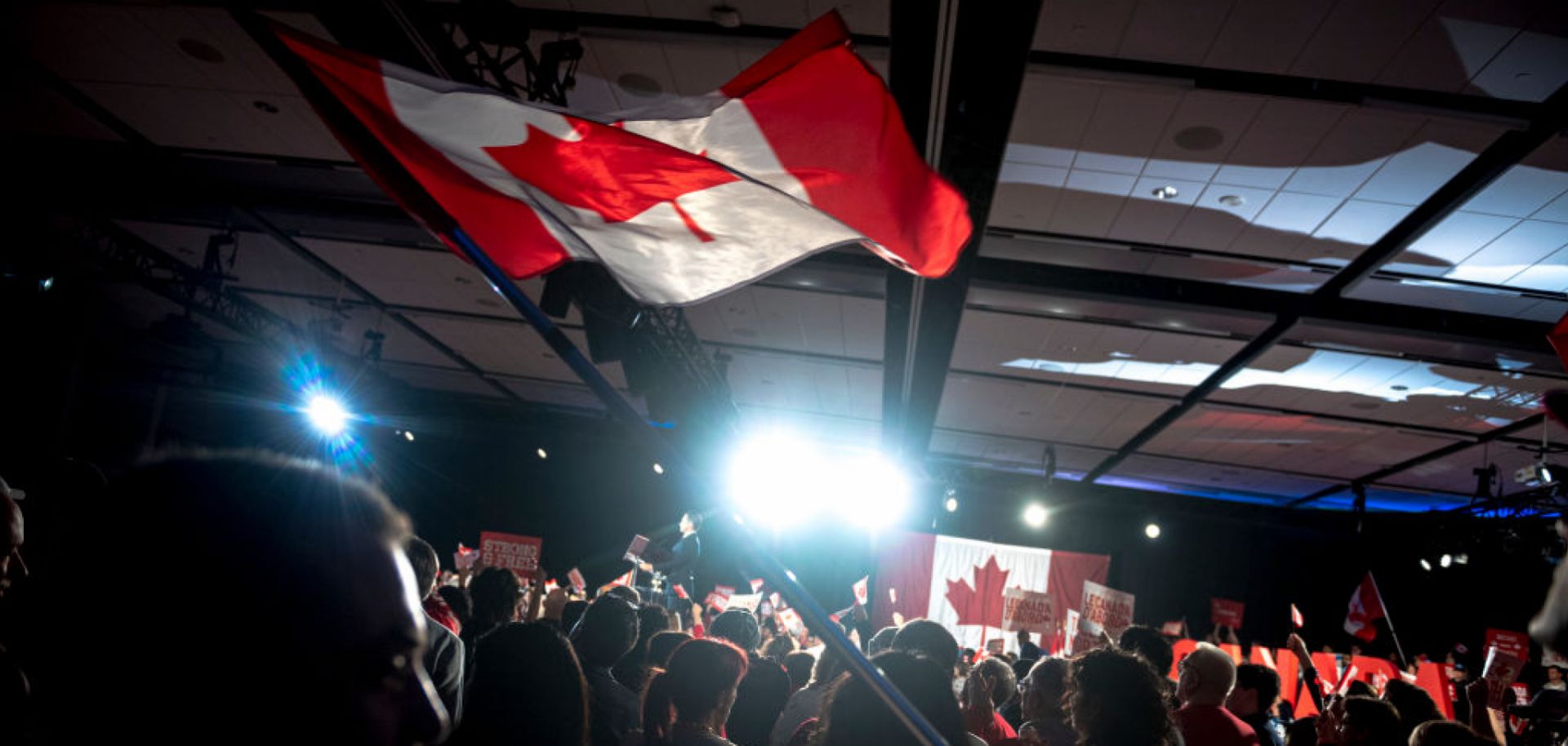
Editor's Note: For significant elections, RANE publishes a series of scenario analyses focused on different outcomes of major elections, describing how an election outcome might unfold with implications for each potential outcome. In 2025 so far, we have profiled Germany. We now profile Canada.
Canadians will head to the polls April 28 for a general election that preelection polls and models suggest will likely see the Liberal Party, led by Prime Minister Mark Carney, winning the most seats. The Liberal Party will most likely win enough seats to form a majority government — a stunning turnaround since former Prime Minister Justin Trudeau's Jan. 6 resignation, when preelection polls and election models suggested the Liberal Party had less than a 1% chance of winning the most seats in an election. Carney and the Liberal Party's electoral chances have strengthened following U.S. President Donald Trump's threats against Canadian sovereignty and imposition of 25% tariffs on most Canadian goods, as Carney has campaigned on strongly resisting and retaliating against the United States.
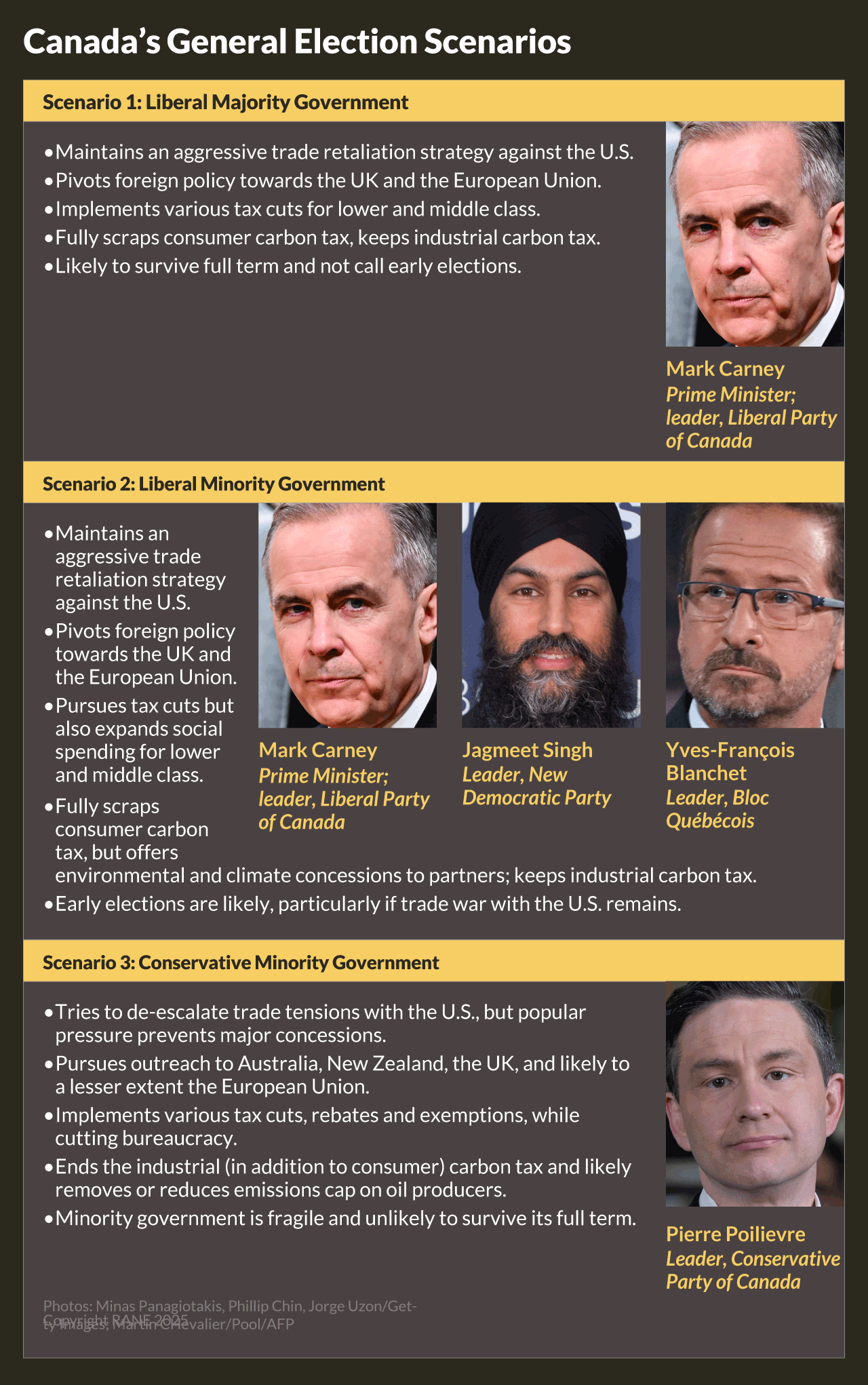
In our first election outcome, Carney and the Liberals are able to capitalize on their momentum and win at least the 172 seats necessary to form a majority government. Carney's government will shift toward more moderate policies on various issues compared to the more progressive policies that proved unpopular during the Trudeau premiership. This moderation will include fully scrapping the consumer carbon tax and implementing modest tax cuts for middle- and lower-income taxes, such as for homebuyers. The government will also seek to aggressively protect Canada's sovereignty against the United States, including through boosting ties with Europe, increasing defense purchases and responding aggressively with retaliatory tariffs against the United States. While the next four years are likely to be challenging for Canada economically if large U.S. tariffs remain in place, the government's parliamentary majority makes it likely to serve its full term.
In our second election outcome, the Liberal Party fails to win a majority, and is forced to form a minority government reliant on the left-wing New Democratic Party and center-left Bloc Quebecois to survive confidence votes. The minority government's foreign policy is largely unaffected by the reliance on smaller parties, but this does limit the extent to which Carney's government can move toward the center on certain priorities, like defense spending, social spending and environmental policy. Moreover, the government's lack of a majority makes early elections more likely, particularly if U.S. tariffs result in an extended economic slowdown that angers voters at the Liberal Party and thus leads the NDP and BQ to support early elections.
In our final election outcome, the Conservative Party under Pierre Poilievre wins the most seats and forms a government, though it is highly unlikely to secure an outright majority and instead must rely on the NDP or BQ to survive confidence votes. Given that the Liberal Party, NDP and BQ are all ideologically to the left of the Tories, their minority government is likely to be highly unstable and prone to an early collapse. The Conservative minority government would respond with tariffs and other retaliatory measures on the United States in response to the U.S.-Canada trade war, but is likely to be more dovish than a Liberal government on the matter. Instead, the Conservatives would seek to reduce tensions with the United States offering broader concessions on issues such as defense cooperation, rolling back environmental restrictions, reducing trade barriers and deregulation — all of which dovetails with the Tories' agenda. On foreign policy, the government would also seek stronger ties with Commonwealth countries and, to a lesser extent, with the European Union while taking a more assertive hawkish stance against China.
The Liberal Party Forms a Majority Government
The Liberal Party wins at least the 172 seats needed to form a majority government without the support of smaller parties, allowing current Prime Minister Mark Carney to remain in office. The Liberal majority government is likely to be a durable one and able to implement policies with a renewed mandate under Carney. Under Carney, the Liberal Party's policies will be more moderate than the party's more progressive policies under former Prime Minister Justin Trudeau. The Liberals will implement modest tax cuts for middle-income families, including reducing or cutting the goods and services tax for first-time homebuyers and fully eliminating the consumer carbon tax, though the industrial carbon tax is likely to remain in some fashion. While Carney's government will remove the consumer carbon tax, it is still likely to maintain Canada's emissions cap on oil and gas production. Carney's government will also seek to protect Canada's sovereignty against the United States and deepen ties with European countries to compensate. The government will, however, also seek to improve ties with the Trump administration through offering concessions, such as on market access, in an effort to reduce U.S. tariffs on Canadian goods. The Canadian government will, however, retaliate against U.S. tariffs. Moreover, the government is also likely to boost defense spending, including trying to hit NATO's 2% spending target as well as reduce its reliance on the U.S. for defense, though it will only have limited success. Finally, the majority government — Canada's first since 2015-19 — is likely to prove durable, keeping the risk of a government collapse before its term expires low, unless Carney decides to call snap elections due to his high popularity and desire to secure a stronger popular mandate.
Implications
- The federal government implements a variety of tax cuts and tax exemptions for lower and middle class families, particularly in industries or areas affected most by the U.S.-Canada trade war. Tax cuts and exemptions offset some of the impact of U.S. tariffs and retaliatory Canadian tariffs on U.S. goods and alleviate some of the pain for Canadians. But job losses and rising unemployment mean that for most Canadians employed in jobs exposed to the trade war, living standards decline significantly in the short term after the election.
- Canada fully establishes a $2 billion Canadian dollar fund, potentially much larger if the trade war lingers, designed to help offset the impact of the trade war between the United States and Canada on autoworkers and other sectors. The fund, however, is not large enough to fully compensate auto companies in Canada if tariffs remain in place for an extended period, likely leading to Ottawa and provincial governments expanding support in the future, risking a worsening budget deficit.
- The federal government maintains the country's emissions cap on oil production that aims to cut emissions from the upstream oil and gas industry by 2030-32, but will consider reducing the targeted emissions cut if Canada's oil industry suffers production declines as a result of an extended U.S.-Canada trade war. If sustained, the cap coupled with tariffs will reduce the profitability of Canada's oil sector and slow oil production growth due to high costs and low returns.
- The Liberal government's contentious relationship with Alberta and the other Prairie Provinces will remain under Carney, particularly as some aspects of Trudeau's environmental and climate policies remain in place and Carney considers restricting or taxing Albertan energy exports to the United States in the trade war. This leads to sustained political polarization within the country between conservative- and liberal-leaning provinces as well as attempts by Edmonton and Regina to thwart federal policies and prevent them from being applied.
- The Canadian government will seek an end to the trade war with the United States but will maintain an aggressive response strategy, using retaliatory tariffs and export taxes or restrictions to increase economic pressure on the White House to reduce tariffs. This keeps the risk of further U.S. tariffs on Canada relatively elevated if a deal is not reached.
- Carney's government will offer some concessions around market access — though probably not for the dairy sector and other agricultural sectors — as well as export quotas for metals and vehicles to get a deal, and will be in a political position to implement them. This will keep the door for a deal with the White House alive despite the contentious bilateral relationship.
- Canada aggressively seeks to negotiate free trade agreements and expand and modernize existing ones with most countries, with the exception of China, to diversify export opportunities for its companies. Canada's distance from other major economies and limited export-oriented infrastructure for oil and gas and other goods, however, will limit the impact of any agreements in the short term.
- Spurred by the trade war with the United States, Carney's government will boost the construction of new — and the expansion of existing — trade infrastructure, such as ports and railways, to diversify trade away from the United States. This plan will inject some new financing into related critical infrastructure. But this will likely have limited near-term impacts, as it will take years for the projects to develop and red tape will likely constrain their progress, especially aspects designed to encourage cooperation rather than competition among ports that will require legal changes.
- Although Canada may not hit the 2% NATO target for defense spending, its spending will increase significantly under Carney, and will see the acquisition of new submarines, icebreakers, drones and other aircraft. The expansion in spending will focus on buying Canadian, European and Asian defense articles in lieu of U.S. defense articles, limiting the extent to which U.S. defense contractors can take advantage of higher defense spending, at least while the trade war is in effect.
- The Carney government pursues closer relations with the United Kingdom and the European Union, which will result in closer regulatory alignment in various sectors as well as greater coordination on diplomatic issues, such as the war in Ukraine, response to U.S. tariffs offsetting loss of U.S. funding for international organizations and environmental issues.
- The federal government does not seek improved relations with China, and instead seeks to offer China-related concessions to the United States to seal a trade deal. Concessions the government will be willing to offer include tariffs on Chinese goods, technology controls, fentanyl trade disruption and a reduction of research and development ties.
- While disputes between different Canadian provinces and between provinces and the federal government occur, the strong political mandate the Liberal Party has will allow Ottawa to offer concessions to the United States and implement policy domestically without significant hindrances beyond energy- and climate-related policies. This includes reducing internal trade barriers between different Canadian provinces, which will help alleviate some of the economic pain of trade tensions with the United States.
The Liberal Party Forms a Minority Government
The Liberal Party wins a plurality of seats, but fails to secure the 172 seats needed to form a majority government. Carney and the Liberal Party are unlikely to form a formal coalition government, which has not occurred at the federal level in more than 100 years, but secures enough support from the New Democratic Party or Bloc Quebecois to govern as a minority government, potentially through a confidence-and-supply deal in which the Liberals rely on one or both parties to back the government on any confidence votes and the federal budget, but otherwise do not explicitly cooperate. Still, the U.S. pressure campaign on Canada may result in Carney and the Liberal Party seeking a united coalition government to unite Parliament behind its policies, though in practice such a coalition government would have many of the same policies as a minority Liberal government. The extent to which the NDP or BQ influence policymaking depends on whether a confidence-and-supply agreement is reached, a coalition government is sought, and how close the Liberal Party is to a majority. If it is close to a majority, the Liberal Party is less likely to enter a formal agreement, but will instead negotiate with BQ and NDP on support in confidence votes. Carney's minority government will still shift the Liberal Party's policies toward the center, implementing tax breaks for the middle class and moving forward with trying to scrap the carbon tax. Reliance on the NDP, especially in a confidence-and-supply agreement, would force the government to spend more on certain social benefit projects. Reliance on BQ, on the other hand, would require concessions on autonomy matters, such as giving Quebec more control over migration into the territory. On foreign policy matters, Carney will seek to boost Canadian defense spending to the 2% NATO target and to reduce its reliance on the United States for defense, though with the lack of a strong mandate, he may struggle to do so. Carney's government will also seek to reach a trade agreement with the United States to reduce tariffs, but the failure to reach a deal will make it more likely that the minority government will collapse earlier as economic conditions bite and Canada potentially enters a recession. (In Canadian political history, minority governments typically only last a few years.)
Implications
- The federal government will pursue tax cuts, but will likely need to offer concessions to the NDP or BQ to push them through the House of Commons. This will mean that they will focus on lower and middle income earners and also likely include increased social spending on health care, education and similar measures in addition to just cutting taxes for lower income Canadians.
- As most environmental and oil and gas policies fall under the direct purview of Carney's Cabinet, the lack of majority in Parliament will not stymie efforts to effectively dismantle the carbon price cap on households. To secure confidence votes with the NDP, however, Carney will need to make concessions on environmental and climate change-related issues, resulting in slightly higher climate ambition than a majority Liberal government.
- The Liberal government will maintain an aggressive stance against the United States through retaliatory tariffs and other measures, and the Liberals' reliance on the BQ — which will demand that Quebec's special status around culture and related issues is not infringed on — as well as the NDP will further limit the types of concessions in trade talks with the United States that Carney's government can give on issues like the auto and dairy sectors, complicating efforts for a deal between the United States and Canada.
- The Liberal party's reliance on NDP and/or BQ will likely result in larger support programs for workers and industries most affected by U.S. tariffs. While this will be beneficial for Canadian companies and workers receiving more financial relief, it risks worsening Canada's government trade balance, as the measures are likely to exceed just the increased revenue from tariffs on U.S. goods.
- The federal government will have a contentious relationship with Alberta and the other prairie provinces due to the emissions cap on oil producers likely remaining in place. This leads to high political polarization in the country between the Prairie Provinces and the rest of Canada and to attempts by the Prairie Provinces to reject or undermine federal environmental and climate policies like the price cap.
- The minority government is unlikely to survive four full years in office, particularly if large U.S. tariffs on Canada remain in place. This is because economic conditions in Canada will likely remain poor even if tariffs are relaxed, and high economic uncertainty will affect growth. Poor economic conditions eventually will likely lead to fraying support for the Liberal Party and Carney, giving an incentive to the NDP or BQ to disassociate themselves from the Liberal Party. This fraying support may not necessarily give way to a Tory government, as that would heavily depend on whether the Conservatives can consolidate around a leader who can manage to distance him or herself from the U.S. Republican Party and U.S. populism.
- Despite being a minority government, the Carney government is likely to push through increased spending to raise Canada's defense spending to close to the 2% NATO threshold demanded by the United States, as even the NDP has been supportive of boosting spending following Trump's election. Most of this spending will be focused on Canadian and other non-U.S. NATO defense contractors, limiting opportunities for U.S. defense contractors.
- The Carney-led minority government will aggressively seek to negotiate new free-trade agreements and expand existing ones, with the exception of China. Diversification efforts, however, will only moderately reduce Canada's reliance on the United States, especially if tariffs are removed.
- The federal government pursues close relations with the European Union and United Kingdom, which will result in closer alignment on regulatory and other similar issues and offset the loss of U.S. funding for other international organizations and environmental issues.
- Carney's government does not seek to improve relations with China, instead keeping the offer of China-related concessions on the table in talks with the United States. Such concessions include matching U.S. tariffs on China, imposing technology restrictions on China, and greater cooperation on curbing fentanyl flows through Canada.
- Carney's and the Liberal Party's weak political mandate will likely intensify disputes between different Canadian provinces and between provinces and the federal government on how to respond to U.S. tariffs and other pressure tactics on Canada, ultimately blunting the effectiveness of Canada's response. This will lead to growing animosity between different provincial and federal leaders that weakens Carney and the minority government's political strength and ability to survive confidence votes and worsens the overall economic impact on Canada, as reforms around internal trade are likely to falter.
The Conservative Party Forms a Minority Government
In this scenario, the Conservatives win a plurality of seats but not enough to win a majority in Parliament. To govern, the party could try to seek out support from the BC and/or NDP, but to varying degrees, both parties are ideologically to the left of the Conservatives, making a coalition or confidence-and-supply agreement unlikely and likely forcing Conservative leader Pierre Poilievre to form a minority government. On domestic policy, a Conservative minority government would lower taxes for both households and industry, while trimming public spending. The party would also focus on bringing down the cost of home ownership, restricting unskilled immigration and cracking down on crime. The Conservatives would also roll back environmental regulations, including eliminating the industrial carbon tax as well as the consumer carbon tax that has already effectively been dropped to zero. On foreign policy, a Poilievre government would trim overseas aid while boosting military spending. The party would attempt to decrease tensions with the United States, but simultaneously deepen Canada's cooperation with the United Kingdom, Australia, New Zealand and, likely to a lesser extent, the European Union. The party would adopt a more hawkish approach toward China, while also drawing closer to Israel. Although the party would seek to build ad hoc support for its policy priorities, it ultimately would be forced to compromise on its agenda in order to get legislation passed, slowing policymaking and diluting reform efforts. Furthermore, the Conservatives' legislative minority means the government would be at constant risk of collapse due to a no-confidence vote from opposition parties, generating policymaking uncertainty and potentially hobbling investor sentiment depending on the level of political instability.
Implications
- Poilievre's government carries out a variety of tax cuts, rebates and exemptions for households, such as an income tax cut for lower and middle income earners, a tax reduction on new home purchases and/or a higher threshold for contributions to a tax-free savings account invested in Canadian companies. While these moves help cushion the blow of the impact of U.S. tariffs and alleviate the high cost of living, they fail to stem the decline in households' real incomes while also worsening the government's fiscal position, as there are unlikely to be sufficient cost savings to fully offset the impact of lost revenue.
- Mirroring a similar move for households, Poilievre's government implements a plan to defer any capital gains tax if companies reinvest the proceeds of an asset sale in Canadian companies. While companies would eventually need to pay if they cash out their Canadian investment or move the money out of the country, the move at least temporarily helps shield Canadian companies from the impact of a trade with the United States, but on its own is insufficient to stem the negative impact of U.S. tariffs.
- Poilievre will seek to de-escalate the trade war with the United States through moves like greater deregulation and improved border security, but popular political pressure will result in his government maintaining an aggressive posture toward the United States via retaliatory tariffs and other trade moves (though there are less likely to be energy export taxes to the United States as Poilievre seeks to boost the oil and gas industry). This will keep trade tensions high between Ottawa and Washington, especially surrounding politically sensitive industries like agriculture, and new punitive measures on the table for the duration of Poilievre's government unless an agreement is reached to lower tariffs.
- The Conservatives roll back a wide variety of environmental policies, most significantly repealing the industrial carbon tax and likely removing or reducing the emissions cap on oil producers. Even if some individual provinces maintain their schemes, the removal of the tax at the federal level deprives the government of revenue and leads to an increase in Canada's emissions in the coming years, though it will ease the financial burden on large emitters and help incentivize investment in industry.
- The government reduces bureaucracy to make it easier to construct pipelines, transmission lines, railroads and other critical infrastructure across Canada, reducing red tape that has stymied corporate investment. But the effort falls short of creating a full-fledged national energy corridor, as the initiative will face regulatory uncertainty due to opposition from individual provinces and Indigenous communities.
- Poilievre axes public spending in numerous areas, including generally reducing the size of the civil service, and more specifically cuts funding to agencies including the federal housing infrastructure fund and the infrastructure bank. His cuts to foreign assistance are specifically sharp, but all of these moves do not save sufficient revenue to offset tax cuts that increasingly put pressure on the government's fiscal space.
- Compared to a Liberal government, a Conservative one has easier relations with provinces — especially Alberta, given greater alignment on conservative political priorities, chiefly the expansion of the oil and gas sector — which reduces policymaking uncertainty by lessening the risk that provinces seek to thwart federal measures. Poilievre's plan to reduce intraprovincial trading barriers by providing more federal funding for provinces that do so will also incentivize cooperation between Ottawa and the provinces.
- The Conservatives hike defense spending, financed in part via deep cuts to foreign aid, but likely still fail to hit NATO's 2% of GDP spending target absent significant measures at creative accounting. Still, Poilievre oversees the acquisition of new military capabilities — increasingly provided by Canadian defense contractors and countries in NATO states other than the United States, as well as in non-NATO partners like South Korea — with a particular focus on improving Canadian defenses in its vast Arctic territory.
- Poilievre intensifies trade, security and other forms of cooperation with Australia, New Zealand and the United Kingdom (the other CANZUK countries), resulting in greater regulatory alignment, joint military development and procurement and diplomatic coordination. Spurred by an increasingly uncertain relationship with the United States, Poilievre also deepens cooperation with the European Union, but likely to a lesser extent than under Carney given a greater divergence between the more conservative government in Ottawa and more liberal one in Brussels — especially regarding green policies — though Canadian deals with individual EU members states would be possible.
- The Conservative government takes a harder line against China in part to try to de-escalate trade tensions with the United States, which sees new tariffs on imports of Chinese goods, an official end to military cooperation with China and advocacy for China's removal from the World Trade Organization. These moves will worsen ties between Ottawa and Beijing, increasing the likelihood of Chinese tariffs on Canadian governments, politically motivated investigations and regulatory actions against Canadian companies in China, and the arbitrary detention of Canadian nationals there.
- Poilievre's government would draw closer to Israel by officially moving Canada's embassy from Tel Aviv to Jerusalem and more forcefully backing Israel's aggressive regional policy. This could include support for Israeli, potentially with U.S. support, strikes on Iran. This policy shift would better align Poilievre's government with the Trump administration, but also expose Canadian citizens and interests to retaliation from Iran (such as via cyberattacks and hybrid operations using paid proxies on Canadian soil).
- The Conservatives would crack down not only on unauthorized immigration but also on unskilled legal immigration, including by tying immigration levels to new homebuilding. Depending on their scope and scale, tightening immigration rules could drive up the cost of labor and cause shortages in certain industries, especially those dependent on low-skilled labor like agriculture, hospitality and construction — the latter of which would also undermine Poilievre's goal to expand homebuilding.
- The minority government's fragility will put it at ongoing risk of collapsing, especially as time goes on and pushback against Poilievre's agenda increases, increasing the likelihood that opposition parties succeed in agreeing to table and pass a no-confidence vote to call early elections.
