
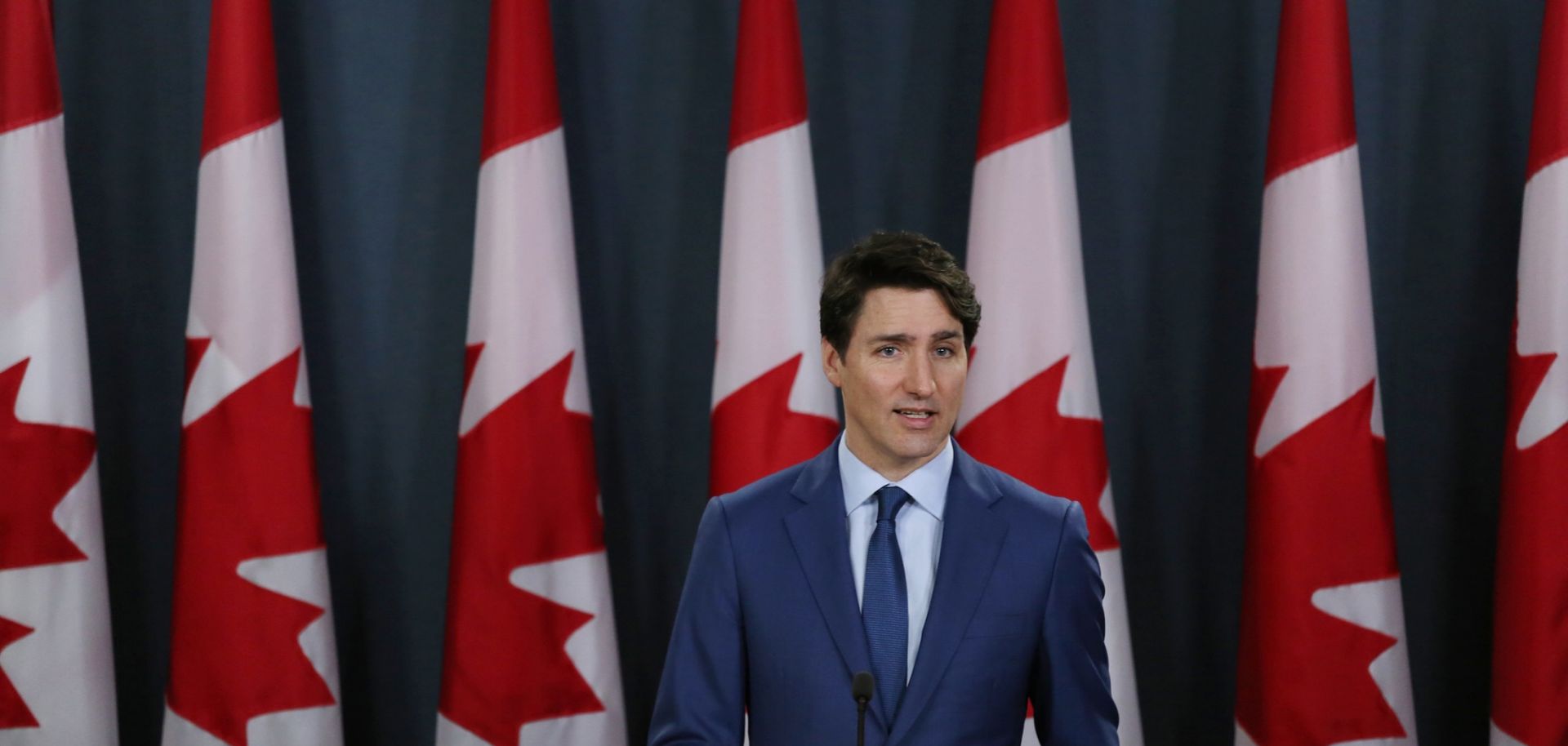
Canadian Prime Minister Justin Trudeau's decision to step aside will buy the ruling Liberal Party time to select a new leader with better chances in upcoming elections, but the Conservative Party's commanding lead in polls indicates the move is unlikely to prevent the return to a Conservative government later this year. On Jan. 6, Trudeau announced that he would step down as leader of Canada's Liberal Party and eventually resign as prime minister once the Liberals select a new leader to succeed him in both positions. Trudeau also announced that parliament would be prorogued until March 24, meaning the legislature will essentially stop all proceedings until then. Trudeau's position as both prime minister and party leader has been under increasing strain as his popularity has fallen dramatically after nearly a decade in power, but his status appears to have become untenable after the Dec. 16 resignation of Chrystia Freeland, who had served as Deputy Prime Minister and Minister of Finance. Her departure amplified calls within the Liberal Party for Trudeau to resign, as he appeared poised to lose a no-confidence vote in parliament, which was anticipated later in January.
- Trudeau, who took office in November 2015, has seen his personal and his party's broader popularity collapse since the September 2021 general elections that forced the Liberals to enter into a confidence-and-supply agreement with the New Democratic Party (NDP) in order to run a minority government. However, the NDP pulled out of the deal in September 2024, and by the end of the year, Trudeau faced a record-high disapproval rating of 74%, primarily driven by popular frustrations over the high cost of living.
- On Dec. 20, NDP leader Jagmeet Singh said he would submit a no-confidence motion against Trudeau's government after parliament was scheduled to return from winter recess on Jan. 27 — though this timeline has now been delayed given prorogation. Singh's statement was significant because the NDP, fearing that it would also do poorly in early elections, previously had blocked three attempts to pass a no-confidence motion by the two other main opposition parties — the Conservative Party and the Bloc Quebecois — meaning that Singh's reversal all but assured that the next motion would succeed.
- Chrystia Freeland, who had been one of Trudeau's most trusted confidants, resigned in a strongly worded letter criticizing Trudeau's alleged "political gimmicks" that she said were failing to seriously prepare Canada for U.S. President-elect Donald Trump's "aggressive economic nationalism," including threatened tariffs on Canadian goods entering the United States.
The Liberal Party will now begin the process of selecting its next leader as it scrambles to close ranks and improve its chances ahead of expected early elections. In his announcement, Trudeau said the Liberals would select their new leader through "a robust, nationwide, competitive process," indicating the party would forgo the faster route of having its executive leadership select a new leader in favor of the more time-intensive process in which party members choose among different candidates. While details are still being decided, the Liberal Party's president confirmed shortly after Trudeau's speech that he will call a meeting of the party's top leadership later this week "to begin the nation-wide democratic process of selecting a new leader." The challenge lies in the typically lengthy process of selecting a new leader, but the Liberals face significant time constraints to unite the party and appeal to voters ahead of elections likely to be called before Oct. 20, as opposition parties are expected to swiftly table a no-confidence vote once parliament reconvenes. According to many experts, this would likely result in early elections in the late spring or early summer. There are multiple contenders widely suspected of angling to take over for Trudeau. In addition to Freeland, some of the most likely include: Dominic LeBlanc, Trudeau's close ally who took over for Freeland as finance minister; Melanie Joly, the Minister of Foreign Affairs and another strong ally of Trudeau; and Mark Carney, the former Governor of the Bank of Canada who Trudeau tried multiple times to recruit into his government. While none of these candidates diverge significantly from Trudeau's positions, each would likely distance themselves from him to bolster the Liberals' prospects in the upcoming elections.
- The Liberal Party's constitution does not provide a precise timeline for how long a leadership contest should be. However, the executive board has the discretion to adjust the process as it deems fit, and some Liberal leaders are already exploring ways to streamline the leadership race timeline.
Regardless of who becomes the next Liberal Party leader, the party faces an uphill battle to close the gap with the Conservatives, whose large lead in the polls portends a new government later this year that will roll back environmental rules, tighten immigration and align more closely with the Trump administration in the United States. With Trudeau's high disapproval rate, any new head of the Liberal Party is likely to stand a comparatively better chance in elections. According to polling data published Jan. 3 from the respected nonprofit Angus Reid Institute, Freeland would be the most likely to increase the party's vote share in the next election — by about eight points — with others like Carney and Joly giving smaller boosts. Nonetheless, polling averages currently show that the Conservative Party, led by Pierre Poilievre, has a 24-point lead over the Liberals. Even if a new Liberal leader closes the gap, it will be very difficult to prevent the Conservatives, who are currently projected to win approximately 230 seats in the House of Commons while needing only 172 to secure a majority (as a 2022 reform increased the number of seats from 338 to 343). While Poilievre and the Conservatives have been quiet about the specifics of their electoral platform, likely in a bid to avoid stoking any controversies and to keep the focus on Trudeau and the Liberals' problems, a return to Conservative rule after a decade would bring major changes on multiple fronts. Chiefly, a Poilievre government would roll back many of Trudeau's environmental regulations, especially a controversial carbon tax that has riled both businesses and consumers. Poilievre would also likely tighten immigration, cut taxes and push for deregulation. On foreign policy, Poilievre would likely align much closer with Washington in a second Trump administration, with a Conservative government in Ottawa less likely to face significant U.S. tariffs as the two would likely work closely on multiple issues, including to tighten border security and take a harder line on China.
- Current projections from poll aggregator Canada338 indicate that if early elections were held on Jan. 7, the Liberal Party would win about only 35 seats, down from the 153 that they currently hold, coming third behind the Bloc Quebecois, which would win 45 compared to 33.
- Poilievre has opposed the carbon tax, which was instituted in 2019 and puts a fee on carbon pollution that has increased over time — one of his signature issues. The provinces of Alberta and Saskatchewan have challenged the tax in court.
- While frequently criticizing Trudeau for what they portrayed as a lenient approach, Poilievre and the Conservatives have been comparatively muted on broader foreign policy issues.
