
Editor's Note: For significant elections, RANE publishes a series of scenario analyses focused on different outcomes of major elections, describing how an election outcome might unfold with implications for each potential outcome. We now profile Germany.
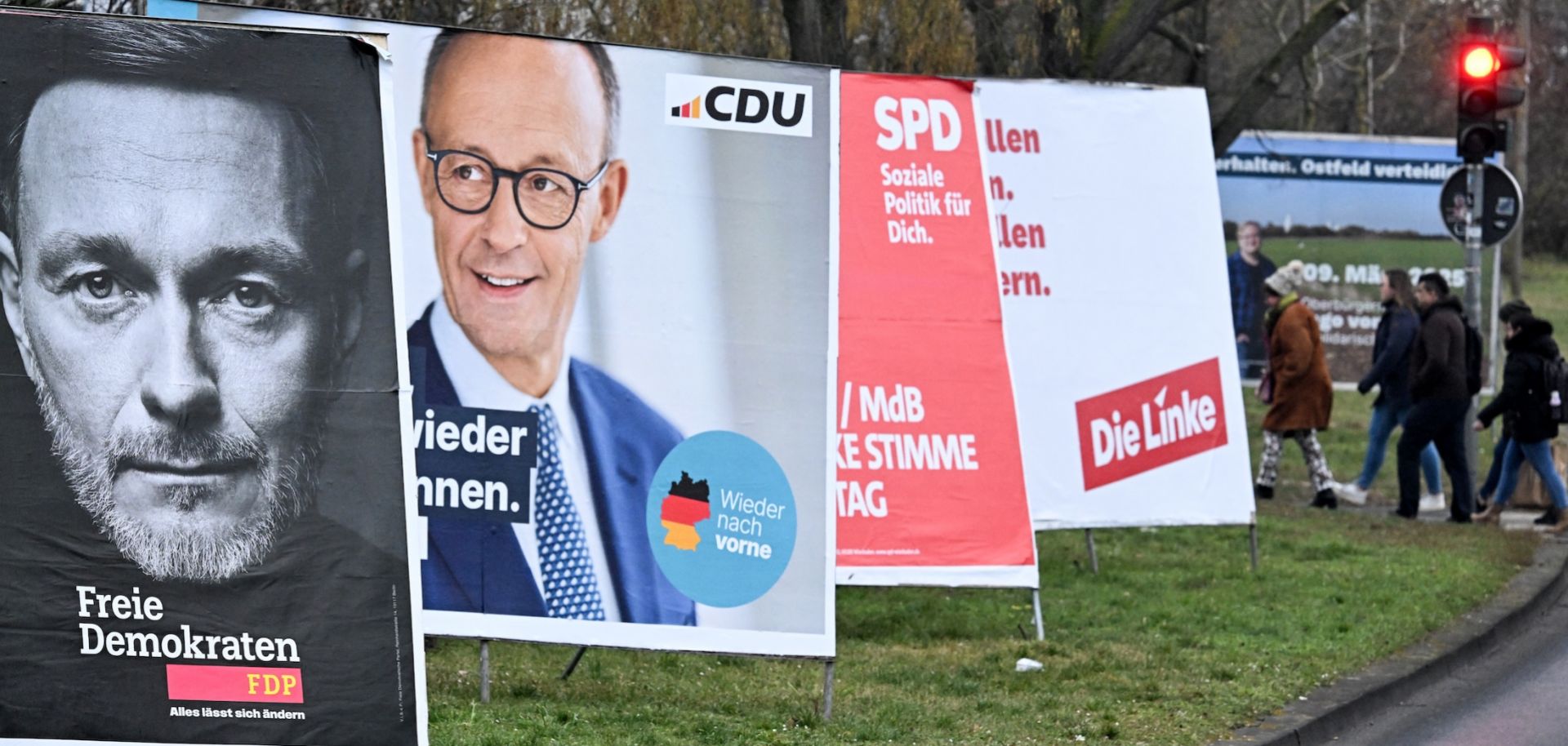
Germany's general election will take place on Feb. 23. A two-party coalition could provide a more stable government with streamlined decision-making in Berlin, while a three-party coalition may lead to instability, prolonging policy uncertainty both domestically and within the European Union.
In the most likely scenario, the conservative Christian Democratic Union (CDU) and its Bavarian sister party, the Christian Social Union (CSU), would lead a coalition with a center-left party, either the center-left Social Democratic Party (SPD) or the Greens (this is a less probable alternative due to significant political differences between the two parties).
A CDU/CSU-SPD coalition would combine moderate tax cuts with targeted industrial subsidies, maintaining key welfare programs while keeping debt levels in check. Migration policies would tighten under CDU/CSU leadership, but radical changes would remain unlikely due to SPD or the Greens' influence. A CDU/CSU-Greens government, while similarly focused on economic competitiveness and energy security, would be more ambitious in climate policy, accelerating investment in renewables and green infrastructure, though facing resistance to emissions regulations from CDU-aligned business interests. In this scenario, Germany would take a more assertive foreign policy stance on supporting Ukraine while acting more hawkish toward Russia and China compared to a coalition with the SPD, aligning more closely with U.S. security interests while reinforcing EU-wide defense efforts.
In a less likely scenario, a CDU/CSU-led three-party coalition — including either the SPD, Greens or the pro-business Free Democratic Party (FDP) — would face greater difficulties in balancing fiscal, energy and industrial policies. A CDU/CSU-SPD-Greens government would support limited debt rule adjustments to boost infrastructure spending and green transition efforts but would be constrained by CDU/CSU fiscal conservatism. Alternatively, a CDU/CSU-FDP coalition would prioritize tax cuts and deregulation to boost growth and investment, clashing with any center-left junior partner advocating for increased welfare protections and industrial subsidies.
Despite their growing ideological convergence, a CDU/CSU coalition with the far-right Alternative for Germany (AfD) party remains unlikely due to German mainstream parties' strong tradition of avoiding collaborating with the far-right. However, should this scenario materialize, it would mark a radical shift toward nationalism, prioritizing strict migration policies, reversing green regulations and challenging some of Germany's EU commitments. This scenario would also likely trigger domestic unrest, EU tensions and economic uncertainty, further polarizing Germany's already volatile sociopolitical landscape.
Finally, the least likely scenario would see the formation of a left-wing multi-party coalition led by the SPD and comprising the Greens, the populist left-wing socially conservative Sahra Wagenknecht Alliance (BSW), and the far-left Die Linke. Such a government would push for higher social spending, progressive taxation and a more state-driven economic model. However, migration and especially foreign policy divisions could create instability, as BSW and Die Linke oppose NATO commitments and military aid to Ukraine, potentially weakening Germany's security posture.
A Two-Party Coalition Led by the Center-Right
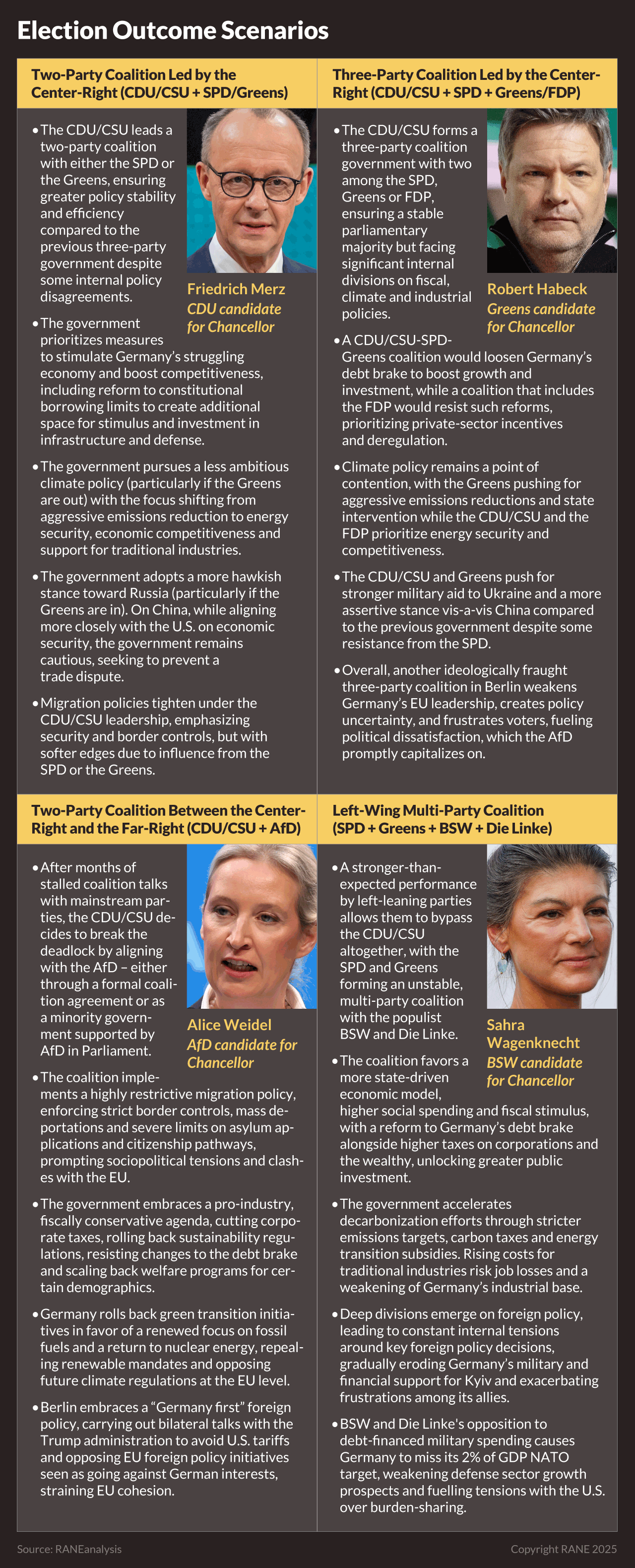
The center-right CDU/CSU alliance wins the election and then leads a coalition government with a junior partner from the center-left (the SPD or the Greens). The government implements stricter migration policies, emphasizing security and border controls. It also pursues a less ambitious climate policy (particularly if the government includes the SPD and not the Greens), with the focus shifting toward energy security and economic competitiveness over aggressive emissions reduction targets, while traditional industries such as automotive and energy-intensive sectors receive increased support. The government prioritizes measures to stimulate Germany's economy and boost competitiveness, including a reform to constitutional borrowing limits to create additional space for stimulus and investment in infrastructure and defense, as well as deregulation, corporate tax cuts, and measures to reduce energy prices and red tape. Despite some continuity in foreign and defense policies, the new government adopts a more hawkish stance toward Russia and China, particularly if the Greens are part of the coalition. Although the CDU/CSU has advocated for reassessing nuclear energy in Germany, a return to traditional fission-based nuclear power is unlikely amid strong opposition from both the SPD and the Greens, and the dismantling of decommissioned nuclear plants continues. Despite occasional stalemates arising over key issues such as fiscal policy, climate action or foreign affairs, the two-party coalition provides a more stable government and streamlined decision-making processes in Berlin compared to the previous three-party coalition.
Implications
- A tightening of migration rules — including stricter visa and citizenship rules — reduces the availability of low-cost labor, particularly in agriculture, logistics, care services and some manufacturing roles. This somewhat drives higher operating costs for businesses dependent on foreign labor.
- Stricter migration policies, a greater focus on border security and refugee control, and a tougher crackdown on Islamist organizations in the country (like those linked to Hezbollah and Iran) somewhat enhance state control over potential terrorist activities but also compound existing grievances within Germany's Muslim community, thus increasing threats of lone actor reprisal attacks, social unrest and personal safety risks.
- The government prioritizes measures to lower energy prices and bolster economic competitiveness, offering subsidies, tax cuts and other incentives to traditional industries like automotive and manufacturing. While this helps boost industrial output, it also slows innovation in energy efficiency and green technologies. In the case of a coalition including the Greens, the government would also introduce investment incentives specifically for renewables to mitigate this effect.
- Corporate tax cuts increase companies' profitability but limit the government's fiscal space to increase spending on green investment and social programs. The inclusion of the SPD or the Greens would moderate the extent of tax cuts, maintaining public investment in energy transition subsidies and increasing welfare spending.
- Increased public spending on transport, energy and digital infrastructure creates opportunities for private contractors and investors, while higher public spending on defense provides opportunities for domestic and European defense manufacturers, boosting economic activity in and around Germany. However, the CDU/CSU's support for only a limited (and very narrow in scope) reform to constitutional borrowing limits still constrains the scope of stimulus measures. Economic headwinds persist in the short to medium term but tax incentives and targeted investments in energy, manufacturing and defense potentially stabilize key sectors while providing some stimulus to the German economy.
- A push for deregulation reduces compliance costs and accelerates project timelines, particularly for large industrial projects. While pro-business reforms improve corporate efficiency and profitability, weaker consumer and environmental protections potentially lead to public backlash and reputational risks for companies. If the Greens are in the coalition, a more nuanced approach to deregulation is likely, with some safeguards for environmental and social standards.
- A tougher stance on Russia and stronger commitment to Ukraine and NATO defense reduce frustrations among German allies in the European Union and create a better alignment with the administration of U.S. President Donald Trump on foreign policy issues. This reinforces Germany's military role in the European Union and NATO, particularly under a CDU-Greens coalition. Berlin plays a central role in promoting European unity on security and defense matters, maintaining support for Ukraine and sanctions against Russia.
- Germany's continued or increased military aid to Ukraine, including support for the use of German long-range missiles against Russian targets, reinforces its status as a prime target for Russian sabotage, all the while Moscow's growing risk tolerance raises the likelihood of more disruptive and potentially harmful operations. Sabotage efforts continue to primarily target military assets, critical infrastructure and defense-linked industries aiding Ukraine. However, heightened activity increases the risk of collateral damage, with bystander casualties and unintended disruptions to broader business operations becoming more likely.
- Under the leadership of the CDU/CSU, Germany continues down the path of a gradual rearmament process initiated under the previous government in the wake of Russia's 2022 invasion of Ukraine. However, the government's rearmament efforts face the same political and financial constraints as its predecessor, such as insufficient (though rising) military spending, inefficient procurement processes, and a strategic and political culture still heavily influenced by the country's traditional post-WWII anti-militarism.
- The government remains somewhat cautious about relations with China, seeking to prevent a trade dispute that would threaten Germany's key industries like automotive, chemicals and industrial machinery. Berlin continues to oppose EU tariffs against Chinese imports, fearing Beijing's retaliation. But it is also more active in screening inbound investment in critical sectors and infrastructure and more willing to collaborate with the United States on export controls as part of engagement efforts with the Trump administration.
- The CDU/CSU-led government — especially in a coalition with the Greens — seeks closer ties with the Trump administration to mitigate the risk of U.S. tariff hikes. This supports limited U.S. security guarantees to NATO in return for higher German defense spending, increased investment in U.S. auto manufacturing, and greater imports of U.S. liquified natural gas (LNG) and defense equipment to help narrow Germany's trade surplus with the United States.
- Despite the CDU's push for energy security, a full return to traditional nuclear energy remains unlikely. Instead, Germany explores small modular reactors (SMRs) while nuclear decommissioning continues as planned. The new government also expands LNG imports from the United States and Qatar to continue diversification efforts away from Russian gas, investing in new LNG import infrastructure and gas-fired power plants.
- The government introduces measures to support struggling German automakers, balancing aid for both traditional combustion engine cars and electric vehicles. A CDU-led coalition with the Greens would make it far less likely that Berlin seeks to reverse the European Union's ban on new combustion engine sales that will take effect in 2035. However, it would still aim to shield German manufacturers from EU emissions fines while offering tax incentives for EVs. Both the SPD and the Greens would advocate for targeted incentives to accelerate the adoption of electric vehicles and hydrogen technologies.
- Under CDU/CSU leadership, Germany upholds its 2045 net-zero target but adopts a more pragmatic energy transition strategy, especially without the Greens in government. Policies emphasize expanding renewables, modernizing grid infrastructure and fostering innovation. Yet, several climate initiatives — including residential heating regulations, auto industry emissions rules and supply chain sustainability legislation — are delayed, weakened or scrapped. At the same time, traditional energy sectors receive continued support to ensure supply stability and lower costs. Hydrogen infrastructure development remains a priority, but with an increased reliance on natural gas as a transitional energy source, emphasizing a more industry-friendly and security-focused strategy.
- The government supports joint EU initiatives on green tech, industrial policy and defense spending, helping to stabilize the broader European economy and accelerate progress toward the European Union's strategic autonomy and competitiveness goals. However, Berlin continues to oppose joint EU debt mechanisms, exacerbating the growing North-South fiscal and economic divide within the bloc.
- A two-party coalition offers relative political stability and policy predictability in Berlin despite some internal disagreements, particularly if the Greens are the CDU/CSU's coalition partner. This enables long-term economic and industrial planning.
- Amid continued rising anti-immigration sentiment and socially conservative trends in Germany, a CDU/CSU coalition with a center-left partner — especially if it is the Greens — further boosts the AfD's appeal, particularly in the country's east. As disillusioned CDU voters shift further to the right, the AfD continues to gain momentum, positioning it for a stronger performance in the 2029 federal elections.
- The AfD's continued inability to participate in the federal government despite its rising popularity pushes the party further to the extreme, amplifying radical views about the state of Germany's democracy and emboldening its supporters to escalate protest activity. With the party's anti-war and anti-immigrant narratives spreading further, the risk of political violence against minorities, rival parties' politicians and possibly Ukrainian refugees in Germany increases, while large anti-government demonstrations by AfD supporters grow in size and intensity and may increasingly turn violent, particularly if they are met with counter-protests by political opponents.
Three-Party Coalition Led by the Center-Right
The center-right CDU/CSU emerges as the largest parliamentary bloc but needs two partners to form a majority. This results in a three-party coalition with two among the SPD, Greens or FDP. A coalition with the SPD and the Greens would agree to reform the debt brake to boost investment in infrastructure, energy transition and digitalization, seeking to combine climate targets with an economic recovery strategy. However, climate policy remains contentious, with the Greens pushing for aggressive emissions reductions and state intervention while the CDU/CSU prioritizes energy security and competitiveness, focusing on policies to lower electricity costs. Meanwhile, the CDU/CSU and Greens push for stronger military aid to Ukraine and a more assertive stance vis-a-vis China compared to the previous government, despite some resistance from the SPD. Alternatively, a CDU/CSU-led coalition that includes the FDP would embrace a more fiscally conservative agenda, resisting reforms to the debt brake while advocating tax cuts and deregulation to stimulate growth through private-sector incentives. This approach would clash with junior coalition partners from the Greens or SPD, who advocate subsidies and increased public spending on infrastructure and climate initiatives, leading to tensions within the coalition. Overall, while the coalition benefits from a comfortable parliamentary majority and initial post-election momentum, ideological differences complicate decision-making, increasing the likelihood of prolonged negotiations and legislative gridlock in Berlin — particularly on fiscal, economic and social policies — while gradually contributing to policy uncertainty at both the domestic and EU levels.
Implications
- A CDU/CSU-SPD-Greens coalition would agree to loosen the constitutional debt brake to stimulate the economy and finance infrastructure, digitalization, energy transition projects and corporate investment subsidies. By contrast, a coalition including the FDP would likely push against debt rule changes, likely constraining the scope of stimulus measures and leading to some delays in public investment projects (thus creating some uncertainty for businesses reliant on government funding). Instead, the government prioritizes private-sector growth through business incentives, deregulation and tax cuts, benefiting corporate investment but slowing green transition projects and public sector-driven economic stimulus.
- Fiscal policy remains a source of intra-coalition tension in both a CDU/CSU-SPD-Greens coalition and a CDU/CSU-led coalition that includes the FDP, as ideological divisions over spending, taxation and investment priorities drive compromises that dilute economic stimulus measures. In the CDU/CSU-SPD-Greens scenario, fiscal conservatives in the CDU/CSU clash with the SPD and Greens, leading to a mix of targeted subsidies for clean energy and infrastructure alongside moderate tax rates. In contrast, a CDU/CSU-FDP coalition prioritizes tax cuts, deregulation and private-sector incentives, boosting investment attractiveness but fueling tensions over reduced social protections, particularly with the SPD or Greens as a third coalition partner. This uncertainty in tax policy makes Germany a less attractive investment destination, particularly for finance, tech and multinational firms.
- Social policy remains a contentious issue in both coalition scenarios, as pro-business and pro-investment priorities clash with social welfare policies. In a CDU/CSU-SPD-Greens coalition, the SPD and the Greens would push for expanded social spending, including higher pensions, workforce upskilling and subsidies for low-income workers, which would boost consumer demand but prompt tax policy disputes with the CDU/CSU. In contrast, a coalition that includes the FDP would prioritize cost-cutting measures, including raising the retirement age, reducing unemployment benefits and cutting some climate subsidies, which would free up fiscal space for public investment subsidies but fuel tensions with the SPD or the Greens pushing for stronger welfare protections. Internal disagreements in both scenarios would lead to compromises that limit tax increases, forcing the government to reallocate spending in ways that create economic uncertainty.
- Diverging industrial policy priorities within both coalition scenarios creates regulatory uncertainty for key sectors like automotive, manufacturing and high-tech industries. A coalition that includes the FDP would emphasize private-sector incentives and deregulation, while a CDU/CSU-SPD-Greens coalition would focus on state-led investment and green subsidies. Disagreements over strategic investment, regulatory frameworks and industrial subsidies could slow the implementation of a cohesive growth strategy, making it harder for businesses to plan long-term investments. While Germany remains a strong industrial player, a lack of alignment on key policies may limit its ability to respond quickly to global competition in growing sectors like electric vehicles, artificial intelligence and semiconductors.
- In both scenarios, the coalition adopts a more pragmatic climate policy, formally maintaining long-term targets like net zero by 2045 but delaying, scaling back or modifying key climate and sustainability measures to reduce regulatory pressure on Germany's struggling industrial sector. Policies affecting residential heating, auto industry emissions and supply chain sustainability are adjusted to balance economic competitiveness with environmental goals. The extent of regulatory easing would depend on coalition composition: the presence of both the Greens and the SPD would retain stricter environmental standards, while if only one of them is part of the coalition alongside the FDP, the alliance would likely prioritize industry relief, benefiting traditional automakers and heavy industry but slowing Germany's green transition. Either way, internal disagreements would result in compromised policies that are unclear or ineffective, delaying renewable energy projects and corporate sustainability investments as businesses wait for regulatory certainty before committing capital.
- The coalition makes compromises on migration policy, tightening asylum and border security rules while expanding worker visa programs to address labor shortages. It expedites deportations for criminals and rejected asylum seekers and enforces stricter entry requirements, but it also moderates CDU/CSU proposals by upholding legal protections for humanitarian cases and rejecting third-country asylum processing. At the same time, the coalition eases pathways for skilled labor immigration, launching targeted visa programs for industries facing acute shortages, such as healthcare, logistics and technology. This approach balances business demands for workforce expansion with public concerns over migration, stabilizing labor markets while addressing security and integration challenges.
- Germany prioritizes energy security and diversification, expanding LNG imports from the United States and Qatar while investing in LNG terminals, gas-fired power plants and hydrogen infrastructure with natural gas as a transitional fuel. While full nuclear revival remains unlikely, the government may explore small modular reactors (SMRs). A balanced approach between security, decarbonization and market-driven policies supports renewables, hydrogen and LNG infrastructure, ensuring stability in Germany's energy transition, though conflicting priorities within the coalition may create some policy uncertainty, negatively impacting long-term investments in energy infrastructure, green tech manufacturing and the decarbonization of industrial processes.
- Germany increases defense spending, focusing on NATO commitments, weapons procurement and cyber defense, while export restrictions are scrapped, reducing frustrations among defense industrial players and Germany's allies. But despite rising budgets under the CDU/CSU's leadership, underlying procurement inefficiencies, political caution, Germany's traditional anti-militarism and some financial constraints still slow military modernization and expansion.
- The CDU/CSU, Greens and SPD prioritize greater EU defense cooperation, boosting joint European defense projects and strengthening Germany's influence over EU security policy. This benefits military procurement and defense contractors while advancing EU-wide industrial and defense integration. However, the CDU/CSU's opposition to joint EU debt issuance — especially if the FDP joins the coalition — limits common EU defense funding, exacerbating North-South and Franco-German tensions over military spending burdens and strategic autonomy within the bloc.
- A CDU/CSU-Greens coalition, even if alongside the SPD or the FDP, strengthens Germany's foreign policy alignment with NATO and the European Union, with Berlin taking a tougher stance on Russia and increasing support for Ukraine. This reduces frustrations among Germany's allies and enhances the country's military role in Europe, aligning more closely with the Trump administration on defense issues and, consequently, easing trade tensions with the United States. Greater transatlantic cooperation also bolsters European security unity, reinforcing sanctions on Russia and raising the prospect of a pan-European peacekeeping mission in Ukraine after the war ends.
- The coalition balances economic ties with China and geopolitical alignment with the United States, tightening investment screening in critical sectors while avoiding EU-wide tariffs on Chinese imports to protect German industries from retaliation. However, export controls on semiconductors and other key technologies, while fostering closer U.S.-Germany cooperation under the Trump administration, increases tensions with Beijing, potentially leading to trade barriers and disruptions that raise costs for German automakers, industrial exporters and supply chains.
- A three-party coalition weakens Germany's EU leadership, as internal divisions over fiscal, economic and defense policies complicate budget negotiations and economic coordination in Brussels. The coalition's slow decision-making creates policy uncertainty, negatively impacting long-term investment and expansion plans, particularly in the high-tech and energy sectors. Meanwhile, policy compromises on migration, fiscal rules and climate measures frustrate voters, fueling political dissatisfaction. The AfD capitalizes on the CDU/CSU's struggle to balance voter demands, gaining support among right-wing voters, increasing polarization and the risk of protests, and further destabilizing Germany's economic and political landscape.
Two-Party Coalition Between the Center-right and the Far-Right
The CDU/CSU reaches a deal with the AfD to either create a formal coalition government or a CDU/CSU-minority government supported by the AfD in the parliament. The coalition's top priority is to implement highly restrictive migration and asylum policy, enforcing strict border controls, mass deportations and severe limits on asylum applications. AfD-promoted ''remigration'' policies lead to legal challenges, along with significant sociopolitical tensions within Germany and clashes with the European Union. Economic policy prioritizes traditional industries, such as automotive and energy-intensive manufacturing, while rolling back green transition initiatives in favor of a renewed focus on fossil fuels and a return to nuclear energy, repealing renewable mandates and opposing future climate regulations at the EU level. On fiscal policy, the AfD vetoes any adjustment to the debt brake, with the government instead opting for tax cuts and deregulation to spur growth and scaling back welfare and energy transition subsidies to fund investment in infrastructure and digitalization. Foreign policy becomes a major source of contention between the two coalition partners. However, Berlin ultimately adopts a more unilateral approach, pushing for an end to the war in Ukraine and engaging in bilateral negotiations with the Trump administration to avoid U.S. tariffs on German products. Additionally, Germany opposes EU foreign policy initiatives that it views as contrary to its interests, including trade restrictions on China. This stance strains EU cohesion and exacerbates tensions in Franco-German relations.
Implications
- The government implements highly restrictive immigration policies and a rollback of asylum rights, including aggressive deportation measures and offshore asylum processing. Authorities accelerate deportations of convicted migrants while incentivizing Syrian refugees to return home through voluntary repatriation programs, combining monetary incentives with tightened asylum criteria such as stricter barriers to citizenship and significant reductions in financial support for refugees. Meanwhile, intensified enforcement efforts — such as security crackdowns to verify immigration status — heighten pressure on undocumented migrants to leave.
- The AfD's presence in the federal government significantly amplifies political polarization and social unrest. The administration's severe asylum restrictions and ''remigration'' policies trigger legal challenges at both domestic and EU levels, leading to lawsuits from human rights organizations, resistance from local governments and backlash from EU institutions, further escalating tensions. Rising frictions with immigrant communities heighten the risk of Islamist extremist attacks and riots, while opposition from human rights activists and left-wing parties fuels widespread protests, increasing security costs for businesses and the risk of public disruptions in major cities.
- Stricter immigration policies contribute to labor shortages in key sectors such as healthcare, construction, logistics and agriculture. With fewer foreign workers available, businesses face higher labor costs as employees gain more leverage in wage negotiations. These shortages also slow public infrastructure projects and reduce productivity in affected industries. Growing anti-immigration sentiment under a government with AfD participation deters foreign workers from relocating to Germany, even higher-skilled ones that would not directly be affected by restrictive migration policies, impacting both traditional and emerging sectors such as automotive, steel and metals, chemicals, semiconductor, and battery manufacturing.
- Highly restrictive migration policies exacerbate demographic challenges in Germany in the long term, placing additional pressure on the country's social security system, while rising labor costs and worsening skills shortages potentially impact Germany's overall economic competitiveness in certain sectors. This, coupled with a climate of instability and legal uncertainty due to mass deportations, creates potential tensions with the European Union, affects international perceptions of Germany's rule of law, and discourages foreign direct investment, especially from those with a strong commitment to diversity and ESG principles, making Germany a less attractive hub for international businesses.
- The AfD's protectionist stance, combined with the CDU/CSU's pro-business agenda, drives government support for traditional industries like automotive and energy-intensive sectors through tax cuts, business incentives and deregulation. The coalition opposes the European Union's 2035 combustion engine ban and pushes to reform EU carbon fleet limits while extending tax incentives beyond electric vehicles to boost demand for conventional passenger vehicles. These policies slow the transition to electric mobility in Germany, increasing German car manufacturers' exposure to EU fines for breaching the bloc's emissions regulations.
- The government repeals Germany's supply chain law. It actively pushes to dismantle EU-wide supply chain and corporate sustainability initiatives, which reduces compliance costs for German businesses in sectors with long and complex supply chains, particularly those stretching across Southeast Asia, Africa and Latin America, where the potential for significant environmental and human rights violations is higher. This particularly benefits the textiles, food, mining, oil and gas, agriculture, electronics, pharmaceutical and automotive sectors, which all heavily depend on raw material imports from regions with lower labor and environmental standards. Small- and medium-sized enterprises, though not directly within the directive's scope, also gain relief from due diligence requirements as suppliers to larger firms.
- The government implements corporate tax cuts, reduces state subsidies and red tape for businesses, and removes wealth and inheritance taxes. This improves short-term competitiveness and profitability for businesses and benefits high-income earners while widening wealth disparities.
- With both coalition parties opposing reform to Germany's constitutional limits to government borrowing, the government finances tax cuts and increased investment in public infrastructure by scaling back green energy subsidies and some welfare policies for specific demographics. While preserving the minimum wage, pension reform and pro-family fiscal incentives, the government implements welfare cuts by reducing benefits for refugees, asylum seekers and non-German EU citizens, tightening eligibility for disability support, and cutting integration programs and social assistance for migrant communities. These measures reduce disposable income for certain lower-income groups, somewhat weakening consumer demand and negatively impacting growth in domestic-driven sectors.
- The government expands public transport infrastructure through investments in rail and road networks, including in rural regions. Grid expansion remains a focus to support industrial needs, though the reduced emphasis on renewable energy lowers the urgency of modernizing transmission capacity for clean energy integration. These investments improve regional connectivity and economic development.
- The coalition reverses Germany's nuclear phaseout to stabilize the energy supply, but regulatory hurdles and technical challenges delay reactor restarts until at least the late 2020s, limiting the immediate impact on energy prices. In the interim, the government slows the phaseout of coal-fired power plants and continues brown coal mining to maintain energy security and reduce costs. While these measures provide a short-term energy buffer, they also increase Germany's carbon footprint, straining relations with EU partners and complicating compliance with EU climate commitments.
- The coalition prioritizes fossil fuels and nuclear energy by removing or watering down renewable energy mandates, slowing the phaseout of coal-fired power plants and restoring subsidies for gas, coal and nuclear to bring down energy prices. While this supports traditional energy-intensive industries and reduces short-term energy costs, it discourages investment in Germany's green technology sector, reducing competitiveness in global wind, solar and hydrogen markets while significantly weakening Germany's leadership in the energy transition.
- The coalition limits government incentives for heat pumps while reversing the previous government's ban on the installation of new oil and gas heaters.
- The government reduces electricity and carbon taxes, benefiting energy-intensive industries such as manufacturing and chemicals. It also abolishes green transition grants and scales back hydrogen funding, favoring a market-driven approach. While these measures lower operating costs for businesses in the short term, they slow decarbonization efforts, increase reliance on fossil fuels, and make Germany more vulnerable to future energy price volatility and emissions-related trade restrictions.
- The AfD drops overt calls for leaving the European Union or the eurozone but pushes the coalition government to adopt a more assertive, nationalist stance in defending German economic interests within the European Union. This leads to selective challenges against both Brussels and individual EU member states like France in implementing EU directives and regulations, particularly in areas where German industries feel disadvantaged. It also leads to a reduction in Germany's financial contributions to the European Union and opposition to joint debt, significantly slowing or watering down EU economic initiatives and deepening fragmentation within the bloc. This fuels economic uncertainty in the European Union, shifts EU leadership toward France and smaller member states — at least in the short to medium term — and undermines business confidence in European markets.
- The government takes a more assertive position on China. It seeks increased cooperation with the Trump administration on economic security, but tries to avoid a trade war with China, especially in light of its close ties with German industries (especially auto manufacturing). Against this backdrop, Berlin may tighten screening on Chinese investment in critical infrastructure and adopt some U.S.-led export controls, for instance, as part of a deal with the Trump administration to remove U.S. tariffs on the European Union (or Germany, specifically). However, the government continues to oppose any major EU tariff hikes on Chinese goods, fearing retaliation that could harm German exports.
- In an unlikely but highly disruptive scenario, Berlin, frustrated by Brussels' failure to resolve major trade disputes with the United States or China, could bypass the European Union and negotiate its own deals on a bilateral basis to shield German exports from increased tariffs. Such a breach of EU rules would severely weaken EU trade cohesion, trigger retaliation from Brussels, and escalate tensions with France and other member states. This would fracture EU unity, embolden other member states to follow suit and weaken the bloc's collective bargaining, making it a high-impact risk for European stability.
- A CDU/CSU-AfD coalition in Germany energizes far-right parties in other key EU member states, including France, Italy and the Netherlands, fueling euroskeptic sentiment and deepening EU instability. This growing fragmentation threatens policy cohesion, complicates EU decision-making and increases long-term risks for businesses reliant on a stable regulatory and trade environment.
- Foreign policy becomes a point of contention within the coalition government, with the AfD's opposition to NATO and EU cooperation clashing with the CDU/CSU's pro-EU and -Ukraine stances. As a compromise, Germany continues its support for Ukraine but insists on an end to the war under U.S.-led negotiations. Should the United States completely disengage with the war in Ukraine as well as Europe's defense, the German government would halt or significantly reduce its support for Ukraine, seeking a resolution to the conflict even on terms that are favorable to Russia. In this scenario, Germany would also re-consider resuming Russian gas imports via the Nord Stream pipelines, though to lower levels than before the war in Ukraine to limit Moscow's strategic leverage over Germany. This would isolate Germany from key European security and defense partners like France, the United Kingdom, and Northern and Eastern European countries.
- Germany increases defense spending but shifts toward a more nationalist, independent approach, weakening collective European security. Franco-German defense cooperation deteriorates as Berlin distances itself from EU-led initiatives, opposes joint industrial policies, and scales back support for French President Emmanuel Macron's vision of deeper integration, undermining EU leadership. This strains relations with the United States and European allies, reducing Germany's strategic influence within NATO and raising doubts about its security commitments while leaving France and Poland to take on greater leadership in European defense.
Left-Wing Multi-Party Coalition
The SPD and Greens perform strongly in the election, enabling them to form a majority government with the populist left-wing BSW and Die Linke. While the parties share some ideological alignment, fundamental policy divisions — particularly on immigration and foreign policy — threaten coalition stability and complicate decision-making. The coalition prioritizes social spending and fiscal stimulus, with a reform to Germany's debt brake unlocking greater public investment in infrastructure, energy transition and social welfare, though BSW and Die Link oppose increased debt-financed spending on defense. All parties agree to implement tax hikes to fund large-scale green subsidies and welfare expansion. However, some tensions emerge over the level of state intervention in the economy, with the BSW and Die Linke pushing for a more state-driven approach while the more moderate SPD and Greens seek to maintain some level of private-sector incentives to maintain a business-friendly environment. Deep divisions emerge on foreign policy, with the SPD and the Greens backing continued support for Ukraine while the BSW and Die Linke oppose military aid and favor a diplomatic rapprochement with Russia. This leads to constant tensions within the coalition around key foreign policy decisions and results in a gradual waning of German military and financial support for Kyiv. Overall, significant internal divisions delay some reforms, prolong negotiations and increase policy uncertainty, exacerbating the governance struggles of Germany's previous three-party coalition government.
Implications
- The coalition relaxes Germany's constitutional debt brake, enabling expanded public spending on infrastructure, social programs and the green transition, including corporate investment subsidies and energy price relief measures. Key fiscal stimulus measures include a multi-billion-euro investment fund, partially financed through higher taxes, to support critical infrastructure, electric mobility, renewable heating, grid upgrades, hydrogen infrastructure and electric vehicle charging networks. Additionally, the government introduces subsidized energy prices for industry alongside tax incentives and subsidies to accelerate private-sector green investments and drive economic modernization. This stimulates short-term growth, modernization and decarbonization.
- Despite major debt brake reforms and increased public spending, Germany's relatively low debt-to-GDP ratio ensures market stability in the short to medium term, preventing credit downgrades. However, over the long term, rising government deficits and public debt levels become a concern, particularly as demographic pressures and a shrinking workforce strain fiscal sustainability. If left unaddressed, these factors could intensify structural budget challenges, gradually limiting Germany's fiscal flexibility and increasing the risk of future spending cuts or tax hikes to maintain stability.
- The government raises corporate and personal taxes on the wealthy (income and inheritance taxes on high earners) to fund welfare expansion and climate subsidies, fueling business and investor concerns. This reduces Germany's appeal for high-net-worth individuals and corporate headquarters, particularly in finance and tech, where firms seek more tax-friendly EU markets. As Germany's tax burden rises, companies face higher operational costs, potentially dampening investment, talent retention, and job creation while strengthening the appeal of lower-tax EU alternatives such as Ireland, Luxembourg and the Netherlands.
- BSW and Die Linke push for greater state intervention in key industries, favoring subsidies, stricter regulations and government-led economic planning. The SPD and Greens seek to balance this by maintaining some market-friendly policies, leading to inconsistent regulatory signals that increase uncertainty for businesses in sectors like energy, manufacturing and digital infrastructure. As concerns over overregulation and political risk grow, private-sector investment declines, negatively impacting industrial innovation and long-term competitiveness. This uncertainty slows capital inflows, particularly in tech and advanced manufacturing, as firms hesitate to expand in an increasingly unpredictable regulatory environment.
- The coalition strengthens union power, workplace protections and job security laws, increasing labor costs and making Germany less competitive than other EU economies. Stricter regulations raise concerns among multinational companies, while higher employer costs discourage hiring, exacerbating labor market rigidities. Meanwhile, increased unemployment benefits, pensions and minimum wage boost consumer spending and reduce wealth inequality in the country, and benefit low-wage workers. However, businesses — especially in manufacturing and retail — struggle with rising wage and compliance costs, reducing hiring flexibility and weakening Germany's investment appeal for global firms.
- The Greens push for rapid decarbonization, including higher carbon taxes, stricter emissions targets and fossil fuel phase-outs, despite some resistance from BSW and Die Linke, which oppose costly environmental policies and would rather allocate greater resources to social policies. The government increases public funding for renewable energy, electric vehicles and green infrastructure, benefiting solar, wind and hydrogen manufacturers and associated industries in the country and Europe more broadly. However, weaker coordination with the private sector and bureaucratic inefficiencies slow implementation timelines.
- The government implements stricter emissions regulations and industrial pollution limits, significantly raising compliance costs for automakers, chemical producers and heavy industries, which is partly offset by tax incentives and subsidies. While this drives green innovation and pushes firms toward cleaner technologies, it also reduces profit margins and increases the cost of doing business in Germany. Energy-intensive industries continue to face mounting pressure, leading some to relocate production to less regulated markets in Eastern Europe and Asia, risking job losses and weakened industrial competitiveness while eroding Germany's manufacturing base.
- The government expands subsidies for electric vehicle production, battery infrastructure and renewables, accelerating the green transition but increasing costs for traditional automakers reliant on combustion engine production. While green industries benefit, supply chain disruptions and higher compliance costs strain legacy car manufacturers, risking job losses and reduced competitiveness in Germany's industrial heartland. Coalition tensions also grow as BSW and Die Linke oppose aggressive EV mandates, warning they threaten employment in conventional auto manufacturing. This regulatory uncertainty complicates long-term investment decisions for automakers as companies navigate political divisions and shifting policy priorities within Germany's crucial automotive sector.
- The SPD and the Greens back continued military and financial aid to Ukraine, but persistent opposition from BSW and Die Linke, who favor diplomatic engagement with Russia, leads to delays and scaled-back arms deliveries. This weakens Germany's credibility within NATO, strains its ties with Eastern European allies and fuels perceptions of German indecisiveness on security policy. Additionally, the coalition rules out deploying German troops in any future international peacekeeping mission in Ukraine, limiting Germany's role in shaping the post-conflict order and complicating efforts to find European-led solutions to the conflict.
- While the SPD supports increased defense spending, BSW and Die Linke oppose debt-financed military budgets, creating budgetary gridlock and delaying key procurement contracts for the defense industry. Germany falls short of its 2% of GDP NATO spending target, weakening its military readiness and defense sector growth prospects. This fuels tensions with the United States over burden-sharing, impacting bilateral trade and investment relations. Reduced government contracts for military suppliers also dampen investor confidence in Germany's aerospace and defense industries.
- Germany maintains an overall pro-NATO stance, but BSW and Die Linke's anti-U.S. rhetoric and push for greater European strategic autonomy strain transatlantic ties. Meanwhile, the coalition continues to oppose EU tariffs on Chinese goods, prioritizing trade relations to protect German automakers and industrial exporters. This approach further frustrates the United States and weakens Germany's alignment with U.S. and EU efforts to counter China's economic influence.
- Immigration policy becomes a major internal conflict within the coalition, as the SPD, the Greens and Die Linke push for only a limited tightening of immigration policies through measures compatible with the EU agreements, while the BSW demands much stricter border controls and deportations. Eventually, rising anti-immigrant sentiment pressures the coalition to tighten asylum and migration rules, though less aggressively than under other scenarios. The infighting and delay in policy implementation increase uncertainty for businesses dependent on foreign labor and migrant workers.
- Significant ideological divides over foreign policy, migration and other policy areas create frequent coalition disputes, delaying key legislative decisions and regulatory clarity. This leads to protracted policymaking paralysis, frustrating voters and businesses, as well as Germany's allies and partners, while policy uncertainty deters private investment and complicates long-term business planning.
- The government's progressive social agenda and only marginally tighter migration policies fuel right-wing populism, boosting support for the AfD at the national and regional levels. This heightens political polarization, increasing risks of protests, strikes and social unrest. Growing uncertainty dampens investor confidence, while businesses face greater regulatory volatility as well as physical safety risks.
- The coalition's conflicting stances on debt, defense and industrial policy create policy uncertainty in Brussels, complicating EU budget negotiations, defense coordination and economic integration efforts. This weakens Germany's leadership within the European Union, increasing regulatory unpredictability for businesses operating across European markets. The lack of cohesive economic strategy raises concerns among investors and multinational corporations, while delays in joint EU initiatives — such as industrial subsidies and defense procurement — hinder business planning and cross-border investments, particularly in the energy, infrastructure, defense and manufacturing sectors.
