
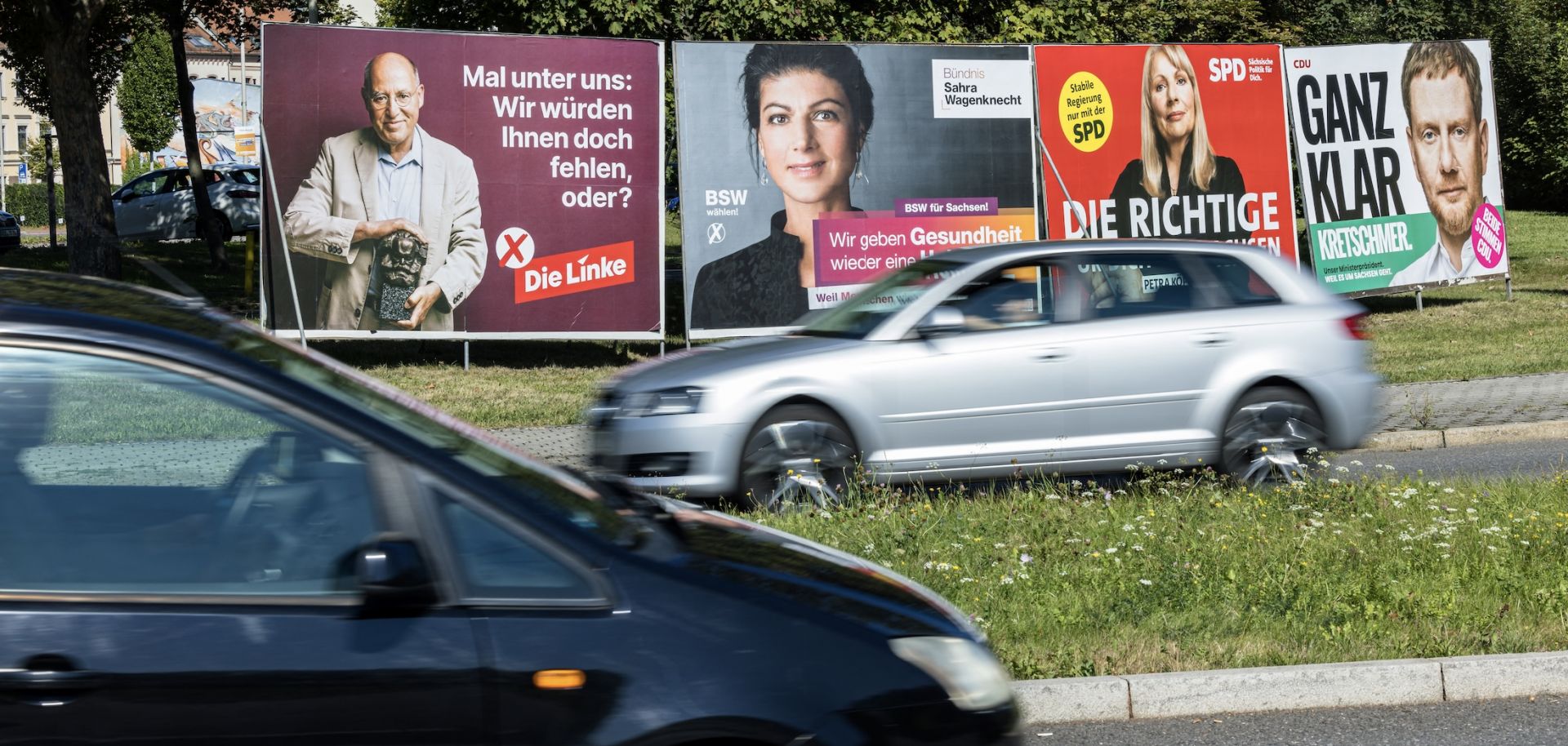
The far-right and the far-left are expected to make unprecedented gains in upcoming state elections in eastern Germany, which could disrupt the implementation of federal migration and energy policies at the regional level while weakening mainstream parties just one year before the country's next general election. Three eastern German states — Thuringia, Saxony and Brandenburg — will elect new governments in September 2024, in elections that polls project will see populist parties from both the far-right and far-left gaining substantial support at the expense of mainstream, centrist parties. Voters will cast their ballots in Thuringia and Saxony on Sept. 1, and in Brandenburg on Sept. 22. The far-right Alternative for Germany (AfD) party, which is polling at 18% nationwide, is currently in second place in Saxony at 30%, right below the center-right Christian Democratic Union (CDU), and first in Thuringia and in Brandenburg, where it is polling at 29% and 25%, respectively. The recently formed far-left Sahra Wagenknecht Alliance (BSW), which is polling at 9% nationwide, is projected to make a strong debut, polling at 19% in Thuringia, 13% in Saxony and 17% in Brandenburg. By contrast, the three parties within Chancellor Olaf Scholz's coalition government — the center-left Social Democratic Party (SPD), the pro-business Free Democratic Party (FDP) and the Greens — are set for a heavy defeat across all three states, polling at a combined 12% in Thuringia, 13% in Saxony and 27% in Brandenburg (where the SPD is fielding current state governor Dietmar Woidke). Meanwhile, though polling first nationwide, the main opposition party, the Christian Democratic Union (CDU), is polling second in Thuringia with 22%, first in Saxony with 32% and third in Brandenburg with 19%.
- A series of recent scandals have dented the AfD's popularity, including allegations of espionage, foreign interference and leaked discussions of a controversial migrant deportation plan that sparked nationwide protests against the party in the first half of 2024. The far-right party's nationwide approval ratings have fallen from 23% in December 2023 to 18% today, with some voters shifting their support to more moderate parties on the right (such as the CDU) or smaller anti-establishment parties across the ideological spectrum (like the BSW).
- Founded in January 2024 by former far-left party Die Linke lawmaker Sahra Wagenknecht, the BSW presents a mix of left-leaning economic and socially conservative views. The party, like the AfD, has strongly anti-immigration and pro-Russia stances, pushing for an end to military support for Ukraine and a resumption of energy trading with Russia.
The strength of anti-establishment parties in eastern Germany is rooted in a mix of historical and socio-economic factors that perpetuate East-West divisions within the country, fuelling a general sense of disenfranchisement among eastern voters with the country's political establishment. In the June 2024 European Parliament elections, the AfD emerged as the strongest party in all eastern states (with the exception of the city-state of Berlin), while the BSW came in third. Yet, the two parties came only fourth and sixth, respectively, across western states, underscoring an increasingly evident East-West divide in German politics that is rooted in historical and socio-economic factors. Nearly 35 years after the country's reunification, the former East Germany continues to trail the former West on key socio-economic measures such as education, unemployment, productivity and purchasing power, while facing demographic challenges that are typical of post-communist Eastern European countries, such as an aging population and depopulation. This has fuelled a sense of disenfranchisement and frustration with the established political order in Germany's eastern states, where many voters feel the benefits of reunification have been unevenly distributed. This economic malaise, coupled with a decades-long history of authoritarian ruling under the communist regime of the German Democratic Republic (GDR), has created fertile ground for radical political movements in the region. In recent years, this political divide has become increasingly marked, with the AfD — and now also the BSW — capitalizing on concerns surrounding immigration and globalization, while mainstream parties, seen as out of touch with the concerns of eastern voters, have lost ground. Since 2022, Germany's support for Ukraine in its war against Russia has also become a key issue for voters in eastern Germany, which tend to be more pro-Russia and to blame the cost-of-living crisis of the past two years on Western sanctions against Moscow.
- According to official government statistics, as of 2023, the average monthly salary in the former East Germany was 817 euros less than in the former West Germany. Moreover, with the exception of Berlin, almost all companies listed on Germany's stock exchange are headquartered in western states, while a recent study from the universities of Jena, Leipzig and Gorlitz/Zittau shows that only about 12% of people in leadership positions in Germany — from politics to public administration and business — were born in the country's east.
- According to recent surveys, more than a third of voters in eastern Germany believe the federal government is giving too much aid to Ukraine, while a majority believe the most important topics to be migration, education and the economy, with climate and the energy transition representing only a minor concern.
Mainstream parties will likely seek to form unusual coalitions in the three eastern states to keep the far-right AfD out of government, even if it means including the far-left BSW in those coalitions, but alliances between the BSW and the AFD cannot be ruled out. While the AfD could come first in all three state elections, the mainstream parties' opposition to cooperating with the far-right party means the AfD is unlikely to enter any of the three regional governments. Against this backdrop, the BSW could emerge as the kingmaker, and has a good chance of entering government in at least one of the three states by making alliances with the mainstream parties. In fact, ideologically awkward coalitions are relatively common at the local and regional level in Germany, particularly since the rise of AfD in recent years, and cooperation between the BSW and the CDU could be necessary to form a government in all three states. Meanwhile, although unlikely given the far-left and -right parties' ideological differences, a BSW-AfD alliance is still possible as the parties share similar positions in areas such as migration, climate, the energy transition and the war in Ukraine. Another scenario could see the AfD forming a minority government in some states even without an outright majority, through the informal support of smaller parties in parliament, including potentially the SWB.
- To keep the far-right AfD from gaining power, political alliances in Germany's eastern federal states have in recent years been shaped by the cordon sanitaire principle, a traditional political practice in Europe in which mainstream political parties isolate and marginalize extremist forces (particularly far-right parties, given Germany's history). This led to unconventional coalitions that would be unthinkable at the federal level, such as in Thuringia, where the conservative CDU is effectively backing a left-wing minority government formed by Die Linke, the SPD and the Greens. The CDU has explicitly ruled out forming any alliance with the AfD, but not with the BSW.
- The BSW's top candidate for Thuringia, Katja Wolf, said she would not rule out collaborating with the CDU or the AfD on a case-to-case basis or as part of a coalition.
Should the AfD enter state governments in eastern Germany, the party could obstruct federal migration and energy policies, potentially harming the local business environment by making it harder to attract foreign workers, as well as investments in renewable energy. While the federal government in Berlin has primacy over policy areas including migration and energy, state governments have various tools to influence, disrupt or slow the implementation of federal policies. For instance, an AfD-led government in Brandenburg, Saxony and/or Thuringia could decide to implement measures aimed at discouraging immigration and/or obstructing renewable energy projects in favor of traditional industries like coal mining and energy-intensive sectors. This could undermine the business environment in the country's east, where many production facilities in traditional German industries (like automotive, steel and metals) are located, and where production facilities in innovative sectors (like semiconductor and battery manufacturing) are being built. A regional AfD government, and eventual implementation of local energy and migration policies that contrast with those being pursued by Berlin, could also hurt local manufacturers' ability to attract foreign skilled workers, advance the decarbonization of their industrial processes and ultimately attract investment.
- In an interview with Germany's N-TV on Aug. 13, the head of the AfD's state branch in Thuringia, Bjorn Hocke, said that if his party won the state's election (which would see him become the head of the regional government), he would seek to implement drastic policy changes aimed at making Thuringia ''as unattractive as possible for social migration.''
- While immigration policies are set at the federal level in Germany, state governments have some degree of influence in specific areas related to immigration, particularly in the implementation process. For instance, state authorities have control over the registration of immigrants, the processing of asylum applications and the enforcement of deportations. Moreover, states have significant autonomy in shaping integration policies concerning immigrants, including in areas such as language education, vocational training and welfare. Against this backdrop, an AfD-led state government could decide, for instance, to expedite deportations of undocumented immigrants or those whose asylum applications have been rejected. Such a government could also impose bureaucratic hurdles that make it harder for immigrants to access federally mandated social benefits, as well as residency and work permits, and create an environment generally perceived as less welcoming to immigrants through changes to school curricula, cuts to programs that promote multiculturalism, and increased policing of areas with large immigrant populations.
- The federal government also has primacy in setting the overall energy policy framework in Germany, including on energy strategy, emissions reduction targets, renewable energy mandates and the regulation of energy markets. However, similar to migration policies, states play a crucial role in implementing federal energy policies, as they are responsible for regional energy planning, granting permits for renewable energy projects and regulating local utilities. As such, an AfD-led state government in Brandenburg, Saxony and/or Thuringia could potentially delay permits for renewable energy projects, impose restrictive land-use regulations and/or prioritize fossil fuel projects at the state level.
While having minimal impact on federal policies, a strong performance by anti-establishment parties in next month's state elections could destabilize Germany's national government and weaken mainstream parties' political prospects ahead of the September 2025 federal election. While both the AfD and the BSW have been campaigning on a platform strongly centered around foreign policy and the war in Ukraine, the outcome of the upcoming elections in Thuringia, Saxony and Brandenburg will not immediately impact Germany's foreign and defense policy, on which state governments officially have no say. Still, given that the ballots are being held just one year before Germany's next national election in September 2025, the outcome could affect the federal government's political calculus and policy priorities. In particular, a triumph for anti-establishment parties would increase pressure on the three parties within Germany's ruling coalition to strengthen their electoral profiles and harden their stances on sensitive issues such as defense, Ukraine, fiscal policies, migration and climate. This could, in turn, exacerbate infighting within an already fractious and unpopular governing coalition, leading to more policy and political instability for the remainder of the federal government's term. Moreover, eventual difficult and politically painful alliances with the BSW to keep the AfD from entering state governments in Thuringia, Saxony and Brandenburg could create rifts within mainstream parties such as the SPD and CDU, potentially harming both parties' popularity only 12 months ahead of the general election.
- Germany's federal government is divided between the Bundestag (parliament), which is made up of federally elected officials, and the Bundesrat (Senate), which is made up of representatives from each German state. If the AfD manages to enter more state governments in eastern Germany over time, the party's increased representation in the Bundesrat, which reviews all federal laws before they are put to a vote in the Bundestag, could also enable it to gain some influence at the national level. However, the party would need to control at least nine of Germany's 16 federal states to exert significant influence over federal policymaking in the Bundesrat, for which it would need to continue to grow its popularity in western German states too.
- Eventual negotiations with the far-left BSW to keep the AfD from entering state governments in the east will prove difficult and politically costly for Germany's mainstream parties. BSW leader Wagenknecht has listed conditions for potential coalition partners at the state level that have very little to do with state policies, including joining calls for peace negotiations in Ukraine and rejecting Berlin's recent agreement with Washington to station U.S. long-range missiles in Germany starting in 2026. While the parties in Germany's ruling coalition and the CDU support Ukraine's war efforts and the U.S. missile agreement, these policies are deeply unpopular with voters in the east. Potential agreements between the SPD or the CDU with the BSW at the state level could thus highlight internal contradictions and sow divisions within both parties, which could emerge weakened and divided before next year's national election.
