
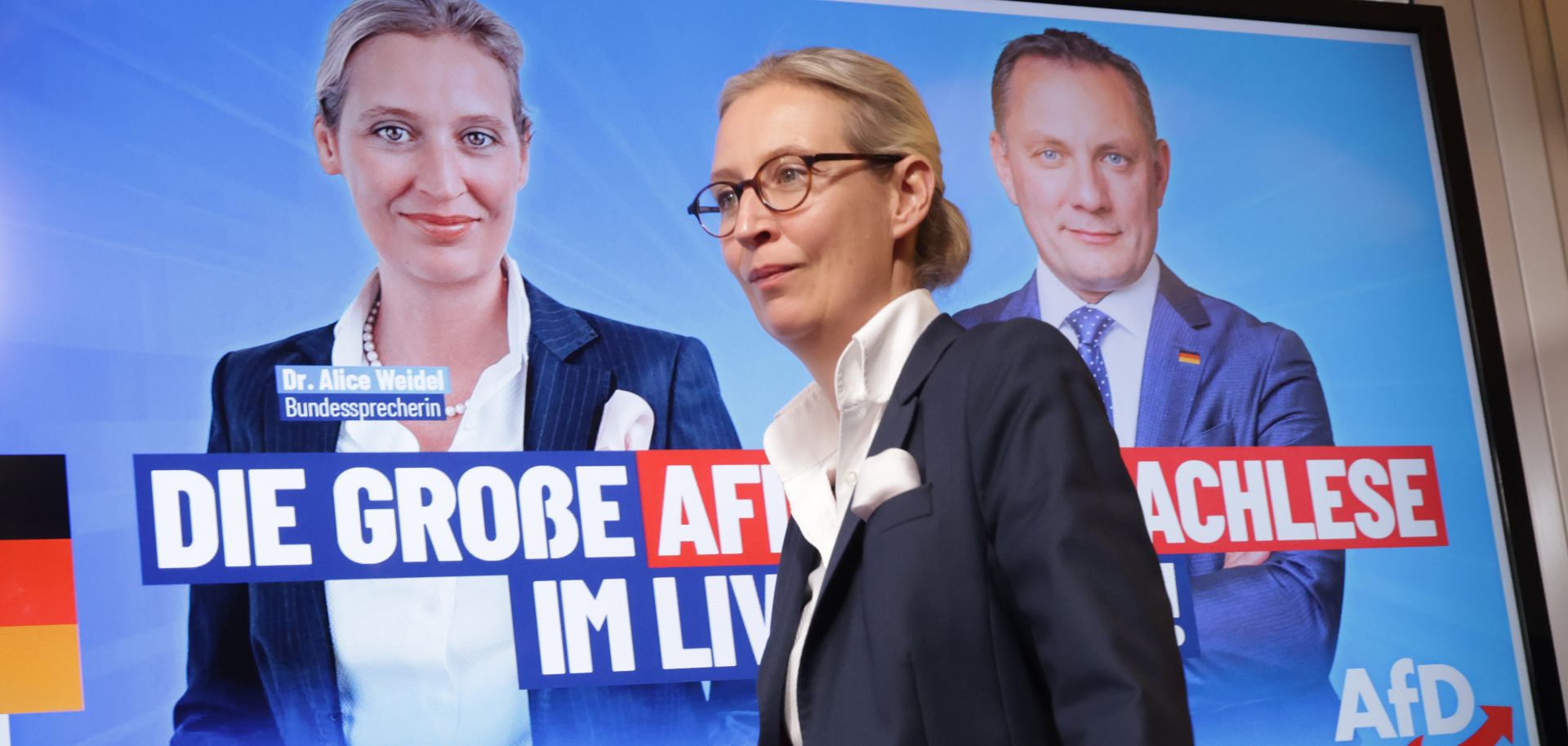
Mainstream parties in Germany will maintain unity in keeping the far-right Alternative for Germany (AfD) party out of government at the federal level, but the AfD's strong support in eastern Germany could increase its influence at the state level, while further contributing to the country's growing political polarization. In recent years, the AfD has become increasingly popular in Germany, as evidenced by the far-right party's strong performance in the recent European Parliament elections in which it secured over 16% of the vote — the AfD's best-ever result in a nationwide ballot. Fueled by concerns with rising migration levels, economic grievances in the county's east and a general dissatisfaction with mainstream party politics, the party continues to poll strongly nationwide, with the AfD currently slated to win 17% of the vote in Germany's 2025 federal election, up from the 10.2% it won in the 2021 election. Support for the AfD is particularly high in eastern Germany, which also puts it on course for a strong showing in the regional elections that will be held in the eastern states of Brandenburg, Saxony and Thuringia in September. However, a series of scandals and controversies will ensure the far-right party remains relegated to the fringe of German and European politics, which will risk further radicalizing the AfD's policy platform and its growing number of supporters.
- In the June 2024 elections for the European Parliament, the AfD performed especially well among younger German voters, as well as voters in former East Germany, where the party secured 29.7% of the total vote (compared with the 16.2% it secured nationwide). Meanwhile, German Chancellor Olaf Scholz's Social Democratic Party (SPD) had its worst-ever electoral performance, securing only 13.9% of the total national vote in the EU elections.
- At the federal level, the AfD is the second-strongest party in the polls, after the center-right opposition Christian Democratic Union (CDU), which is currently polling at 31% ahead of Germany's 2025 national election. Scholz's SPD is polling third place with 16%. While the AfD continues to poll strongly nationwide, its approval rating has taken a hit amid the slew of recent controversies and scandals, dropping from 22% at the end of 2023 to the current 17%, down from 22% at the end of 2023.
- In the states of Brandenburg, Saxony, and Thuringia, the AfD leads regional polls with 25%, 34%, and 30%, respectively, ahead of the CDU's 19%, 30% and 20%.
Despite the AfD's strong performance in the EU elections, recent controversies affecting the party will limit its national popularity, as well as its capacity to cooperate with other parties in Germany and Europe, further weakening the far-right party's influence at the national and EU levels. Despite its recent electoral victory, the AfD's designation as a ''potentially extremist'' organization by federal authorities, as well as a series of scandals and allegations of espionage and foreign interference affecting its leadership, have significantly affected the party's public image. Furthermore, leaked internal party discussions for a highly controversial migrant deportation plan led to widespread protests against the AfD across Germany, while repeated controversial remarks by the party's leading candidate for the European Parliament elections prompted other European far-right parties to distance themselves from the party, ultimately causing its expulsion from the far-right Identity and Democracy (ID) group in the European Union's supranational legislature. This series of scandals will continue to limit the party's rise in nationwide polls, as less radical voters are likely to shift their support to more moderate parties (such as the CDU) or distribute their votes among smaller anti-establishment parties across the ideological spectrum (like the left-wing, socially conservative Sahra Wagenknecht Alliance). Furthermore, widespread condemnation from mainstream parties in Germany, as well as the AfD's expulsion from the far-right ID group in the European Parliament, will significantly impede the party's ability to increase its influence at the national and EU level, despite its rising popularity among German voters. At the EU level, this means that AfD will likely continue to play a marginal role alongside other eurosceptic opposition parties in the European Parliament, with little to no impact in shaping EU policies. At the national level, due to mainstream parties' reluctance to enter coalitions with the AfD, the party also remains unlikely to play a role in Germany's federal government or meaningfully affect policy.
- A 2023 investigative report by the German newspaper DER SPIEGEL uncovered connections between the AfD and the Russian government, revealing that an AfD staffer sought Moscow's assistance to delay weapons deliveries to Ukraine and allegedly provided state secrets to Russian intelligence officers. In April 2024, a German soldier and AfD party member was also charged by a German court for providing Russia with military intelligence.
- On April 23, an aide to AfD EU politician Maximilian Krah was arrested for allegedly providing intelligence to China. Following the scandal, Krah refused to step down as a leading AfD candidate for the June EU elections. Krah then made controversial remarks to the Italian newspaper La Repubblica on May 18, claiming that the ''SS were not all criminals,'' sparking an outcry from other European far-right parties, including France's National Rally.
- In early February, over 200,000 people across Germany marched in opposition to the AfD, with over 150,000 protesters gathering in front of the German Parliament in Berlin.
- The AfD's relegation to the fringe of German and European politics sets it apart from far-right parties in other large and influential EU member states — namely, Italy's Brothers of Italy and France's National Rally, which have long been on a path of progressive ''normalization,'' with the former leading a coalition government in Rome and the latter having a real chance at victory in France's upcoming parliamentary elections.
Support for the AfD is expected to remain strong in East Germany, with state elections in September giving the party a chance to enter a regional government for the first time, which could have significant implications for local migration and energy policies. While weakened at the federal level and further marginalized at the EU level, the AfD's rise is expected to continue at the state level. In fact, despite the recent scandals, the party continues to garner significant support in the eastern regions of the country as the local population grapples with the effects of a weaker economy, deindustrialization and a general sense of disenfranchisement from Germany's political establishment. This sets the stage for a strong electoral showing by the AfD in the September state elections and beyond. Should the party manage to enter state governments in Brandenburg, Saxony and/or Thuringia, it would grant the AfD much greater sway over regional policymaking and governance in eastern Germany, particularly on migration and energy policies. The AfD would likely push for stricter immigration controls and oppose renewable energy projects in favor of traditional industries like coal mining and energy-intensive sectors. This could have a significant impact on the country's east, where many production facilities in traditional German industries (like automotive, steel and metals) are located, and where production facilities in innovative sectors (like semiconductor and battery manufacturing) are being built — negatively impacting the capacity of local manufacturers to attract foreign skilled workers, advance the decarbonization of their industrial processes and ultimately attract foreign investment.
- Germany's federal government is divided between the Bundestag (parliament), which is made up of federally elected officials, and the Bundesrat (Senate), which is made up of representatives from each German state. If the AfD manages to enter more state governments in eastern Germany over time, the party's increased representation in the Bundesrat, which reviews all federal laws before they are put to a vote in the Bundestag, could thus enable it to gain some influence at the national level.
In the longer term, the AfD's growing popularity, coupled with its continued marginalization at the federal level, could see the party support more radical policy proposals and narratives, resulting in increased political polarization and related safety risks in the country. The party's likely continued inability to participate in the federal government may help push it further to the extreme, amplifying radical views about the state of Germany's democracy and emboldening its supporters to escalate protest activity. If the AfD's narratives blaming the current German government, the United States and NATO for the war in Ukraine spread further, this has the potential to increase the risk of far-right violence against minorities, center-left politicians and possibly Ukrainian refugees in Germany. Moreover, large anti-government demonstrations by AfD supporters could grow in size and intensity, and may increasingly turn violent, particularly if they are met with counter-protests.
- In April and May alone, suspected far-right activists physically attacked four politicians of the SPD and Greens. Furthermore, in June 2019, a far-right neo-Nazi assassinated the local Hesse CDU politician Walter Lubcke and confessed to the crime in the weeks afterward.
