

Increased security threats in Europe are driving countries to tighten their border controls, heralding a more spotty functioning of the passport-free Schengen area in the coming months that will result in greater economic costs and business disruptions. In recent months, several members of Europe's passport-free Schengen area have reintroduced security controls at their international borders. Between June and July, Germany, Austria, Slovenia, Italy, Norway, Denmark, Sweden and France all introduced or extended border controls, which also affects Slovakia, the Czech Republic, Poland, Switzerland, Croatia and Hungary due to their shared borders with these countries. As a result, half of the Schengen area's 29 member states are currently facing controls at all or parts of their borders. Most of these measures are currently scheduled to end between November and December, but Schengen rules allow for extensions, which means they could remain in place well into 2025.
- The Schengen Agreement was signed in 1985 with the goal of eliminating physical border controls within Europe and facilitating the movement of people and goods across the Continent. The agreement entered into force in 1995 and currently includes 25 of the 27 members of the European Union and the four members of the European Free Trade Association.
- The Schengen Agreement has multiple economic benefits, including reducing transportation costs between member states (as vehicles transporting goods and people are not subject to delays at border crossings), promoting tourism between member states, and allowing people to travel between member states for study or work without facing any passport controls. According to official EU data, Europeans make an estimated 1.25 billion journeys within the Schengen area every year.
- The introduction of temporary border controls within the Schengen area was a relatively rare event between 1995 and 2015, and was primarily connected to high-profile events (such as large sports events or the arrival of a high-profile visitor like the U.S. president). However, they have since become more frequent. Border closures became widespread during the 2015-2016 migration crisis, when over 1.3 million people reached Europe seeking asylum; and almost all Schengen states closed their borders during the COVID-19 pandemic in 2020-2021 in an effort to mitigate the virus' spread. Over the past decade, there have always been controls at some borders within Schengen at any given time for reasons connected to migration or terrorism.
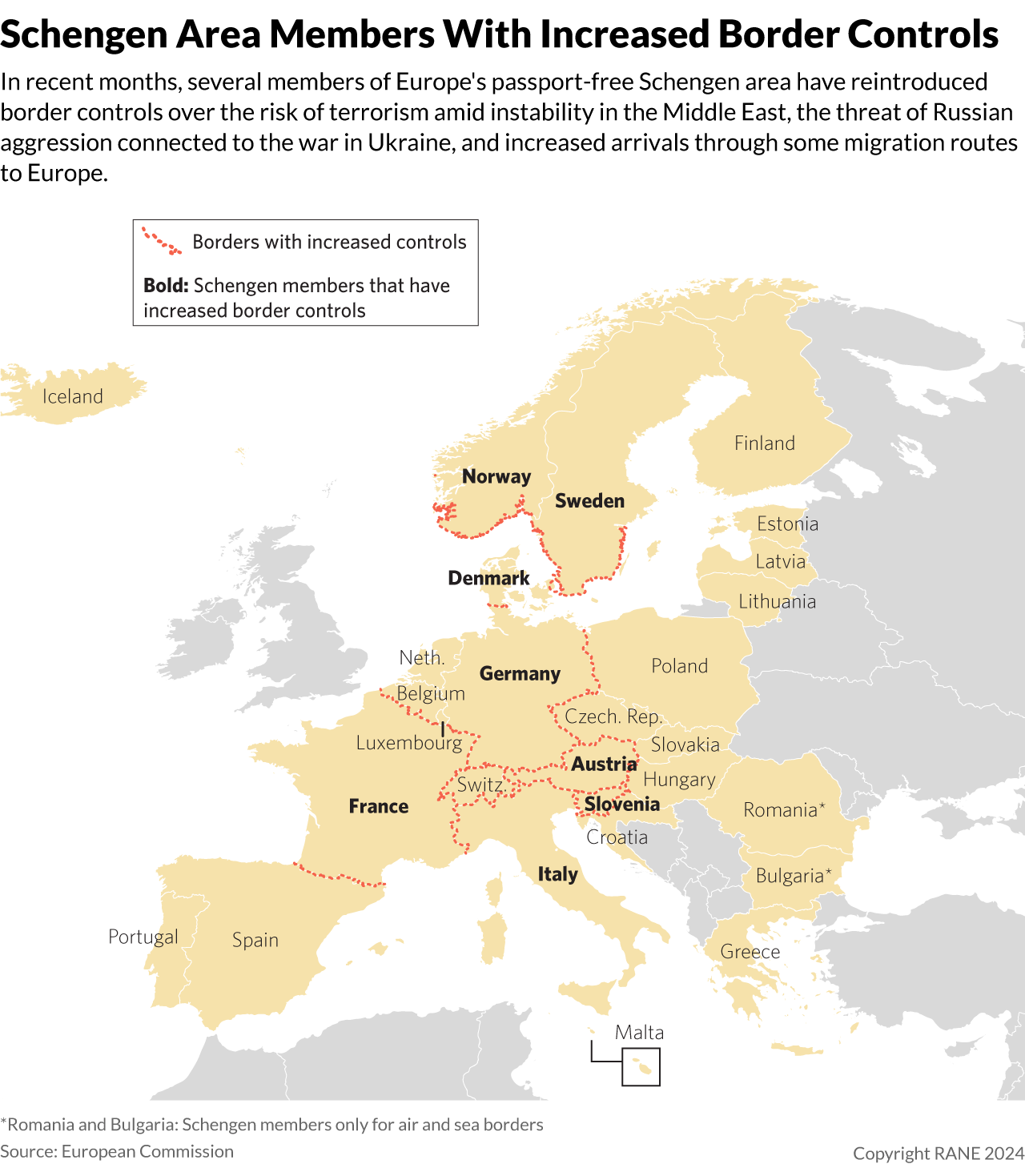
The main reasons behind the current border controls include increased migration levels in Europe, terrorism risks linked to the conflict in the Middle East, and threats of Russian aggression linked to the war in Ukraine. According to the Schengen Agreement, member states must provide valid justifications for reintroducing border controls. In recent months, the main drivers behind the tightening of controls have included the heightened risk of terrorism in Europe connected to the ongoing conflict in the Middle East, the risk of conventional and unconventional aggression from Russia over the conflict in Ukraine, and increased activity in some of the main migration routes to Europe (in the first six months of 2024, arrivals through the migration route connecting Western Africa to the Canary Islands increased by 174% while arrivals through the Eastern Mediterranean route connecting Turkey to the Balkans increased by 75%, compared with the same period of 2023). Although Schengen members must notify the European Commission in advance, the decision to reintroduce border controls is ultimately in the hands of national governments and Brussels cannot stop it. And while Schengen rules establish that border controls should not stay in place for longer than six months, the treaty also establishes that under extraordinary circumstances they can remain in force for as long as individual governments decide they are needed.
- Austria's reasons for introducing controls in its borders with Slovenia and Hungary include ''the new threat situation in connection with the extremely unstable migration and security situation in the EU, pressure on the asylum reception system, high migratory pressure at the EU's external border to Turkiye and the Western Balkans, threat of arms trafficking and criminal networks due to the war in Ukraine, human smuggling, the security implications following the [Oct. 7] Hamas attack on Israel...numerous terror warnings and threats in the EU Member States, the rise of anti-Semitism in Europe, and the risk of criminals and terrorists infiltrating migration flows.'' Most of the other European governments currently imposing border controls cite similar reasons.
- In justifying its decision to reimpose border controls with Germany, Denmark referenced the heightened risk of Islamic terrorism and the threat of espionage from Russian intelligence. In August, Denmark said it would also strengthen controls at the main bridge connecting it to Sweden due to an increase in violent crimes in its northern neighbor.
- Norway's justifications are particularly focused on Russia, and include the ''increased threat to critical infrastructure'' and ''Russian intelligence operations threatening Norwegian exports of gas or military support to Ukraine.''
- Other countries have more specific reasons for reintroducing border controls, in addition to mitigating threats connected to Russia, the Middle East and migration. Italy, for example, also highlights its ongoing presidency of the G-7, while France mentions its hosting of this summer's Paris Olympics and Paralympics, which both Rome and Paris argue expose them to greater external threats.
The drivers behind the ongoing border controls will remain in place in the coming months, portending continued security measures across the Schengen Area. The war in Ukraine has no end in sight, and Kyiv's recent gains in Russia's Kursk region suggest that peace negotiations will remain elusive. Meanwhile, in the Middle East, a sustainable Gaza cease-fire between Israel and Hamas also remains out of reach, while the ongoing tit-for-tat strikes between Israel and the Lebanese militia Hezbollah suggest that a wider regional conflict — potentially involving additional actors more actively (such as Iran) — remains a possibility. Of the main drivers prompting European countries to reimpose border controls, irregular migration is the only one that will likely abate in the coming months, as migration flows to Europe often die down during the winter, when weather conditions are less conducive to land and sea crossings. But even if the actual number of arrivals to Europe drops, the current strength of anti-immigration political forces across the Continent, combined with high-profile terror attacks by lone actors with migration backgrounds, means that national governments will continue to face significant social and political pressure to keep border controls in place. Schengen countries with anti-immigration and euroskeptic political parties in power will be more willing to maintain their border controls, but their actions will also impact the more progressive countries they share a border with.
- On Aug. 14, Germany's Interior Minister Nancy Faeser said that the country is considering extending its border controls beyond the current Dec. 15 deadline. According to Faeser, the border controls with Austria, Poland, Switzerland and the Czech Republic are helping to reduce irregular migration and should stay in place ''as long as they are necessary.'' The issue is controversial within the German coalition government, as members of the Greens party (one of the three members of the ruling coalition) have called for the lifting of border controls.
- On Aug. 26, a spokesperson for the Czech Republic's Interior Ministry said that the Czech Republic and Poland are worried about the economic fallout from Germany's border controls, and asked Berlin to consider alternative measures.
While the Schengen area is unlikely to be abolished, companies and individuals relying on the cross-border movement of people and goods will face shipping and travel delays amid overall heightened uncertainty about border scrutiny in the coming months. The Schengen area is unlikely to be completely abolished for the foreseeable future due to the deeply negative impact this would have on Europe's economy. For similar economic reasons, individual countries are also unlikely to exit the passport-free travel zone anytime soon. But recurrent reintroductions of border controls will remain the norm in Europe, at least in the short to medium term — resulting in an increasingly patchwork enforcement of the Schengen Agreement that will heighten economic costs and uncertainty for individuals and businesses relying on the cross-border movement of goods and people. In the low-likelihood but high-impact scenario that Schengen is abolished, it would produce much deeper disruptions in trade and tourism and permanently increase costs for businesses and consumers in Europe. The collapse of the passport-free zone would also permanently complicate cross-border mobility for work, education and family visits. Additionally, relationships between neighboring European countries would likely become strained due to the imposition of border controls that negatively impact their neighbors, leading to diplomatic disputes that weaken the unity of the European Union. This scenario would probably take shape over many years, as European governments' increasing focus on border security is more likely to steadily erode the Schengen area than spur its sudden abolishment. But it will become particularly probable if anti-immigration and euroskeptic political parties enter more governments across the European Union, which cannot be ruled out given the ongoing social and political trends within the bloc.
- According to a 2016 report by the European Parliament (one of the most comprehensive reports on this topic to date) a permanent suspension of the Schengen Agreement would represent a loss of up to 0.14% of the European Union's annual GDP, or some 230 billion euros per year. The costs would be lower if only some members of Schengen suspended their participation permanently. Per the report, the impact on labor markets would include ''restricted job mobility, greater heterogeneity of regional job markets and an uneven development of real estate prices.'' The report also establishes that ''reintroducing border control could directly impact movements of goods and services as waiting times for truck drivers and commuters could increase,'' while ''businesses could be affected indirectly by the rise in personnel costs and other costs such as replenishment of their stocks since just-in-time delivery may be limited.'' In addition, ''higher import prices could in turn lead to a general increase in prices as households and businesses' real incomes fall; and therefore also consumption and investment.''
