
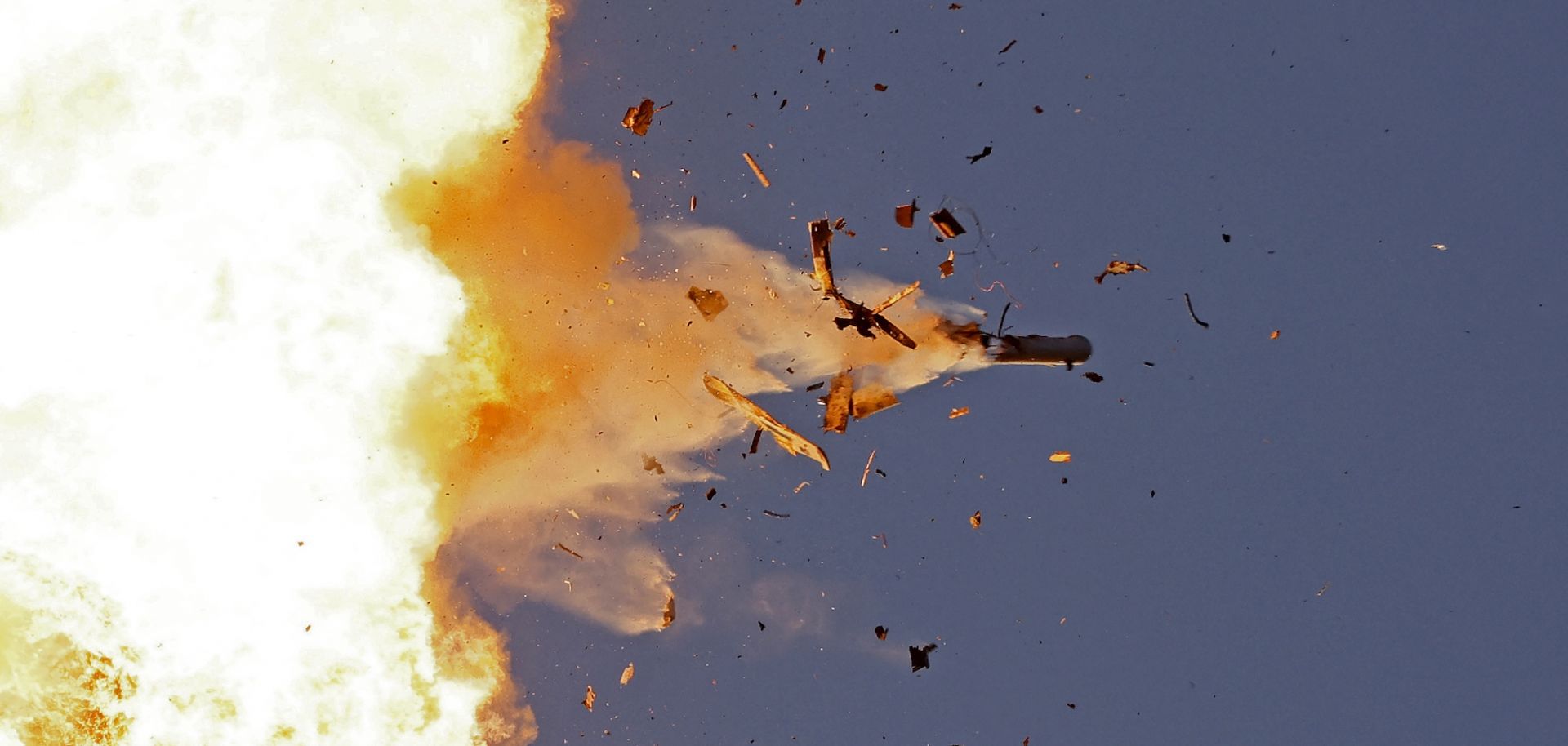
Hezbollah's marginally impactful attack is unlikely to deter Israel, leaving the door open for further Israeli strikes in Lebanon that sustain the risk of an all-out war, especially as Iran and other militant groups prepare for their own rounds of retaliation. On Aug. 25, the Lebanese militant group Hezbollah launched hundreds of rockets and dozens of drones toward numerous Israeli military targets in northern Israel. Hezbollah claimed that these strikes were part of its long-awaited retaliation for the assassination of Hezbollah commander Faud Shukr in Beirut on July 30. The group also claimed the barrage was aimed at distracting the Israeli military's air defenses and paving the way for drones that targeted two bases deep inside of Israel: the Gelilot base, which houses Israel's elite signals intelligence Unit 8200 and is located just 1.5 kilometers north of Tel Aviv, and an airbase 75 kilometers south of Lebanon. Half an hour before the Hezbollah attack, the Israeli Air Force (IAF) launched what it described as a preemptive aerial campaign targeting hundreds of Hezbollah launchers that were ready to be used as part of the strike. The Israeli military claimed to have used 100 fighter jets simultaneously and destroyed thousands of rockets and missiles, including precision-guided ones, aimed at Israel. In a speech later the same day, Hezbollah's Secretary General Hassan Nasrallah acknowledged the preemptive strikes but refuted Israel's claims, saying that fighter jets destroyed only dozens of rocket launchers and that the group did not aim to use precision-guided missiles. Nasrallah also claimed to have successfully achieved Hezbollah's objective with the attack, which the Israelis were quick to refute, saying that most of the drones and rockets were shot down while the rest impacted open areas. By Aug. 26, both sides reportedly exchanged messages through intermediaries indicating they were interested in de-escalation.
- Unit 8200 is the Israeli Military Intelligence Directorate's largest and primary information-gathering unit, and Hezbollah likely targeted it as part of the retaliation for Israel's assassination of Shukr last month. In his speech, Nasrallah alleged that this unit was linked to the strike that killed Shukr in Beirut, explaining why the group chose to target the base.
- It is currently difficult to verify the claims by both sides. Israel's government issued new censorship regulations that include restrictions against publishing information about ''damage caused by rocket attacks to strategic national infrastructure or to military bases.'' Meanwhile, Hezbollah has prevented journalists from assessing the damage of the Israeli airstrikes. One Israeli sailor was confirmed killed when a missile hit a warship in the Mediterranean, while Hezbollah said only two fighters and an allied militant were killed by the Israelis, suggesting that the immediate damage of this round was relatively limited.
The Hezbollah attack is part of the group's response to the assassination of Hezbollah's chief military advisor Fuad Shukr on July 30, and it coincides with Israel's faltering negotiations with Hamas on a Gaza cease-fire deal. Hezbollah vowed to avenge the assassination of its chief military advisor shortly after he was killed, but the group has postponed its reprisal attack for several weeks due to numerous factors. Among other things, Hezbollah likely wanted to play the long game by engaging in psychological warfare against Israel, especially as Iran and its regional allies, including Yemeni Houthi militants, vowed revenge for the separate killing of Hamas' political chief Ismail Haniyeh on July 31 in Tehran and for Israel's July 15 airstrikes against the Hodeidah port in Houthi-controlled Yemen. Following these Israeli attacks, Western diplomats flocked to the region as part of a diplomatic push to defuse tensions, which included reviving negotiations between Israel and Hamas on a potential agreement to end their ongoing war in the Gaza Strip. But after these cease-fire talks became clearly stalled, it appears Hezbollah chose not to postpone its retaliation any further, especially as Israel prepared itself for potential attacks and as the United States deployed more naval forces to the region to help defend Israel against such attacks.
On Aug. 25, Hamas reportedly rejected the latest proposed framework for a Gaza cease-fire deal, though talks continued to try to adjust the terms to meet the Palestinian militant group's demands. The cease-fire is hung up on Israel's insistence on leaving forces in some fashion in Gaza for the long term, especially along the Philadelphi Corridor on the Egyptian border.
The Hezbollah strikes are unlikely to deter Israel from continuing to target high-ranking Hezbollah officials, even in Beirut, at the risk of further escalation. Despite Hezbollah's show of force, the fact that most of the rockets and drones were shot down and that the rest likely did not reach their targets will embolden the Israelis, who will likely see this as proof that Hezbollah does not have the intent to cause serious damage against Israeli targets. Thus, Israel will likely capitalize on its perception of success in its preemptive strikes, and on what it perceives as Hezbollah's underwhelming attack, to launch further escalatory attacks when presented with an opportunity, leaving room for escalation. Given the current political landscape in Israel, with Prime Minister Benjamin Netanyahu relying on his far-right coalition government partners and the war for his political survival, the risk of escalation remains high as Netanyahu faces political pressures for further aggressive strikes in Beirut and elsewhere in Lebanon. The Israeli Air Force's preemptive attacks also underscore Israel's readiness for an aerial campaign against Hezbollah whenever a significant Hezbollah attack seems imminent, assessing that preemptive strikes can foil a potential Hezbollah retaliation or at the very least minimize its effectiveness.
- On Aug. 26, Israel reportedly attempted to assassinate another Hamas official in Sidon in southern Lebanon with a drone strike, further indicating that Israel's campaign of targeted killings remains undeterred by the latest Hezbollah exchange.
Despite the apparent failure to hit most of its intended targets, Hezbollah's attack suggests it will increasingly respond to Israeli provocations with attacks on targets deeper inside Israel, including near Tel Aviv. The strikes had a limited physical impact, but Hezbollah claims its recent response nonetheless achieved its intended political and strategic objectives by targeting the suburbs of Tel Aviv. In doing so, Hezbollah claims the attacks successfully asserted the group's established precedent of ''city for city'' reprisal attacks, in which Hezbollah strikes major Israeli cities in response to Israeli attacks on Beirut (where the Israeli airstrike killed Shakr in July), while delivering a strong message that Israel cannot violate Lebanese airspace and target Beirut without facing consequences. Hezbollah's use of advanced drones and large barrages of Katyusha rockets, instead of medium- and long-range precision-guided missiles, highlights the group's intent to avoid a wider conflict while still demonstrating its will to strike sensitive sites deep within Israel when needed. Furthermore, Hezbollah is claiming a political victory from the fact that it can carry out such a large-scale attack despite Israel's weeks of readiness, U.S. intelligence sharing and Israel's preemptive strikes. Finally, by announcing the use of hitherto largely unused launch sites in the Bekaa Valley and areas north of the Litani River for some of these launches, Hezbollah has expanded the geographic scope of the conflict in the hopes of both mitigating potential damage from Israeli aerial campaigns in the south and maximizing the group's missile and drone launching ability, especially in the event of a wider war, by using more of Lebanon's geography.
- On Aug. 21, the Israeli military launched several airstrikes against Hezbollah weapons storage facilities in the Bekaa Valley in eastern Lebanon. Hezbollah generally reportedly stores its more advanced weapons, including air defenses, in storage facilities in this region.
The latest exchange between Hezbollah and Israel is most likely to result in a limited war of attrition in the near term, but in the long term, Israel will probably move toward a wider war to achieve its strategic goal of establishing a buffer zone in southern Lebanon. As neither Israel nor Hezbollah has a clear path to victory in case of a 2006-style war, they are more likely to try to force one another to alter the other's strategic behavior with sustained military pressure. For Hezbollah, this will mean continuing to make the northern part of Israel a no-go zone for civilians and expanding the geographic scope of limited strikes on strategic targets across the country. For Israel, this will mean a sustained air and covert assassination campaign against Hezbollah and a continued focus on the destruction of the militant group's launchers and arsenals. Overall, this dynamic disadvantages Hezbollah, as Israel can systematically degrade its military capabilities and command structure without getting embroiled in a likely unsuccessful ground incursion of Lebanon that would risk exacerbating problems at home for Israel. Despite the disadvantages, Hezbollah may perceive that if it can sustain military pressure on northern Israel and withstand Israel's degradation campaign, domestic political pressure against Netanyahu's government in Israel could eventually force a diplomatic settlement by making Israel more wary of the potential diplomatic and political repercussions from an escalation into a wider conflict. But in the course of this campaign, either side might strike a politically sensitive target that would shift the drivers toward war, such as a Hezbollah strike that causes numerous civilian casualties in Israel or an Israeli strike that kills another high-profile Hezbollah leader or significant numbers of Lebanese civilians. Moreover, regardless of what happens in the near term, Israel's government will likely continue to lose support for an extended conflict in Lebanon that does not seem to increase the chances of civilians returning home to the north or of sufficiently deterring Hezbollah from more attacks on the north. As the Gaza campaign winds down, the Israelis will thus likely increasingly move closer to an eventual extended ground campaign in Lebanon over the long term, especially if repeated attacks by Iran and its allies fail to substantially undermine Israel's security or political dynamics.
- Neither Israel nor Hezbollah has a path to a clear military victory over the other. Israel was unsuccessful in its 2006 campaign to destroy the group due to Hezbollah's entrenchment in southern Lebanon and foreign support from Iran, and Hezbollah has only further deepened its defenses and broadened its supply lines from Iran since then. Meanwhile, Hezbollah cannot conventionally defeat the Israeli military nor coerce the Israelis to abandon their Gaza campaign by force. This means that if Hezbollah escalated to another broader war with Israel, it would result in an inconclusive military and diplomatic outcome while imposing significant economic costs on Lebanon.
Finally, Iran, the Houthis and militias in Syria and Iraq remain poised to conduct their own retaliations against Israel, which may still precipitate a rapid escalation to a regional war. Hezbollah's barrage is unlikely to have appeased hard-liners in Iran and its allies who have their own reasons to retaliate against Israel, meaning that Tehran, Yemeni Houthis and Iran-backed militias in Syria and Iraq remained poised to eventually attack Israel. Such strikes may be coordinated to maximize their political and psychological impact, but the pattern of behavior shown by the Iran-led network of militias means these groups' eventual retaliations are unlikely to be designed to intentionally cause mass casualties in Israel that would drive the region toward war. Instead, their strikes will probably be designed to create maximum political impact, weakening Israel's resolve for further escalation while strengthening the regional political support for Iran and its allies by showcasing their willingness to militarily confront Israel. In the near term, Israel is unlikely to respond to such attacks with significant escalation, likely instead choosing to carry out politically important counterstrikes as it did in response to Iran's April 2024 attacks on Israel. However, as each of these barrages takes place, there remains the latent risk that one strike could cause significant casualties inside Israel, spurring a hawkish Israeli military reaction that pushes the region closer to an all-out regional war between these forces.
- Iran has continued to warn that it is preparing its own retaliation for the killing of Hamas' political leader in Tehran, with Iranian Foreign Minister Abbas Araghchi saying that the reprisal strikes would be ''definitive'' and ''well-calculated'' in an Aug. 25 phone call with his Italian counterpart.
- The Israeli government recently warned that the Aug. 25 attacks by Hezbollah ''have the potential to escalate into a widespread, multi-front conflict.''
