
Russia's renewed push toward Kharkiv is initially intended to spread thin and distract Ukrainian forces, but the growing threat it poses to the city and surrounding region will likely become core to Russia's war efforts in 2025 and beyond. On May 10, Russian forces reopened a front north of the northeastern Ukrainian city of Kharkiv by attacking two locations in the surrounding region, enabling them to gain a foothold in a number of Ukrainian settlements along the Russia-Ukraine border. Russian troops had besieged Kharkiv — which is located roughly 30 kilometers south of the Russian border — earlier in the war, but were forced to retreat in September 2022 as a result of Ukraine's successful counteroffensive. On May 14, the Ukrainian military acknowledged it had withdrawn from the border town of Vovchansk, though fighting continued on the town's outskirts. As of May 17, Russian forces were still advancing toward the Ukrainian village of Lyptsi, which is within 10 miles of the outskirts of Kharkiv, meaning its capture would put Kharkiv within standard artillery range. But their advance has already slowed ahead of reaching Ukrainian defensive fortifications in the area, and continued advances are unlikely and will come at increasingly high cost. Ukraine's Security Council estimated that up to 30,000 Russian troops are involved in the current attack in the Kharkiv region or earmarked for the new front, though this number is only around half of the up to 60,000 troops that Russia was expected to commit toward Kharkiv. But while Russian gains have slowed significantly in recent days, much depends on how many and at what pace Russia commits additional forces to the area, or if it instead redeploys for attacks elsewhere.
- Speaking to the press at the end of his visit to China on May 17, Russian President Vladimir Putin said ''as for Kharkiv, as of today there are no such plans'' to take the city. He claimed Russia was establishing a ''sanitary zone, a security zone,'' in response to Ukrainian shelling in Russia's nearby Belgorod region (located roughly 40 kilometers from the Ukrainian border), and that Russian forces in the region were steadily advancing in the Kharkiv region according to plan. Putin's comment is intended to signal that Russia will not seize Kharkiv if Ukraine and its Western allies accept a cease-fire on Russia's terms, but that Russia will continue to seize more territory near the city and increase its demands if they do not capitulate.
- The Russian troops advancing toward Kharkiv are composed of elements of Russia's 11th Army Corps, including the 18th Guards Motor Rifle Division, two motor rifle brigades of the 6th Combined Arms Army and the 44th Army Corps. Notably, the Russian forces have primarily been operating dismounted — relying on artillery and close air support instead of armored vehicles, which Russia is likely preserving to continue its advances southward if its troops are able to breach Ukraine's defensive lines. The composition of opposing Ukrainian forces is less clear, but they were initially comprised of less experienced units.
- Speaking to The New York Times on May 14, Ukraine's military intelligence chief, General Kyrylo Budanov, said he expected Russian forces to open a new front in the neighboring Sumy region, even further from the main frontline in southeastern Ukraine. Ukrainian officials have warned for months that Russia is amassing troops to open new fronts in the Sumy or even Chernihiv regions. However, the scale of such a front in the Sumy region would likely be even smaller than the one in Kharkiv, as Russia currently only has around 10,000-15,000 troops that it could quickly commit to an attack there.
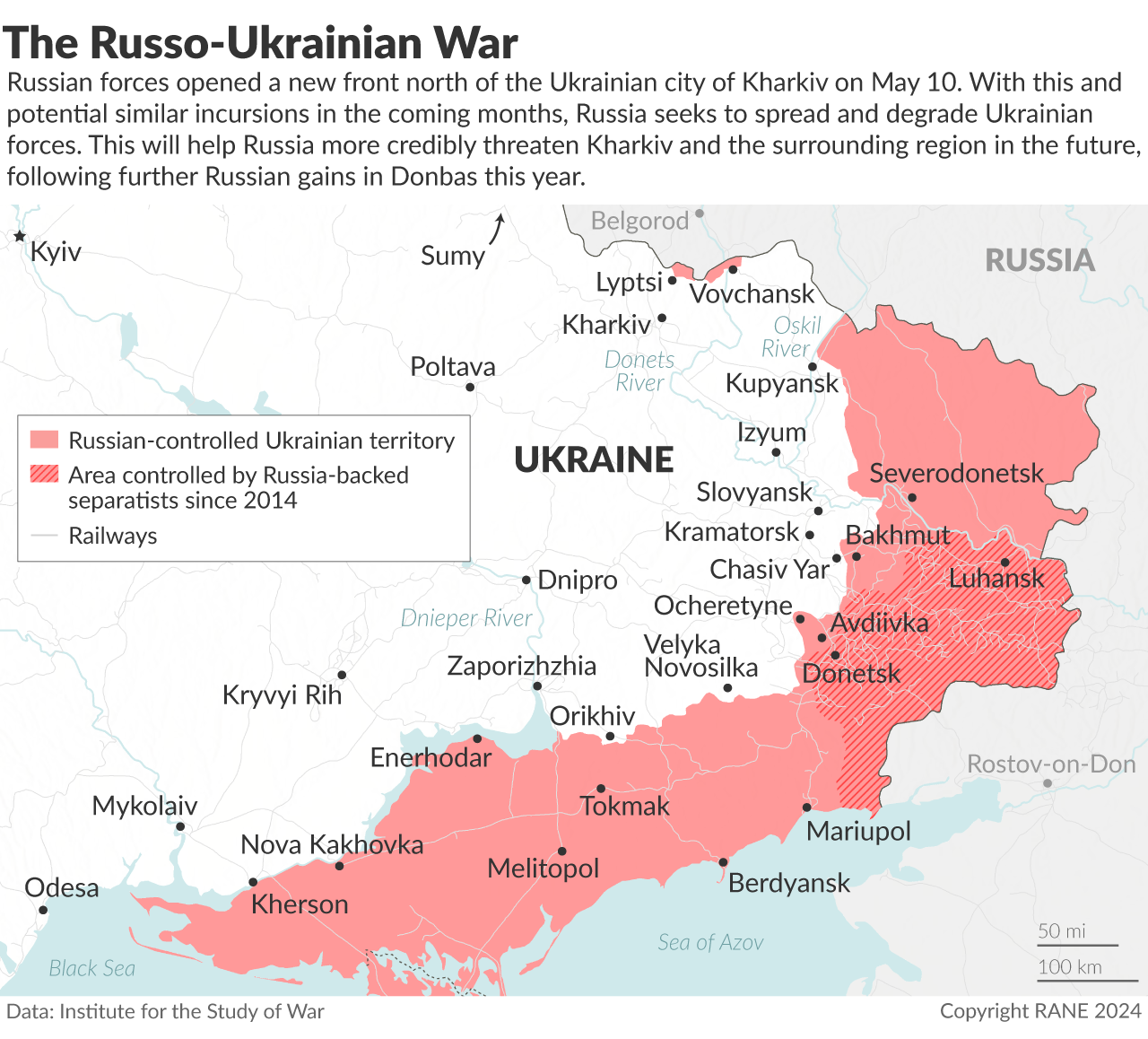
In the short term, Russia's new front north of Kharkiv — and the prospect of similar incursions in Sumy or Chernihiv — is intended to draw Ukrainian resources away from more crucial areas in the eastern Donbas region, while degrading Ukraine's precious equipment and reserve forces. Russia's attack toward Kharkiv has so far not involved a significant number of Russian forces, nor have those forces made major territorial gains. This is because Russia has neither the capacity nor desire to seize large swaths of territory in Ukraine's northeast, at least in the next few months. Indeed, the majority of Russia's best forces — including its most elite breakthrough units — are in the Donbas, rather than arranged for an attack to rapidly seize more of the Kharkiv region. By opening the new front north of Kharkiv (and by threatening to launch a similar incursion in Sumy or even Chernihiv), Russia is instead seeking to drain Ukrainian manpower and resources, as well as draw Ukrainian forces away from sensitive areas of the front in Donbas to open Russian gains there, which Moscow currently sees as more crucial to its war efforts. Seizing additional territory in the Donbas aligns with Russia's stated war aims, which include securing Russia's territorial integrity per its constitution. It would also make the threat of Kharkiv's capture more credible, which Moscow is hoping would further undermine support in both Ukraine and the West for continuing the war by prompting more Ukrainians to call for cease-fire negotiations, arguing that inking a truce with Russia — even if it involves territorial concessions in Donbas — is still preferable to subjecting Kharkiv and the millions of people who are still living there to Russia's steady capture. The Ukrainian government likewise believes that Donbas is the focus of Russia's current efforts and that the region's loss would increase domestic pressure to enter talks with Russia, as evidenced by the fact that Ukraine's most advanced troops are in the Donbas as well. In the near term, Russia will thus remain chiefly focused on seizing as much of Donbas as possible, and threatening Ukraine's last remaining strongholds in the region — Slovyansk and Kramatorsk — rather than making significant gains in the Kharkiv region.
- In the Donbas, Russia wants to see the front line pushed further from Luhansk and Donetsk, the largest urban centers it occupies in Ukraine. In doing so, Russia is seeking to capture the city of Chasiv Yar in the Donetsk Oblast, the high ground and gateway to seizing the rest of the Ukrainian-controlled region. Control of Chasiv Yar would pave the way for Russia to make gains in Slovyansk and Kramatorsk, as well as farther south around Ocheretnye and the other villages behind the former Ukrainian stronghold of Avdiivka, where Ukraine's defensive lines are much less well-established.
- Ukraine retains enough drones and long-range munitions to continue striking around the Russian city of Belgorod for the foreseeable future, and Russian forces would still need to push deeper and take more territory on the new front's flanks to prevent Ukraine from striking targets around Kharkiv. This suggests the so-called ''security zone'' Putin and Russian officials have spoken of is of secondary significance to Russia compared with degrading Ukrainian forces and threatening the city of Kharkiv, and is instead largely a rhetorical device used to threaten the Kharkiv region with seizure, albeit at a later time.
However, the risk to Kharkiv will likely grow in 2025, as Russia increasingly uses its newly opened front to more credibly threaten the city and the surrounding region to gain leverage over Ukraine and the West in cease-fire negotiations. While the Donbas will remain Russia's main focus in the months ahead, the primary focus of Russia's war efforts will likely shift to the Kharkiv region as the war continues in 2025 and beyond. This is because Kharkiv is more important to both Ukraine and Russia in the long run due to the fact it is Ukraine's greatest economic and population center in the eastern part of the country; the remaining portion of Donbas under Ukraine's control has negligible population and economic significance by comparison. Prior to the war, Kharkiv was home to 1.4 million people, making it the second-largest Ukrainian city after Kyiv. Kharkiv was also one of Ukraine's top industrial and economic hubs. For Russia, threatening to depopulate, destroy and eventually annex the city and region would thus present a cost-efficient way to pressure Ukraine into entering cease-fire negotiations, as well as meaningfully increase its leverage over Kyiv and the West to ensure such talks yield a deal favorable to Moscow. This suggests that the new front opened in Kharkiv will become more important once the topic of negotiations returns to the fore, which could happen as soon as next year once the next U.S. president is inaugurated.
- In June 2022, Russian occupation forces declared the ''Kharkiv People's Republic,'' modeled on Russian occupation administrations created in the neighboring Donetsk and Luhansk regions, and even created a flag and symbols for the pseudo-statelet. However, at the time, Russian forces only occupied around 30% of the Kharkiv region, and only for a matter of months before they were forced to retreat; mention of Russia's pseudo-statelet and its occupation authorities quickly disappeared from Russian media after Russia withdrew from Kharkiv in September 2022.
The threat posed by the new front could also strengthen calls for the United States to let Ukraine use American weapons to attack Russian territory, or to let more NATO instructors train Ukrainian soldiers from inside the country, which could help slow Russia's advances toward Kharkiv. A group of officials led by the chair of Ukraine's ruling Servant of the People party in the Ukrainian parliament, David Arakhamia, traveled to Washington earlier this week to lobby the United States to lift its ban on using American weapons to strike Russian territory. The visit came amid signs that the United States is beginning to soften its position on the issue. White House officials cited in a Politico report published on May 15 noted that the opening of Russia's new front in Kharkiv provided a clear case for why the U.S. ban on Kyiv using its weapons to strike inside Russia needed to be adjusted or scrapped, as the current policy was a major reason Russia was able to open a new front in the first place. Indeed, to neutralize the threat posed by Russia's recent advances toward Kharkiv, Ukraine would need to use long-range Western weapons to conduct cross-border strikes against Russian logistics and supporting forces in the Belgorod region. In light of this growing reality, the United States could eventually allow Ukraine to use the Army Tactical Missile System rockets and other U.S. weapons it has received to attack Russian territory under specific circumstances (such as destroying Russia's rear support networks for the new Kharkiv front in Belgorod), while continuing to restrict Ukraine from using similar weapons to strike at more escalatory targets deeper inside Russia or critical infrastructure, such as the Kerch Strait Bridge or Russian oil refineries. However, while Washington's categorical opposition to Ukraine striking Russia with U.S.-made weapons may erode with time, in the near term, the United States remains unlikely to make formal policy changes toward this end, which would risk significantly escalating tensions with Russia and domestic political risks ahead of upcoming U.S. elections. NATO countries are also likely to cite the Kharkiv front to justify possible expansion of their advising and training missions in Ukraine in order to allow newly mobilized Ukrainian forces to more quickly train and move to the front, which would carry similar risks.
- On May 15, The New York Times reported that Russia's new front north of Kharkiv had made White House officials increasingly concerned that Russia was gathering enough momentum to change the trajectory of the war in its favor, necessitating new measures to stop Russian advances. So far this year, Russian forces have captured over 70 square miles of territory — more than Ukraine retook during last year's entire counteroffensive.
- During his recent visit to Kyiv, U.K. Foreign Secretary David Cameron said on May 3 that it was up to Ukraine to decide how to use British weapons, and insisted Ukraine had the right to strike targets on Russian territory. Days later on May 6, Russia's foreign ministry said it could strike British military installations and equipment both inside Ukraine and ''elsewhere'' in response. The Russian Defense Ministry also announced exercises of Russia's nonstrategic nuclear forces in response to Cameron's statement and statements by French President Emmanuel Macron about possibly sending troops to support Ukraine.
- On May 15, during a joint press conference with his Ukrainian counterpart in Kyiv, U.S. Secretary of State Antony Blinken said that while the United States has neither encouraged nor ''created the opportunity'' for strikes with its weapons outside of Ukraine, at the end of the day, ''Ukraine must decide for itself how it is going to fight or how it will fight a war in defense of its freedom, sovereignty and territorial integrity.'' Blinken's addition of the qualifying statement about Kyiv's ability to ''decide for itself'' regarding how it uses U.S. weapons was widely interpreted in Russia as a weakening of U.S. opposition against the use of American weapons for strikes inside Russia.
