
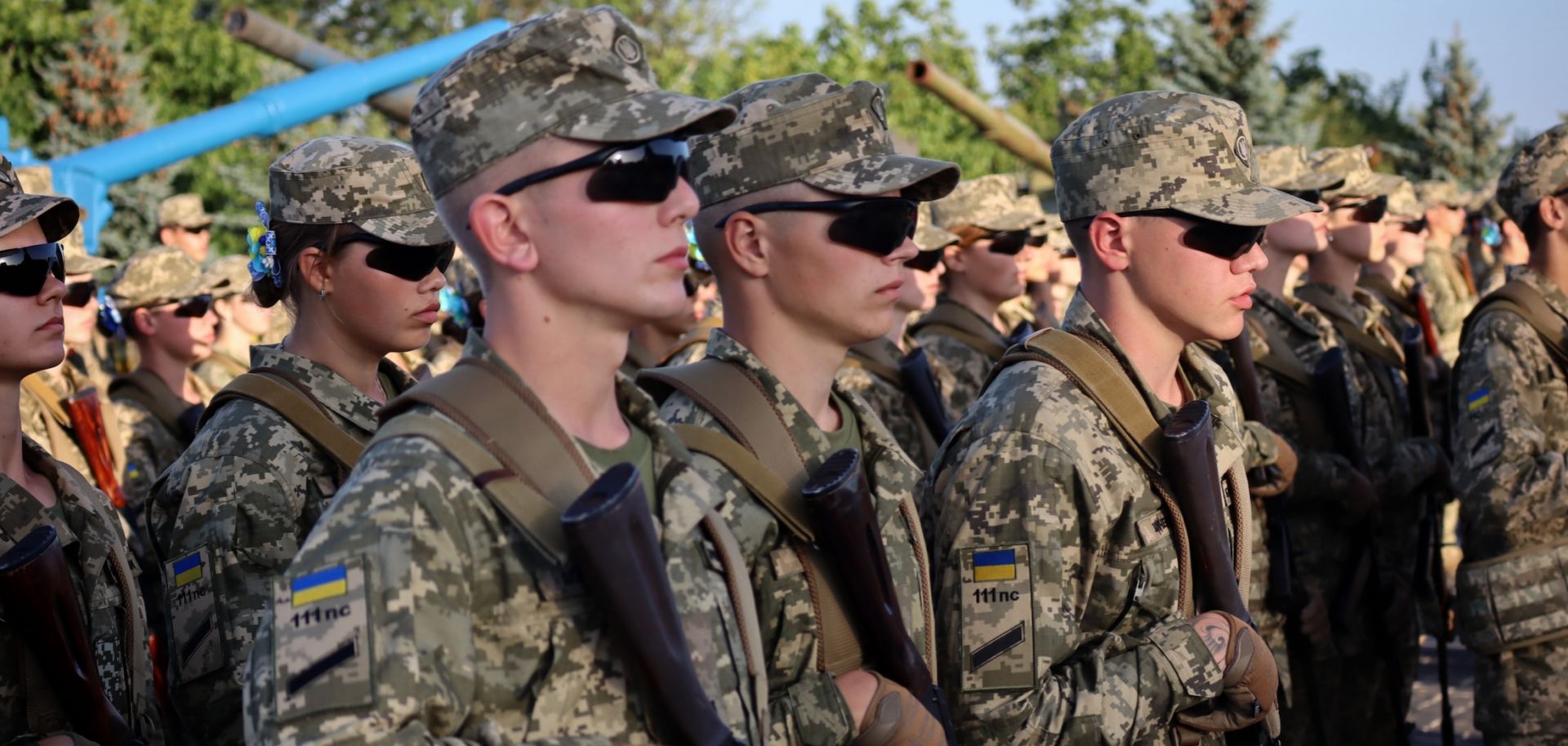
Ukraine's mobilization law will bolster Kyiv's ability to continue resisting Russia's invasion in the coming year and beyond, but will come with domestic and international political risks and will not enable it to deal a decisive blow against Russia. Ukrainian parliamentarian Roman Kostenko, the secretary of the Ukrainian parliament's Committee on National Security, Defense and Intelligence, said April 1 that the long-awaited draft law on mobilization procedures and military training will be submitted to parliament for a vote in mid-April. This timeline was confirmed by another influential parliamentarian, Dmytro Razumkov, the former head of President Volodymyr Zelensky's Servant of the People party. Razumkov said that voting on various amendments and its adoption in a second reading could take place as soon as April 10-11. A third parliamentarian, Yaroslav Zheleznyak of the opposition Holos party, said that toward the end April, the bill will pass all of its necessary readings in parliament and be signed into law and that the adjusted mobilization criteria and procedures would likely enter force by the beginning of June. While details of the law are still subject to debate, parliamentarians confirmed that it will further codify the lowering of the age at which Ukrainian men are actively mobilized for service from 27 to 25. On April 2, Zelensky signed a separate law to this effect reducing the age of mobilization in Ukraine from 27 to 25 years that parliament passed May 30, 2023. The law enters force April 3, meaning the active mobilization of 25- and 26-year-olds will commence before the mobilization law adjusting other rules and procedures is adopted in the coming weeks.
- The version of the mobilization law passed in a first reading Feb. 7 does not openly state how many Ukrainians will be mobilized, and parliamentarians have not advertised detailed mobilization statistics, which are classified. But the bill is expected to include a large combination of measures, such as the removal of various administrative and medical exemptions, to increase the number of Ukrainians eligible for mobilization and provide the relevant authorities the tools to increase compliance with, and enforcement of, mobilization rules.
- On Dec. 19, 2023, Zelensky said that the General Staff, at the time under the since-removed military chief Valery Zaluzhny, asked for the mobilization of an additional 450,000 to 500,000 Ukrainians. This number would be roughly 10 times the close to 40,000 troops Ukraine used to form 12 new Western-trained brigades raised for its 2023 counteroffensive.
- Zelensky has opposed hasty and ambitious mobilization measures unless they are part of a detailed plan that figures into a broader strategy for the continuation of the war, including by ensuring its economic and political effects could be managed. But Kyiv concluded it needs more manpower to replenish units and rotate more forces to prevent Russia from using its population advantage to increase its gains on the battlefield in late 2024 and 2025. Military analysts believe that a more realistic target for mobilization, at least in the months immediately after the law enters force, is closer to 200,000, with an eventual total of 300,000. This manpower would be used to increase rotations among the approximately 300,000 Ukrainian soldiers on the front line at a given time (about half of the around 600,000 already mobilized nationwide and capable of combat roles).
The law will come with a significant political and economic price tag for Kyiv, making the country more dependent on Western support at a time when the United States and the European Union are struggling to come up with additional assistance for Ukraine. The Ukrainian government has allowed the mobilization law to go through an extensive parliamentary review process to prevent it from undermining support for Zelensky or leading to broad political backlash. In recent weeks, parliamentarians have softened the penalties associated with failure to follow mobilization procedures (such as the freezing of bank accounts of citizens not properly registered for the draft) and instead emphasized improving conditions for newly mobilized personnel, including the digitization of military records, new legal protections to guarantee and regulate the amount of training mobilized soldiers will receive, and greater clarity regarding possible demobilization — which will likely increase compliance compared to previous waves of mobilization in Ukraine. While the bill will likely generate small-scale protests and sporadic civil disobedience, these will not undermine public support for continuing to resist the Russian invasion, to which most Ukrainians do not see an alternative at present. Even so, the bill will certainly prompt a renewed wave of attempts by Ukrainian men to illegally flee the country, and will increase competition for the remaining exemptions from mobilization and permission to leave the country. In the short term, the upcoming mobilization will exacerbate Ukraine's labor shortage. It will also have a long-term demographic impact because it will reduce the number of Ukrainians of prime childbearing age via combat losses or emigration. Mobilization will also increase military spending and cause the civilian economy to contract, making Ukraine even more reliant on more aid from Western partners at a time when some, such as the United States and to a lesser extent the European Union, are showing increasing signs of reluctance to maintain military and financial support.
- According to Eurostat, about 650,000 Ukrainian men aged 18-60 left Ukraine and now reside in the European Union (plus Switzerland, Liechtenstein and Norway) since Russia's Feb. 22, 2022, invasion. Data on Ukraine's male population shared by Ukraine's parliamentary economics committee shows that of 11.1 million Ukrainian men aged between 25 and 60, only an estimated 3.7 million are eligible for mobilization. The others are fighting, disabled, abroad or considered critical workers; the last category accounts for some 550,000 to 700,000 Ukrainian males. Under the new system, critical workers will have to contribute to the war effort financially through a monthly levy.
- The Ukrainian Finance Ministry has said the new wave of mobilization will cost Ukraine about $20.8 billion in 2024, which comes on top of Ukraine's previously estimated $41 billion budget deficit for 2024. U.S. House Republicans who have continued to block a Ukraine support bill approved by the Senate can point to the growing price tag for supporting Ukraine to argue that the United States should withhold some support to pressure Kyiv to accept Russian terms for a cease-fire. U.S. House Speaker Mike Johnson has said his chamber will finally begin to examine the issue of supporting Ukraine starting the week of April 8.
The law will enable Kyiv to boost rotations of its frontline soldiers, but Russia's own increased recruitment and mobilization efforts will prevent Ukraine from achieving a decisive advantage on the battlefield in 2024 or 2025. Manpower availability is currently the most decisive factor in the war because both sides believe further successful large-scale ground offensives are necessary to ensure higher leverage in eventual negotiations, but only a significant manpower edge could allow significant gains as both sides become increasingly well-entrenched. So far, Kyiv and Moscow have been cautious in their mobilization efforts because of the high economic costs connected to them. In the meantime, neither side is likely to gain the financial or technological edge needed to deal a decisive blow to their opponent, at least in the next two years. With the mobilization law entering force in June, it is unlikely to boost Ukrainian frontline manpower until the end of summer. Moreover, Russia is likely preparing further mobilization measures of its own both in response to Ukraine's mobilization but also as part of its long-term strategy for threatening to seize more Ukrainian territory until Western governments pressure Ukraine to accept Russia's terms for negotiations. Therefore, Russia is likely also to step up its own mobilization measures in the coming months, most likely later this year to pressure Ukraine and the United States before and after the November 2024 election, but also to replace the hundreds of thousands of Russian soldiers killed or wounded since the start of the war.
- Russian Defense Minister Sergei Shoigu announced March 20 that the Russian Armed Forces will create two new combined arms armies, 14 divisions and 16 brigades by the end of 2024. Military analysts believe staffing them would likely require further mobilization of at least 200,000, although the units could be created organizationally only to exist in a skeleton staff until a decision on further mobilization is made should Russian leaders deem it necessary. Russia will use these and other new units to increase the effectiveness of its threats to Ukraine regarding the seizure of more territory in the east in further offensives. U.S. Defense Secretary Lloyd Austin said March 19 that the Pentagon's current estimate was 315,000 killed and wounded Russian soldiers, a number likely significantly higher than estimated casualties for Ukraine.
- Reports indicate that Russia has been stepping up its use of foreigners, primarily from Central Asian states, for the war in Ukraine to reduce the need for domestic mobilization. These efforts have seen recruitment in friendly countries from farther away, most notably Cuba, India, Nepal and Syria, but also from numerous other countries in the Global South. Such recruits are often lured with promises of high pay. In some cases, diplomatic rows have emerged with Russia's foreign partners after their nationals are killed, captured or denied permission to exit their contracts and leave the war.
