
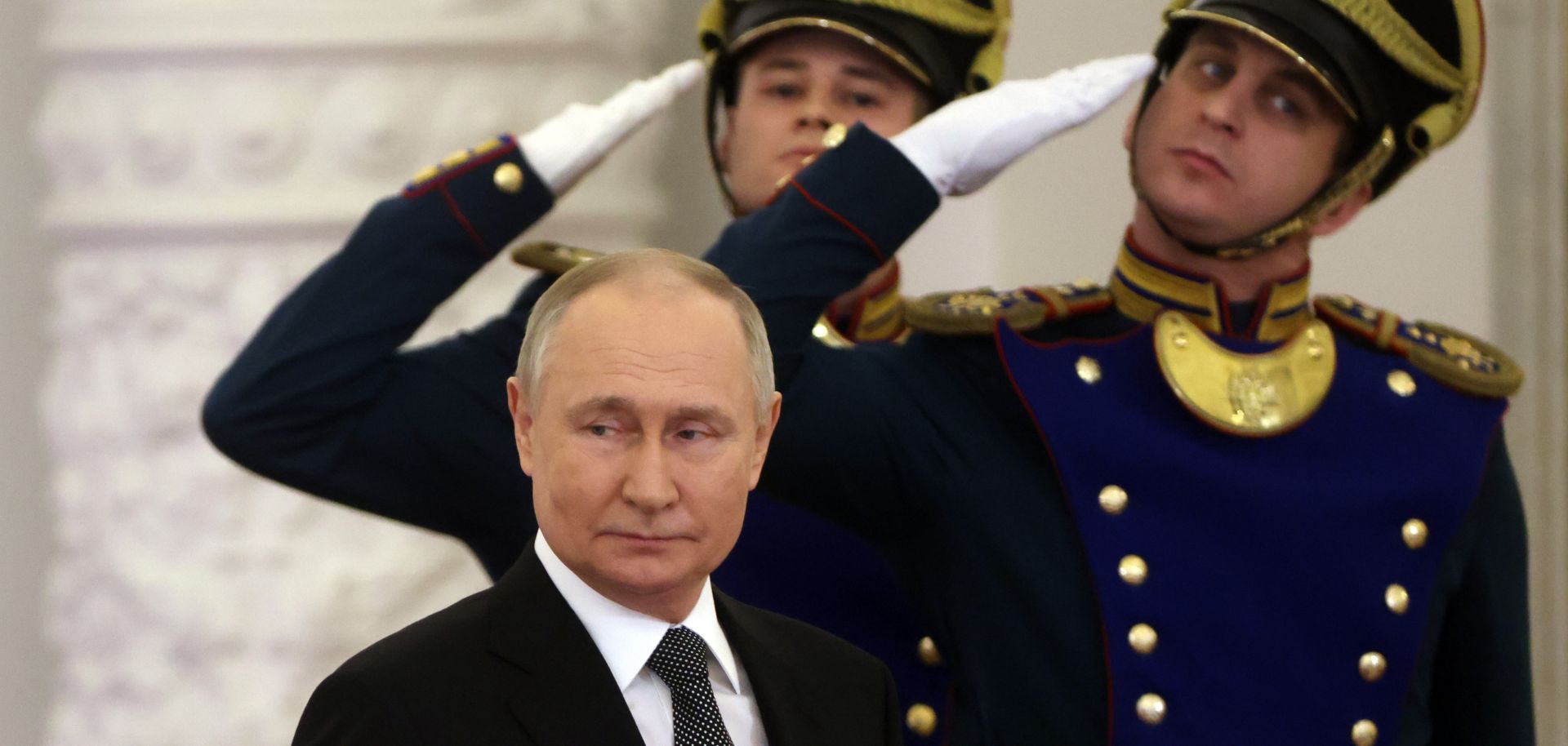
Should Western military and financial support for Ukraine weaken in 2024 and beyond, Russia will keep or even expand its territorial control of Ukraine, which will increase the risk of Russian aggressions against other countries amid an increasingly fragmented and ineffective West. On Dec. 14, Russian President Vladimir Putin held a large end-of-year press conference, marking the first time in nearly two years that he gave a public engagement of this type. His statements — particularly on the back of his recent visit to the Middle East — underscored Moscow's renewed confidence in the trajectory of the war in Ukraine, Russia's economy, and Putin's grip on power ahead of Russia's March 2024 presidential election.
- At the event, Putin reiterated his maximalist goals for the war in Ukraine. Putin said the war would end only when Russia achieves its goals: the ''denazification'' and demilitarization of Ukraine, and Kyiv's acceptance of ''new territorial realities'' (i.e. Russia's annexations). Putin also reiterated that Odesa, Ukraine's largest remaining city on the Black Sea, is a Russian city — an implicit threat to expand Russia's territorial occupations in Ukraine.
- Putin said there was no need for a second wave of mobilization because sufficient volunteers were signing contracts with the Russian army, but he provided no details on rotating Russian soldiers. His comments underscored that Russia not only had sufficient soldiers to hold the frontline, but could conduct further mobilization after the presidential election if necessary.
- Putin noted that Russia's economy returned to growth in 2023 and will keep growing in the years ahead, which the International Monetary Fund has also forecasted. While inflation in Russia remains high, currently running around 7%, and will likely grow, real domestic consumption remains steady. Russia's long-term economic difficulties — including its labor shortage, lack of productivity growth, and growing deficit — will likely continue. But while they may constrain Moscow's appetite for mobilization measures, these challenges are unlikely to meaningfully hinder Russia's ability to keep funding its war efforts in Ukraine over the next two to three years.
Russia will likely hold onto its captured Ukrainian territory for the foreseeable future due to its manpower advantage over Ukraine, expanding war industries, and growing war fatigue in the West. Unless the West increases the quantity, quality and range of key weapons systems it is currently providing Kyiv (which is unlikely considering the political disputes over these issues in both the United States and the European Union), Ukraine is unlikely to make territorial gains capable of ending the war anytime soon. Furthermore, the prospect of Ukraine ever restoring full control over the Kherson and Zaporizhzhia regions will grow more costly and less likely with each passing year, as Russian forces become increasingly entrenched in their positions, building deeper fortifications and planting more minefields. This will buy time for Russia to better leverage its advantages over Ukraine — which include a larger army, greater imports of key systems like drones, and expanding defense industrial capabilities — to hold its ground and threaten new offensives in the hopes of ultimately winning a war of attrition. Western governments, meanwhile, will face mounting domestic pressure to push Ukraine to accept Russian terms for a cease-fire, particularly without a credible plan for how Ukraine can mobilize and arm sufficient forces to overcome these battlefield challenges. And Moscow will perceive the uptick in war fatigue in Ukraine and the West as a sign that its strategy is working, which will motivate Russia to gain further ground and continue its attacks in Ukraine in order to exacerbate that fatigue and further erode Western support for Ukraine.
Unless Kyiv secures greater financial and military support from the West, Russia's occupation of the Kherson and Zaporizhzhia regions will neuter Ukraine and likely prevent its accession to the European Union and NATO in the years ahead, likely resulting in Ukraine's steady depopulation. Russia's continued occupation of the southern Kherson and Zaporizhzhia regions is economically, politically and demographically devastating for Ukraine. Russia's control of portions of these regions completely cuts off Ukraine from the Sea of Azov and means Moscow will solidify its control of one bank of the Dnieper River, which constitutes Ukraine's geographic core and has historically served as the economic and ideological backbone of the Ukrainian state. Russia's presence on the river enables Moscow to control Ukrainian commercial traffic up and down the river, which has previously served as a crucial transportation corridor for Ukrainian exports, such as grain and steel, to economically reach global markets. Furthermore, the destruction of the Kakhovka dam in June 2023 will prevent the stabilization of the lower Dnieper's water levels and hinder the river's use for regional irrigation, lowering agricultural yields in Ukraine in the coming years and decades while causing long-term ecological damage. Finally, Russia's successful occupation of the Crimea land corridor will likely be among the many factors preventing Ukraine from joining the European Union or NATO, as member countries in these organizations would likely seek clarity regarding Ukraine's borders before approving its membership. Failure to receive EU and NATO membership will only entrench Ukraine's status as an unsafe strategic gray zone, prompting more Ukrainians to flee abroad, while deterring those who've already left from ever returning home. Such an exodus would accelerate Ukraine's demographic decline and likely further inhibit its ability to defend itself, potentially leading to the country's steady absorption by Russia.
- On Nov. 21, data from the U.N. Refugee Agency (UNHCR) indicated that over 6.3 million people have fled Ukraine since Russia launched its invasion in February 2022. According to the UNHCR, around 4.8 million of those Ukrainians have fled to European countries; an additional 3.7 million people have also been internally displaced. Overall, this would mean that nearly a quarter of Ukraine's approximately 40 million pre-war population has been displaced by the ongoing war, with many unlikely to return and have children in the country, thus exacerbating Ukraine's demographic decline.
- Even before Russia's 2022 invasion, Ukraine's population was already set to shrink by around 20% from 2020-2050, making it one of the fastest-declining populations on a percentage basis in the world. According to other recent U.N. estimates, Ukraine's population will never recover from war and could fall under 30 million as soon as 2035.
Russia's successful occupations in Ukraine would solidify its authoritarian governance for decades and make it more threatening toward its neighbors, pushing those outside of NATO to fall deeper into Moscow's orbit. So long as Russia keeps the portions of the Zaporizhzhia and Kherson regions it currently occupies (which appears almost certain), Moscow will be able to cast its ''special military operation'' in Ukraine as a success, because it will argue the invasion seized the strategically significant land connection with Crimea and severely inhibited Ukraine's ability to integrate with the West, all while defeating U.S. and NATO weapons, intelligence, planning, tactics, defense production and political will. This will likely prompt Russian military planners to downgrade their assessments of NATO's military power and the Western security bloc's resolve to maintain political cohesion. Perceptions among the Russian elite and populace that Putinism is effective at increasing Russia's power on the global stage would also grow, likely enabling Putin and his chosen successor to preserve Russia's orientation as an ultranationalist and authoritarian state. Following a reduction of hostilities in Ukraine, Russia would likely use its mobilized manpower and expanded defense industries to engage in coercion against its other neighbors in order to extract concessions from them. In Europe, Russia would likely increasingly threaten Poland, Finland and the Baltic states to convince Western publics that their oppositional stance to Russia is expensive and has made them less safe so that they instead seek to de-escalate and normalize relations with Russia, or even negotiate a new European security framework. In Eurasia, Russia would likely signal to states that have toyed with leaving its orbit — including, most notably Kazakhstan, but also Georgia and Azerbaijan — that such plans would only create additional risks for them, likely forcing such countries to preemptively moderate their stances toward Russia, or even agree to deeper political and economic integration with Moscow.
- On Dec. 17, German Defense Minister Boris Pistorius said ''[Putin's] threats against the Baltic states, Georgia and Moldova must be taken very seriously. This is not just saber-rattling. We could be facing dangers by the end of this decade.'' On Dec. 5, in response to a report by the influential German think tank DGAP warning that Russia may directly attack a NATO state in as little as six years, the head of Poland's National Security Bureau said that Russia could attack NATO in less than 36 months.
- Western assessments about Russia's ability to reconstitute its armed forces for war with NATO in the coming years are likely accurate because a presumed end to major combat operations in Ukraine by that time would enable Russia to use its massively expanded arms industries and freed-up soldiers to threaten deployments across Russia's frontiers.
- Russia's military expenditures have ballooned in recent years. The country's 2024 defense budget is 70% larger than its 2023 budget, and more than double the size of its 2022 defense budget, which was three times larger than its 2021 budget. Nearly 40% of the Russian government's entire 2024 budget is allotted to domestic security and defense spending, and that percentage may stay elevated in the years ahead as the Russian arms industry expands to replenish lost stockpiles while maintaining exports.
Russia's occupations would reinforce preexisting trends of political polarization in the U.S. and Europe, resulting in a more isolationist West and an accelerated transition to an increasingly unstable multi-polar world order amid the questioning of U.S. commitments. Russia's successful occupation of large portions of Ukraine would intensify political polarization in the West, even if U.S. President Joe Biden is reelected in November 2024. In the United States, fringe political forces, primarily in the Republican Party, would argue that the billions of dollars Washington has spent on supporting Ukraine's resistance was all for naught, leading to an increase in anti-establishment and isolationist sentiments among U.S. lawmakers and voters. In Europe, these developments would also fuel the pre-existing trend of a rise in far-right parties, arguing that money spent on Ukraine is a waste and that European states should spend more on other issues at home or, at a minimum, on their own defense rather than Ukraine's. But precisely as this political infighting over supporting Ukraine in the West increases, so too will global security challenges amid an increasingly multi-polar world order. Russia's successful use of force, combined with the ineffectiveness of the West's sanctions campaign and support for Ukraine, could embolden other rogue states about the viability of military force to shift regional power dynamics in their favor without worse drawbacks, as Moscow and Beijing argue Ukraine shows the limits of Washington's power and the unreliability of its commitments. This would have particularly acute ramifications for regions like the Middle East and Indo-Pacific, where U.S. security partners would see the evolution of U.S. rhetoric on supporting Ukraine from ''as long as it takes'' to ''as long as we can'' as evidence that the United States is an unreliable ally. With the roadmap for undermining U.S. security commitments now relatively straightforward (i.e. partisan politicization in the United States), nations may increasingly cite the example of Ukraine when choosing to pursue alternative security arrangements, including nuclear weapons.
- China may become more skeptical of the United States and Europe's willingness to sacrifice funding and equipment, let alone the lives of their own soldiers and security personnel, to respond to far away contingencies across the world in East Asia. Russia, meanwhile, could threaten NATO to tie down U.S. resources in the European theater in support of a Chinese invasion of Taiwan. Russia would likely also be willing to supply China with a portion of its expanding production in missiles, ships, aircraft and other weapons to support Beijing's preparations for escalation vis-a-vis Taiwan.
- The list of countries dependent on U.S. security commitments to varying degrees is long, but Washington's notable non-NATO allies that will likely be alarmed by the precedents set in Ukraine include South Korea, Japan, Taiwan and Saudi Arabia. Countries that have been considering deepening their security ties with the United States, such as the United Arab Emirates and Vietnam, may also be less likely to do so, seeking closer ties with China and Russia instead.
- A successful Russian invasion of Ukraine would likely contribute to nuclear proliferation as well. Ukraine gave up its Soviet nuclear weapons in exchange for Western security guarantees. Amid the West's failure to fulfill those guarantees, countries secured under the current U.S. umbrella may increasingly conclude they should have their own nuclear deterrent. Russia's nuclear weapons also made the West hesitant to have Ukraine use Western-supplied weapons on Russian territory, presumably for fear of triggering a direct, potentially nuclear conflict with Russia — demonstrating the utility of nuclear weapons for enabling offensive conventional wars by placing limits on Western desire to intervene or support due to escalation concerns.
Against this backdrop, if there is a cease-fire, it would probably be under Russia's terms and would not prevent additional Russian aggressions against Ukraine in the future, preventing Ukraine's reconstruction and prolonging existing Western divisions over support for Kyiv. Russia's likely retention of its gains in Ukraine risks constituting a Russian victory because Moscow can prevent Ukraine's reconstruction at an acceptable cost. While Russia has lost more soldiers and equipment in Ukraine and occupies less of the country than it likely expected when it first launched the invasion, barring greater Western support for Kyiv, such losses are likely acceptable for Russia, as demographic holes can be overcome by increased social conservatism and migration from Central Asia. While several hundreds of thousands of educated young Russians have fled their country since it invaded Ukraine and announced subsequent mobilization measures, Moscow likely prefers these political dissenters leave. Economically, Moscow is in a better position than even it anticipated, as the country appears likely to maintain stability on the back of energy and raw materials exports. Meanwhile, for Ukraine, even in the case of peace talks, lackluster Western political and military equipment could leave Kyiv incapable of getting Moscow to stick to any cease-fire or halt its efforts to destabilize Ukraine. In fact, the scenario of the West pouring money into Ukraine's reconstruction following a cease-fire, only for Russia to violate it and cause the money to go to waste, would be a preferred outcome for Moscow that would only further fuel political dynamics favorable to Russia. NATO and the European Union's military production expansion may prove insufficient to bolster Ukraine's defense, but even if production increases exceed expectations, political dynamics may prevent more weapons from reaching Kyiv. In the United States, skeptics of Ukraine support will likely gain influence in the Republican Party in the months and years ahead. Should this translate to underwhelming U.S. political aid for Kyiv, support for Ukraine would face increased political headwinds in Europe.
- Some have argued that Ukraine can secure victory through its reconstruction, pointing to South Korea's experience after the Korean War. But this fails to recognize key differences between South Korea's situation since the 1950s and Ukraine's current situation, with the largest being the scope of territory to defend. Ukraine's border with Russian forces — including the Belarus-Ukraine border, the front line, and the undisputed Russia-Ukraine border — is 2,000 kilometers long, which may prove much more costly to reliably secure compared with the 250-kilometer demilitarized zone between North Korea and South Korea.
