
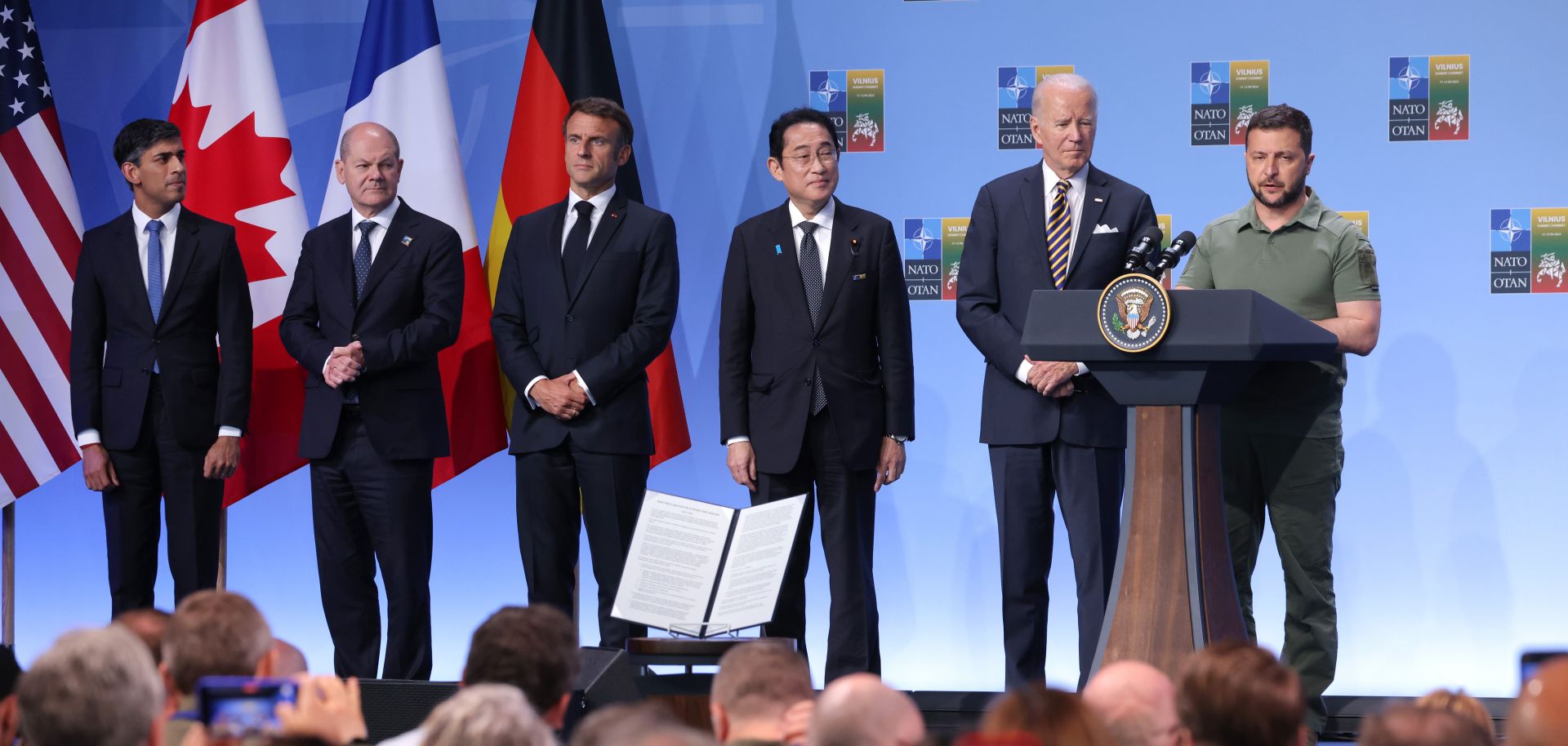
The NATO summit's failure to provide any further clarity regarding the future of Ukraine's membership prospects or alternative security guarantees will fuel the war's continuation and embolden Russia's current strategy of degrading Ukraine. On July 11, the first day of the annual NATO summit in Vilnius, Lithuania, Secretary-General Jens Stoltenberg presented a three-part plan to ''bring Ukraine closer'' to the Western security alliance. The plan enshrines a multi-year assistance program to ensure full interoperation between NATO and Ukrainian forces, along with a Ukraine-NATO Council to allow regular interaction with Ukraine at a higher level (the first meeting of the council took place on July 12). It also eliminates the Membership Action Plan (MAP) process as a prerequisite for Ukraine's membership in the alliance, which both Ukrainian and Western officials framed as a concession to Kyiv that showed that the country's eventual path to membership had become shorter. But NATO's joint summit communique failed to provide any plan or timeline for Ukraine's accession, and instead only noted it would ''be in a position to invite Kyiv to join the alliance ''when allies agree and conditions are met.'' Ukrainian President Volodymyr Zelensky decried the communique's failure to clarify his country's future in NATO as ''unprecedented and absurd.'' Though the following day on July 12, he softened his tone, saying the results of the summit were ''good'' but that they ''would have been ideal'' if NATO had invited his country to join. While Kyiv had never expected to receive a membership invitation during this year's NATO summit, it had been pushing for concrete details on when and how an invitation may be issued eventually amid Russia's ongoing war in Ukraine.
- Despite statements made by Ukrainian and Western officials, NATO's decision to forgo the MAP process will not materially expedite Ukraine's accession to the alliance. Indeed, few expected that NATO would subject Ukraine to this process, given the likely speed with which Kyiv would need to be admitted to the alliance following Russia's invasion to deter Moscow from committing further hostilities. Finland and Sweden's recent invitations to join NATO without the MAP process also underscore that it was never a formal requirement for membership.
While NATO is formally exploring ''Israel-style'' support guarantees for Ukraine, the summit did not yield any concrete new commitments of such support. In the weeks leading up to the summit, reports emerged that U.S. and European officials were discussing providing ''Israel-style'' security guarantees to help Ukraine fend off current and future Russian aggression. Such commitments would see the West preemptively budget military support for Ukraine in larger, multi-year increments (similar to how the United States authorizes military support for Israel, which is another non-NATO security partner), as opposed to annual commitments and irregular disbursements of military hardware. But official documents and statements made at the NATO summit did not add any concrete details or binding obligations of the ''Israel-style'' guarantees that Western leaders have allegedly been considering. On July 12, for example, G-7 countries unveiled a ''security pact'' as a first step toward realizing their security guarantees for Kyiv, which U.K. Prime Minister Rishi Sunak said reaffirmed the G-7's commitment to ensuring Ukraine is ''never left vulnerable to the kind of brutality Russia has inflicted on it again.'' But the joint statement only noted that the G-7 countries had agreed to ''launch negotiations with Ukraine'' to formalize their support for the country ''through bilateral security commitments and arrangements aligned with this multilateral framework.''
- Even if NATO members eventually commit to ''Israel-style'' support guarantees, using Israel as a model is imperfect and may still result in underwhelming support for Ukraine due to several reasons. First and foremost, Russia's economic and military capacity to wage war against Ukraine far exceeds the collective threat from Israel's enemies. Unlike Israel, Ukraine also lacks both a nuclear deterrent to prevent large-scale conflict, as well as the level of political and ideological support in the West that Israel has built up over many decades.
- During the summit, several NATO members announced new packages to help Ukraine continue to fight Russia in the coming months. France pledged to supply Kyiv with SCALP missiles (the French version of the Storm Shadow previously supplied by the United Kingdom), while Germany unveiled a new 700 million euro support package that includes tanks and Patriot launchers. A coalition of 11 NATO states also promised to train the Ukrainian Air Force on how to fly U.S.-made F-16 fighter jets. However, these support measures on their own are incapable of altering the strategic course of the war because they are unlikely to enable Ukraine to retake sufficient territory to politically destabilize Russia and hold its gains.
NATO's vagueness on when Kyiv will be invited to join or what security guarantees it will receive will embolden Russia to maintain its current strategy in Ukraine. Reports claim all NATO members agree that Ukraine cannot join the alliance while Russia's war is still ongoing — a sentiment U.S. President Joe Biden overtly expressed in a July 9 interview. But for now, there is still little evidence the West is spending enough money to quickly produce and supply Ukraine with the military equipment it needs to win the war, which would require retaking sufficient territory to force Russia into cease-fire negotiations on Kyiv's terms. NATO's attempts to stop further substantive discussion of Ukraine's membership process so long as the war continues will only further incentivize Moscow to continue its invasion, as Russian officials have claimed. By continually stressing that Ukraine cannot see progress on its membership bid until the conflict is resolved, while also failing to provide Kyiv with the arms it needs to soundly defeat Moscow, NATO is thus effectively embracing a war of attrition that will increasingly come at the expense its members' military equipment and monetary resources, as well as Ukrainian lives. As a result, Ukraine's position is unlikely to significantly improve and the alliance will continue to face all the same questions about Ukraine's path to membership, as well as what interim security guarantees would be considered adequate to commence reconstruction in Ukraine whenever Western governments de facto force Kyiv to capitulate to a cease-fire.
- Evaluating the summit, former Russian President Dmitry Medvedev said that everything indicated that Moscow should continue the special military operation with the same goals. He also claimed World War III was getting closer, even though unnamed and likely made-up ''realists in the alliance'' were concluding that Ukraine could probably never get into NATO.
Therefore, discussions of security guarantees for Ukraine will increasingly shift to proposals — both inside and outside of NATO — acknowledging that Russia's occupation will continue and Ukraine will have a likely perpetual territorial dispute. Ukraine has already moved the ''Overton window'' of discussion regarding its NATO aspirations and weapons support from the West. Before the summit, several NATO members — including the United Kingdom, Turkey and Poland — explicitly said they support Ukraine's membership aspirations. Kyiv has also received access to increasingly advanced and long-range systems that many NATO leaders previously viewed as too escalatory in the early days of Russia's invasion. Similarly, the United States and its European allies will likely continue to collaborate on ways to provide Ukraine security guarantees beyond the military equipment, training and intelligence they have already vaguely committed to in statements like the new G-7 Security Pact. If Russia and Ukraine eventually reach a cease-fire to end their war, and in particular if the intensity of the war declines without a formal cease-fire, stronger political guarantees will be needed to prevent a renewed conflict. This will likely see NATO countries start discussing more security guarantees that are stronger than the material, training and intelligence support they've so far committed to Kyiv. And those guarantees would also need to fit into plans regarding Ukraine's NATO prospects. In particular, NATO will need to work on defining what, exactly, would constitute an ''end'' of hostilities in Ukraine — i.e. whether it's a cease-fire, armistice or a peace treaty — as well as what each of those agreements and the various stages of their enactment would mean for Ukraine's NATO application and bilateral security pledges from specific countries in the alliance. But new Western policies on these key questions are unlikely to be codified before NATO's next summit, which will be held in Washington D.C. in July 2024. Over the next year, Western governments' efforts to provide security guarantees sufficient for Ukraine's reconstruction to commence will probably increasingly focus on security guarantees from individual member states via bilateral agreements with Ukraine, as foreseen in the ''Kyiv Security Compact'' that Kyiv published last September, which specifically envisions other countries (such as Poland, Turkey and the United Kingdom) providing forces to secure Ukraine. But without a significant increase in Western support to Ukraine, the conflict is highly unlikely to end before NATO leaders reconvene next year. Against this backdrop, the United States' approach in Ukraine is thus poised to be the main focus of the alliance's 2024 summit, given the critical nature of U.S. support in determining the evolution of the conflict. But any major breakthroughs that could change the war's trajectory will probably again prove elusive due to political headwinds in the West and especially the United States, which will be in a presidential election year.
- On July 11, Polish President Andrey Duda acknowledged that because it is in Poland's interest for Ukraine to join NATO as soon as possible, Poland could send soldiers to Ukraine after a cease-fire as part of a NATO mission. Experts and politicians are increasingly acknowledging that soldiers from third countries may be needed to guarantee a cease-fire and/or provide sufficient security guarantees to Ukraine to fully end the war and prevent its renewal.
- On July 7, German lawmaker Michael Roth, who chairs the Bundestag's foreign affairs committee and is a member of Chancellor Olaf Scholz's party, said that Ukraine could be admitted to NATO in parts, as NATO's Article V guarantees would not cover the regions of Ukraine with which Russia claimed to have territorial disputes. He proposed this as a way out of a situation where full membership is constantly being postponed due to NATO's unwillingness to enter into a direct conflict with Russia over Ukraine's internationally recognized borders.
- West Germany's ascension process to NATO in 1955 is increasingly being explored as a starting point for how Ukraine could eventually enter the alliance despite its ongoing territorial dispute with Russia. West Germany had to agree to ''never to have recourse to use force to achieve the reunification of Germany,'' and NATO's Article V would not apply in such a case. Ukraine will likely have to agree to a similar language to move forward with its NATO bid, instead relying on political means to achieve the return of its territories following a political change in Moscow.
