
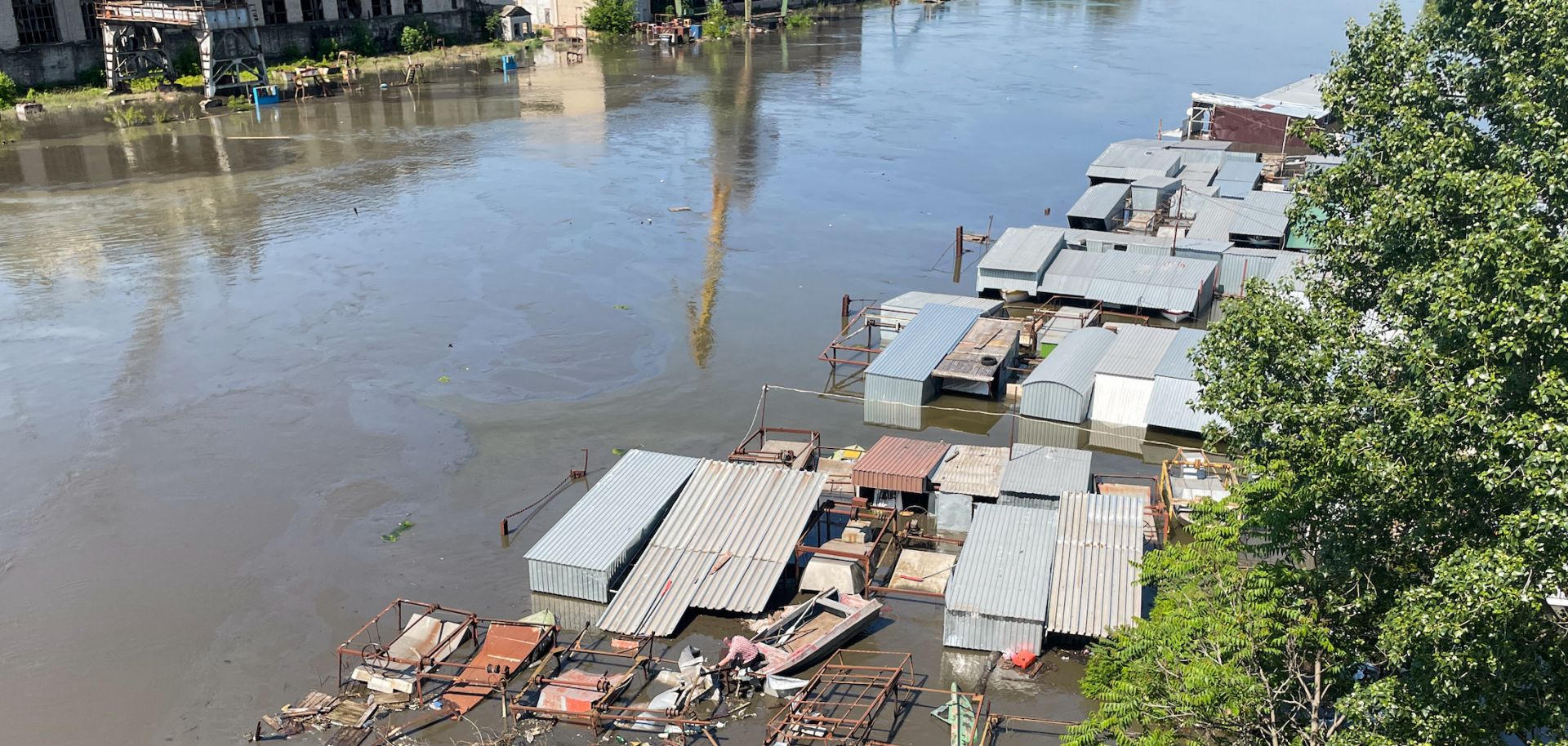
Flooding is seen in the Ukrainian city of Kherson, which is located downstream from the damaged Nova Kakhovka Dam, on June 6, 2023.
The collapse of a major dam in southern Ukraine will damage crop yields and force Kyiv to adjust (but not fundamentally alter) its emerging counteroffensive plans. The incident could also impact both Russia and Ukraine's militaries depending on several factors, including how water flows stabilize in the coming weeks and months. On the morning of June 6, the dam in Kakhovka, which sits on the Dnieper River and is the site of the city's hydroelectric power station, was severely damaged when its gates collapsed. It was not immediately clear whether the damage was the result of an explosion — both Kyiv and Moscow blame each other — or from wear due to previously sustained damage. For now, only the dam's gates and the power plant's upper works have failed and been completely swept away. Although the underwater parts of the dam remain intact, the situation could significantly worsen if the dam itself fails in the coming days. Villages located below the dam have already started to flood, with water levels in those areas expected to crest in a matter of hours. Meanwhile, water levels above the collapsed site of the dam in the Kakhovka reservoir are steadily dropping, with experts hoping the reservoir will bottom out in the next 3-4 days.
- Kremlin spokesman Dmitry Peskov alleged that Ukraine sabotaged the dam because, having started large-scale offensive actions two days ago, the Ukrainian armed forces supposedly are not achieving their goals. Russian Defense Minister Sergei Shoigu echoed this idea, claiming the damage to the dam was ''a tactic to enable Kyiv to redeploy defensive units from the area downstream of the dam into offensive operations.''
- Ukraine's foreign ministry said it considers ''the Russian Federation's detonation of the dam...a terrorist act against Ukrainian critical infrastructure, which aims to cause as many civilian casualties and (as much) destruction as possible'' and called for an emergency meeting of the U.N. Security Council to discuss the incident.
- White House National Security Council spokesman John Kirby said the administration of U.S. President Joe Biden currently ''cannot say conclusively'' who was responsible for the Ukrainian dam's collapse. But according to officials cited in U.S. media reports, the U.S. government is considering disclosing intelligence that suggests Russia was the culprit.
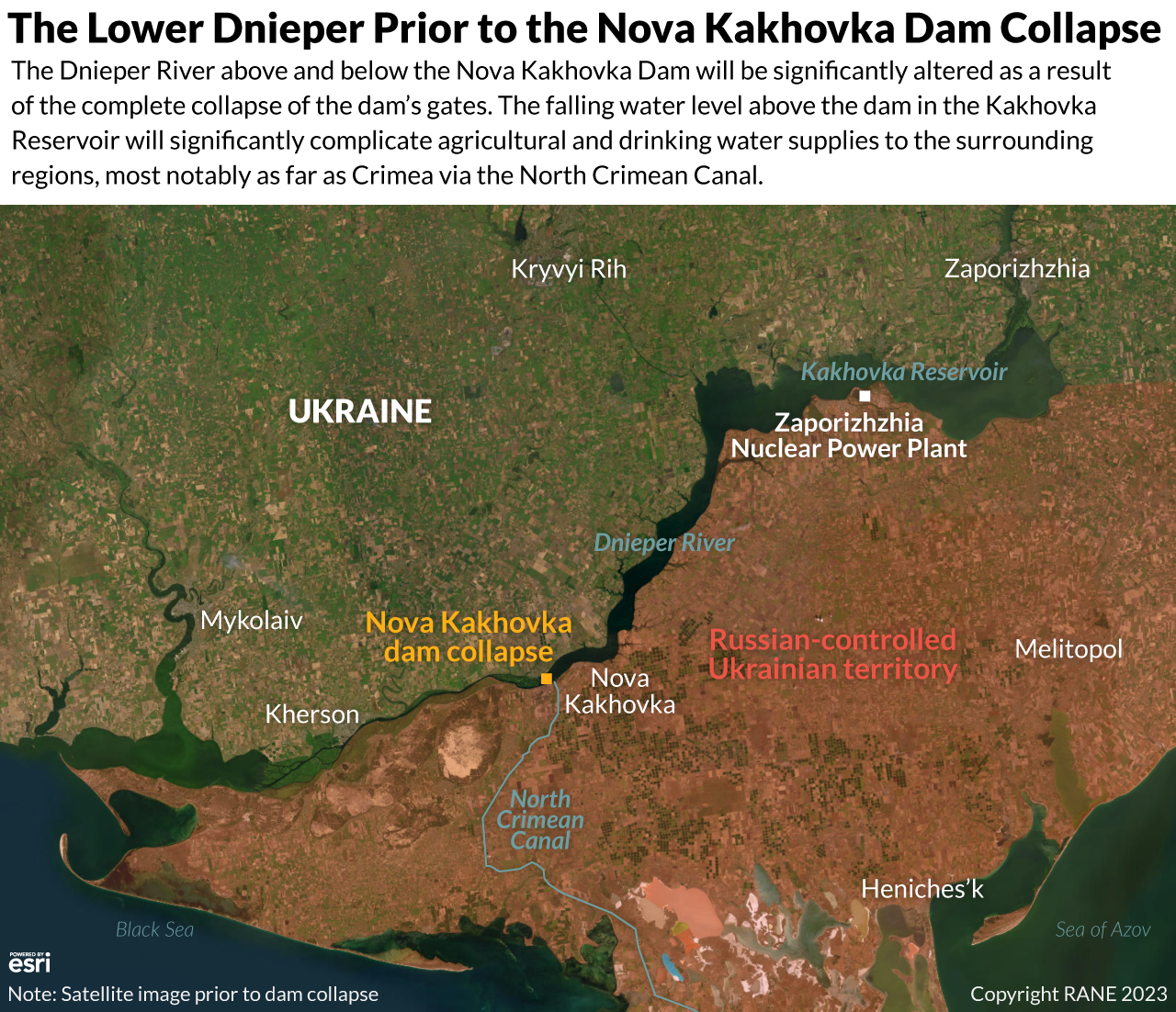
The impacts of the incident will hinge largely on how water flows develop, but there will likely be domestic and possibly global economic repercussions from damaged crop yields. In the coming months and beyond, the effects of the damage will depend on the level at which the water below and above the dam stabilizes, which will itself be determined by factors such as how much Ukraine continues to let through the Dnieper Hydroelectric Station in Zaporizhzhia and how much water the two sides continue to siphon off for their freshwater needs. But regardless, the dam's collapse will harm crop yields in Ukraine, as all of the regions bordering the river rely on high water levels in the Kakhovka reservoir to irrigate vital farmlands. The war-torn country's agricultural output will thus likely fall in the coming months compared with previous expectations, putting upward pressure on global food prices. Drinking water systems in regions around the reservoir may start failing as well, which could see more civilians try to flee to Western Ukraine and beyond as living conditions worsen.
- Ukraine's Dnipropetrovsk, Zaporizhzhia, and Kherson regions bordering the Kakhovka reservoir — and even regions not bordering the reservoir, such as Kharkiv — are all major producers of cereals and sunflower oil. They are also all reliant on water from the Dnieper stored in the Kakhovka reservoir, which can only be drawn when the river is above a certain level.
- The Zaporizhzhia Nuclear Power Plant also normally draws water from the Dnieper River and can only do so if it remains above a certain level. But the falling level of the river in the Kakhovka reservoir does not pose the immediate threat of a meltdown, as the plant's reactors are in cold shutdown and its large water coolant pond is currently full.
- The Kakhovka reservoir's low level will almost certainly entail the end of water supplies from the Dnieper to Crimea, which supplies approximately 85% of the region's fresh water. However, the peninsula functioned for nearly eight years between 2014 and 2022 without access to the Dnieper, which indicates the Russian-administered peninsula will be able to again cope with such difficulties.
When it comes to the war, the collapse of the Kakhovka dam will also create near-term tactical challenges that will force both Russia and Ukraine to shift their military positions eastward. Kyiv and Moscow are likely extensively prepared for such a contingency and therefore should be able to adjust. But regardless of who's at fault or how it occurred, the damage to the dam will nonetheless have immediate tactical implications for Ukraine's counteroffensive, as both sides will redeploy troops away from the region toward Zaporizhzhia and other parts of eastern Ukraine. For Russian forces stationed south of the Dnieper River, rising water levels will soon flood their minefields, as well as destroy any of the fortifications and equipment they couldn't evacuate in the coming days, which will complicate the Russian war effort in the near term.
But in the long term, both sides could see military benefits as well, depending on exactly where water levels stabilize. For Russia, the widening of the river may prove beneficial for a significant period by reducing Ukrainian forces' ability to conduct amphibious operations across the Dnieper. This could, in turn, enable Russia to redeploy forces to the Zaporizhzhia region to meet Ukraine's expected primary offensive efforts in both Zaporizhzhia and southern Donetsk regions. For Ukraine, the damage to the dam, which Kyiv is framing as a major Russian war crime, could prompt its Western backers to bolster their supplies of key weapon systems, such as fighter jets and long-range munitions. While it remains unclear where the water level on the lower Dnieper will settle, the evaporation of water from the delta could also eventually complicate Moscow's war efforts in this sector by forcing Russian troops to constantly adjust their defensive posture as water levels fall. On the other hand, however, the possible re-extension of the front could also force Ukraine to further disperse its precious military assets, which would enable Russia to better leverage its manpower advantage.
