
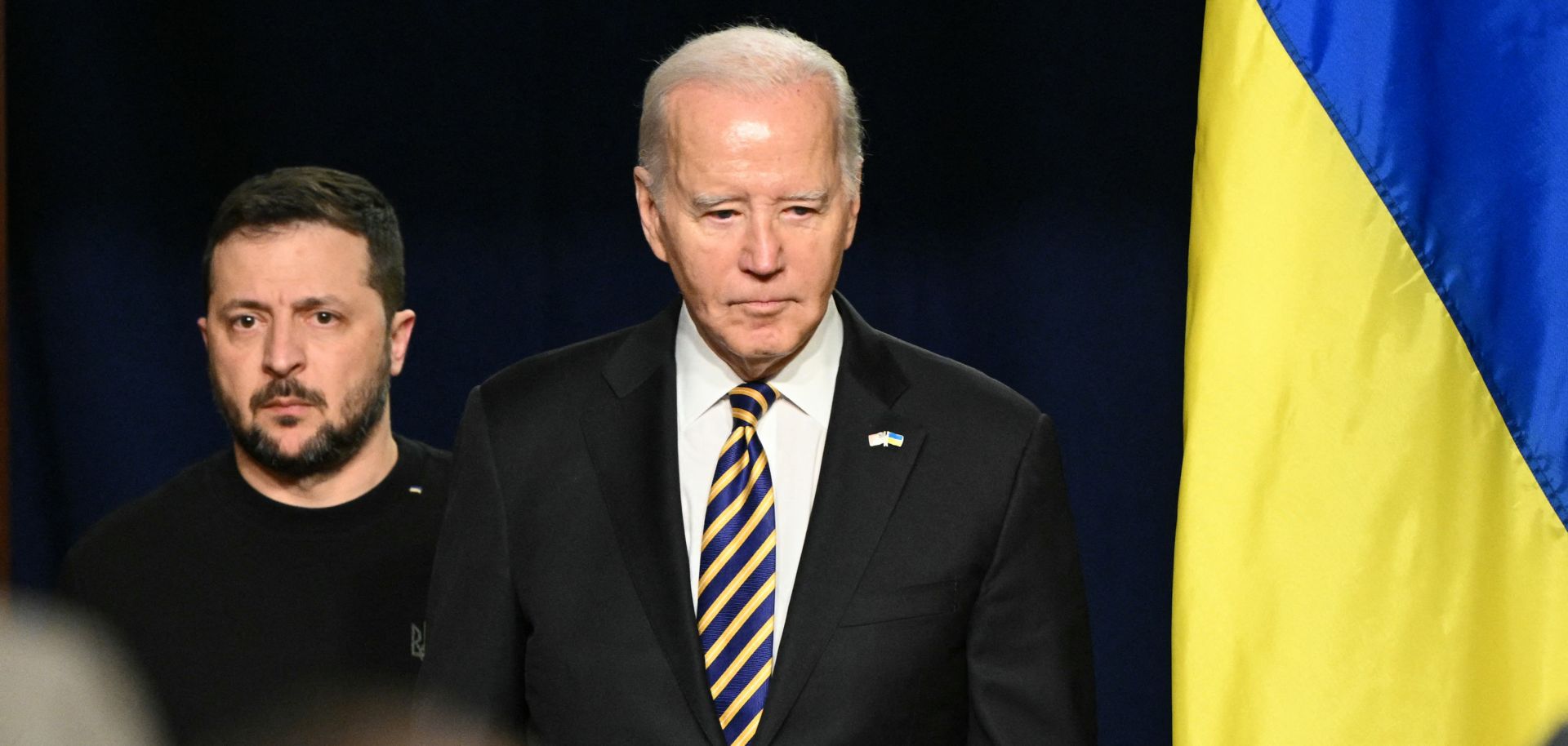
Ukrainian President Volodymyr Zelensky's latest trip to the United States highlights the crumbling political support for Ukraine in the West, which will prevent Kyiv from making significant advances on the battlefield in 2024 and likely ensure Russia keeps its territorial gains, further dimming the prospects of a near-term peace deal. Zelensky arrived in Washington on Dec. 12 to meet with U.S. officials, including President Joe Biden and Senate leaders. During his trip, the Ukrainian president conveyed the need for more U.S. support to continue resisting Russia's invasion, and reportedly communicated his country's military strategy for 2024 and beyond. While Senate minority leader Mitch McConnell praised Zelensky's presentation, he also said it would be ''practically impossible'' to get a new Ukraine support bill through the Senate and the House of Representatives before the end of the year. Meanwhile, Senator Lindsey Graham informed reporters that he told Zelensky ''you've done everything anybody could ask of you… this is not your problem here,'' underscoring that the roadblock to a new support bill was unresolved disputes over a U.S. border policy that Republicans attached to Ukraine aid in the fall, rather than flaws in Zelensky's presentation of Ukraine's plans. Congress is expected to eventually approve a deal for continued military support to Kyiv linked to border funding and policy changes in January. However, the saga is further evidence of the increasing politicization and delays of Ukraine support in the United States, which bode ill for Kyiv's ability to receive the weapons it needs to continue resisting Russia's invasion, let alone have a chance to win the war by retaking the Kherson and Zaporizhzhia regions.
- On Oct. 20, the Biden administration submitted a $106 billion national security supplemental funding request to Congress that included more money for Ukraine, Israel and U.S. partners in the Indo-Pacific region, as well as for security measures on the U.S.-Mexico border. Since then, however, a growing number of Republicans have voiced their opposition to providing military aid to Ukraine on various political and ideological grounds, most often arguing that the United States should spend more money on border security and other issues.
- On Dec. 12, Biden announced the disbursement of the latest round of military assistance to Ukraine, valued at $200 million — a small tranche of the more than $44 billion in direct military assistance that Washington has provided Kyiv since the war started in February 2022. The White House has alerted Congress that money for Ukraine will run out by the end of the year, with any further disbursements being inadequate to significantly improve Ukraine's war efforts.
The situation on the battlefield remains stagnant, while Western support has failed to break the stalemate and instead appears at risk of decline. Ukraine's counteroffensive, which commenced in early June, failed to retake significant territory due to various reasons, including the entrenchment of Russian forces behind large minefields, as well as Ukraine's inability to sufficiently concentrate along the southern front amid the need to stem continued Russian advances in the east. But the largest obstacle to the counteroffensive's success was arguably Russia's control of the skies and extensive use of radio-controlled, first-person-view (FPV) drones, which Ukraine's inexperienced forces had little counter against, forcing them to abandon a large-scale armored breakthrough and proceed on foot in small groups. With the West unlikely to ramp up its support to Ukraine in 2024, these issues will likely remain unresolved and engender a continuing stalemate on the front line. Indeed, the United States and Europe appear unwilling, largely due to political rather than financial constraints, to supply Ukraine with sufficient amounts of armored vehicles, demining equipment, and precision munitions to supply Ukraine for a similar breakthrough attempt in 2024. They're also likely unable to provide Kyiv sufficient artillery ammunition and FPV drones due to production constraints. In addition, Ukraine's Western partners will probably attach more strings to further assistance going forward, which could further reduce the overall value of support. This lack of resources will dissuade Kyiv from significantly deeper mobilization, which would further damage the country's demographic outlook and economy by exacerbating the labor shortage and prompting more people to flee, and to which Russia could always respond in kind. Russia can likely acquire enough manpower to achieve its goal of degrading Ukraine through its current volunteer campaign and the steady removal of draft exemptions. Russia doesn't need to make large territorial gains to accomplish its goals, which would require many more soldiers and come at a high cost against increasingly entrenched Ukrainian forces. Over the next year, this means neither side will likely make significant gains akin to those seen in 2022 or even 2023.
- In the spring of 2023, the U.S. Pentagon calculated that Ukraine needed 90,000 or more 155mm artillery shells a month to maintain its war efforts against Russia. But the United States is currently only producing barely more than a tenth of that. U.S. artillery shell production is scheduled to increase sixfold to 85,000, but only by 2028. Meanwhile, the EU looks poised to supply Ukraine with less than 500,000 shells out of the million it promised to supply this year, while North Korea has exported over 1 million shells to Russia in less than half of the year. The outbreak of the Israel-Hamas war in October has only since exacerbated the West's artillery shortage, with the United States transferring shells to Israel that were previously earmarked for Ukraine.
- On Dec. 13, a commander of Ukraine's 92nd Assault Brigade told Ukrainian media that Russia had a significant advantage over Ukraine in terms of small and cheap FPV drones along the key sectors of the frontline. According to the commander, for each FPV drone that Ukrainian troops have, Russian troops have five to seven more on key sections of the front. Such drones are revolutionizing modern warfare, as the quadcopters are typically available for only a few hundred or thousand dollars on the commercial market in the West, and can render multi-million dollar equipment inoperable. FPV drones are primarily produced in China, which is prioritizing commercial deliveries to Russia, ignoring their ultimate military use.
- There's a chance Russia could conduct another wave of formal mobilization in 2024 similar to the one it launched in the fall of 2022, in order to gain a decisive manpower advantage over Ukraine and more credibly threaten a large-scale offensive. However, a broader mobilization would damage Russia's economy by aggravating the labor shortage and inflation, making this a low-likelihood scenario.
Facing these constraints, Ukraine will likely focus on repelling Russian attacks and stockpiling resources in 2024, while attempting small-scale offensives. Both sides will attempt offensives in 2024, but these efforts will likely be somewhat smaller-scale than Russia's offensive around Bakhmut during the winter and spring of 2023 and Ukraine's effort through the summer and fall. Russia will continue the operation it commenced in October to encircle Avdiivka, a Ukrainian stronghold on the pre-2022 frontline, as well as similar operations across the front, in the hopes of breaking Western political will to support Ukraine by showing that Russian forces are gaining ground. Ukraine, for its part, will also attempt small-scale offensives to show that continued Western aid is capable of allowing their country to continue taking ground, which for some Western politicians is necessary to keep justifying support for Kyiv. But Ukraine will likely largely be forced to take a more conservative and defensive posture, buying time for the Western military-industrial production to increase over the course of 2024. Ukraine's strategy will be focused on degrading Russia's political, economic and military ability to continue the war through attrition, dealing maximum damage to Russian forces on the front line while trying to minimize losses to its own. Kyiv hopes this will enable a larger-scale future offensive in 2025, or at a minimum better position Ukraine for negotiations in that year or beyond, than if the country entered negotiations in 2024.
Against this backdrop, neither Ukraine nor Russia will be interested in a peace deal in 2024, which means that the war will continue for at least another year. The desire for a cease-fire in Ukraine will likely grow over the next year. However, Kyiv will not agree to engage in meaningful peace negotiations with Moscow until the West provides political guarantees or military equipment strong enough to deter future Russian aggression (which appears very unlikely); otherwise, a cease-fire would risk giving Russian forces time to regroup and renew aggression against Ukraine from a stronger position. Russia's unwillingness to scale back its maximalist war aims cast further doubt on the potential for productive peace talks anytime soon. When asked at his annual press conference on Dec. 14 when the war in Ukraine will end, Putin reiterated that there will only be peace once Russia secures Ukraine's ''denazification,'' demilitarization and neutrality. Furthermore, Moscow believes war fatigue will only grow in the West and especially the United States, where former President Donald Trump, who is vocally opposed to providing Ukraine with more aid, is polling strongly ahead of the November 2024 election. If Trump and his allies opposed to supporting Ukraine assume greater power, the subsequent loss of U.S. political support will further weaken Kyiv's negotiating position in 2025, which will dissuade Russia from engaging in peace talks before then. Growing war fatigue will also increase pressure on U.S. and European lawmakers to resolve the conflict, which could see Western governments further reduce military support for Ukraine to try to force Kyiv into negotiations with Russia. This, however, would only embolden Russia to escalate the war through new offensives and more mobilization, preventing the conclusion of a cease-fire by the end of 2024.
