
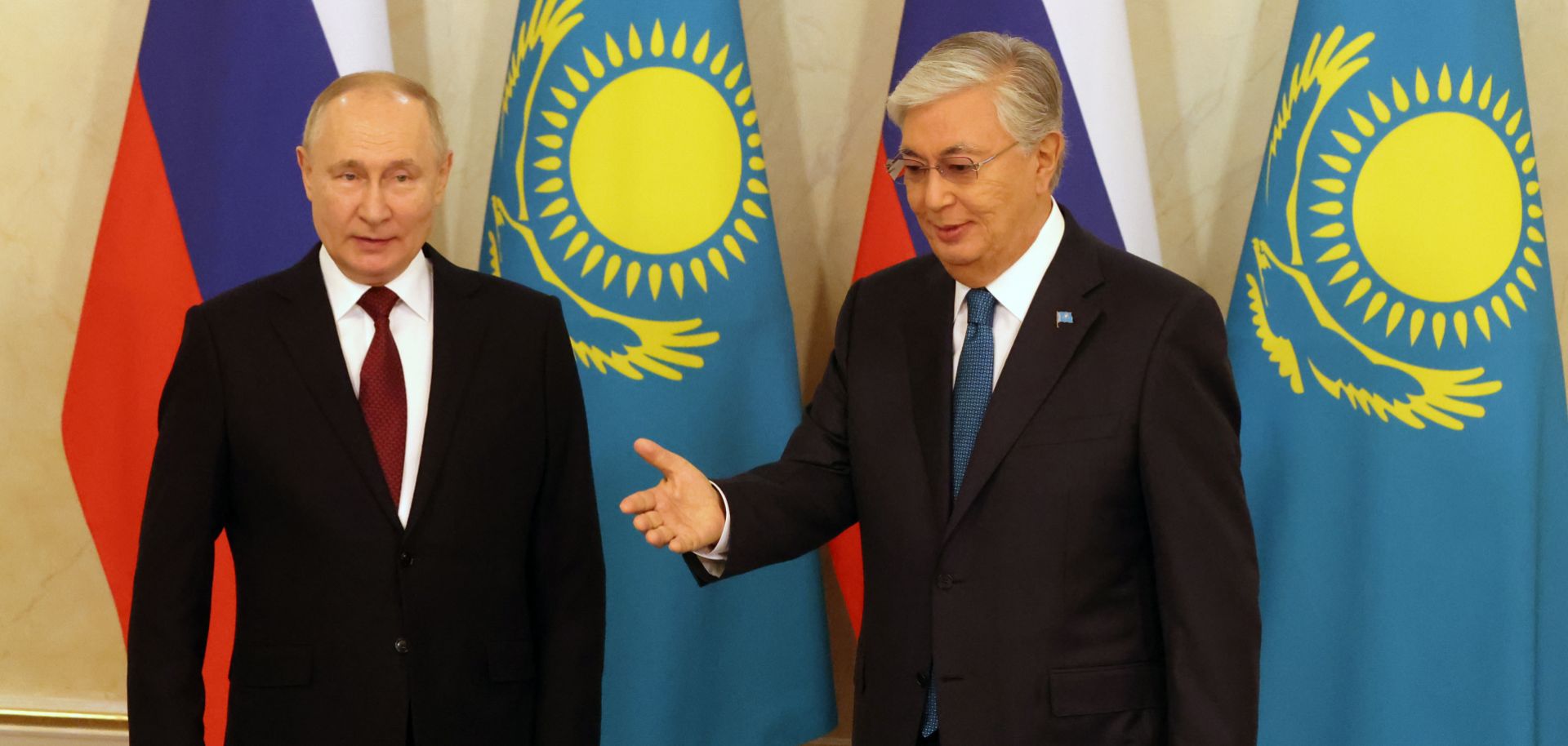
Despite new agreements with Russia in the energy and transportation spheres, Kazakhstan will continue its strategy of reducing dependencies on Russia in favor of deeper ties with China, the West and Turkey, which over time could result in conflict with Moscow. On Nov. 9, Russian President Vladimir Putin, joined by a delegation of high-ranking Russian officials, visited Kazakhstan to hold talks with President Kassym-Jomart Tokayev and attend the 19th Forum of Interregional Cooperation between Kazakhstan and Russia. The visit also marked the 10th anniversary of the two countries' Treaty of Good-Neighborliness and Alliance in the 21st Century. During the meeting, Putin said Russia and Kazakhstan are ''not just allies, but the closest of allies.'' Tokayev, for his part, said his country was deepening and expanding cooperation with Russia. The presidents signed a plan for joint cooperation for 2024-2026 in the energy, agriculture, trade and investments sectors and other documents, most notably a memorandum of understanding on Russia's participation in constructing three new thermal power plants in Kazakhstan. However, in his public remarks following the talks, Tokayev also surprised Putin and the Russian delegation by speaking in Kazakh, leaving the Russian attendees scrambling to affix their translator headsets — a gesture widely seen as signaling Astana's desire to distance itself from Moscow.
- According to the Russian and Kazakh leaders, Russia remains Kazakhstan's largest trading partner. The two countries' trade turnover has increased by more than 30% over the past three years, growing 10.2% in 2022 to a record $28.2 billion compared with the previous year.
- Putin and Tokayev agreed that the volume of Russian gas supplies, currently at 3 billion cubic meters a year each to Kazakhstan and Uzbekistan, could increase. Additionally, they discussed key aspects of interaction in the oil and gas industry and the energy sector more broadly, including Russian oil shipments to China. Kazakhstan currently plans to ship up to 100 million metric tons of Russian oil to China by 2033.
- During their meeting, Putin and Tokayev also emphasized food security and the development of wheat and fertilizer cargo transport routes in Asia. Putin called for further development of shipping routes for Russian wheat through Kazakhstan to large Asian markets such as China and India.
Kazakhstan will likely remain politically and economically integrated with Russia, while also serving a key role as a sanctions-busting jurisdiction. Kazakhstan is closely tied to Russia through a customs union, the Eurasian Economic Union. But despite this, President Tokayev has insisted his country would unambiguously adhere to the West's sanctions regime following Russia's invasion of Ukraine in February 2022 — a commitment he most recently reiterated following talks with German Chancellor Olaf Scholz on Sept. 28. Since the onset of the Ukraine conflict, Astana has sought to diversify its economic ties and balance away from Moscow as well. But at the same time, Kazakhstan has also helped Russia evade Western sanctions by facilitating large flows of illicit trade and sanctions-violating transactions within its borders and across its extensive border with Russia, often enabled by falsified paperwork that misrepresents the nature of the transactions. Because Kazakhstan continues to provide this crucial service, Moscow is unlikely to engage in economic coercion against Kazakhstan or other significant destabilizing action that could jeopardize its relationship with Astana, despite Kazakhstan's clear efforts to reduce its dependence on Russia. And Kazakhstan, for its part, will likely seek to retain its status as a key source of parallel imports and sanctions-eluding activities for Russia because such imports and activities also benefit the Kazakh economy, and any efforts by Astana to economically isolate Russia could lead to retaliation from Moscow. This means that while Kazakhstan's investments from other partners have recently started to outpace those from Russia, the scale of Astana's trade and cooperation with Moscow may keep growing in absolute terms, as Kazakhstan continues to selectively enforce and demonstrate adherence to sanctions, primarily to avoid secondary sanctions imposed by the West.
- The European Union is the top destination for Kazakhstan's exports and source of foreign investment forKazakhstan, accounting for more than 30% of Kazakhstan's foreign trade and investment in 2022. France, the Netherlands, the United States and several other countries including China, have also seen their share of Kazakhstan's foreign direct investment grow compared with Russia's since last year.
- Kazakhstan currently relies heavily on trade routes that cut through Russia to export its oil and gas products. To reduce this reliance, Kazakhstan has been actively seeking to establish new routes that bypass Russia. Astana has also delayed some energy integration with Russia to ensure it doesn't undermine Kazakhstan's own interests, including its oil and gas exports to China. On Nov. 7, prior to the Tokayev-Putin meeting, Kazakhstan pushed back the signing of a binding, 15-year natural gas import contract with Russia's Gazprom until 2024, opting to endure the upcoming winter without Russian gas supplies.
While Russia-Kazakhstan political and economic ties will persist, Kazakhstan will continue to steadily reduce key dependencies on Russia and dilute Moscow's overall influence, including through deepened ties with the West and Turkey. Since Russia's invasion of Ukraine, both Astana and Moscow have taken numerous actions that demonstrate strained ties between the two. And despite Tokayev and Putin's rhetoric about their countries' close and deepening bilateral ties at their Nov. 9 meeting, the results of Putin's visit appear relatively unremarkable on the back of Tokayev and his government's recent meetings with other countries. On Nov. 1, Tokayev hosted French President Emmanuel Macron to sign new cooperation documents on nuclear energy and other spheres. On Nov. 3, Tokayev then hosted the leaders of Turkey, Azerbaijan, Hungary, Turkmenistan, Uzbekistan and Kyrgyzstan for the 10th Summit of the Organization of Turkic States, which saw the signing of multiple integration documents, most notably a joint declaration on cooperation between the group's members and roadmap for developing regional the transportation infrastructure for 2023-27. Finally, Tokayev's meeting with Putin came as U.S. Assistant Secretary of State for South and Central Asian Affairs Donald Lu was also in Astana to develop the C5+1 format (which held its first-ever presidential level summit earlier this year) and participate in the fifth meeting of the U.S.-Kazakhstan Enhanced Strategic Partnership Dialogue (ESPD). This flurry of diplomatic activity in the days leading up to and during the Tokayev-Putin summit shows that Kazakhstan is diversifying its political and economic partnerships. It also indicates that while Russia remains unlikely to engage in meaningful economic or kinetic retaliation against Kazakhstan anytime soon because it does not view Astana's diversification efforts as an immediate threat, Kazakhstan is continuing to develop on a trajectory that could eventually expose the country to such action by Moscow.
- In his comments following the Nov. 9 ESPD meeting, Kazakhstan's First Deputy Foreign Minister Kairat Umarov noted the intensification of political, cultural and humanitarian cooperation between Kazakhstan and the United States over the past year, as well as the two countries' deepening economic collaboration, including in energy, rare-earth metals and climate change technologies.
