
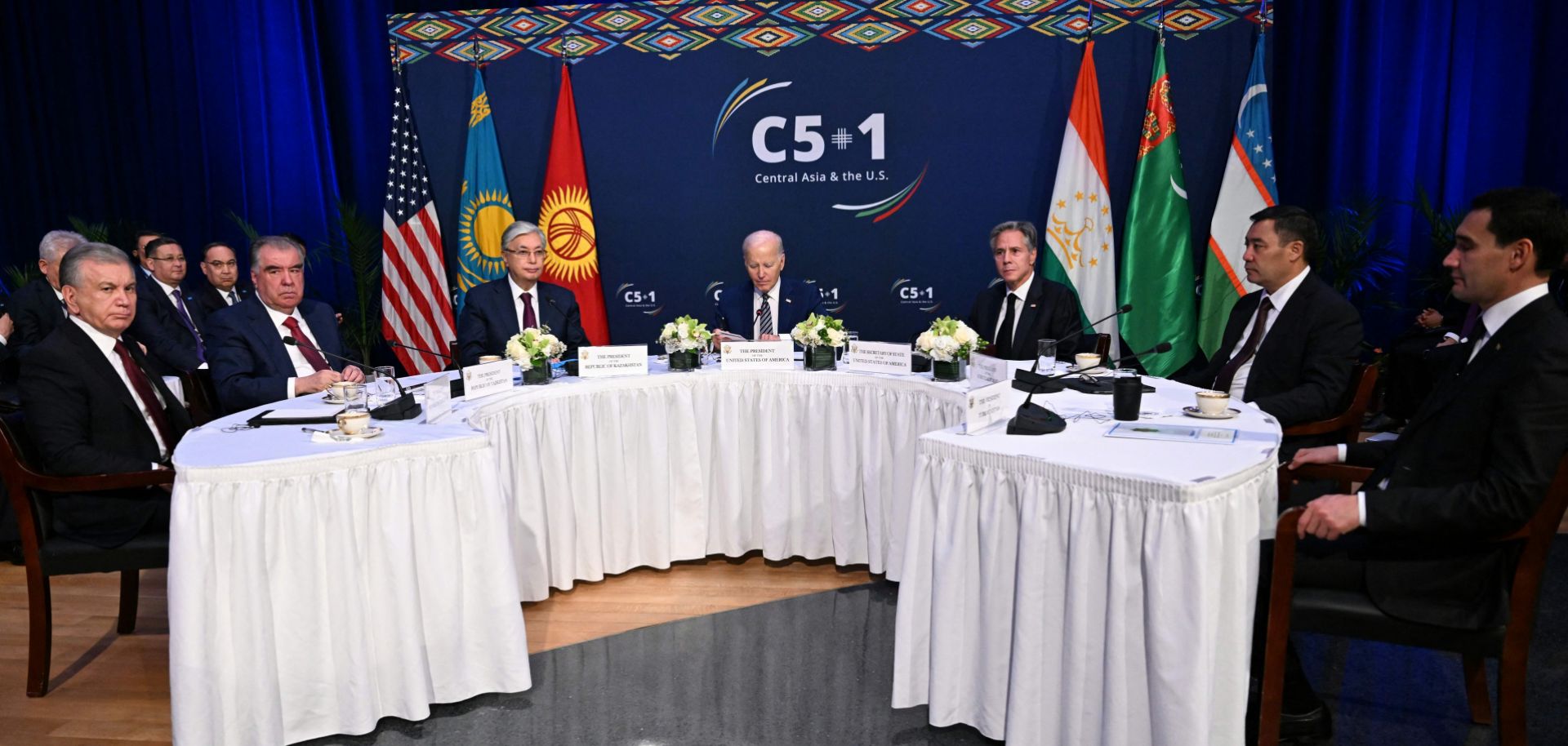
U.S. President Joe Biden (C) and U.S. Secretary of State Antony Blinken (3R) participate in a meeting of the C5+1 with Kazakh President Kassym-Jomart Tokayev, Kyrgyz President Sadyr Zhaparov, Tajik President Emomali Rahmon, Turkmen President Serdar Berdymukhamedov and Uzbek President Shavkat Mirziyoyev in New York City on Sept. 19, 2023.
A meeting between U.S. President Joe Biden and Central Asian leaders does not portend a significant deepening of U.S. engagement with the region, but it will give regional leaders additional leverage in their struggle to avoid overreliance on Russia and China. On Sept. 20, U.S. President Joe Biden hosted the first-ever heads of state summit between the United States and Central Asia's five countries (Kazakhstan, Kyrgyzstan, Tajikistan, Turkmenistan and Uzbekistan), a cooperation format known as the C5+1. The C5+1 began as an annual foreign ministers format meeting in 2015, and the 2023 meeting was the first involving presidents. Biden described the meeting as "a historic moment, building on years of close cooperation" and said the "shared commitment to sovereignty, independence, territorial integrity" would remain the cornerstone of their cooperation. Biden proposed a C5+1 Critical Minerals Dialogue to harness the region's abundant mineral resources and promote the security of critical mineral supply chains. The summit also addressed creating a more favorable business environment for U.S. trade and private sector investment in Central Asia, exploring opportunities for American companies in sectors such as critical minerals, renewable energy, manufacturing and others. Finally, Biden said the United States would strengthen counterterrorism cooperation with the five Central Asian nations and increase security funding in the region. While the meeting resulted in few concrete announcements, the attendees suggested that U.S. engagement with the region through this and possibly other formats was set to increase going forward.
- The most concrete result of the meeting was that the U.S. Agency for International Development (USAID) said it would convene a C5+1 Regional Connectivity Ministerial in Central Asia in October to explore actions for inclusive and sustainable economic development. Biden also hinted at the possibility of continuing the C5+1 format when he ended the meeting by saying, "I look forward to seeing you soon, possibly in one of your countries." This is notable because no sitting U.S. president has ever been to a Central Asian country.
- Past U.S. engagement in Central Asia has at times been extensive, such as immediately after the fall of the Soviet Union when Washington sought the establishment of secular governments, and at the height of U.S. involvement in Afghanistan, when U.S. logistics relied on the region. But in general, compared with other regions, Washington's engagement has been subdued.
U.S. interest in Central Asia is rising as trade in the region increases under the attentive watch of Russia and China. The geopolitical importance of Central Asia has grown significantly as a result of Russia's invasion of Ukraine, as many countries and companies are seeking to avoid Russian goods or even transiting goods through Russia, while Russia's own trade is shifting to new markets. For this reason, the region has seen a significant increase in East-West trade between China and Europe along the so-called Middle Corridor and has served as an avenue for increased North-South trade, not only easing bottlenecks between Russia and China but also between Russia and Iran. In fact, Central Asia has seen an increased flow of Russian trade and, simultaneously, an increased flow in transit specifically intended to bypass Russia. This, along with the region's extensive mineral and other resources, has prompted the geopolitical powers surrounding the region to recently elevate the level and frequency of their cooperation formats with Central Asia. In this context, Washington's goal is likely to show the region's leaders that high-level contacts with the United States can grow, which will give Central Asian leaders additional leverage in negotiations with Russia, China, Turkey and others. Thus, the upgraded C5+1 summit format will further U.S. efforts to simultaneously contain China and distance Russia from its partners.
- On May 19, Chinese President Xi Jinping inaugurated a new China-Central Asia heads of state summit, which is now set to occur every two years. On Oct. 14, 2022, Russia — despite having several redundant formats during which it can meet with Central Asian leaders — launched a new annual heads of state meeting format when President Vladimir Putin attended the inaugural Russia-Central Asia summit in Astana, Kazakhstan. Even India inaugurated a new annual India-Central Asia foreign ministers summit in 2022 and has since expanded the summit to other ministries. These events likely triggered the United States to upgrade the C5+1 to a presidential-level format.
However, concerns over governance and human rights, as well as fears of provoking Russian and Chinese backlash, will constrain significantly deeper economic or diplomatic U.S. engagement with the region. Ahead of the C5+1 summit, human rights organizations urged Biden to use the meeting to emphasize human rights and democracy in Central Asia, but he opted not to do so in his public remarks. Central Asian states typically rank near the bottom in the world on indexes related to freedom of speech, democracy, rule of law and observance of human rights, which will likely serve as a major constraint on Western governments' and organizations' ability to significantly ramp up activities in the region. Additionally, Central Asian leaders will likely resist increased economic or diplomatic cooperation with the United States that could prompt Russian and Chinese retaliation, for example by reducing economic cooperation and thereby endangering the economic stability on which Central Asian regimes depend. Despite these limitations, a modest increase in economic cooperation between the United States and the region may be expected in the coming years, as Washington will seek to demonstrate that it is willing to offer economic incentives for increased observance of U.S. sanctions on Russia, rather than just secondary sanctions on violators of the Western sanctions regime.
- Central Asian governments have recently committed to increasing economic cooperation among themselves and with partners other than Russia or China. On Sept. 14-15, the fifth annual consultative meeting of heads of state of Central Asia took place, at which the honorary guest was Azerbaijani President Ilham Aliyev. Discussions focused on increased transit along the Middle Corridor to encourage connectivity between the region and global markets.
- China is the largest trading partner of Kyrgyzstan, Turkmenistan and Uzbekistan, the second-largest trading partner of Kazakhstan (after the European Union), as well as the third-largest trading partner of Tajikistan (after Russia and Kazakhstan). Russia is a top trade partner for all the countries in the region, and Central Asian nations already make up 5% of Russia's trade, a percentage that will likely grow in the coming years. U.S. companies play leading roles in energy projects in Kazakhstan, but U.S. trade with the region is generally behind China, the European Union, Russia and Turkey.
