
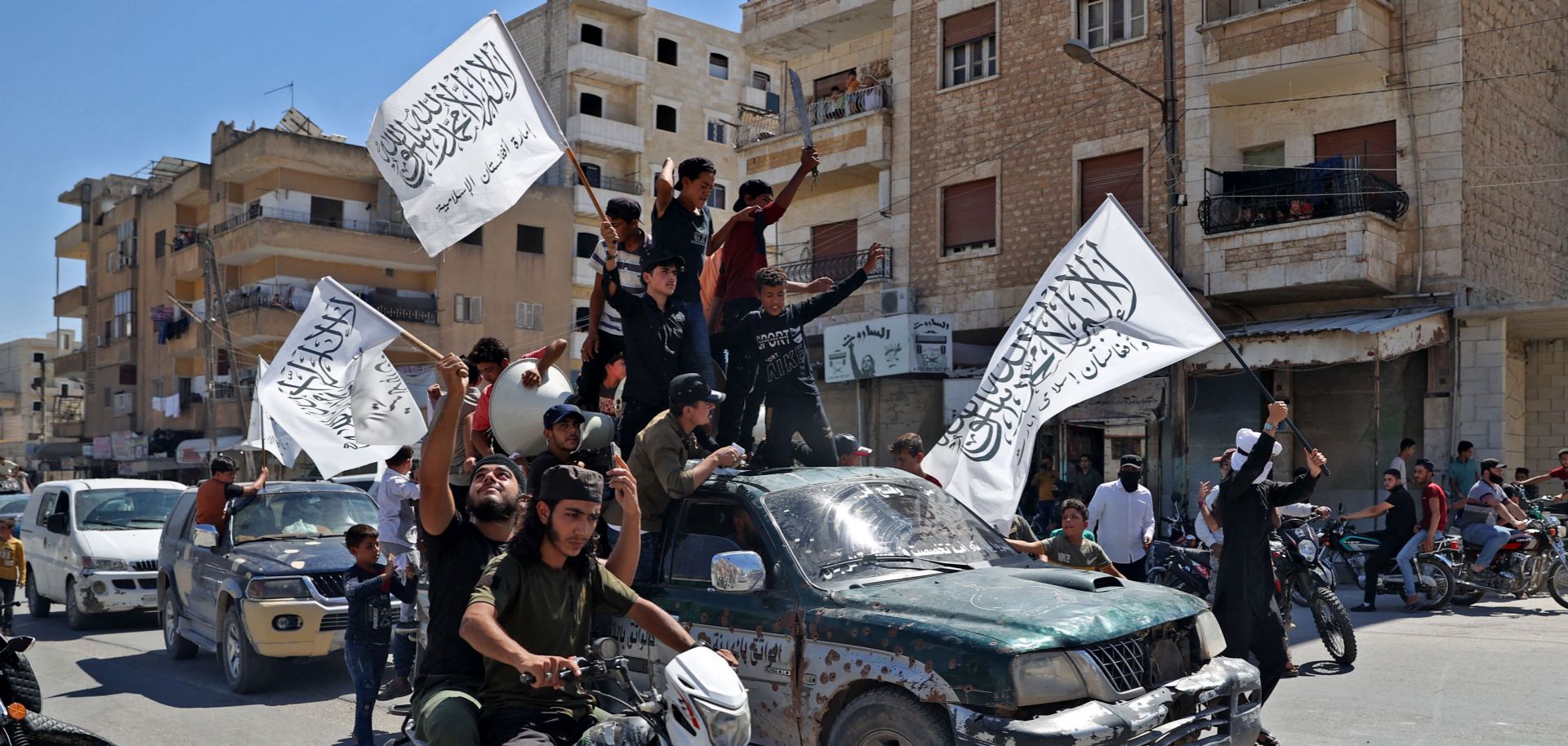
Islamic State's Aug. 3 acknowledgment of the death of its leader, allegedly at the hands of rival Syrian jihadists, raises important questions about the future of jihadism, especially amid renewed great power competition and multipolarity. The jihadist ideological landscape in recent years has been fractured between al Qaeda and the Islamic State's competing models of jihad and governance. Al Qaeda generally favors a relatively gradual approach, seeking to overthrow existing regimes by targeting what the group sees as their main benefactor — the United States — to eventually establish a supranational religious state. The Islamic State, by contrast, emphasizes creating a state from existing countries, which can then challenge the existing order. These different visions were seen in the 2010s during the Islamic State's creation and subsequent collapse of a self-proclaimed caliphate, which to its supporters showed that the group's more aggressive approach was possible, but to its critics confirmed the more gradual approach of al Qaeda.
Since then, a combination of sustained international counterterrorism pressure and these differing visions have had further real-world consequences, fostering fighting and discord between al Qaeda and Islamic State affiliates in Mali, Nigeria, Syria and elsewhere. This discord is occurring in the context of a lack of clear ideological alternatives to Islamism, especially in the Middle East and North Africa, where the ideology of Islamism — the idea that the Islamic religion can and should be the source of law — generally continues to be the most popular alternative form of government. In fact, polling conducted by the Arab Barometer between 2021-2022 showed that Islamism's popularity increased for the first time since the 2011 Arab Spring uprisings. But in many places, jihadist groups have been unable to capitalize on that popularity, as Arabs' increased religiosity and approval for political Islam have not translated into support for jihadist violence. Successive jihadist leadership losses and increasingly effective security forces around the region have also countered the jihadist threat. However, growing multipolarity and inter-state competition may create opportunities for jihadist groups if al Qaeda and the Islamic State can overcome their divisions and/or clearly define an enemy to help unify more people behind their cause and overcome the constraints on their influence.
Examining Jihadism's Roots: From Localized Opposition to Global Militancy
The jihadism we know today is a product of both violent and nonviolent religious movements, with its ideological roots in the Egyptian Muslim Brotherhood political movement of the 1950s and 1960s. Modern jihadism, as embodied by groups like al Qaeda and Islamic State, has been a driving ideology for terrorism and militancy in the Middle East and North Africa since the late 1970s, growing out of pre-existing Islamist movements like the Muslim Brotherhood. The Soviet-Afghan War from 1979-1989 was the pivotal moment that led to the internationalization of violent jihadism, and ultimately the founding of al Qaeda in 1988, which aimed to expel the Soviet Union from Islamic territory as a first step toward establishing Islamist rule globally. Later, after the fall of the Soviet Union, the United States became the so-called ''far enemy'' by serving as the primary sponsor of secular Arab regimes in the Middle East. Under the guidance of Egyptian jihadists like Ayman al-Zawahiri and Abdel Salaam Faraj, jihadists justified attacks on the United States and the West as necessary to overthrow pro-Western regimes like Saudi Arabia and Egypt in order to create an Islamic state. Al Qaeda's vision of fighting the West ultimately culminated in the 9/11 attacks that sparked the U.S. global ''war on terror.''
While the U.S.-led war in Afghanistan initially dealt a serious blow to al Qaeda, the U.S. invasion of Iraq fueled the rise of a regional al Qaeda affiliate, al Qaeda in Iraq, which eventually became the Islamic State in 2014 and began operating in both Iraq and Syria after the Arab Spring of 2011. Unlike al Qaeda, which saw ejecting Western influence from the region as a prerequisite to founding an Islamist state, the Islamic State under Abu Bakr al-Baghdadi preached the reverse: the creation of a caliphate as the key first to challenging Western influence. While both groups seek to attack Western interests in the Muslim world, and ultimately launch terrorist attacks in the West, a combination of their differing strategic goals and subtle ideological and tactical differences continue to foster discord and outright fighting between al Qaeda and Islamic State affiliate groups. This is the case not only in the Middle East and North Africa, but also in sub-Saharan Africa, which has increasingly become the more active theater for jihadist groups. And in South Asia, Afghanistan may be the most prominent example of infighting as the Islamic State's regional affiliate, Khorasan Province (ISKP), continues to battle the al Qaeda-linked Taliban.
Adding to setbacks like intra-jihadist infighting, sustained U.S. counterterrorism pressure in the form of on-the-ground military operations in places like Iraq, Syria and (at least until August 2021) Afghanistan — along with frequent drone strikes targeting key al Qaeda and Islamic State leaders — severely weakened both groups. Increasingly effective security forces in Iraq and U.S. partner militia forces in Syria continue to prevent a significant resurgence of jihadist groups in those countries as well. Even in Afghanistan, the United States to an extent remains capable of conducting drone strikes when seen as crucial to weaken al Qaeda, as best demonstrated by the July 2022 killing of al Qaeda leader Ayman al-Zawahiri in Kabul.
A Jihadist Balancing Act
Growing counterterrorism pressure has forced jihadist groups to become increasingly focused on surviving and maintaining local/regional influence. This has seen groups in Afghanistan, Yemen and the Sahel region of sub-Saharan Africa focus mainly on subnational conflicts, rather than fighting a global jihad, while still maintaining allegiance to the Islamic State or al Qaeda brand to accrue various benefits. According to the July 25, 2023, U.N. Monitoring Report published on July 25, the structures of al Qaeda and the Islamic State ''continually adapt to pressure on the core leadership, with regional affiliates exercising operational autonomy.'' In this respect, al Qaeda and Islamic State affiliates are conducting a balancing act. On the one hand, they take advantage of local insecurity and political instability to focus their attacks on local security forces, rival militant groups and Western targets of opportunity that happen to enter their areas of operation. This is in part a deliberate effort to avoid U.S. counterterrorism pressure, and because such attacks are much easier to conduct than attacking the much more secure West. On the other hand, however, such groups also maintain allegiance to global jihadist organizations and thus ostensibly profess at least a desire to attack the West, in order to gain access to weapons, funding, recruits and media resources, which in turn increases the global reach of the central organization.
In Afghanistan, Islamic State Khorasan Province (ISKP) militants are fighting one such regional conflict that appears to illustrate this balancing act and ultimate choice to focus on the local rather than the global jihad. On the one hand, ISKP proclaims a clear intent to attack the West, and the U.S. intelligence community also continues to assess the group has the desire to conduct attacks abroad. However, ISKP has devoted the vast majority of its attention to conducting attacks within Afghanistan targeting minorities and the Taliban, al Qaeda's historical ally and closest thing to a model Islamist state. And even in this fight, the group has faced setbacks, with recent data showing a steep fall in the number of ISKP attacks over the past year, even as the group has conducted more high-profile ones against targets like foreign nationals in Afghanistan.
In Yemen, al Qaeda in the Arabian Peninsula (AQAP) — al Qaeda's historically most active affiliate — is now focusing its efforts on attacks that foster insecurity in ostensibly government-held areas of the country, especially Abyan and Aden. In service of that goal, AQAP's recent attacks have focused on the UAE-aligned Southern Transitional Council (STC) forces, as attacking the STC has the potential to foster discord with the internationally-recognized Yemeni government, and is more vulnerable to such attacks. While such an operational focus allows AQAP to retain local relevance, it is a far cry from the early 2000s and 2010s when the group plotted a series of high-profile attacks in the West that made it something of a household name. For comparison, AQAP's most recent claimed attack in the West was a Dec. 2019 shooting at U.S. Naval Air Station Pensacola, where it took credit for inspiring the perpetrator who killed three people. While a tragedy, the shooting paled in comparison to AQAP's much more sophisticated directed plots of prior years.
Such regionalized efforts are not entirely new, nor limited to the Middle East, but have accelerated in recent years given the losses suffered both by the core commands of Islamic State and al Qaeda, and significant degradation of the capacity of such groups to launch attacks in the West. In the Sahel, jihadist groups have also had to balance between local priorities and global relevance amid internecine fighting. For instance, Jamaa' Nusra al-Islam wa al-Muslimin (JNIM) is taking advantage of regional insecurity to pose a threat to multiple governments, including Mali, Niger and Burkina Faso. Meanwhile, the group is simultaneously locked in a struggle with Islamic State Sahel Province (IS Sahel), leaving it with little capacity to launch attacks outside of the region despite a professed desire. While frequent jihadist attacks have expanded insecurity across the African region, JNIM, IS Sahel and other groups have struggled to build the capacity to launch attacks outside of the Sahel, given such groups' more immediate attack priorities and capability challenges.
Multipolarity Opens Opportunities, but Also Challenges
Given the increasingly regionalized (or localized) focus of jihadist groups, the rise of multipolarity ultimately may create opportunities for jihadists in the long term if one vision (the Islamic State or al Qaeda's) becomes dominant, and/or if the focus of U.S. and other major intelligence services and militaries worldwide becomes more focused on great power competition over counterterrorism, exacerbating security vacuums in countries like Syria, Yemen and Afghanistan. Right now, the intra-jihadist dispute between al Qaeda and Islamic State serves as a constraint on the growth of the global jihadist movement, as neither is dominant and both are trying to draw recruits from the same pool. Indeed, the recent killing of Islamic State leader Abu al-Hussein al-Husseini al-Qurayshi, allegedly by members of al Qaeda-linked Hayat Tahrir al-Sham in northern Syria, highlights how the bifurcation of jihadism has made jihadists less focused on attacking the West in the short term. The killing also demonstrates the effectiveness of U.S.-led counterterrorism efforts in weakening the Islamic State to the point where other rebel groups pose a major threat to its leadership. Al-Qurayshi was the third leader of the group to be killed in less than two years, with both him and his successor having to maintain very low profiles to avoid detection. Al Qaeda leaders have similarly had to avoid the limelight due in large part to U.S. counterterrorism pressure and the persistent threat of lethal drone strikes.
In a multipolar environment, the increased focus by the United States and other Western allies on their competition with adversaries like China and Russia means the West could have less bandwidth over the long term to deal with counterterrorism. The increased focus on great power competition will likely also continue to hamper intelligence-sharing, especially between adversarial great powers like the United States, Russia and China, even on counterterrorism issues. After all, for all the counterterrorism pressure against them, al Qaeda and Islamic State have survived repeated leadership decapitations and have shown a recurrent ability to exploit security vacuums. And should (especially Western) militaries devote more of their procurement to systems designed for nation-state conflicts — a trend already being seen in Europe following Russia's February 2022 invasion of Ukraine — armed forces will be less prepared to fight counterterrorism campaigns and counterterrorism doctrine will atrophy.
Syria is one such place where counterterrorism and great power competition is steadily coming into conflict. The United States is increasingly having to devote force protection resources to counter increasing Iranian and Russian threats in the war-torn country, as Washington also tries to maintain its mission to counter the Islamic State. While the United States has succeeded thus far in terms of killing or capturing Islamic State leaders, the group has adapted by sustaining a low-grade insurgency in rural areas, taking advantage of spaces where the United States cannot operate without increasing the risk of coming into conflict with the Syrian regime and Russian forces. In the Sahel, a similar dynamic is at play with the encroachment of Russian-backed Wagner forces in Mali, which has complicated and in some cases undermined Western counterterrorism efforts against JNIM and other jihadist groups in the country. In particular, human rights abuses by Wagner in conducting counterinsurgency operations have only fueled jihadist recruitment in Mali, leading to increased jihadist activity.
As the world becomes increasingly multipolar, jihadists will likely focus more of their attention on middle powers, at least in the short term, to avoid triggering international attention. In the Middle East and North Africa, Israel probably presents the most natural future enemy for jihadist groups in the region, given the resonance of the Palestinian cause. Historically, while jihadist groups have focused rhetoric against Israel, they have devoted few resources to actually targeting Israel, likely due in part to the competition they would face from already established Palestinian militant groups, as well as constraints from especially strong Israeli counterterrorism capabilities. However, more recently, Islamic State sympathizers among Israel's marginalized Israeli Arab community have conducted attacks in Israel, including a rare and symbolic double bombing in Jerusalem in November 2022. Other states like Saudi Arabia, Iran or Turkey — which already face jihadist threats — could also see more attacks as al Qaeda or the Islamic State tries to claim the mantle of leadership of the global jihad, but all have the potential to turn jihadist groups into proxies, which jihadists themselves have resisted given their hostility toward the nation-state. Al Qaeda is already dealing with this problem as Saif al-Adel, the likely successor to deceased leader Ayman al-Zawahiri is presently in Iran, and al Qaeda has likely refrained from announcing a successor given the desire to avoid association with Iran.
But multipolarity also presents challenges for jihadists in that having more targets can dilute a group's message and operational focus and, in turn, undercut the strategic vision of the global jihadist movement. In Afghanistan, for example, ISKP's propaganda has already cited China's mistreatment of Uighur Muslims and the Taliban's ostensible friendliness toward China in justifying militant attacks. The group also purportedly employed a Uighur suicide bomber in an October 2021 attack in the northern Afghan city of Kunduz, which killed 50 people and wounded 150 others. But despite ISKP's tactical use of the Uighur cause against the Taliban, the group has so far been unable to harness that cause as a recruitment tool, or operationalize attacks on China directly, likely in part due to the peripheral nature of the Uighur issue, even to committed jihadists. Russia, meanwhile, has historically been an enemy of jihadist groups, with jihadist volunteers frequently going to the breakaway Russian republic of Chechnya in the 1990s and early 2000s. More recently, Russia's efforts to prop up Bashar al Assad's regime in Syria and Russian mercenaries' involvement in counterterrorism operations in sub-Saharan Africa have drawn even more ire from jihadist groups. However, jihadist groups have been unable to translate their local fights against Russian influence into a broader global fight against Russia or into a sustained campaign of attacks on Russian soil, suggesting that even if a logical target, focusing on Russia may be somewhat of a distraction that fails to achieve jihadist unity.
Thus, as they navigate a new multipolar world where great powers are less likely to prioritize counterterrorism, jihadist groups will have an opportunity to rebuild capabilities without significant interference. Fully seizing that opportunity, however, will also require jihadist groups to overcome their internal divisions and develop a new strategic vision in an environment where they no longer have just one main enemy, but several.
