
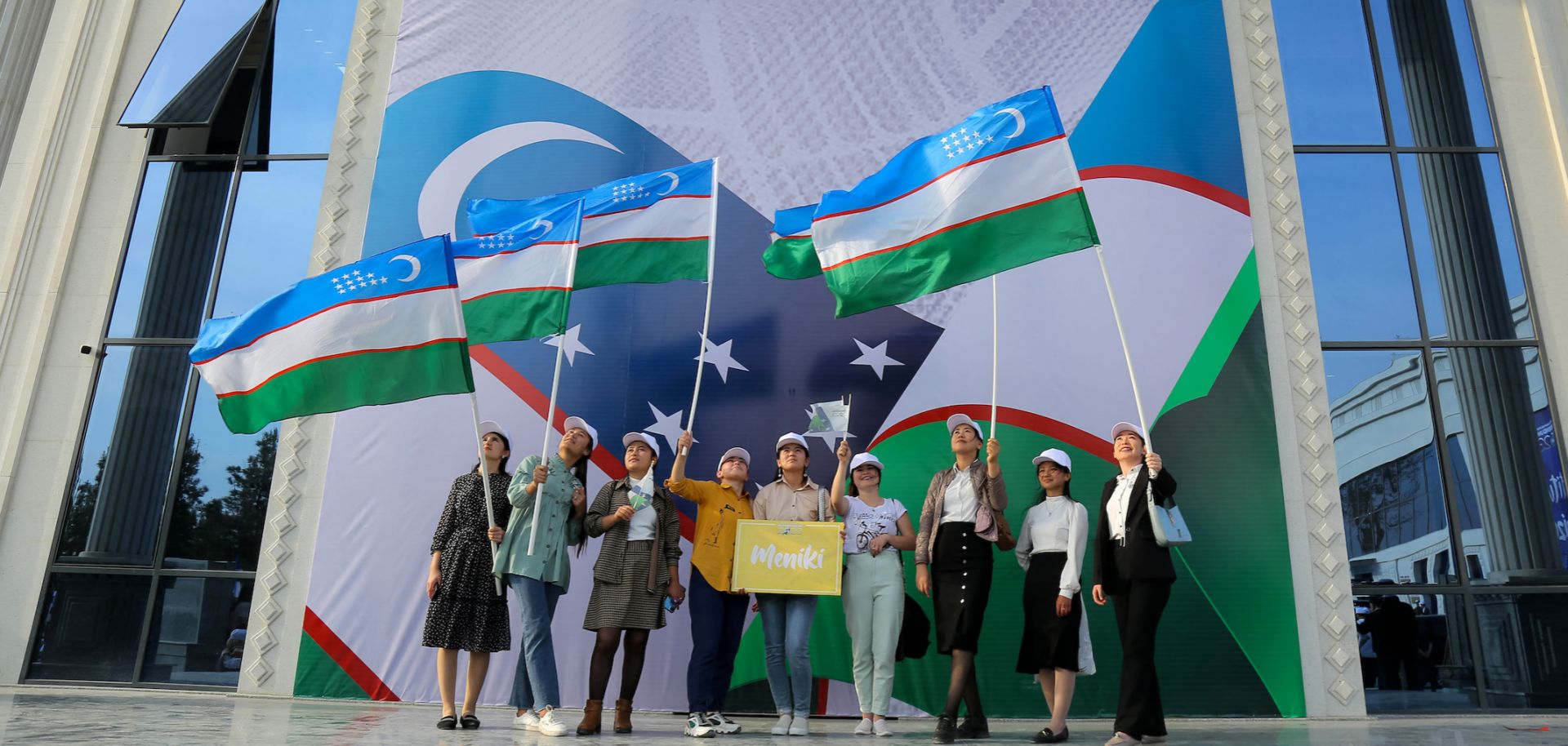
People attend a rally in support of Uzbekistan's constitutional referendum on March 28, 2023, in the city of Jizzakh, located roughly 250 kilometers (155 miles) south of the capital Tashkent.
Uzbekistan's constitutional referendum is unlikely to portend further liberalization in the country, and is instead an attempt to ensure domestic stability. According to the Uzbek government, 90% percent of voters approved a package of constitutional amendments in a national referendum held on April 30 that reportedly garnered an 85% turnout. The changes — which lawmakers claim impact 65% of the constitution's text — will allow President Shavkat Mirziyoyev to run for two more seven-year terms beyond the end of his current five-year term in 2026. The constitutional reforms have been in the works since Mirziyoyev first proposed them during his November 2021 inauguration for his second term. The Uzbek president has insisted that the overhaul of the constitution would improve governance and quality of life in the country by reflecting and fortifying changes in Uzbekistan under his rule. On the surface, some of the changes suggest timid steps toward political and social liberalization, such as a reduction in the number of senators from 100 to 65, a ban on the death penalty, and more legal protections for women. But the amendments are primarily meant to secure Mirziyoyev's grip on power and avoid political instability by nullifying his previous two terms and extending the length of presidential terms from five years to seven, which could see him stay in office until at least 2040.
- The Organization for Security and Cooperation in Europe called the referendum ''technically well prepared,'' but said that despite being promoted as a move to enhance various rights and freedoms, it took place in an environment that lacked — and will likely fail to engender — ''genuine political pluralism and competition.'' The 57-member security organization also noted that numerous elements of the referendum were ''not in line with international good practice.''
- Conversely, Zhang Ming, Secretary-General of the Shanghai Cooperation Organization (SCO), congratulated Uzbeks and said the organization's observer mission ''recognizes the constitutional referendum in Uzbekistan as open, transparent and democratic''.
- The amendments were initially planned to be put to a vote by December 2022, but this timeline was thrown off after the publication of a preliminary draft of the amendments in July triggered mass protests in the northern Karakalpakstan region that left at least 21 dead. The first draft of the constitutional changes revoked Karakalpakstan's nominally autonomous status, which authorities later walked back and did not include in the final version. The referendum was then further delayed by gas shortages in December.
- Mirziyoyev succeeded the mercurial post-Soviet dictator Islam Karimov in 2016 after serving under him as prime minister for 13 years. Over the past seven years, Mirziyoyev has cultivated the image of a reformer compared with his predecessor. But apart from liberalizing some parts of Uzbekistan's economy in a bid to increase foreign investment flows, the political reforms enacted by his government have been insignificant.
The move is intended to secure the Uzbek regime and, in turn, attract more foreign investment to the country. The referendum signals Mirziyoyev's intent to remain the undisputed leader of the country for many years to come, rather than his commitment to further reforms. Since his 2021 reelection, Mirziyoyev has focused predominantly on economic reforms, including the privatization of hundreds of state-owned companies and other measures intended to attract foreign investors. In this light, the referendum is an effort to reassure foreign partners and potential investors that his regime's policy course will remain steady and that political instability will not pose a significant risk to their investments. The updated constitutional language includes provisions guaranteeing the right to dignified working conditions and free healthcare and education, but this hardly suggests that significant progress toward these goals will now be realized. In other post-Soviet states (including Russia, Belarus and Azerbaijan), the advancement of human rights has either stagnated or further regressed following similar referendums nullifying the president's previous terms, and there is little reason to believe Uzbekistan will prove any different. The referendum is thus highly unlikely to engender any increase in civil rights or political liberties, even to the slightly higher level enjoyed in neighboring Kazakhstan and Kyrgyzstan. But when these liberal promises of unenforceable rights and social guarantees inevitably go unfulfilled, they could suddenly boil over into street protests similar to those seen in Karakalpakstan over the past summer.
- Changing constitutionally mandated term limits to stay in office for longer is a common practice among Eurasian autocrats, including Russian President Vladimir Putin, who in July 2020 pushed through constitutional amendments that could see him remain in office until 2036. Uzbekistan's referendum also drew comparisons with its northern neighbor, Kazakhstan, where President Kassym-Zhomart Tokayev recently secured a longer second term in a snap election that was held shortly after lawmakers approved constitutional changes that increased presidential term limits from five to seven years.
- Uzbekistan scored a mere 11 out of 100 in the U.S.-based Freedom House group's 2022 Freedom in the World Index — significantly lower than nearby Kazakhstan and Kyrgyzstan, which scored 23 and 27, respectively.
Russia and China will support Uzbekistan's reforms because they guarantee stability in the country, while the United States will refrain from criticizing Mirziyoyev to avoid pushing him from falling deeper into Moscow and Beijing's orbit. Russia and China, Uzbekistan's top trade partners, hailed the referendum and underscored their strong bilateral ties with Mirziyoyev's regime. While not overtly celebratory, the United States' response was comparatively muted, likely in an effort to maintain productive relations with Uzbekistan — a desire expressed by U.S. Secretary of State Antony Blinken during his recent trip to the country. On March 1, Blinken traveled to Uzbekistan to meet with Mirziyoyev, during which they reportedly discussed Uzbekistan's reform agenda. But in a press conference held after the meeting, Blinken avoided answering directly when asked about Mirziyoyev's push to extend his rule via constitutional amendments, and instead spoke broadly of the need for further reforms following the Uzbek government's previous success in eliminating forced and child labor in the country's cotton industry. Blinken also noted that his discussion with Mirziyoyev primarily focused on the dangers posed by Russia's invasion of Ukraine, which he said ''fostered deep concern across the region.'' This underscored Tashkent and Washington's mutual interest in preserving ties, as Uzbekistan (like Kazakhstan) seeks outside partners to avoid overreliance on political and economic ties with China and Russia, which the United States is similarly seeking to prevent.
- With a population of nearly 35 million, Uzbekistan is by far the most populous country in Central Asia and an increasingly important east-west and north-south transit hub. Russia, China and the United States are also concerned that the country is more vulnerable to destabilization due to its proximity to neighboring Afghanistan, which could pose national security risks to all three geopolitical powers amid the Taliban's continued rule.
- Russia said the results of Uzbekistan's recent constitutional referendum ''clearly demonstrate'' Uzbek citizens' ''high degree of support [for] the political course'' of President Mirziyoyev and mark a ''welcome stage'' in the country's political development that will provide ''an opportunity [to] further strengthen the multifaceted Russian-Uzbek strategic partnership and alliance.'' China's foreign ministry released a similar statement expressing its confidence in Mirziyoyev's leadership and the future of China-Uzbekistan ties.
