
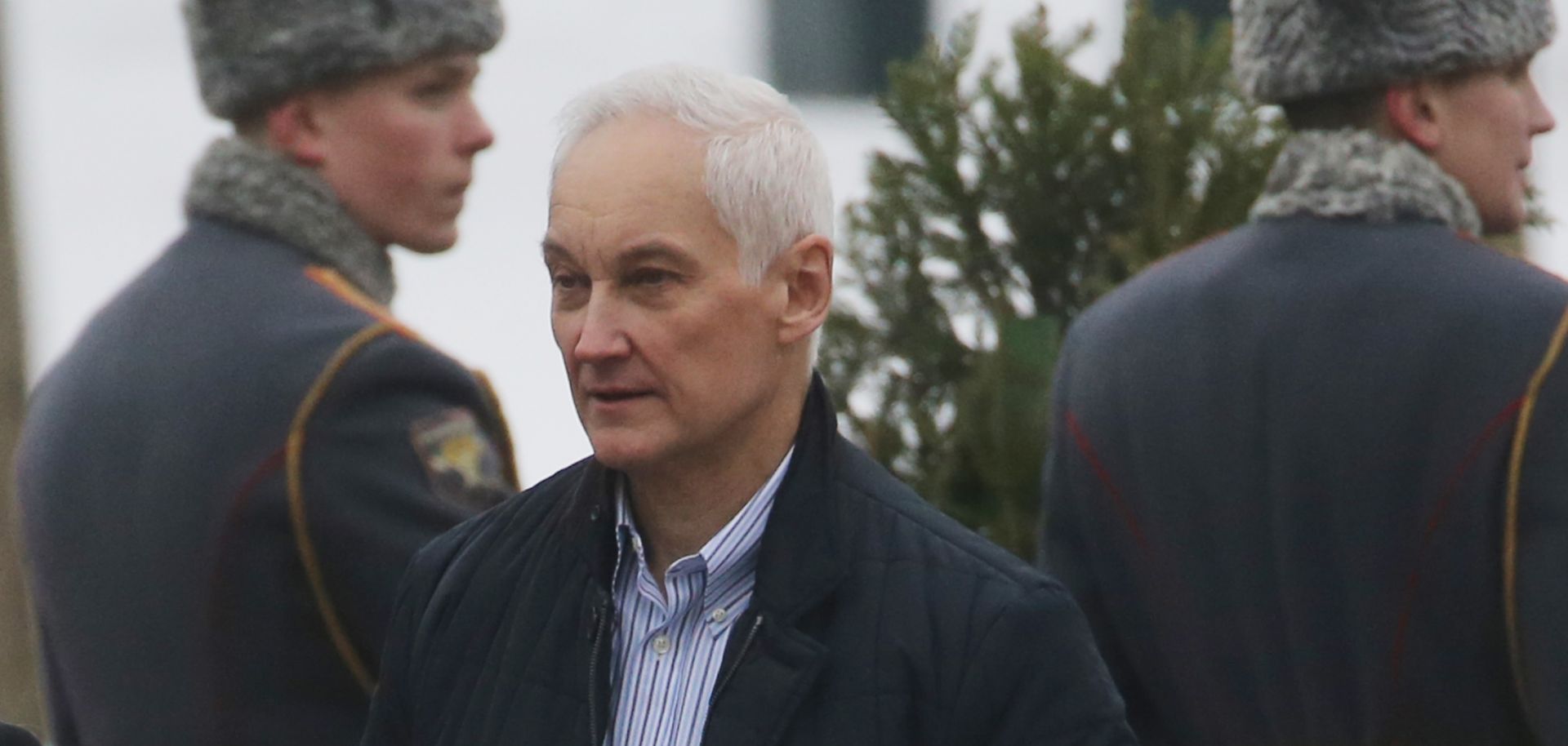
Russian President Vladimir Putin's move to name a new defense minister but largely preserve his cabinet is intended to improve military efficiency and production while maintaining Russia's overall economy and solidifying political loyalty. On May 12, Putin appointed former First Deputy Prime Minister Andrey Belousov as defense minister. Belousov will replace Sergey Shoigu, who had been in the position for 12 years and was appointed the new Secretary of Russia's Security Council, replacing one of Putin's closest associates, former Federal Security Service Director Nikolai Patrushev. These announcements were part of Putin's cabinet reshuffle, which took place after his inauguration for a fifth term on May 7. Belousov's replacement as first deputy prime minister was Denis Manturov, the former minister of industry and trade who was heavily involved in military production. The rest of the appointments were less relevant, outside of the promotion of Putin's relatives and sons of his closest associates.
- The other appointments of note involved the elevation of individuals closely tied to Putin and potential successors. Boris Kovalchuk, the son of the president's longtime friend and one of the most influential people in the country, Yuri Kovalchuk, will become the head of Russia's Accounts Chamber, while former agriculture minister Dmitry Patrushev, the son of Nikolai Patrushev, will become promoted to a deputy prime minister. Both individuals are considered potential successors to Putin. The former governor of the Kemerovo Oblast, Sergey Tsiviliov — whose wife is one of Putin's cousins — was appointed energy minister.
- In a brief statement regarding the cabinet reshuffle, Kremlin Spokesman Dmitry Peskov said that former Security Council Secretary Dmitry Patrushev's new position would be announced in the coming days. It appears likely that a new position will be made specifically for Patrushev. In any case, Patrushev's reappointment does not constitute a blow to his standing, as his new role will likely be of importance to Putin, while his son's promotion only furthers the standing of his camp.
Belousov's appointment as defense minister signals Moscow's resolve to increase military production and improve the military-industrial complex's alignment with the government's broader economic strategy and efforts to reduce corruption. Belousov gained Putin's favor as an economic manager over the past decade, and his appointment is a technocratic move to ensure the defense ministry is run by an individual better equipped to manage the complex questions related to military production and mobilization measures, and their interaction with the greater Russian economy. Belousov's advanced economic and management background sets him apart from his predecessor Shoigu, who for decades had worked almost exclusively in domestic politics and the security sector. The Kremlin thus believes Belousov will be able to assemble a more competent and economically-oriented management team at the defense ministry to better coordinate Russia's military-industrial complex and its interaction with the broader Russian economy, including through the creation of incentives in the civilian economy to stimulate military production. A champion of statist industrial policy, Belousov will bring the ministry's record 10.8 trillion ruble ($117.2 billion) budget under more efficient management and greater political control of the Kremlin. With no broader political power base of his own, Belousov will also seek to better carry out the Kremlin's orders of reducing corruption, even as the defense spending he oversees likely continues to rise as part of his propensity for statist economic management and pumping cash into the Russian economy via the defense sector.
- Putin first noticed Belousov when Putin had just left the Russian presidency and occupied the office of prime minister from 2008-2012, leaning on Belousov to curate complex economic issues in which Putin lacked expertise. Putin later appointed Belousov to be his chief economic advisor when Putin returned to the presidency in 2013, and seven years later, in January 2020, Belousov became first deputy prime minister, maintaining Putin's close monitoring of economic issues from within the cabinet of the new and untested Prime Minister Mikhail Mishustin.
- Compared with many other economic technocrats in Putin's administration (including Finance Minister Anton Siluanov, Central Bank Governor Elvira Nabiullina, and Economic Development Minister Maxim Reshetnikov), Belousov is known as being a vocal supporter of expanding the state's role in the economy and increasing the micromanagement of industry.
- Shoigu's removal as defense minister partially addresses long-standing dissatisfaction with his performance in the role, notably from nationalist factions following Russia's failed attack on the Ukrainian capital of Kyiv in 2022. Indeed, nationalist bloggers largely celebrated Belousov's appointment, underscoring its political benefits for the Kremlin. Prior to his apparent assassination in August 2023, former Wagner chief Yevgeny Prigozhin — who led the paramilitary group's armed rebellion against the defense ministry in 2023 — had also criticized Shoigu as being incompetent and corrupt.
- Shoigu was not terminated but rather symbolically promoted to secretary of Russia's Security Council. This maintains the appearance of loyalty within Putin's inner circle, as removing Shoigu outright would have risked destabilizing Putin's authority by suggesting to his associates that their safety was no longer assured, potentially fostering conspiracies against him. For Putin, the symbolic promotion also ensures the benefits of Shoigu's removal without appearing weak to critics, as firing Shoigu would have risked being seen as a capitulation to public pressure, setting a dangerous precedent.
- On April 26, Shoigu's close associate and Deputy Defense Minister Timur Ivanov was arrested on corruption charges, providing further justification for Shoigu's ''reassignment,'' effectively ridding him of the real levers of power that come with a ministerial office.
The reshuffle unfavorably impacts Prime Minister Mikhail Mishustin and signals challenges for other government officials labeled as moderates or liberals, like Former President Dmitry Medvedev. Mishustin and his allies bore the brunt of the cabinet reshuffle, notably with the promotion of Patrushev Jr. as deputy prime minister at the expense of Mishustin's ally, Viktoria Abramchenko. The reshuffle thus indicates that the influence of figures like Mishustin and other systemic liberals will likely remain limited, as the Kremlin seeks to prevent perceptions of their ascent to power in a post-Putin era. Indeed, Mishustin's retention as prime minister is partly due to his non-contender status for Putin's successor, avoiding potential elite infighting. Former president Medvedev, for his part — who currently serves as deputy chairman of Russia's Security Council — has recently attempted to rebrand himself as a nationalist. But Putin's dissatisfaction with his efforts overseeing the Military Industrial Commission is evident — given that Shoigu will now reportedly oversee the commission under his new role as secretary of the Security Council. Shoigu's elevation and Patrushev's departure from Russia's Security Council, along with Medvedev's stagnant role, also suggest a waning influence of the council more broadly, as its primary function increasingly becomes providing positions to close associates (removing from the direct exercise of power in the presidential administration and government ministries due to poor performance and age) rather than serving as a key decision-making body.
Belousov's appointment will not impact Russia's strategy in Ukraine, which will continue to focus on degrading the war-torn country's military and economy through further offensives, though it could marginally improve the Russian military's effectiveness. The Kremlin has stated that Russia's top general, Chief of the General Staff Valery Gerasimov, will keep his position and that it currently envisions no staffing changes in this regard. But short-term improvements in Russian military effectiveness are possible if the Kremlin reverses this stance and allows Belousov to appoint his own Chief of the General Staff as part of his team at the defense ministry. In this scenario, Belousov would likely replace Gerasimov with someone more competent whom he has greater confidence in, which could marginally benefit the operational effectiveness of the Russian army on the battlefield in Ukraine. However, there is little reason to believe that Belousov's appointment — nor any of the other reshuffled positions in Russia's government and military — will alter Moscow's greater strategy in Ukraine and willingness to maintain its war, which in the near term is driven by the need for offensive actions to increase Russia's leverage ahead of any potential negotiations with Ukraine, and in the long term is driven by strategic and political calculations in the Kremlin to impose costs on Kyiv for its efforts to leave Moscow's orbit. Furthermore, the naming of different officials is unlikely to alter Russia's military options this year because the new appointments will not relieve the military production and manpower constraints currently facing the Russian army. In the medium-to-long term, however, Belousov may be able to strengthen Russia's military through the appointment of more effective leaders and the implementation of long-overdue reforms to reduce corruption and budgetary waste, while ensuring the proper economic stimuli exist in the civilian economy to incentivize increased production, ultimately allowing the Russian army to field more troops. But while they could have a major impact, these actions would likely take significant time to do so.
