
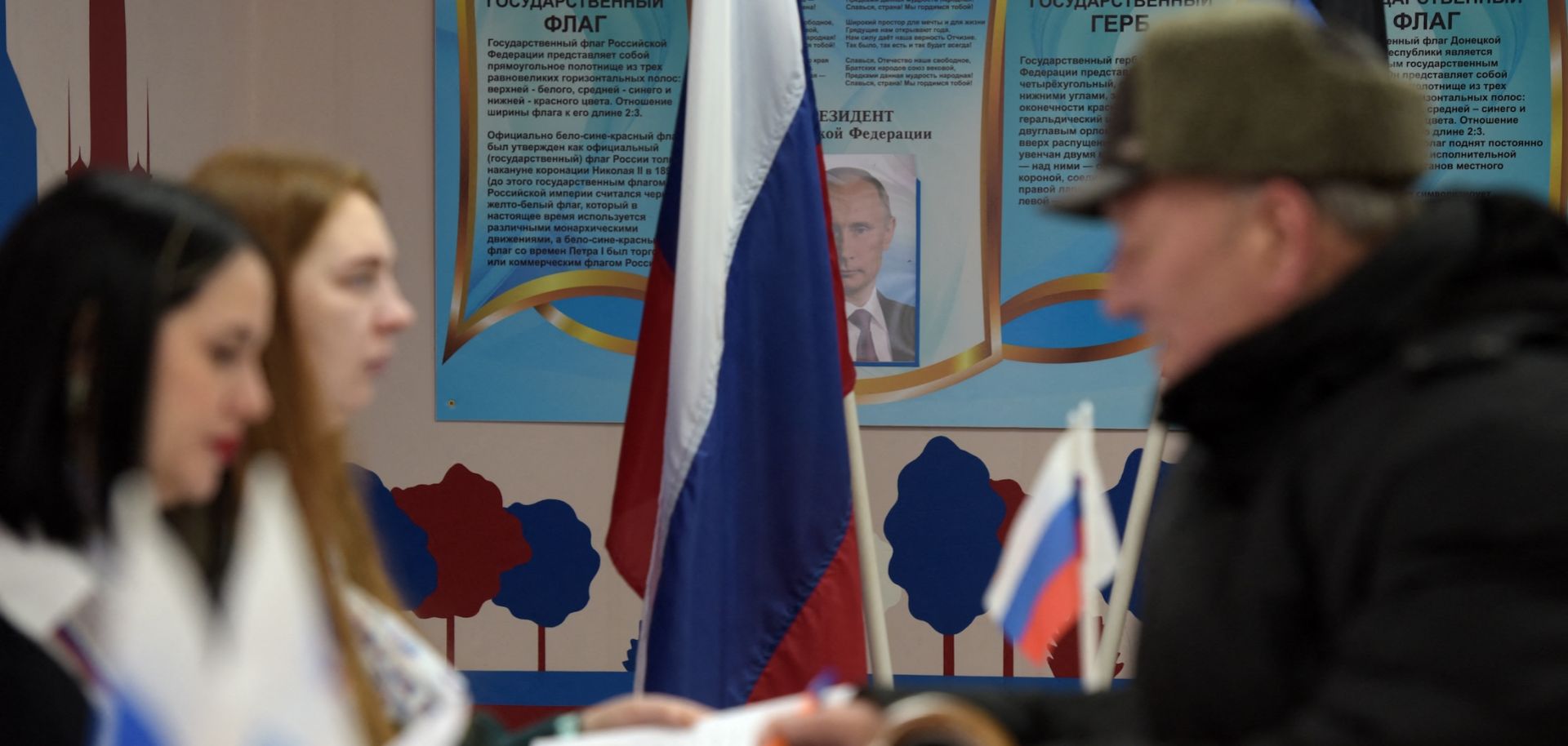
Russia will use President Vladimir Putin's reelection to prepare for continued conflict in Ukraine and fortify Putin's continued rule long ahead of an eventual succession process. On March 17, Russia's presidential election concluded after three days of in-person voting that commenced on March 15. The vote was accompanied by higher-than-usual disruptions at polling places, most notably the destruction of ballot urns, as well as lines at voting places across the country and at Russian embassies abroad around noon on the final day of voting, as called for by opposition supporters. In a result that was a foregone conclusion, the official results claimed that incumbent Vladimir Putin received a record share of the vote – over 87% – far exceeding the 76.69% Putin received in the 2018 elections, and with a record turnout of over 74%, surpassing the 2018 level of 67.5%. Putin will serve another six-year term until 2030 — at which point he will be 78 years old — and will also be allowed to run for another six-year term after that. While Russian elections under Putin have never been completely competitive, this one was less free or fair than previous votes; the past two years have seen a flurry of new restrictions on speech due to the ongoing war in Ukraine, and the government barred even token liberal opposition candidates from running in the election due to the danger they could've posed to the regime.
- Both the share of the vote and the turnout figures corresponded to the desired outcomes reportedly set by the Kremlin long before the vote, but were highly inflated compared with independent exit polls organized by the Russian opposition. Falsifications on behalf of Putin were likely used by regional authorities to achieve the record figures because a decrease in them would have suggested a decrease in Putin’s popularity as a result of the ongoing invasion of Ukraine, which could have destabilized the regime.
- The Kremlin further reduced opposition candidates' ability to participate in the presidential election for fear of providing the opposition a vehicle to quickly undermine the image of overwhelming support for Putin amid the war in Ukraine, despite growing evidence of the conflict's declining popularity in Russia. This fear was illuminated by the 2020 presidential election in neighboring Belarus, in which opposition candidate Svetlana Tikhanovskaya was allowed to participate and then went on to perform stronger than expected by the Belarusian regime.
- As occurred following the election in Belarus but in a first for a Russian presidential election, some Western governments and legislatures will likely pass various resolutions and executive actions denying recognition of the Russian presidential election results. However, Western countries will not break off diplomatic relations with Russia and the moves will have little immediate effect, though these reactions will send an important signal in the long run to civil society and elites in Russia.
- While the results of Russian elections are often pre-determined, they, like elections in other authoritarian states, are intended to provide the regime with a veneer of legitimacy. The Kremlin's power is demonstrated by its ability to effectively use its administrative resources to secure the needed electoral result without major backlash, intimidating would-be regime skeptics in both the Russian bureaucracy and general public, while enabling Moscow to claim to foreign audiences that Russians are united behind the Kremlin's vision for their country.
The Kremlin will use the election result to justify measures to maintain its war in Ukraine, most notably tax increases aimed at reducing the strain on Russia's public finances. With the election now behind it, the Kremlin will now be free to pursue the controversial measures it had delayed until after the vote. As part of Putin's effort to create a more ''fair'' taxation system announced at his Feb. 29 address to the Federal Assembly, Moscow will likely try to change Russia's tax code by expanding progressive income taxation, in order to increase budget revenues and slow the rate at which Russia's sovereign wealth fund is being depleted (which, at current spending rates, could be exhausted as soon as next year). Moscow will frame the move as a populist measure to ensure the wealthy are paying their fair share to finance Russia's war effort. However, due to intricacies in how different types of taxes are shared between the federal and regional budgets in Russia, the tax increase on the wealthy could have a regressive effect by causing proportionately more money to be disbursed to Russia's financially richer areas (like Moscow and St. Petersburg), as well as its resource-rich regions (like Western Siberia), while leaving even less money for Russia's poorest rural regions where fewer wealthy individuals reside. But while the increased tax burden could dampen Russia's economic growth prospects in the years ahead, it will fortify Russia's macro-financial stability. The Kremlin is thus more likely to pursue such tax adjustments than more destabilizing economic and military mobilization measures, which the Kremlin likely believes are unnecessary amid its confidence in the Ukraine war's current trajectory.
- When first introduced in 2021, the progressive income tax initially only affected the top 1% of Russia's population and had a negligible effect on boosting revenues. But the new changes appear likely to lower the wealth threshold at which the tax is levied, subjecting millions of urban upper-middle-class Russians previously exempt from the tax for the first time. The added tax burden will likely increase disenchantment among Russians living in large cities and prompt more of them to consider moving abroad.
- The Russian government has reportedly been working on the tax reform since 2023, but is still finalizing the details. Reports indicate that under the new system, Russians who earn more than 1 million rubles a year would be subjected to the higher tax rate currently reserved for those who earn more than 5 million rubles a year. According to incoming data from Russia's statistics agency Rosstat, this expansion of the progressive income tax would shift as many as 20 million Russians, or around 14% of the population, out of the lowest tax bracket. The measures under consideration would also raise the corporate tax rate from 20% to 25%, among other changes. Such changes would provide the government with trillions of rubles worth of new revenues, reducing Russia's budget deficit, and thereby reducing the possibility of higher inflation and other adverse economic conditions in the years ahead.
Putin could also use the election to conduct a Cabinet reshuffle as part of long-term preparations for his eventual succession process, seeking to ensure ideological continuity. Reports suggest Putin may reshuffle his Cabinet following the election as well. On the surface, Putin would justify such a move by claiming that a new government is needed to realize the ambitious plans he's laid out for his next term, and overdue given that the previous Cabinet was formed in 2020 — well before the February 2022 invasion of Ukraine brought major changes to Russia's domestic and foreign policy. A post-election Cabinet reshuffle would likely involve the removal of some older ministers, as well as technocrats reputed to be ''systemic liberals.'' Any individuals elevated to new roles would also be speculated as possible candidates to replace Putin, should he choose to initiate a succession process rather than serve another two full terms until 2036, which seems unlikely given that he would be 84 years old by then. This would particularly be the case for ministers more than just a few years younger than Putin, as Putin's succession may not begin for several years. In addition to institutionalizing the intergenerational nature of Moscow's current course, the elevation of younger ministers committed to the Kremlin's vision would be intended to send a message to the West that their strategy of waiting for Putin's departure will not result in a Russian leader more willing to conduct significant domestic liberalization, de-escalate in Ukraine, or significantly reduce tensions with the West – unless it's on Moscow's terms, with all the subsequent implications for the West.
- 46-year-old Agriculture Minister Dmitry Patrushev and 46-year-old Boris Kovalchuk, the recent head of Russian utility Inter RAO, are the sons of two of Putin's closest associates and are both expected to be granted greater roles in Putin's reshuffled government. Kovalchuk left his post as the CEO of Inter RAO on March 14 and was appointed deputy head of the Control Department of the Presidential Administration on March 15, while Patrushev is rumored to potentially become a Deputy Prime Minister. If confirmed, Patrushev and Kovalchuk's elevations would fuel speculation that they are being primed as potential successors to Putin.
- 58-year-old Prime Minister Mikhail Mishustin appears likely to keep his job precisely because he is not considered a probable successor to Putin. If someone considered a viable successor to Putin moved into the prime minister's role, Moscow and local elites would preemptively reorient from Putin to this person — something dangerous for Putin, unless as part of a carefully managed process.
- 74-year-old Foreign Minister Sergey Lavrov and 72-year-old Energy Minister Nikolai Shulginov appear among the most likely to leave their posts in any reshuffle, but they and other more senior ministers may be kept on as special advisors to the Russian president.
