
The Quintessential Land Power
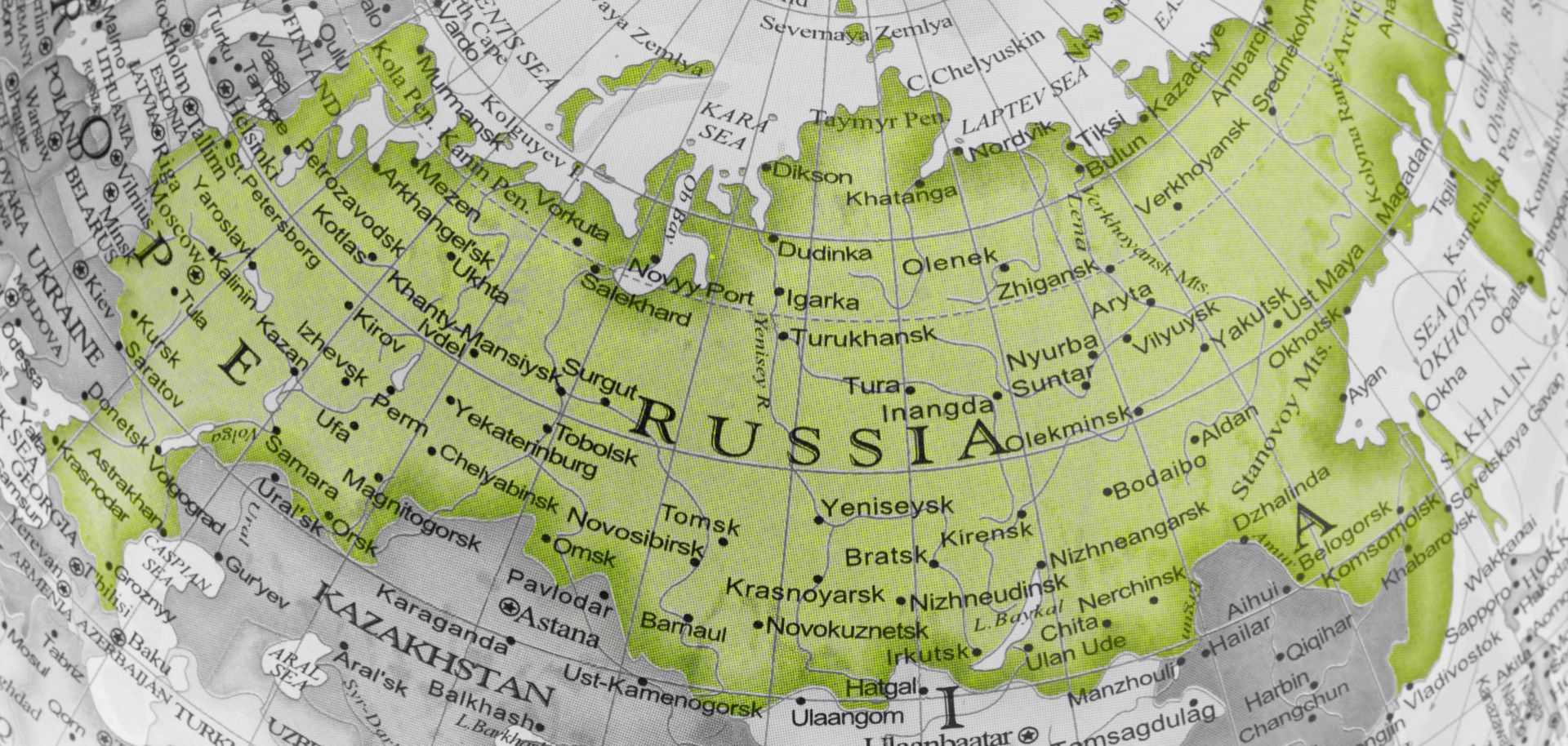
For much of its history, Russia has been a quintessential geopolitical great power, and it arguably remains so today. Russia's power stems from its vast territory and geography, which spans 11 time zones and possesses large reserves of nearly every strategic resource. The country's amassment of the largest nuclear arsenal in the world has only solidified great power status in more recent decades.
Yet periodic contractions of Russia's boundaries have created a historical reality that its power can be curtailed. This has compelled Russian leaders to not only seek direct or indirect control over the country's borderlands and near abroad, but also to weaken opponents' ability to encroach on the Russian core by establishing buffer spaces. Within Russia, this creates a contradictory perception of the country's global position: Russia's power is simultaneously irreversible due to its sheer size, but also highly vulnerable to insurrection, encroachment and invasions. It also has created a Russian strategic culture fixated on geographic determinism – a belief that Russia's internal structures and external actions are uniquely tied to innate geographic imperatives.
Russia's ongoing war in Ukraine fits into this historical pattern of expansion, a pattern that drives Moscow to coerce or even invade its neighbors, regardless of social or economic constraints. But the Ukraine invasion has also caused significant demographic and economic damage to Russia over the past two years, complicating its international standing and potentially undermining trust in an aging President Vladimir Putin internally — all while China is clearly understood as the senior partner in an emerging axis where Moscow is often seen as of mere ''vassal'' status in relation to Beijing.
The key question is how the war will change Moscow's approach to the geopolitical compulsions and constraints it will face in the years ahead, which will determine whether Russia reaffirms great power status, is downgraded to a mere regional power, or even unravels altogether.
Russia's Geographic Core
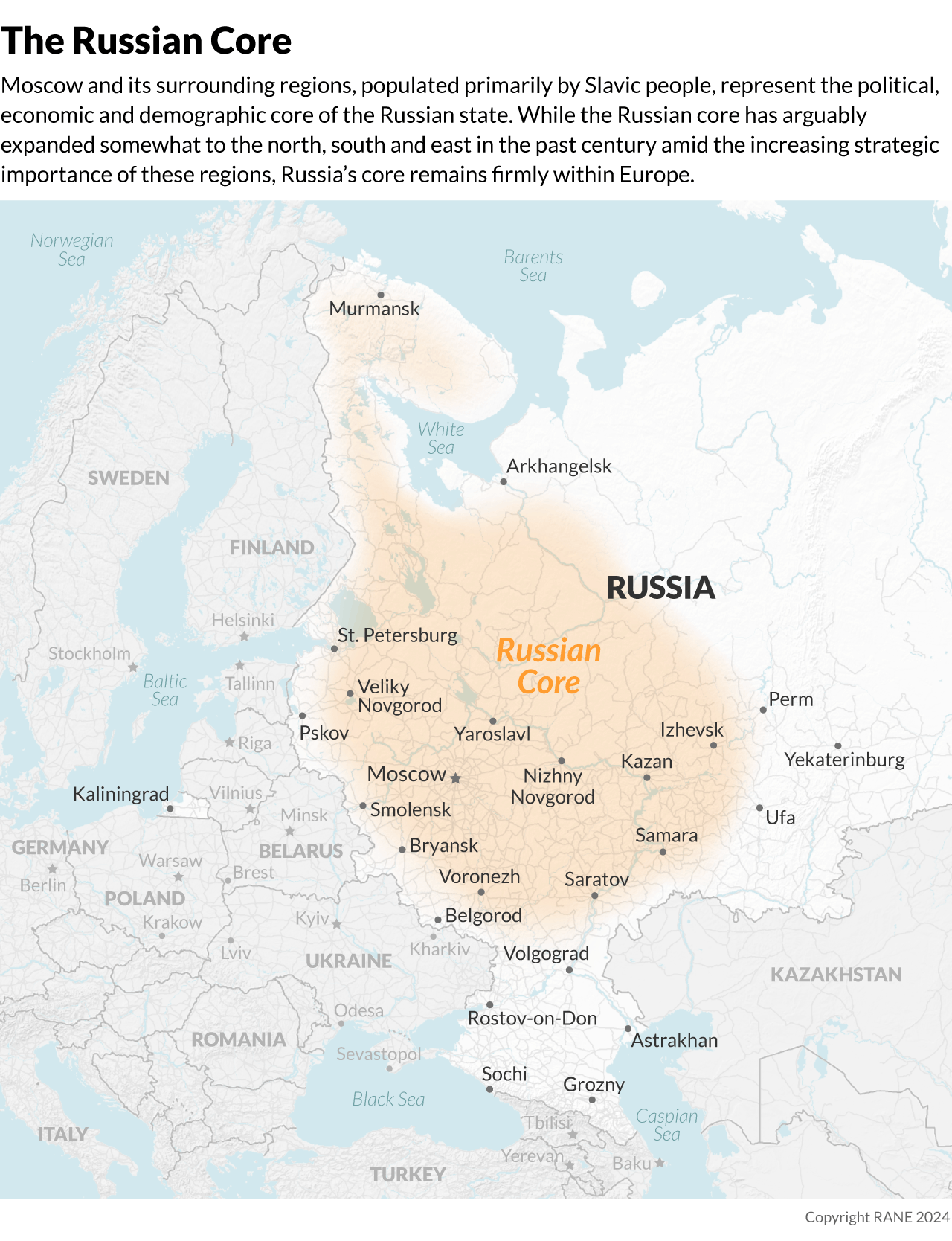
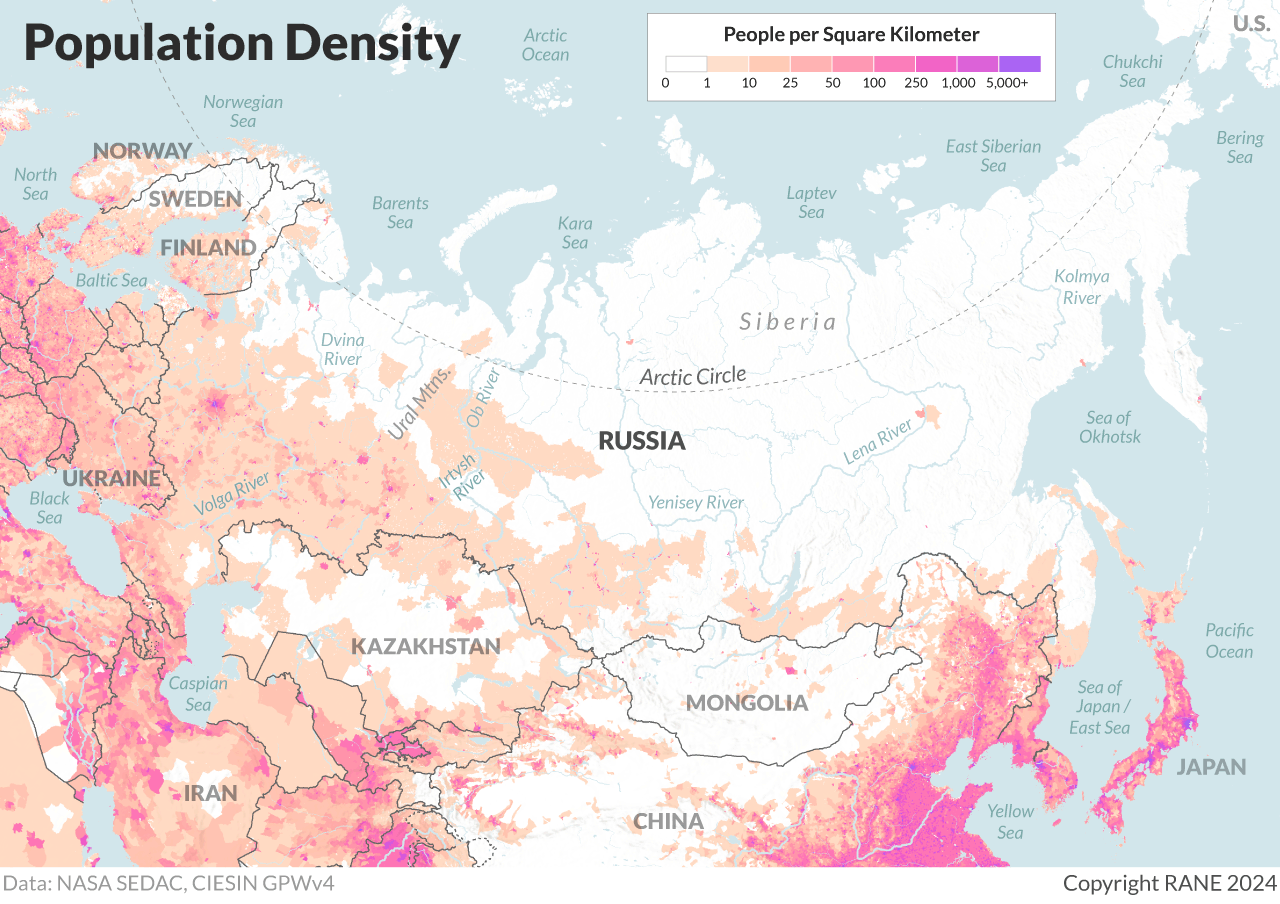
Russia's geographic core territory lies roughly from its western frontier with the Baltic Sea region between St. Petersburg and Pskov near Estonia, up to its main northern seaport in the Arctic at Arkhangelsk, eastward to the Kama River and foothills of the Urals near Perm, and finally to the southwest where the Great European Plain meets the Great Eurasian Steppe at the Volga around modern-day Volgograd. Confined to the European part of Russia, this area comprises the economic, political, demographic and ideological center of gravity of the Russian state. The area arose as Russia's core because, around the time of Moscow's expansion in the Late Middle Ages, it was roughly the limit of settlement of the predominantly Slavic population (itself originally migrating from what is now modern Ukraine). Climatic, infrastructural and other geographic challenges later prevented Russia's core from significantly expanding in subsequent centuries. Russia's modern core has arguably in the past century expanded southward toward the Caucasus and Sochi, and in the north toward Murmansk and the Kola Peninsula, as well as to the east to include industrial centers on the other side of the Urals such as Yekaterinburg. But other vast regions, like Siberia, never gained the demographic, political or economic heft to be considered part of the core. To this day, around 75% of Russia's population lives in the European part of the country, despite 77% of Russia's territory being in Asia.
The Russian core's defining feature is that it is fundamentally exposed to external aggression. Some states' geographic cores are protected by physical geography (something particularly true for modern great powers, like the island nation of Great Britain or the continental power of the United States). Russia's historic core, however, is comprised of plains and forests surrounded by more plains, forests and steppes — meaning it has no large oceans, rivers, swamps or mountains to rely on for defense. This lack of reliable natural buffers has fostered a deep sense of insecurity, which has been reinforced by the numerous invasions and periods of external pressure Russia has faced throughout its history, some of which have threatened the very existence of the Russian state.
Indeed, the Russian state's genesis is the direct result of the Mongolian Empire's invasion in the 13th century. Under Mongol rule, the city of Moscow notably emerged from relative obscurity to be the center of a tributary vassal of the Golden Horde until 1480. Previously, Moscow had not been a significant center of trade, but the city became the gatherer of the tribute for the Khans. Influenced in part by its existence under Mongol rule, Moscow also began to develop a distinct Slavic identity and sense of insecurity that prompted Moscow's subsequent leaders to seek expansion.
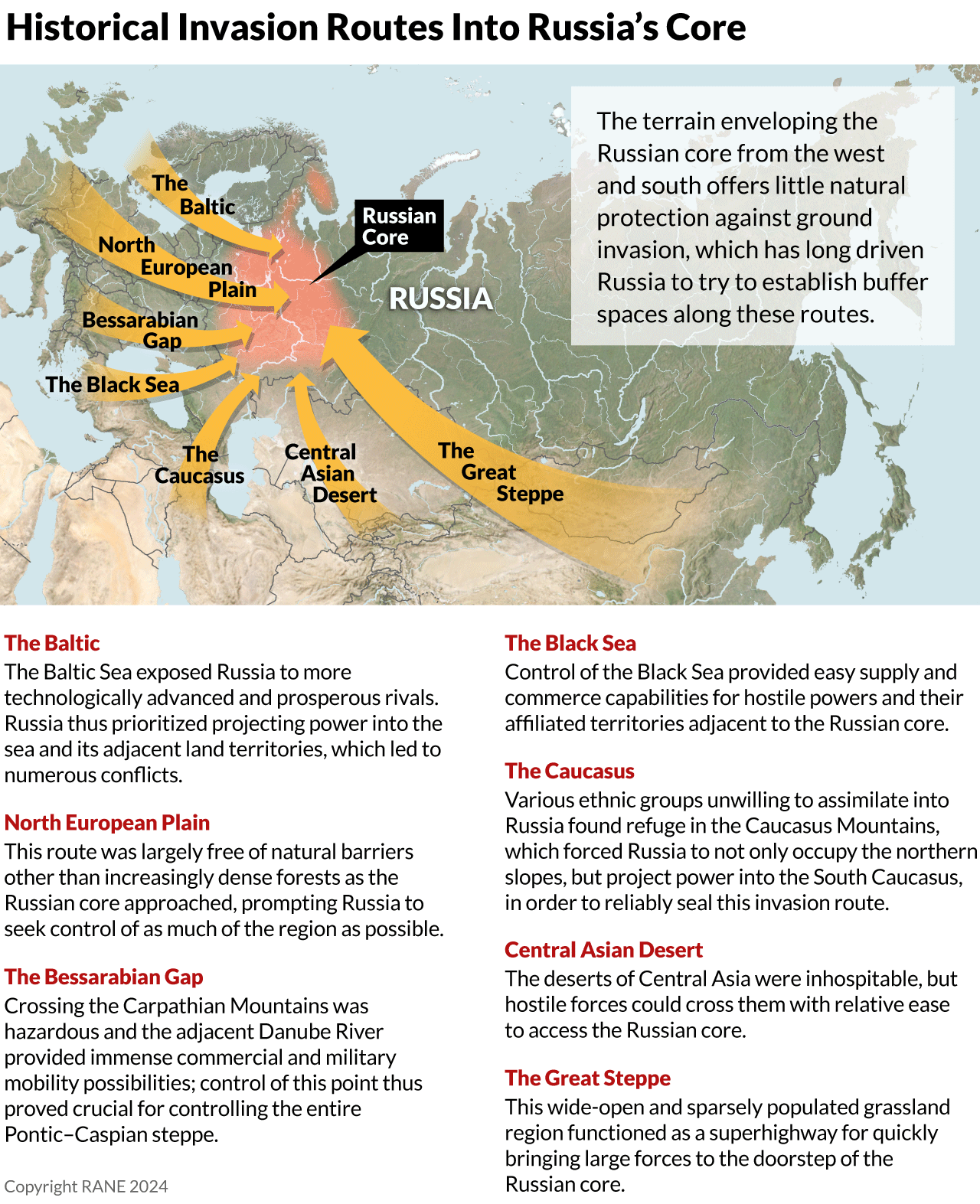
Russia's current geographic core developed when the medieval Grand Principality of Muscovy, or Grand Duchy of Moscow, threw off the yolk of Mongol vassalage in the late 1400s. In the mid-16th century, Muscovy finally moved to seal off the Mongol invasion route by expanding eastward and southward under Ivan IV (commonly known as ''Ivan the Terrible''), conquering the Khanates of Kazan and Astrakhan. But Ivan the Terrible, seeking new trade routes in so-called ''warm water ports'' that were ice-free year-round, also attempted to expand westward into what are now the Baltic States in the Livonian Wars. The wars would begin the period of Russia's growing military might that fueled expansion until it encountered similarly powerful rivals in the Ottoman Empire in the south, the Qing in the east, and the Polish–Lithuanian Commonwealth to the west.
This period of expansion also set the governance pattern for Russia's core. Russia's modern authoritarian governance structure descended from how it dealt with its external security challenges in the past, setting up the cycle that continues to this day. The Livonian wars weakened checks on the Czar's power, which in turn contributed to the slow pace of political and other reforms in tsarist Russia in the coming centuries. During this war, Ivan authorized the dreaded Oprichnina, a personal guard of the Tsar, to repress both the Boyars (feudal elites) and common folk alike, including by confiscating property, as well as land owned by the nobility and the church, in favor of the state. This helped quash the dissent that persisted in places such as Novgorod, which had long been a republic, and fueled a vicious cycle of internal repressions and foreign wars that ultimately led to the end of Ivan's Rurik dynasty in the notorious Time of Troubles. In the following years, Russian rulers sought to use the norm set by the Oprichnina to override the parochial interests of the elite and establish Russia as a highly centralized state.
Eventually, the establishment of the Romanov dynasty in 1613 brought Russia back to expansion, first eastward and then southward. Facing a vast geography and increasingly armed with Western European-style military technology, Russia carried out these expansions in search of defensible borders and to create buffer space for the growing empire. For Moscow, controlling territory separating itself from its foes — even if this territory is easy for a hostile military to transit — would give Moscow valuable time to bleed out any invasion via attrition and attacks on supply lines. But this buffer space came with a poison pill: the conquered populations were not Russian and would not want to serve as a buffer. Russia chose to deal with this through colonization and transmigration to dilute ethnicities through Russification, paving the way for annexation and repression that would, in turn, make the Russian state more dependent on a vast nationwide internal security apparatus.
By 1700, Russia had rapidly pushed across Asia to the Pacific Ocean. But it was specifically following its westward expansion into Europe after defeating regional rival Sweden in the Battle of Poltava in modern-day Ukraine that Russia declared itself an empire in 1721 under Peter the Great. Sweden had been the master of the Baltic and its defeat enabled Russia to safely develop its window into Europe from St. Petersburg. Russia similarly established itself on the Black Sea soon after, beating back the Ottomans who had previously dominated the Black Sea region as the Swedes had the Baltic. In the following centuries, Russia continued to expand until it butted up against other powers, including the Austro-Hungarians, Prussians, Persians, Chinese and British in Central Asia, and eventually the Japanese.
It was only through this later imperial expansion that Russia acquired the immeasurable resource wealth on which its current great power status is based. Russia's core possessed some notable resource value in its early history in the form of furs and cheap lumber, and later in moderate stocks of ferrous metals and coal. However, the resources of Russia's core paled in comparison to those acquired during Russia's imperial expansion. To this day, Russia's mineral wealth is based on the area outside its core — on the other side of the Urals mountains, in the vast expanses of Siberia and the Far East, and across the steppe to the North Caucasus. Historically, Moscow's wealth also came from even farther frontiers that are no longer occupied by Moscow — first and foremost Ukraine, followed by the South Caucasus and Central Asia — even though Russia initially seized these areas for protection and access to trade rather than for resources.
Due to its vast territory, Russia has historically been occupied with two core geopolitical challenges: protecting its borders against external threats via expansion while maintaining internal cohesion. However, these two goals are difficult to balance, as overinvestment toward the achievement of one tends to undermine the achievement of the other. The Russian government has historically allotted the bulk of its budget to defense and security spending, at the expense of investments in infrastructure, education, technological innovation or other priorities that might more deeply unify the core with its outlying regions. As a result, Russia has often lagged far behind its peers in institutions and technological advancement, infrastructure and social improvements. For example, Czar Alexander II began his reign in 1855 with a focus on reforms, including the emancipation of the serfs in 1861. But he stopped pursuing such reforms amid backlash that led to an assassination attempt in 1866 (Alexander II was later assassinated in 1881 for failing to make further political reforms).
Russia's leaders have often defaulted to expansion over development, in part because of the immediacy of its geographic problems. But this also tends to lead to periods of overexpansion and contraction, itself a product of underinvestment in key industries, technologies, infrastructure and social developments needed for Russia to keep pace with its neighbors. In the 20th century, the Russian Empire felt the effects of this overexpansion, beginning with the Russo-Japanese War, where Russia's infrastructural and logistical challenges led to its defeat and resulted in the subsequent 1905 Russian Revolution. This continued with Russia's disastrous effort in World War I and the subsequent October Revolution, which cost Russia its Baltic and eastern European territories.
Russia's Modern Opportunities and Constraints
Russia's 20th-century experience repeated its previous cycle of history, as the Russian state experimented with different ideologies in an attempt to secure the core and overcome the social and cultural constraints to unifying it with outlying areas.
At the beginning of the century, Russia's czarist system reached the limits of its political capabilities, collapsing during World War I. Various ideologies surged to try to fill this political vacuum, including liberal and democratic movements along with anarchist and communist ones. This, in turn, unraveled the Russian Empire, with Finland, Poland, and the Baltic states and Bessarabia (modern-day Moldova) slipping away from Moscow's control. Ukraine, Central Asia and the Caucasus all briefly slipped away as well, but the Communist Bolsheviks pushed White Russian forces to the edge of the empire. The Russian Civil War (1917-1923) then drove the Soviet state to reclaim Russia's colonial holdings, starting with the 1919 Soviet invasion of Ukraine, followed by the invasions of the Caucasus and continued fight against rebels in Central Asia in the 1920s, restoring many of Russia's imperial frontiers.
While Russia's frontiers in the east were secure, the Russian core remained exposed to the threat of invasion from Europe. Under Josef Stalin, Moscow embarked on immense internal transformations intended to rapidly modernize the Soviet Union as Europe's geopolitical balance was brought into question in the 1920s and 1930s. This period saw massive repressions, intense spying, extreme centralization, the redrawing of internal borders, and demographic engineering. The Soviet state even sought to remake nature through large-scale public works using prisoners in an effort to smash the constraints that had plagued the czarist system. By the late 1930s, the massive transformations had secured Stalin's grip on power and kick-started Russia's much-needed industrialization, but at an immense human cost that sowed doubt in the communist ideological project at home and around the world. Disenchantment over the repressions and the failure of Stalinist policies left the country unprepared for the start of World War II.
Stalin worked to reconquer the lost buffer spaces in Europe and make Soviet borders more defensible in the case of an eventual German invasion. The opportunity came with the signing of the 1939 Molotov-Ribbentrop Pact between the Soviet Union and Nazi Germany, which shortened the potential front with Germany along the Northern European Plain by occupying the Baltic states and much of Poland. In 1939, Stalin also launched the disastrous Winter War against Finland in an effort to gain as much Finnish territory as possible. The military campaign led to marginal territorial gains for the Soviet Union but also pushed Finland to align with Germany during the Continuation War. In 1940, Stalin issued an ultimatum to Romania to give up Bessarabia, thereby closing the Bessarabian Gap and restoring Russian access to the Danube as held under the Tsar. Despite this, Stalin's purges, particularly of the military, and numerous other factors left Russia unprepared for the Nazi invasion in June 1941.
World War II nearly dissolved the Russian state, but as Germany's armies reached their logistical limit in the winter of 1941-42, Moscow was able to take advantage of survival instinct and an international coalition abroad to endure and then counter the Nazi onslaught. At home, Russia's varied peoples united in a Herculean war effort to halt the invasion, temporarily shelving the disunity that existed between the core and its outlying regions. Abroad, the Soviet Union's alliance with the United States and the United Kingdom brought with it vast quantities of war materiel, security on the sea and new advanced technologies. Combined, these factors helped give Moscow the power to reverse the German invasion and eventually invade Eastern Europe and Central Europe in 1945. Communism as an ideology also experienced a global surge, as it pinned itself to anti-fascist and -imperialist movements globally, while the Soviet Union's military victory over fascist Germany gave communism a newfound credibility.
The conquest of Eastern Europe and Germany brought with it access to the region's industries, technologies, manpower and markets. Controlled by the Red Army, this buffer zone, which eventually coalesced as the Warsaw Pact, saw Russian power arguably at its zenith around 1950. Russian geopolitical imperatives seemed achieved, with control of Eastern Europe, an alliance with Maoist China, an industrialized core, and a strong military armed with atomic weapons.
But it didn't last long for three reasons. First, the Soviet Union still faced an ideological imperative to expand communism, which was expensive and distracted from internal development. Second, the Soviet Union's internal development remained costly due to Russia's geography and the centralization of the Soviet system. And third, the Soviet Union found itself facing the same diplomatic dilemma as the czars, with a coalition of states opposed to its expansion forming under a Western-led liberal bloc.
Thus, the Soviet Union was saddled with the continuation of czarist Russia's challenge: maintaining internal stability while fending off external challenges. The Soviet elite still believed that communism would solve Russia's internal problems — most notably nationalism, economic inequality, and political instability — and its external ones, by resolving the ideological battle with the West via political change there. However, the Soviet Union's failure to fundamentally change the centralized economy only marginally increased the standard of living compared with the West, which fueled internal malaise and foreign skepticism, despite the Soviet Union's global superpower status.
The Soviet Union was also saddled with an expansive European frontier that it had to hold together with military force. The Soviet army invaded Hungary in 1956 and Czechoslovakia in 1968 and forced the imposition of martial law in Poland in 1980, to prevent these states from drifting out of Soviet orbit. Ideologically, the Soviet Union was compelled to support communist movements around the world, which drained resources and pulled Moscow into international confrontations with the United States. Attempts to moderate communism's influence on state behavior gave way to a form of nationalism that not only left the Soviet system wedded to interventionism abroad, but also discredited the Soviet Union's internationalist angle, which led to the resurgence of nationalism in the 1970s and 1980s in both the Soviet Union and the communist world generally. National democracy movements gained steam in Ukraine, the Caucasus, and the Baltic region.
The imperative of reform became overwhelming by the mid-1980s when a boom in economic activity in the West highlighted the disparity between the West and the Soviet Union, particularly in Russia's periphery and satellites. However, Moscow's attempts at reform ultimately led to the Soviet Union's collapse in 1991 due to manifold factors. One of the biggest was geostrategic, as the country's economic decay was related to its large physical size and need to maintain a vast military beyond its borders (in the 1980s, the Soviet Union's military budget comprised around 15% of its GDP, compared with the United States' 5-6% of GDP). The arms race with the United States thus left little money for investment in infrastructure and innovation. Other factors included the Soviet Union's disastrous war in Afghanistan (1979-89) and the political fallout from the 1986 Chernobyl disaster, along with the steady penetration of Western youth culture, which turned vast swathes of Soviet youth, particularly in the crucial major cities of Moscow and Leningrad, against the Soviet way of life.
To this challenge arose Mikhail Gorbachev, who served as the Soviet Union's leader from 1985 until the country's dissolution in 1991. Gorbachev believed that Soviet authoritarianism was too inefficient to hold together the vast array of nationalities then held by the Soviet Union, and sought to solve the country's insecurity through reform instead of external expansion and internal repressions. Unlike prior Soviet leaders, Gorbachev believed that democracy and Marxism-Leninism were not mutually exclusive. His belief that ''democracy'' was desirable on philosophical grounds, popular on political grounds, and effective on technocratic grounds drove his reforms, known as Perestroika (political and economic restructuring) and Glasnost (openness). This premise came as an immense shock to the Soviet system and the entire communist bloc, where ideologists had for decades touted Soviet socialism as a higher form of democracy than the West's bourgeois variant. But centuries of centralization meant that once Gorbachev achieved supreme power in the Soviet Union, there were few institutions able to check his policies.
Once the door of reform was opened, a snowballing of processes began that echoed earlier collapses in Russian power. The sweeping nature and fast pace of economic reforms undid the system by decentralizing power too quickly. Political authorities and factory managers used their increased freedoms to engage in more corrupt practices and schemes to accumulate wealth rather than embrace the technocratic spirit of change. Meanwhile, political leaders in the constituent republics — including Georgia, Ukraine and the Baltic republics — began to use their new-found political freedom to assert themselves on nationalist grounds. Seeking to reverse these processes, hard-liners in the KGB launched the August 1991 Putsch, the failure of which accelerated the collapse of the Soviet Union by the end of that year via the Belovezha Accords. The USSR formally dissolved on Dec. 25, 1991.
Russia's Post-Cold War Strategy
Shorn of its superpower status, Russia's first post-Soviet president, Boris Yeltsin, confronted a Russian state still in the process of unraveling and rebalancing. Russian GDP contracted by as much as 40% between 1990 and 1998. Chechnya fought for independence against the Russian army, defeating it in 1994. A parliamentary revolt in 1993 spurred a political crisis that divided the nation and required a humiliating Russian military intervention. In 1998, Russia defaulted on its debt, and Russian politicians warned that Russia might soon fall to ultranationalists preying upon the despondency of the population.
To combat these challenges, Yeltsin strove to stabilize the Russian system, which arrested its democratization. Yeltsin saw Russia inherently as part of Europe and believed that Russian interests would therefore be best served by engagement rather than confrontation with the rest of the Continent. But in 1993, after Russian tanks shelled the parliament, he pushed through a new constitution that enshrined a ''super-presidential'' system, wherein the president wielded powers separate from and above the traditional three branches of government. To stabilize the economy, Yeltsin also turned to a series of post-Soviet oligarchs, who carved up the economy into private fiefs.
But while the internal situation deteriorated, Moscow believed Russia's geopolitical situation was salvageable. Belarus and Ukraine remained tightly tied to Russia, and Armenia and Azerbaijan were unlikely to seriously challenge Moscow's influence or pose a threat due to the conflict between them. Central Asian governments, meanwhile, remained secular and strongly supportive of Russia, on which they remained economically and militarily dependent amid the rising threat from Islamist insurgent groups. Pro-Russian breakaway regions in Moldova and Georgia prevented those countries from decisively leaving Russia's orbit. Furthermore, liberals in Moscow believed that Russia could pursue its geopolitical imperatives by accepting a smaller geographic space, new security and economic partnerships with the West, and making Russia indispensable to global energy, commodity and industrial supply chains.
Yetsin's failure to stabilize (let alone democratize) Russia set the stage for revanchism. In 1999, Vladimir Putin assumed power, first as prime minister and then in 2000 as president. Putin embodied both a desire for modernization and a nostalgia for the Soviet norms and culture that remained prevalent among Russia's population. He re-centralized the Russian state and sought to find ways to project Moscow's power abroad again to prevent a further unraveling. This precipitated a crackdown on independent voices and media, particularly on TV, and then on the oligarchs to ensure only loyalists or obedient and apolitical forces ran the ''commanding heights'' of the economy.
Crude oil and other commodity prices began to boom just as Putin entered office, which helped him secure control over Russia by enabling him to preside over a rise in living standards. The increased export revenue gave Moscow the financial resources to keep the local elites in Russia's vast regions satisfied with budgetary flows rather than increased sovereignty. The Kremlin was able to secure the loyalty of local elites by making their local economies and political futures entirely dependent on the Kremlin, a policy best displayed in Chechnya. In a nominally post-ideological Russia, Putin saw the importance of anchoring public focus in the national glory, power perceptions and norms of the past, instead of the future — a recipe for reunifying the fractured Russian core. Putin also emphasized supporting quality of life in the heart of Russia's geographic core — namely Moscow, the central location in which revolts and revolutions might emerge. It and St. Petersburg's increasingly European appearance diplomatically normalized the country in the eyes of the West, which rapidly became one of Russia's biggest trading partners.
Soon, challenges came much closer to the Russian borders, most notably in Ukraine. In 2004, the Orange Revolution showed that popular protests in the post-Soviet space could remove the region's pro-Moscow hybrid regimes and raised the possibility of a similar protest movement emerging in Russia itself. In the context of NATO's 2004 expansion into the Baltic states, Russia saw the potential for Ukraine's westward drift to remove any strategic depth between Moscow and NATO.
Ukraine occupies a unique geographic position to Russia. For one, an independent and potentially hostile Ukraine would pose the largest conventional threat to Russia's core due to the two countries' shared border and the risk of Ukraine impinging on Russia's use of the Black Sea or even isolating the Caucasus from the Russian core. But more importantly, it would severely undermine the Russian government domestically by enabling millions of Ukrainians, many of them Russian speakers, to live much more prosperously and freely than Russians in Russia. Norms and expectations engendered in Ukraine could quickly spread to Russia unless Moscow proactively ensured otherwise.
For Putin and his country, the most surefire (and historically normal) way for Russia to prevent the loss of buffers amid stalling political arrangements was through force. Force also simultaneously proved a convenient tool to rally patriotic sentiment and distract from domestic issues. But force was not the first option. In 2004, after the Orange Revolution in Ukraine, Ukraine still had pro-Russian elites that dominated the country's economy, while Ukraine's large Russian-speaking population could be leveraged to regain control of its political system. This occurred in 2010 with Viktor Yanukovych's election as Ukraine's president.
But Russia's disastrous attempt to force Yanukovych and Ukraine into a customs union with Moscow instead of accepting an association agreement with the European Union in 2013, and Ukraine's subsequent Maidan Revolution in February 2014, left military action the only way to maintain influence over Kyiv. This saw Russia use its special operators and regular army to annex Crimea and later begin the war in eastern Ukraine's Donbas region in April 2014. Russia still hoped that it could use these conflicts to return pro-Russian forces to power in Kyiv, or at least slow Ukraine's integration with the West.
Around this time, Russia also increasingly returned to interventionism, first in Georgia in 2008, and later in Syria, Libya and other parts of Africa. These activities not only helped Moscow build the capabilities needed to launch the more important interventions to come in Ukraine, but served to further Russian interests in strategic regions in their own right, distracting Western attention and diverting their resources.
However, the effectiveness of Russia's levers over Kyiv only continued to fall after 2014. And with Moscow's other options exhausted and the West not concluding a political deal to formally divide spheres of influence in Europe, Russia's post-Cold War strategy came to a head in 2021, when Ukraine began to overtly slip from its orbit. Knowing that Ukraine's pro-Western course could not be reversed with only political means, Russia soon escalated into full-scale war by launching its invasion of Ukraine in February 2022.
The Imperatives of Modern Russia
In the coming decades, Moscow's top imperatives include securing a buffer space along its borders by continuing to degrade Ukraine; changing or weakening Western policies toward Russia; ensuring political cohesion by avoiding domestic reform; avoiding diplomatic and economic isolation; and finally, managing Russia's demographic decline.
Degrading Ukraine
Under Putin, neutralizing the alleged threat posed by Ukraine's Western orientation by slowing (or stopping) the country's integration with the European Union and NATO will remain a top priority for Moscow. This will inevitably involve continuing its invasion of Ukraine, or at least constantly threatening to rekindle the war in the pursuit of this buffer space. To retain credibility, Russia must also maintain sufficient equipment production and mobilization to hold or seize a sufficient portion of Ukraine. Russia must eventually restore its military power by drawing on its still-large population and accessing vital technologies needed to enhance military development.
Influencing Western Policies
Secondly, Russia must reorient Western states away from confrontation, or, failing that, divide the West between neutral and hostile states. This will involve influencing Western society by supporting fringe ideologies and political movements, while fueling disenchantment toward governments supportive of Ukraine. Moscow will seek to empower Western political forces focused on internal issues and willing to normalize relations with Russia. Wearing down Western support for Ukraine is crucial for Russia because it significantly reduces the economic and political costs associated with the ongoing invasion and occupation, and is the most viable way to solve both Russia's internal and external challenges for any extended period. Moscow will use coercive threats and hybrid warfare against NATO to fuel the rise of political parties seeking this normalization, and will only consider subsiding support for those forces once they have gained greater influence.
Ensuring Domestic Political Stability
Russia's third major imperative is to maintain social cohesion via political unity by retaining the security-oriented style of Putin's government and avoiding any structural political reform. Specifically, Russia must find a path to minimize political reform while maintaining political cohesion, as the continuity of the current centralized system is crucial for such a geographically and ethnically diverse country.
For the Russian state, political reforms risk the geopolitical disasters of 1917 and 1989-1991, in which a torrent of pent-up criticism resulted in significant challenges to state power and subsequent territorial losses along Russia's periphery. Political reforms also risk getting out of hand by convincing key elites or too many Russians that change is possible, and that Russian politics can eventually become real and competitive if more people start treating them that way.
Moscow has traditionally focused heavily on its political stability and external security objectives to the detriment of other objectives, such as growing or modernizing the Russian economy. This is because Moscow has long feared that shifting focus to Russia's economic flourishing or technological advancement would risk fueling, or at least distracting from, the perceived security threats to its geopolitical core, rather than relieving those threats.
In their effort to maintain political stability and cohesion, Russian leaders will rule out anything resembling a repeat of Perestroika and Glasnost reforms. Compared with the imperatives for buffer regions and political continuity, Russia's economy is secondary. Pseudo- and quasi-reforms similar to those already seen in Russia since 2000 will continue to take place. These so-called reforms involve efforts to make the current system more sustainable, buying it time rather than restructuring it.
Avoiding Further International Isolation
Russia's next imperative is to avoid further diplomatic and economic isolation to ensure access to the money, trade, resources and technology it needs to assert its interests abroad without having to resort to physical coercion. Russia must maintain economic lifelines crucial to maintaining living standards in the Russian core by preventing diplomatic isolation. This means increasing sympathies for Russia among states of the Global South, most importantly China, and perceptions that Russia's invasion of Ukraine is justified. But this also means securing Russia's continued use of the Baltic and Black Seas, as well as ensuring the security of Russia's vast, newly opened maritime frontier in the Arctic.
Relatedly, Russia will need to continue importing sufficient technology for its military and civilian industries, including semiconductor chips and various other electronics, high-tech components and machines. Russia does not need (or expect) to grow its domestic tech industries significantly to the point of approaching self-sufficiency in these areas; rather, Russia must merely remain inside the global technology supply chain to ensure its future access to such products.
Managing Demographic Challenges
Finally, there are at least five major, potentially malignant demographic trends that Moscow must oversee in the years ahead. These include Russia's overall demographic decline brought on by the country's aging and shrinking population (including in both the core and in the remote but economically significant northern and eastern regions); the falling share of Russians as a percentage of the population in key regions; the rising share of Muslim citizens of Russia; and the rising number of Central Asians receiving permanent residence and citizenship in Russia. All of these trends risk social and political backlash and economic consequences if not properly managed.
Russia's Modern Imperatives
Geographic
- Establish buffer zones, either militarily or diplomatically, across the country's borderlands.
- Diplomatically unite the Eurasian landmass through organizations such as the Shanghai Cooperation Organization, or SCO, in opposition to the maritime powers of the broader West.
- Ensure Russian maritime access and capabilities in its adjacent maritime zones, namely the Black, Baltic, White and Caspian seas, as well as the broader Pacific and Arctic oceans.
- Secure the Arctic frontier.
Security
- Secure a neutral or friendly government in Ukraine or a buffer space between an unfriendly Ukraine and Russia's heartland.
- Develop a credible conventional and nuclear deterrence.
- Degrade Ukraine's military capabilities and economy to limit its Western integration, long-term security prospects and growth potential.
Political
- Maintain internal geographic unity and territorial integrity and prevent separatist and sovereignty movements.
- Use Russian nationalism to achieve social and political cohesion.
- Suppress supporters of competing ideologies, namely liberal democracy, alternative nationalisms and leftist ideas.
- Foment ideological regime change in the West to neutralize the threat posed by the West's liberal democratic ideologies and undermine Western countries' unity.
Economic
- Deepen trade with the Global South, especially Asia.
- Maintain export volumes and state tax revenues by supporting globally high prices and domestic production volumes for commodities.
- Secure sufficient flows of key technologies, including through illicit means.
- Overcome labor shortages and combat population decline through immigration and natalist policies.
Diplomatic
- Maintain foreign policy independence and avoid global isolation, most importantly through alignment with China and partners in the broader Global South.
- Continue breaking from the West to undermine Western coercive and deterrent tools vis-a-vis Moscow.
- Use coercive influence, integration and coordination within organizations such as the Eurasian Economic Union, the
- Collective Security Treaty Organization, the Commonwealth of Independent States and SCO to maintain influence in Belarus, the South Caucasus and Central Asia.
Russia's Future Outlook and Risks
In the coming decade and beyond, Russia's geopolitical compulsions will likely drive it toward imperial expansionism, but tactical considerations in Ukraine, Western political events and Russia's domestic politics will constrain Moscow's actions. The resulting clash of compulsions and constraints will shape the global geopolitical landscape in the decades ahead. From these realities stem three broad scenarios of how Russia will confront its future geopolitical challenges: one of aggression, one of political liberalization and one of turmoil.
In the first scenario, Russia will aggressively pursue a return to great power status by forcefully rebuilding its buffer spaces, pivoting economically to Asia and the Global South, implementing political suppression techniques at home to stifle dissent, and balancing its demographic need for more people with its political need for national unity. Though this strategy will isolate it diplomatically from the West, Russia will continue to export commodities to the rest of the world that will provide sufficient revenue to support these actions, even if living standards are stagnant.
In this scenario, Moscow will remain focused on Ukraine, Belarus and its western flank. It will devote a large portion of its budget to defense spending to ensure it has the military power needed to secure sufficient buffer space in Ukraine and neuter Kyiv's development and integration with the West. Maintaining the credibility of the threat of renewed aggression against Ukraine will remain one of Russia's primary sources of leverage vis-a-vis Kyiv and the West. Even if/when there is a cease-fire or treaty between Ukraine and Russia, Moscow will remain focused on ensuring that Ukraine is unable to fully join the Western camp, re-escalating with military force should other tactics fail.
Concurrently, Moscow will strive to maintain political cohesion without engaging in meaningful political reforms, preserving Russia as an empire-state, that is, a predominantly ethnic Russian nation-state that holds or expands its borders acquired from imperial expansion. Putin will hold on to power for as long as possible before raising up a loyal and ideologically similar successor. Knowing that political change historically is what risks systemic change and compromising Russia's geopolitical position, Russia will remain a highly repressive dictatorship under Putin, and his successor will largely preserve the political system and vague ideology that he built. Any political reforms will primarily be cosmetic, as Russia's historical imperatives weigh heavily on its government.
The 20th century displays a political and ideological pattern in Russia that Putin's administration will seek to avoid. The end of the Czar's imperial despotism in the 1917 February Revolution made way for a brief period of hope for Russia's liberal and European future, Stalin's death led to the hope of Nikita Khrushchev's Thaw and de-Stalinization, Gorbachev's reformist Perestroika came in response to Leonid Brezhnev's nationalist turn, and Yeltsin's calamitous attempts at liberalization came in response to the end of the Soviet Union. All of these events suggest that hardline Russian leaders tend to focus on expansionism but create internal strife, and are then followed by leaders focused on prosperity, internal development, and greater cooperation with the West and a European vision of Russia's future. Moscow will seek to stop this cycle at all costs.
A key element of maintaining political unity is preparing and conducting a successful succession process for Putin, who would be 77 when his next term expires and 83 in 2036 following the term after that. Putin has maintained internal power by carefully balancing multiple competing centers of power and influence and resolving the competition between them. The risk for Russia is political instability undermining social and economic cohesion.
Russia's most important foreign relationship will be with the People's Republic of China as Russia seeks to reinvigorate its economic capacity enough to maintain its aggressive stance. However, Russia will also seek to avoid dependency on China; should a China-U.S. war break out, Russia is unlikely to join combat on China's side, and Moscow's alignment will likely be driven by the state of its confrontation with the West rather than sincere affinity for China. Moscow will diplomatically and through its huge trade reliance demonstrate a strong commitment to a China-led multipolar world order, and work closely with Beijing to dilute the West's dominance in the current world order. Out of necessity, Russia will present itself as leading efforts to de-dollarize global trade and support the yuan or BRICS currency as a substitute. But Russia will also continue to act independently and strengthen ties with the rest of the Global South to increase its negotiation leverage vis-a-vis China and achieve greater political and economic support from Beijing. Russia will seek international recognition of its invasion of Ukraine as an element of modern statecraft in line with the foundations of an increasingly multipolar world order.
Russia is likely to be increasingly militant and threatening toward its other neighbors. This includes NATO, even though Moscow does not intend to spark a direct confrontation. Instead, Russia will aim its coercive efforts toward its near abroad. Russian politicians and high-ranking officials will make provocative and threatening statements toward Armenia, Azerbaijan, Estonia, Finland, Georgia, Japan, Kazakhstan, Latvia, Lithuania, Moldova, Poland, Romania and the United States. With these statements, Russian officials will signal an understanding of Russia's permanent geographic struggle, as well as demonstrate loyalty to the government within Russia.
Should Russia militarily intervene somewhere other than Ukraine, Kazakhstan will be the most likely target. Numerous security interventions are possible in the Central Asia region — most likely light-footprint operations to uphold regional governments similar to the January 2022 intervention in Kazakhstan. Russia will seek to deepen relations and preserve authoritarian stability in Central Asia to preserve the region as a buffer and solution to Russia's demographic challenges. Central Asia is home to less stable economies and regimes, and the costs and potential risks of intervention there are lower than in Europe. Aggression is also possible but less likely against the states of the South Caucasus.
As Russia is weaker than NATO and has fewer significant economic or other tools than the West, Moscow will rely on informational tools to better secure its interests, including propaganda campaigns and other covert actions. Because Brazil, India, and other Asian and African states cannot ultimately serve as a sufficient counterbalance to China, the Russian state's most important task will be to foment political change and possible upheaval in the West that brings to power political forces seeking detente and, eventually, normalization with Russia. The goal of Russia's efforts will be for Western states to reverse the internationalization of foreign policy challenges and reprioritize a narrow view of national self-interest, thereby reducing political will in the West to counter Russia's moves in its near abroad. The rise of Ukraine-skeptic political movements and calls for de-escalation with Russia will embolden Moscow to sustain its policy toward Ukraine.
But this strategy is unlikely to wholly reverse Moscow's isolation from the West, and Russia will fall even further behind the West and China in the development and production of many high-tech industries. Russia will purchase the electronics and other components it needs from China or other states, including through illicit sanctions avoidance schemes, to maintain its domestic and foreign policy course. A lack of technology will pose challenges for Russia, for example in its development of modern weapons systems, which impacts Russia's coercive and deterrence capabilities, and in limiting its ability to expand access to natural resources in the Arctic and Far East.
Russia will rely on migration, predominantly from Central Asia, to avoid workforce shortages in key sectors such as construction and mineral extraction. This will prompt a rise in anti-migrant and ethnonationalist sentiments among Russian politicians and radical groups, leading to increased possibilities of inter-ethnic violence, but this sentiment is unlikely to prompt a major policy reversal against migration as long as Putin is in power. Russia will bolster its natalist and assimilationist policies to increase the Russian proportion of the population, but these measures will not be able to reverse Russia's overall population decline.
However, aggression is not necessarily Russia's determined future. There remains a low-likelihood possibility that as a result of leadership and possible system change in Moscow, Russia will seek to use reduced tensions with the West, along with reforms and liberalization, to better achieve its ends. Arguably the most likely way this happens is by Putin's successor proving unable to hold together the fractious political and economic elite in the face of international isolation and a myriad of problems at home. Following a period of instability, a Europe-oriented leader in Moscow would seek to mend relations with the West. Were such a government to appear possible in Russia, the West would likely seek to support this government's course by restoring contacts and offering to reopen Russia's access to Western markets.
This government would face nationalist and hardliner backlash, challenging its hold on power. As a colonial inheritor state, this scenario would saddle the Russian government with the immense political challenges of preventing separatism while maintaining popular support. An economically strong Russia would likely be able to maintain national cohesion and resist separatist pressures through internal economic tools. However, the West would still be reluctant to invest significantly in a Russia that could easily slide back into a nationalist cycle and does not have a demographic dividend or significant consumer power. It is therefore unclear how long such a Russian government could stay in power, as revanchist forces would inevitably rise again.
Thus, the final scenario is one in which Russia becomes embroiled in deep domestic turmoil and teeters on the verge of implosion. This scenario is significantly less likely than the West sometimes suggests. Its most likely version is one in which Russia devolves effectively into economic warlordism within the current Russian borders, similar to what occurred in the 1990s. Moscow's effective frontiers would shrink amid separatism and sovereignty movements, while its foreign standing would severely atrophy.
The more remote version of this scenario is one in which Russia dissolves into multiple states and inter-ethnic violence. But such an outcome is very unlikely because decades of successful Russification policies have left Russia far less ethnically diverse than it was 100 years ago or even at the time of the Soviet Union's collapse in 1991, as ethnic Russians constitute a larger share of the population in key regions. This means that there are few clear ethnic and geographic fault lines along which Russia could break apart. Many of the separatist regions would have high numbers of Russians, and national ethnic minorities would not seek to fight their neighbors. Only a few regions — the most obvious being Chechnya — would have both the capability and desire to take up arms against the Russians in the first place.
