
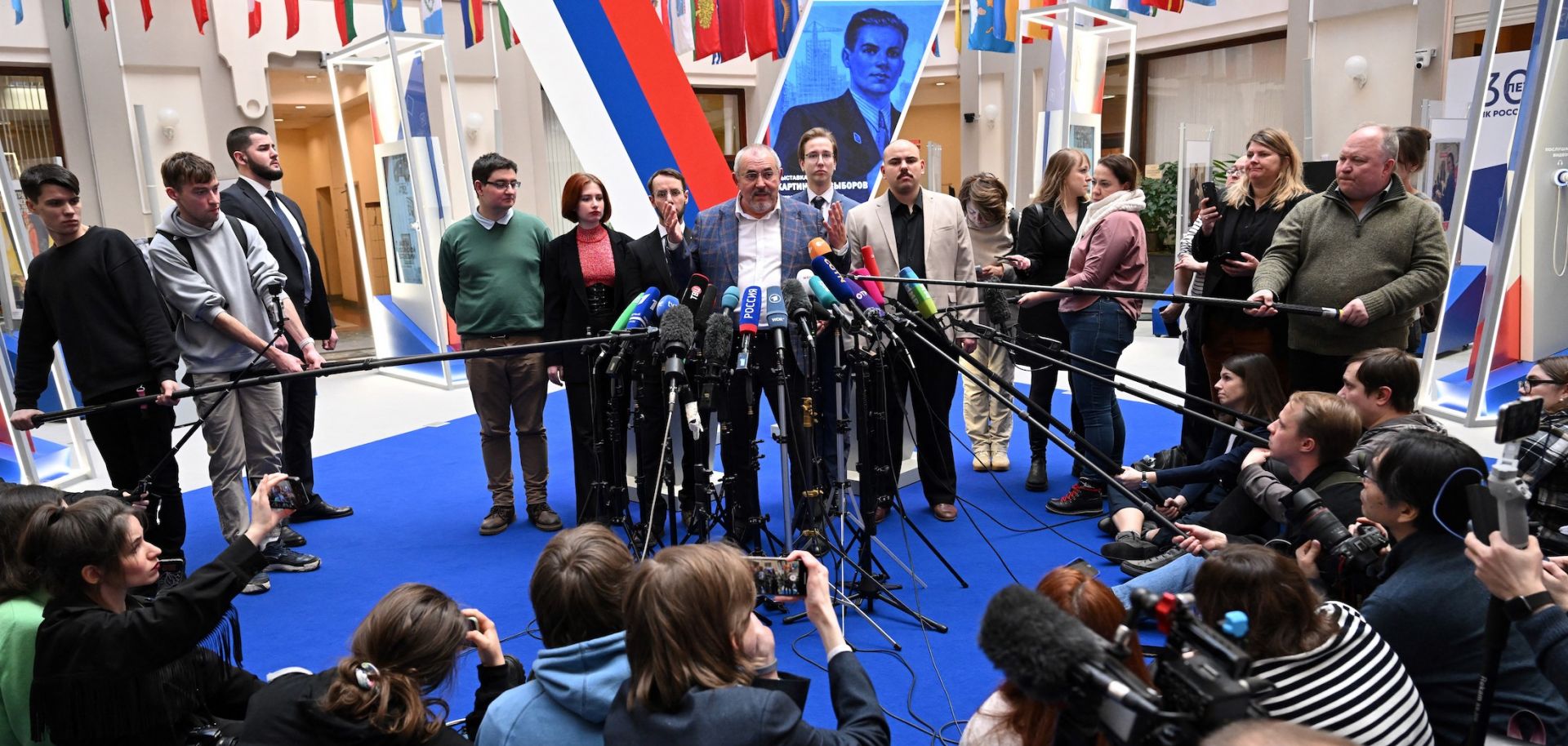
Russia's decision to bar rising opposition candidate Boris Nadezhdin from running in the upcoming presidential election confirms the Kremlin's trepidations of opening the door to anti-war dissent while also underscoring the Kremlin's total control of the electoral process. On Feb. 8, Russia's Central Election Commission formally barred Nadezhdin, a former Russian parliamentarian and long-time liberal pundit who had been running on a vaguely anti-war platform, from participating in Russia's March 15-17 presidential election. The commission claimed, providing scant evidence, that irregularities rendering the signatures invalid had been found in around 15% of signatures presented in support of his candidacy. In January, Nadezhdin received the nomination of the opposition Civic Initiative party, suggesting that his participation had the preliminary approval of the Russian presidential administration.
- Nadezhdin had made it further than other nominally anti-war candidates, such as former TV journalist and regional deputy Yekaterina Duntsova, who was barred from participation in December. Previously, Russia's traditional pre-war opposition, most notably Alexei Navalny's associates and allies, have been forced to disassociate from him or flee the country under threat of criminal prosecution.
- Nadezhdin's campaign claims he will appeal the decision in the Supreme Court, but these efforts will not reverse the Central Election Commission's decision. Nadezhdin has signaled he may now focus on using newly acquired political capital in the Moscow City Duma elections in September 2024 and other subsequent campaigns.
- The Civic Initiative party is the same party under which Putin's goddaughter and former opposition figure Ksenia Sobchak was allowed to run against Putin in 2018, officially receiving only 1.7% of the vote. The Kremlin likely intended Nadezhdin's candidacy to perform a similar function, allowing the Kremlin to claim support for liberal opposition is negligible.
The Kremlin's original plan seems to have been to allow Nadezhdin to run to give the presidential election a veneer of legitimacy and show strong support for the war. The Kremlin's original decision to let Nadezhdin participate in the election was a likely response to several causes: First, his candidacy allowed moderate critics of the war in Ukraine to participate in the election. Nadezhdin criticized the war, but only because it had not reached its original goals and because it was doing immense economic and demographic damage to Russia. Nadezhdin's campaign platform said that Russia must "complete" the so-called Special Military Operation (SMO) and begin peace negotiations with Ukraine and the West — a position not substantively different from that of the Kremlin. Second, the Kremlin likely sought to claim that because Nadezhdin ran on an allegedly anti-war platform and would receive only a few percent of the vote, it meant that the vast majority of the country supported the war. Third, some in the Kremlin may have believed that Nadezhdin's participation would add a veneer of legitimacy and competition to the vote. Finally, Nadezhdin's participation could have been used to increase turnout, which is important to show that disinterest in Russian politics is not falling as a result of the war. At the same time, the Kremlin believes that images of high turnout — followed by Putin receiving a record share of the vote — would go a long way to convincing Russians that support for Putin is, in fact, at record highs.
Despite the potential benefits of Nadezhdin's candidacy for the Kremlin, unexpectedly strong support for the opposition candidate suddenly made him a threat to Russia's political stability. Security officials concerned about the destabilizing effects of Nadezhdin's participation likely overruled the preliminary decision by the Kremlin's political wing to allow Nadezhdin's participation. Shortly after Nadezhdin's candidacy was announced, disparate elements of Russia's opposition, which had been calling for a boycott of the election or for the support of various other candidates, urged their supporters to back Nadezhdin. Polling by the independent pollster Russian Field, published Jan. 30, showed that in just a matter of weeks, Nadezhdin had risen from obscurity to become by far the most popular opposition candidate in Russia, with 10.4% of decided voters and 7.8% of all voters willing to vote for him — more than the three other quasi-opposition candidates from Russia's parliamentary parties combined. These factors, combined with the possibility of Nadezhdin going off script and engaging in increasingly scathing rhetoric about Putin and the war, likely prompted the Kremlin to signal Russia's Central Election Commission that Nadezhdin should not make the ballot due to the signature technicality. If Nadezhdin had been allowed to participate, anti-war Russians could have rapidly rallied around him, drawing large crowds and shattering the image of near-total support for Putin that intimidates Russians into believing that opposing Putin is futile. While opposition forces would not have any chance of winning the election outright, this would have significantly destabilized Russia's political system, explaining why Nadezhdin was barred.
- The Kremlin is highly motivated for Putin to receive a larger share than the 77.53% he received in 2018 because anything less would suggest a decrease in his popularity as a result of the war.
- Data published by Russian Field on Feb. 1 showed the share of Russians who view the invasion of Ukraine as a mistake has reached a new high, accounting for 37%, while Russia's only other remaining authoritative pollster, the Levada Center, shows that an astounding two-thirds of Russians (66%) agree that Russia is paying too high a price for participation in the SMO, while 55% of Russians support beginning peace negotiations.
- Nadezhdin's backers will be split on how to proceed. Alexei Navalny's allies have called for supporters to show up exactly at noon on election day and vote for anyone but Putin. But most will likely argue for boycotting the election in order to force the Kremlin to engage in greater falsifications to achieve the higher turnout numbers it desires. Meanwhile, many other prominent opposition figures will call for voting for one of the other non-Putin candidates as a new magnate for the anti-war, anti-Putin protest vote — though this will have little significance because the other candidates are not even nominally opposed to Putin and the war to the extent that Nadezhdin is, while slightly elevated vote totals for them would have no material consequence.
With Nadezhdin barred from participation and the remaining candidates expressing pro-Kremlin views, Putin's reelection will not risk triggering political instability or an accelerated growth of anti-war sentiments. Arguably, the most impactful thing to watch for ahead of the election is clues Putin may give regarding future escalation of the war and mobilization after the election later in 2024 or 2025. While Putin is very unlikely to do so due to the unpopularity of such measures and unnecessary expectations they may create, hints toward these possibilities would be a sign of his confidence in his domestic support, allowing him to ask for even greater sacrifices from the Russian people to continue the war. It would also represent a further sign of Russia's confidence in its leverage vis-a-vis Ukraine and the West. Still, the Nadezhdin episode highlights the importance of electoral events, such as Russia's next municipal and regional elections in September 2024, in serving as one of the few triggers for potential political instability in Russia, as otherwise, the opponents of Putin and his war against Ukraine would have few safe platforms or reasons to gather and remind the Russian people of their existence. Therefore, while opposition to Putin is unlikely to boil over suddenly — unless unlikely incidents related to Putin's health or setbacks on the battlefield come to light — electoral events will continue to serve as vehicles of expression of opposition to the Kremlin's course, even if prophylactic measures mean they are unlikely to pose an acute threat.
