
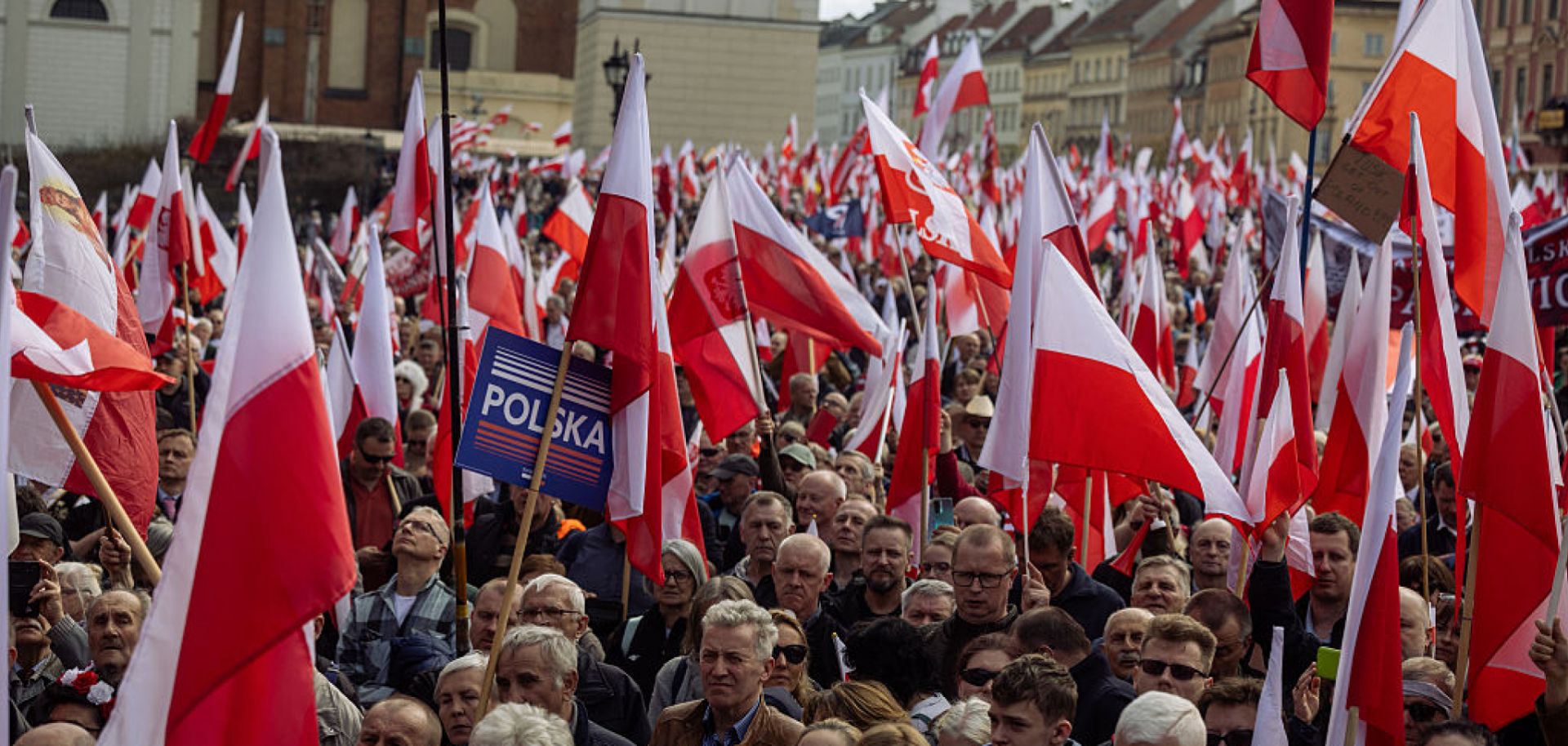
Supporters of the PiS party demonstrate April 12 in Warsaw, Poland.
Editor's Note: For significant elections, RANE publishes a series of scenario analyses focused on different outcomes of major elections, describing how an election outcome might unfold with implications for each potential outcome. In 2025 so far, we have profiled Germany, Canada and Australia. We now profile Poland.
Poland will hold a presidential election May 18 and runoff June 1 if no candidate obtains more than 50% in the first round. The outcome will determine whether Prime Minister Donald Tusk's centrist government will coexist with a cooperative president or continue to face institutional constraints from an ideologically opposed president. While Polish presidents hold limited executive authority, they have veto power over legislation and wield considerable influence on foreign and defense policy. The vote will thus impact the pace and coherence of reforms, the level of policy and institutional risk, and the country's broader positioning within NATO and the EU.
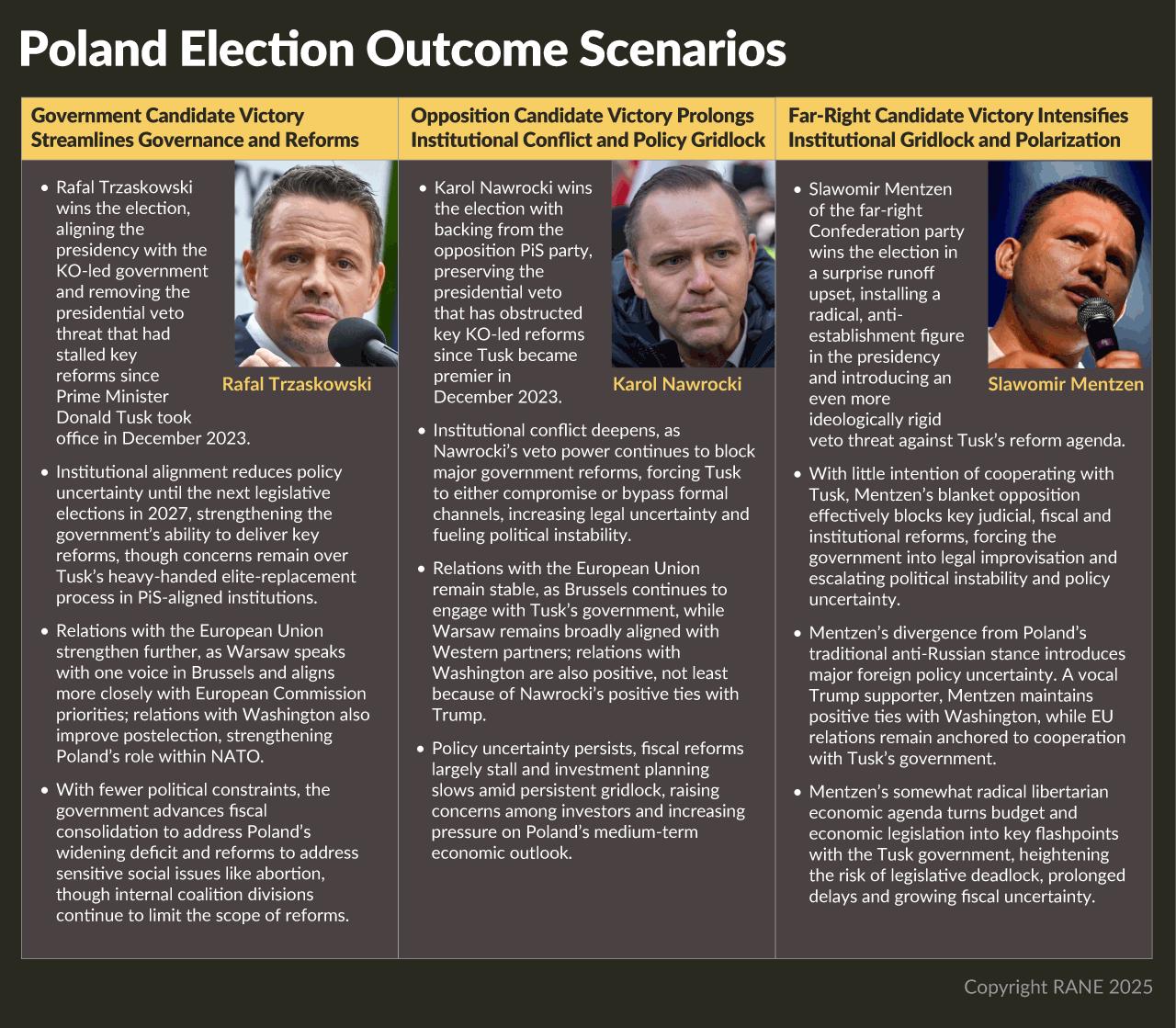
In the most likely scenario, Civic Coalition, or KO, candidate Rafal Trzaskowski wins the election and aligns the presidency with Tusk's government. This outcome would streamline the legislative process by removing the presidential veto that has largely stalled reform efforts since Tusk took over in December 2023. Institutional tensions would subside, enabling the government to accelerate judicial reform, public media restructuring, fiscal consolidation and infrastructure investment. Market sentiment would likely improve due to reduced policy uncertainty and a more cohesive government. Relations with the European Union would strengthen further, as Warsaw would speak with one voice in Brussels and align more closely with European Commission priorities. The presidency's alignment with the government would also bolster Poland's voice in NATO discussions and ease some recent tensions with U.S. President Donald Trump's administration, leading to more consistent strategic coordination with Washington and Brussels.
A second scenario sees Karol Nawrocki, backed by the national-conservative Law and Justice, or PiS, party, win the presidency. In this case, institutional conflict would persist as Nawrocki uses his veto power to block or delay the government's reform agenda. Nawrocki would preserve PiS's ability to disrupt policymaking and obstruct government efforts to dismantle the party's deep-rooted influence over the country's institutions. Domestic uncertainty would persist as the government faces pressure to water down or abandon initiatives, especially in areas such as judicial reform and public appointments. Investors would face continued unpredictability, and Poland's ability to implement fiscal adjustments or regulatory improvements would be constrained. Relations with the European Union would remain stable due to greatly improved cooperation with the Tusk government despite escalating institutional tensions. Foreign policy would see continuity, particularly regarding defense spending and support for Ukraine, though Poland's credibility as a coherent and fully functional regional leader would weaken.
A third, less likely but more disruptive scenario involves a victory by Slawomir Mentzen of the far-right Confederation party. Lacking parliamentary support, Mentzen would be unable to implement his economically radical libertarian and socially conservative agenda, but his confrontational stance and veto power would severely disrupt legislative activity and deepen institutional conflict. His foreign policy positions — particularly his calls to reengage with Russia and halt support for Ukraine — would introduce uncertainty into Poland's international posture. The resulting gridlock would elevate policy risk, undermine investor confidence, and weaken Warsaw's influence within the EU and NATO. Budget legislation and fiscal consolidation efforts would become flashpoints, increasing the risk of fiscal slippage and threatening Poland's credibility with both markets and Brussels.
Government Candidate Victory Streamlines Governance and Reforms
Rafal Trzaskowski, from Prime Minister Donald Tusk's centrist KO, wins the presidency, removing the presidential veto threat that had stalled key reforms since Tusk took office in December 2023. His victory streamlines the legislative process, allowing for smoother, more consistent policymaking until at least the next legislative elections at the end of 2027 and strengthening the government's ability to deliver judicial, media and pro-EU reforms. Policy uncertainty declines, relations with the European Commission improve and regulatory clarity boosts investor confidence. With fewer political constraints, the KO-led government accelerates fiscal consolidation and institutional investment to address Poland's widening deficit and infrastructure shortfalls. Trzaskowski's presidency also creates space to begin tackling sensitive social issues, including softening Poland's near-total abortion ban, though divisions within the coalition persist. On foreign and security policy, a presidency aligned with the government reinforces Warsaw's pro-EU and trans-Atlantic stance, deepening cooperation with Brussels on Ukraine, European defense and other matters. It also helps ease current tensions with Washington, where the Trump administration's backing of a rival candidate has complicated ties. After the election, the United States will likely set political preferences aside, recognizing Poland's alignment with key U.S. expectations for European allies such as increased defense spending and deep ties with U.S. strategic industries such as defense and nuclear energy. Together, these dynamics position Warsaw as an increasingly assertive voice in regional security debates. Markets respond positively to the reduction in policy uncertainty, and Poland reestablishes its image as a stable investment destination and reliable partner in Europe.
Implications
- Improved institutional alignment reduces legislative gridlock, enabling the government to implement judicial and media reforms more swiftly. However, some of the government's measures — such as taking legal action against PiS figures and the government's approach to public media, including by forcing leadership changes and revoking licenses of rival broadcasters — raise concerns about the actual improvement of democratic norms in Poland. Still, clearer policy direction and the endorsement of EU institutions contribute to enhanced regulatory predictability and improve Poland's attractiveness to foreign investors.
- The government accelerates fiscal consolidation measures, including tax reform and spending cuts, with no obstruction from the presidency. This increases Poland's creditworthiness and reduces the likelihood of a sovereign downgrade, which in turn lowers borrowing costs and stabilizes debt dynamics.
- Greater political stability and policy clarity allow the government to advance long-term investment planning, enabling more effective disbursement of EU recovery and cohesion funds; improving infrastructure project timelines; and creating opportunities for companies in the construction, energy, infrastructure and logistics sectors.
- A pro-EU presidency deepens Poland's engagement in European defense initiatives, including stronger participation in joint procurement and industrial cooperation programs, boosting prospects for Europe-based defense contractors seeking to expand in Poland's growing defense market.
- Poland strengthens its leadership role within NATO and EU security policy coordination, working more closely with allies on Ukraine support, forward defense strategies and regional deterrence posture — a development also welcomed by Washington as in line with its strategic reposturing in Europe.
- Improved relations with Brussels and stronger political stability at home improve Poland's ability to shape key EU policies, including on the energy transition (which Tusk aims to focus on energy security rather than emissions cuts), industrial competitiveness and defense spending, positioning Warsaw as an interlocutor between Western and Eastern EU members.
- The alignment between presidency and government allows for an at least partial liberalization of Poland's strict abortion law, which, while still controversial among ruling coalition partners, demonstrates the government's ability to navigate divisive social reforms. This further signals to markets that Poland has entered a more stable political phase.
- Foreign investment in the country benefits from reduced political volatility and improved policy predictability, especially in the context of EU supply chain resilience strategies that favor nearshoring to stable, competitive and EU-aligned economies like Poland.
- U.S.-Poland relations normalize postelection, as the Trump administration sets aside prior political preferences to work with what is ultimately a reliable pro-NATO and pro-defense partner, helping preserve defense cooperation, including troop deployments, military aid coordination and continued opportunities for U.S. defense contractors to benefit from Poland's defense spending surge.
- While institutional alignment with the presidency improves overall policy coherence in Poland, lingering ideological differences among coalition partners within Tusk's Cabinet continue to create friction on economic and social issues. This limits the government's ability to present a fully consistent policy agenda and somewhat weighs on investor confidence in Poland's medium-term strategic direction.
Opposition Candidate Victory Prolongs Institutional Conflict and Policy Gridlock
Karol Nawrocki, backed by the national-conservative PiS party, wins the election, prolonging the institutional conflict that has plagued Polish politics since the KO-led centrist government took office in December 2023 and keeping friction in the legislative process. As Polish presidents have limited executive powers and Nawrocki's campaign promises lack parliamentary backing, his victory would not translate into major policy shifts. He would, however, occasionally veto legislation, disrupting the government's agenda. A Nawrocki presidency would preserve the veto power PiS has relied on under Duda to block Tusk's reform plans, particularly in the areas of judicial overhaul, media regulation and public appointments. Without the three-fifths parliamentary majority needed to override a presidential veto, the government would face greater pressure to compromise or abandon key initiatives, compounding delays and policy uncertainty. Relations with the EU remain stable, however, as Brussels continues to engage with Tusk's government and has already resumed funding flows for Poland. Still, with the presidential veto still in place, Tusk may be tempted to bypass institutional constraints to push forward with efforts to replace PiS-aligned judges and continue purging state institutions of the party's influence — a move that could intensify domestic political instability and reignite rule-of-law concerns in the country. The resulting uncertainty negatively impacts investor confidence, delays reforms and increases risks to Poland's medium-term fiscal and economic outlook. On foreign and defense policy, Nawrocki maintains a hawkish stance on Russia and support for aggressive Polish rearmament while affirming strong defense ties with the United States and NATO, not least because of positive ties with the Trump administration.
Implications
- Legislative gridlock continues as presidential vetoes stall reforms, particularly in judicial, media and institutional appointments. Without a three-fifths majority in parliament, the government struggles to override vetoes, significantly delaying its legislative agenda and eroding its ability to implement structural reforms.
- Despite Poland's diversified economy, strategic location and competitive labor force continuing to support long-term growth potential, prolonged political turbulence and institutional gridlock raise investor caution. Policy uncertainty and delayed reforms increase perceived risks in key sectors like energy, infrastructure and finance, which could gradually reduce foreign direct investment and slow Poland's economic momentum over time.
- Fiscal consolidation efforts are largely stalled or watered down, as social spending reforms become politically toxic amid continued polarization and populist pressure. Delays in passing budget legislation or implementing tax and pension reform raise concerns among credit rating agencies and international lenders.
- Judicial reform efforts trigger a constitutional and political crisis, as the government attempts to bypass presidential obstruction through executive or parliamentary workarounds, raising rule of law concerns that could reignite legal scrutiny from EU institutions and/or increase domestic unrest.
- Defense procurement slows due to bureaucratic friction as presidential opposition delays or contests government-backed tenders and procurement decisions. This creates uncertainty for international defense contractors and risks stalling elements of Poland's military modernization.
- Foreign policy coherence remains somewhat weak, as Nawrocki's office sends conflicting messages on EU priorities, Ukraine and NATO cooperation, but Tusk's government remains aligned with Western partners despite discordant presidential rhetoric.
- U.S.-Polish relations become more transactional, as the Trump administration engages directly with Nawrocki while EU officials favor Tusk. Competing channels of diplomacy complicate defense cooperation and may delay bilateral decisions, including arms transfers or joint exercises.
- Institutional dysfunction leads to policymaking ministerial regulations and legal improvisation, with the government testing the limits of constitutional authority to pursue its agenda. This approach generates legal challenges and increases the risk of political crisis, particularly if Nawrocki refuses to approve critical appointments or security-related decisions.
- A PiS-aligned presidential victory intensifies internal strains within the governing coalition, as junior partners seek to differentiate themselves politically ahead of future elections, reducing cohesion and complicating legislative coordination. The resulting instability increases the risk of government collapse, with defections or prolonged paralysis potentially pressuring Tusk to call early elections.
Far-Right Candidate Victory Intensifies Institutional Gridlock and Political Polarization
Slawomir Mentzen of the far-right Confederation party wins the election in a surprise runoff upset, installing a radical, anti-establishment figure in the presidency and ushering in a period of intensified institutional conflict, deepening political polarization and mounting policy instability in Poland. Lacking parliamentary backing, Mentzen cannot implement his somewhat radical libertarian economic agenda — which includes sweeping deregulation, flat taxes and drastic welfare cuts — but his presidency introduces an ideologically uncompromising veto threat that significantly disrupts governance. With little intention of cooperating with the KO-led government, Mentzen's blanket opposition effectively blocks key legislation, including judicial, fiscal and institutional reforms. The budget and related economic legislation become key sources of tensions, as the president holds veto power over both, increasing the risk of delays and fiscal uncertainty. Even so, total paralysis remains unlikely given the potential political costs for Mentzen. On foreign policy — where the presidency holds substantial sway — Mentzen's divergence from Poland's traditional anti-Russian stance introduces major uncertainty. He calls for reengagement with Moscow and disengagement from Kyiv to achieve a negotiated settlement to the war in Ukraine, undermining Warsaw's alignment with the European Union on this matter and constraining any significant Polish participation in any European efforts to provide Kyiv with substantial postconflict security guarantees. A vocal supporter of U.S. President Donald Trump, Mentzen maintains positive ties with Washington and supports Poland's rearmament efforts. While EU relations remain anchored through cooperation with the Tusk government, Mentzen's rhetoric complicates messaging and reduces Poland's influence in Brussels. The resulting institutional and policy gridlock dampens investor confidence, intensifies economic uncertainty and weakens Poland's ambitions to lead on regional security.
Implications
- Mentzen's presidency exacerbates conflict with government and parliament, leading to significant gridlock on judicial reform, budget legislation and key appointments. With little prospect of compromise, the government struggles to function, increasing regulatory unpredictability and making long-term planning difficult for domestic and foreign businesses, investors and households.
- Mentzen's opposition to welfare spending and tax hikes raises the risk of repeated budget vetoes. This complicates debt issuance and delays fiscal consolidation efforts, triggering concern among investors and potentially pushing up borrowing costs, especially if credit rating agencies reassess Poland's fiscal outlook amid worsening political risk.
- While Mentzen's libertarian platform lacks parliamentary support, his use of the presidency to challenge government fiscal plans and promote deregulation and welfare cuts fuels market anxiety. Ongoing policy instability and legislative deadlock weaken investor confidence, particularly in sectors highly dependent on regulatory clarity for long-term planning such as infrastructure, public services, construction, energy and utilities.
- Although Mentzen supports military spending, his institutional conflict with the government likely delays procurement approvals and complicates coordination with NATO. This uncertainty affects timelines for defense tenders, potentially delaying or downsizing planned acquisitions that would benefit European and non-European defense suppliers targeting Poland as a priority growth market.
- Mentzen's positive ties with Trump, contrasted with his strong emphasis on Polish sovereignty, lead to an inconsistent and more transactional U.S.-Polish relationship, especially given strained ties between Trump and the Tusk government. While defense cooperation remains intact, weaker coordination on economic and regulatory issues adds uncertainty for U.S. investors and complicates broader trans-Atlantic policy alignment.
- Mentzen calls for dialogue with Moscow and downplays support for Kyiv, adding to growing internal divisions within NATO and the European Council while weakening Poland's voice in shaping a European postwar security framework. This shift raises concerns in Brussels and could reduce Poland's role as a key conduit for Western military aid to Ukraine or a host for European troops participating in a so-called coalition of the willing to provide Kyiv with postconflict security guarantees.
- While Brussels continues to engage with Tusk's government, Mentzen's anti-EU rhetoric undermines diplomatic cohesion and weakens Poland's ability to shape EU policy on defense, migration and climate, as conflicting leadership erodes Warsaw's credibility in European forums and limits its influence over joint industrial and regulatory initiatives.
- Mentzen's vow to veto all legislation related to the green transition exacerbates policy gridlock, halting progress on renewable energy and grid modernization. This derails Poland's decarbonization agenda, complicates EU funding absorption and reduces investment opportunities in green infrastructure — increasing reliance on high-emission coal and undermining long-term energy security.
- Despite broader political instability, Poland's nuclear energy program remains on track, as both the government and Mentzen support expanding nuclear capacity to bolster energy security. Continued bipartisan backing ensures that large-scale U.S. and South Korean nuclear investments proceed, offering long-term opportunities for foreign contractors.
- The combination of domestic gridlock, fiscal uncertainty, and policy ambiguity weighs on investor sentiment, leading to pressure on Polish assets. Bond yields edge higher, and the zloty softens as markets reassess political risk, raising concerns about Poland's medium-term outlook and gradually eroding its reputation as a regional safe haven for capital.
