
Editor's Note: For significant elections, RANE publishes a series of analyses focused on different outcomes, describing how an election scenario might unfold with implications for each potential result. In 2025 so far, we have profiled Germany and Canada. We now profile Australia.
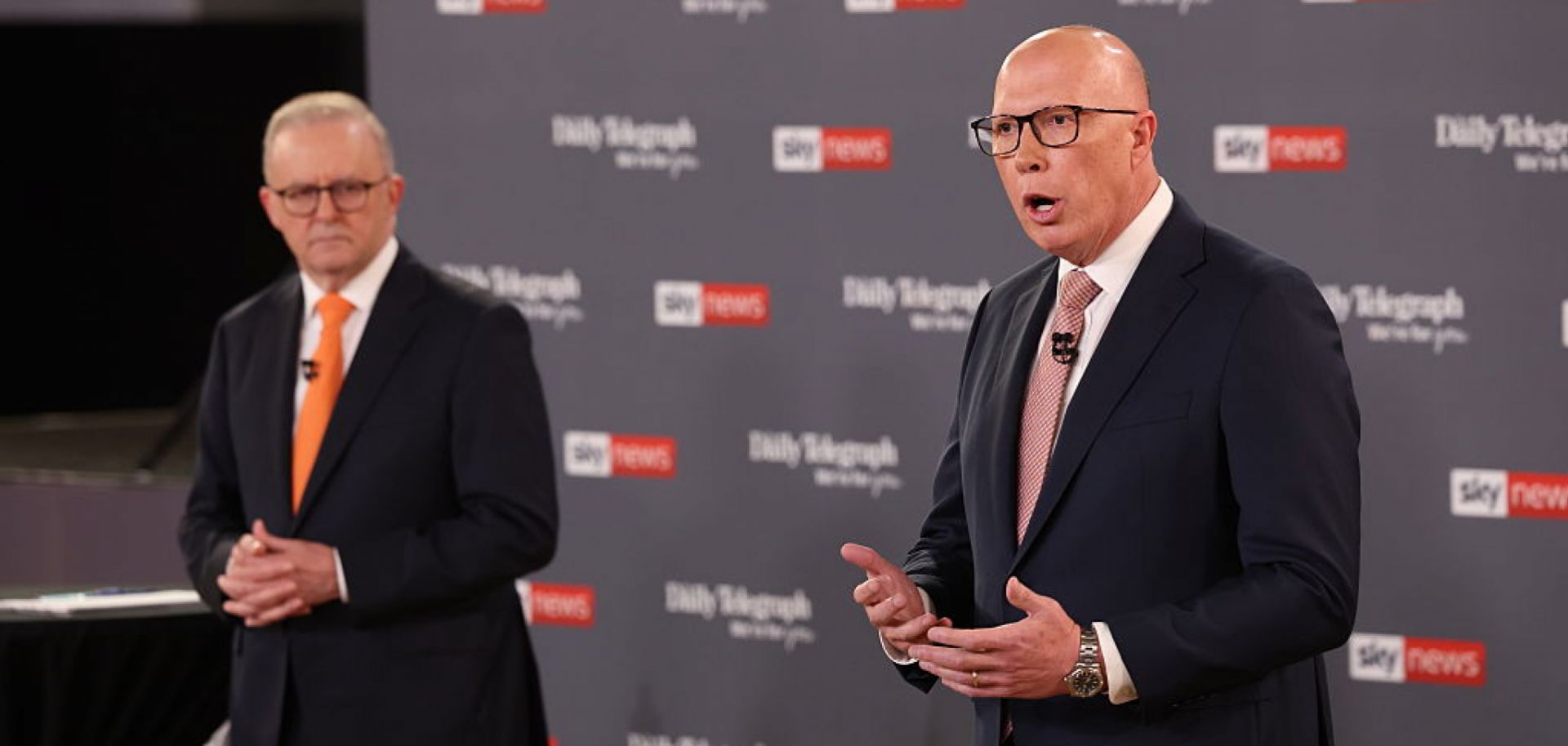
Australia will hold a federal general election on May 3 after Prime Minister Anthony Albanese of the incumbent Australian Labor Party, or ALP, called new elections on March 28, hoping to take advantage of the federal budget's release to secure a bump in popularity ahead of the polls. The election will determine whether the ALP, led by Albanese, secures a second three-year House term, or whether the Liberal-National coalition, or LNC, returns to power after one term in opposition. Half the Senate will also be up for election, with the outcome critical to the next government's ability to pass legislation.
If Albanese, in office since May 2022, and the ALP win a majority, it would extend Labor's current policy agenda on defense modernization — including the implementation of the AUKUS submarine program and deeper strategic alignment with Australian allies and defense partners. A Labor victory would also enable further expansion of Medicare, targeted cost-of-living relief and strategic investment in clean hydrogen and renewables-linked industrial capacity.
Alternatively, if Peter Dutton and his LNC return to lead the government, Dutton's administration would pursue a platform focused on curbing renewable energy subsidies, tightening migration and expanding defense expenditure with a sharper posture than the ALP, though largely along the same lines. An LNC government would also seek to fast-track gas and coal projects, impose stricter visa controls, and fund defense expansion through public sector cuts and deregulatory reforms.
A hung parliament would likely result in a minority government reliant on cross-bench negotiations, complicating the passage of major legislation and forcing compromises on key issues such as climate targets and defense procurement, though either of the major parties securing a plurality would mean the same respective agenda, albeit more politically constrained. Though unlikely, if no governing arrangement can be reached, the governor-general could call an early election to resolve the deadlock. This would extend Australia's political uncertainty, delay major policy decisions and heighten public frustration with political fragmentation, likely prompting voter consolidation around the major parties in a follow-up contest.
The ALP Forms a Government
If the Australian Labor Party secures a majority, giving Albanese a second term, policy continuity on public services, cost-of-living relief, energy, health care, defense and foreign relations would be likely. The ALP would prioritize investment in infrastructure, jobs and targeted cost-of-living relief, rather than the public sector job cuts and fiscal tightening proposed by the LNC, while also curbing inflation. On energy policy, Labor would aim to increase the share of renewable energy in Australia's electricity grid, with a target of 82% renewables by 2030. A majority ALP government would back large-scale wind, solar and battery storage projects, while also investing in transmission infrastructure to modernize the grid. A second-term Labor government would continue funding clean hydrogen projects and supporting domestic green manufacturing as part of its broader economic and climate strategy. On health care, Labor would likely focus on expanding Medicare by committing $8.5 billion to broaden government-funded doctor visits, aiming to fully cover nine out of 10 general practitioner consultations by 2030. The ALP argues this will improve access to health care, but critics warn that it could strain public finances, leading to difficult budget decisions in the future. On defense and national security, while both parties have vowed defense spending hikes, the ALP would pursue an additional approximate $31.3 billion (AU$50.3 billion) over the next decade, aiming to reach approximately 2.4% of GDP by 2033-34. Labor would likewise prioritize defense spending on long-term investments and strategic partnerships, including the AUKUS nuclear submarine program, the expansion of missile capabilities, upgrades to defense infrastructure and a stronger domestic defense industry. As with AUKUS, the ALP would likewise likely maintain and strengthen regional partnerships with New Zealand, Japan and the Philippines while balancing economic ties with China, its largest trading partner.
If the ALP falls short of a majority in a hung parliament scenario, it would be more likely than the LNC to form a minority government because it is structurally better positioned due to ideological overlap with key cross-benchers like the Greens and the teal independents, a more centrist image, and incumbency. A minority ALP government would likely result in strengthened climate targets, increased renewable funding and tighter corporate emissions rules. Labor's defense and fiscal policies would face greater scrutiny from a progressive cross-bench, potentially leading to delayed procurement timelines, scaled-back spending hikes or greater transparency measures. In exchange for their support, Greens and independents would likely also push for broader integrity reforms, housing protections and social investment, constraining Labor's fiscal flexibility and making major initiatives more difficult to implement without cross-party support.
Implications
- The ALP's likely $8.5 billion expansion of government-funded doctor visits will likely improve access to general practitioners, but long-term financial sustainability amid growing social spending commitments will require tradeoffs, likely leading to higher taxes, spending cuts elsewhere or increased national debt. This would be particularly likely if Labor controls the House but not the Senate, which would, for example, create a situation wherein the Greens push for expanded health care while senators with the right-wing One Nation party resist tax increases.
- Labor will likely maintain or implement additional new targeted cost-of-living relief measures, such as energy rebates and housing rental assistance, but budget constraints — exacerbated by major new spending commitments like the $8.5 billion Medicare expansion — could force reductions in other welfare programs over time, especially given an oppositional Senate.
- Labor's rejection of austerity implies public sector expansion, but without corresponding productivity gains; this risks straining the labor market and suppressing private sector investment, especially if Senate dynamics result in further expansionary demands from the Greens while fiscally conservative cross-benchers block offsetting reforms.
- Labor's infrastructure spending will enhance outer suburbs by improving transportation and digital connectivity beyond major cities, though suboptimal planning risks demand mismatches and thus underused infrastructure, resulting in growing public debt, especially if Senate negotiations lead to region-specific project funding pushed by independents or One Nation, or if the Greens condition support on climate-focused infrastructure, diverting funds from high-demand growth corridors, for example.
- Labor's focus on investment over spending cuts could help support economic growth, but without significant productivity improvements. Inflation risks will remain high, which will undermine wages and consumer purchasing power while also risking long-term debt increases that limit Australia's fiscal flexibility in responding to future economic shocks or global downturns.
- The push for 82% renewable electricity by 2030 will accelerate wind, solar and battery storage projects, but restricting new gas supply and phasing out coal could exacerbate gas shortages and price volatility in more densely populated southeastern Australia, especially during peak winter demand or heatwaves, increasing risks of grid instability and supply rationing. Meanwhile, an oppositional Senate would intensify these risks, with the Greens pushing for a faster fossil fuel exit and blocking transitional gas investment, while One Nation and resource-state independents resist coal closures or demand protections for regional industries, making coherent transition planning more difficult.
- Regional communities reliant on coal and gas jobs are likely to continue pushing back against Labor's energy transition policies, potentially leading to federal-state political friction in resource-heavy states like Queensland and Western Australia, which will risk delaying project approvals, fragmenting policy implementation and, ultimately, undermining national climate targets. These risks are compounded in the event of an oppositional Senate, where One Nation and resource-driven independents are likely to oppose transition measures that affect regional employment, while the Greens will refuse to support compromise frameworks involving transitional gas, risking legislative deadlock.
- Increased funding, likely around $12 billion, for clean hydrogen and domestic renewable manufacturing, like solar panels and wind turbines, will accelerate Australia's green energy exports and make the sector more competitive by lowering production costs, However, the upfront costs risk straining the budget before the sector reaches commercial scale and generates meaningful returns, with an oppositional Senate likely to impose additional conditions on funding, making investors less certain.
- The ALP will seek a $31.2 billion defense expansion over the next decade, including long-range strike capabilities, northern basing upgrades, advanced munitions production and upgraded air and naval power. This will strengthen Australia's domestic defense industry and regional partnerships, which will enhance its strategic autonomy and defense posture while making it less reliant on foreign supply chains during potential crises and more able to contribute to defense partnerships like AUKUS and the Quad. However, delays in nuclear submarine procurement and military infrastructure development — much of which is dependent on partner countries such as the United States — risk limiting near-term capability improvements.
- While Labor will likely maintain AUKUS and strengthen regional security partnerships, continued cooperation on nuclear-powered submarines and missile expansion risk exacerbating diplomatic and military tensions with Beijing, potentially harming trade relations (e.g., by driving Beijing to reimpose 2022-era trade restrictions) and economic stability.
- A Labor-led government is likely to deepen defense and trade ties with Japan, India and Southeast Asian countries like the Philippines and Vietnam, reinforcing Australia's strategic position in the broader Asia-Pacific region without fully aligning with an increasingly mercurial United States.
- Labor's historical alignment with unions suggests a likely push for higher minimum wages and stronger worker protections, increasing household incomes but raising labor costs for businesses and undermining Australian companies' competitiveness.
- While the ALP has committed to addressing housing affordability, its strategy of expanding supply through public and private investment is unlikely to keep pace with surging population growth and construction sector constraints (e.g., labor shortages, rising material costs and regulatory and zoning bottlenecks). This imbalance will keep property prices and rents elevated while also driving political pressure to limit immigration.
- Labor's focus on digital access, cybersecurity and domestic tech capability will support sector growth, though a divided Senate would likely delay or reshape key initiatives, e.g., AI oversight, data privacy and digital ID, due to, for example, Greens-backed privacy demands and cross-bench resistance to skilled tech migration.
- Labor will resist U.S. tariffs through quiet, sustained diplomatic outreach and seek carveouts pursuant to the two countries' free trade agreement (AUSFTA) and based on strategic defense ties (such as aluminum), though the success of negotiations will depend on U.S. President Donald Trump's willingness to compromise. Labor will also prioritize maintaining access to U.S. markets and is thus unlikely to escalate with tit-for-tat retaliation or by seeking WTO intervention, though an oppositional Senate could force a more aggressive stance.
- On critical minerals and rare earths, Labor will prioritize developing processing infrastructure as well as expanding subsidies and developing export partnerships away from China, which will render Australia less dependent on and stoke trade tensions with Beijing. However, an oppositional Senate could impose constraints, such as Greens demanding more stringent environmental safeguards or conservatives pushing for domestic ownership.
- The ALP securing a minority government would mean stronger climate policies and increased social spending prompted by cross-benchers, but Greens and teal independents would likely oppose military spending increases.
- A Labor minority government reliant on Greens and teals would likely maintain a cautious diplomatic tone toward Beijing, emphasizing de-escalation and climate or trade cooperation. However, such a government would likely face pressure from progressive cross-benchers to strengthen human rights advocacy, risking friction with China, particularly if paired with new foreign investment scrutiny.
- In a Labor minority government, Greens and progressive independents would likely demand tighter oversight of Australia's AUKUS commitments, including nuclear submarine procurement and defense spending growth, forcing Labor into compromises that could delay procurement timelines or require greater transparency measures, potentially straining U.S. and U.K. defense ties.
- As with a majority government, Labor would seek to quietly negotiate carveouts or exemptions from Trump's reciprocal tariff policies, but a constrained fiscal position and cross-bench opposition to new concessions for U.S. companies under a minority government would limit its ability to offer reciprocal benefits, thus lowering the likelihood of carveouts while raising the risk of targeted U.S. tariffs on Australian exports.
- A Labor minority government would be vulnerable to no-confidence motions from both the right and left, especially on climate, housing and industrial relations. Investor confidence could waver amid uncertainty over whether policies like tax reform, the net-zero transition or migration control can survive cross-bench scrutiny.
- A Labor minority facing a hostile or divided Senate would see its signature initiatives — such as environmental regulation, Indigenous reconciliation measures and industry policy — blocked or defanged, necessitating a more piecemeal policy strategy.
- In a minority government scenario, cross-bench pressure, especially from the Greens, could constrain Labor's AUKUS agenda, limit regional military commitments and complicate relations with China. Trade diplomacy and Australia's defense posture would likely become more reactive and internally contested.
The LNC Forms a Government
If the Liberal-National coalition wins the election, resulting in Peter Dutton becoming prime minister, policies would shift toward fiscal austerity, loosened energy regulations, expanded defense spending and stricter immigration regulations. The coalition would focus on reducing public expenditure, boosting national security and limiting government intervention in key economic sectors. Dutton and the LNC would roll back some Labor policies, focusing on reducing health care spending, scaling back climate ambition and energy transition commitments, and curbing social welfare programs. On economic policy, the LNC would likely prioritize reducing government debt and limiting spending growth. The coalition's fiscal strategy would include tax relief for businesses, deregulation to encourage investment and cuts to government programs it deems excessive or inefficient. Dutton's government would likely reintroduce corporate tax incentives, promote resource extraction industries, and encourage private-sector job creation rather than expand social spending. On energy policy, the LNC would scale back some of Labor's renewable energy targets, particularly its push for 82% renewable electricity by 2030. While some wind, solar and battery storage investments would continue, the coalition would expand support for natural gas and maintain coal-fired power plants longer than Labor had planned by extending plant lifespans, fast-tracking new gas projects and relaxing emissions standards. The government would also try to lift Australia's ban on nuclear energy. On health care, the LNC would allocate $5.6 billion for "free" general practitioner visits, aiming to address health care affordability while offsetting costs through cuts to public service jobs. Unlike Labor's universal approach to expanding bulk billing, the coalition's plan would be more targeted and funded by reducing the size of government. Critics warn that cutting 36,000 public sector jobs to fund these health care initiatives could strain essential government services, particularly in welfare, immigration and regulatory enforcement. Defense spending would likely rise beyond 2.5% of GDP and more rapidly than Labor's envisioned hike to 2.4% by 2033-2034, with a focus on rapid procurement of military assets, strengthening coastal border security and increasing defense ties with the United States and its other AUKUS partner, the United Kingdom. The coalition would likely take a harder stance on China, further restricting Chinese investments in critical infrastructure and expanding military operations in the Asia-Pacific region around Taiwan, the South China Sea and the Pacific islands region. However, a Dutton government would likely face resistance from the Senate, particularly if Labor, the Greens or independents hold significant power in the upper house, leading to legislative gridlock.
If the LNC falls short of a majority, it would likely form a minority government by courting teal independents and aligning smaller right-wing parties, such as One Nation, the United Australia and the Trumpet of Patriots Party. This would likely lead to more aggressive immigration restrictions, protectionist trade measures and an increased law-and-order emphasis, including crackdowns on crime and reduced welfare spending. Energy policy would skew further toward fossil fuel expansion, with support from cross-benchers demanding coal and gas protections. At the same time, minor party influence would complicate efforts to pass fiscal reforms, as populist demands for economic sovereignty, domestic manufacturing support and higher tariffs could collide with the coalition's traditional deregulatory agenda, forcing compromises that dilute policy coherence.
Implications
- The LNC's planned $5.6 billion health care investment would improve targeted access to general practitioner visits, but funding it through cuts to 36,000 public service jobs risks weakening government efficiency in key areas like immigration, national security and welfare administration, and would also face Senate resistance should the coalition fail to win a majority in that chamber.
- The coalition's fiscal approach could lower government spending and reduce debt accumulation, which would improve Australia's sovereign credit profile and potentially reduce long-term borrowing costs. Corporate tax incentives and deregulation would likely boost private-sector investment, particularly in mining, energy and infrastructure, enhancing Australian companies' competitiveness, but at the potential cost of reducing government revenue in the long term, as well as weakening regulatory frameworks in areas like labor standards, environmental protection and corporate transparency.
- Spending cuts under a coalition government would risk disproportionately impacting lower-income households reliant on social programs, thus compounding the existing effects of higher housing prices. This would lead to increased political pressure from state governments, labor unions and civil society groups resisting such cuts, which would, in turn, raise the likelihood of policy gridlock, federal-state standoffs and labor strikes.
- Faster defense spending increases would accelerate military procurement, strengthening Australia's immediate combat readiness, but could also strain the budget, requiring trade-offs in other areas like reduced infrastructure, health care and climate funding.
- Energy policy would shift toward fossil fuel reliability, with increased gas production and extended coal operations, creating new investment opportunities in upstream projects while helping to ease supply constraints on Australia's eastern coast and stabilize prices during peak demand, particularly amid the gas shortfall in the country's southeast. However, an oppositional Senate would delay enabling legislation, with the Greens and climate-focused independents opposing fossil fuel expansion and using procedural tools to stall approvals or impose environmental conditions.
- Government efforts to slow Australia's transition to renewables would reduce long-term investor confidence in wind, solar and battery technologies, and likely redirect capital to transitional projects. These changes would face Senate resistance from the Greens and progressive independents, who would look to block repeal efforts or condition support on emissions safeguards, thereby limiting the coalition's ability to fully implement its rollback agenda.
- The LNC's focus on border security and immigration restrictions would likely lead to stricter visa policies, potentially affecting skilled migration and international student enrollments, both key drivers of the Australian economy. While low-cost labor migration from the Pacific Island nations would likely continue due to agricultural workforce demand, labor availability in other sectors could be impacted, such as the health care, construction and technology industries.
- Australia's relations with China would likely deteriorate further amid government efforts to impose more restrictions on Chinese investments in critical infrastructure and tech, tighten scrutiny of university and corporate partnerships, and expand Australia's regional security posture. Such efforts would likely prompt Beijing to reimpose trade restrictions on Australian exports such as wine, beef and lobsters, delay customs clearances, and/or limit access to rare earths and components critical to Australian manufacturing and clean energy supply chains.
- A coalition government would focus on expanding joint Australia-U.S. military operations in the Pacific by, for example, immediately investing approximately $1.86 billion (A$3 billion) in Australia's growing fleet of F-35 fighter jets, though this also depends on evolving U.S. policy. This would enhance regional deterrence and interoperability but also risk escalating tensions with China and complicating Australia's relations with ASEAN member states wary of great power competition.
- Australian rural areas reliant on mining and agriculture would likely benefit from LNC policies, as the coalition prioritizes resource sector expansion and reduced environmental regulations. But such policies will also risk entrenching regional economic dependence on extractives, deepening the urban-rural political and cultural divide and complicating national efforts to meet emissions targets and transition planning.
- The coalition government would focus on reducing digital regulation and supporting private-sector innovation in AI, cybersecurity, and defense tech but could deprioritize digital inclusion and consumer protections, while Senate resistance from the Greens and independents would likely slow or reshape digital ID and privacy-related legislation.
- The coalition would likely align more closely with U.S. strategic and trade objectives, resisting reciprocal tariffs on Australian goods through backchannel diplomacy and a bolstered defense posture. But Canberra would likely face domestic pressure to adopt retaliatory measures if Washington imposes tariffs on key Australian exports like beef, wine or critical minerals, particularly in the event of an oppositional Senate.
- Compared with a Labor-led government, an LNC-led government would double down on critical minerals extraction and processing, fast-tracking project approvals and expanding subsidies to reduce reliance on China and align with U.S. supply chains more rapidly. However, weaker environmental oversight would risk triggering public backlash while an oppositional Senate would impose environmental conditions or otherwise slow legislative approvals, risking delays to project timelines.
- A hung parliament would bode ill for the LNC given Labor's structural advantages over it in forming a minority government. But an LNC-led minority government would remain possible, particularly if Labor alienates centrist or populist-leaning independents.
- A Dutton-led coalition minority government, especially if reliant on One Nation or the Trumpet of Patriots Party, would adopt an even more confrontational stance toward China than a coalition majority government. This would portend an expansion of Australian investment restrictions and military operations in contested regions like the Taiwan Strait and South China Sea, prompting Beijing to reimpose trade barriers and launch additional deterrence initiatives, such as more drills in the Tasman Sea.
- The LNC would deepen strategic alignment with the United States, accelerating defense integration and AUKUS procurement, though minor right-wing party partners would likely demand greater sovereignty protections or economic returns from military investments, creating friction with U.S. negotiators over basing rights or procurement conditions.
- The coalition forming a minority government would lead to tougher immigration restrictions and economic protectionism, particularly if One Nation and/or the Trumpet of Patriots Party hold influence.
- Under a minority government, the coalition would likely tolerate a harder U.S. tariff position in exchange for broader strategic cooperation, but minor party pressure would likely force it to retaliate with tariffs of its own on U.S. imports, risking escalation and damaging Australia's access to U.S. markets.
- In an LNC-led minority government, cross-bench influence would likely skew policymaking toward vocal right-wing interest groups (e.g., mining, gun rights, anti-mandate activists), potentially resulting in rent-seeking or regulatory carve-outs that undercut market competition or national interest planning.
- In a minority government and divided Senate scenario, LNC proposals such as on nuclear energy, industrial policy or national security would face blocking from Greens, Labor and even conservative cross-benchers with divergent views or interests.
