
Power lines are seen in the countryside of New South Wales, Australia.
Australia’s energy crisis is likely a preview of things to come amid worsening global shortages and market uncertainty. This will compel Canberra to make significant policy changes aimed at securing the country’s power supply, including boosting investment in renewables. On June 15, the Australian Energy Market Operator (AEMO) took the unprecedented step of suspending the wholesale spot market in all five eastern Australian states making up the National Electricity Market. The operator’s CEO said it was forced to intervene to direct 5 gigawatts of power generation to be available to supply power if needed in order to ensure “a reliable supply of electricity” for eastern Australia. AEMO’s drastic suspension, which it will review daily, comes after AEMO issued load shedding warnings and introduced price caps for Queensland, New South Wales, South Australia and Victoria.
- Australia’s electricity market is divided into several regional grids with little or no interconnectivity due to the large desolate deserts that encompass much of Australia’s interior.
- The National Electricity Market operates in the eastern states of Queensland, New South Wales, South Australia, Tasmania and Victoria. These states — along with the Australia Capital Territory that surrounds Canberra and Jervis Bay Territory along the New South Wales coast — are home to almost all (88%) of Australia’s population.
Eastern Australia’s power crisis is the result of a combination of short-term factors, including an earlier-than-usual onset of winter weather, as well as a long-term energy strategy that has prioritized natural gas and coal exports. Southeastern Australia has suffered a series of cold fronts since mid-May that have led to an early start of winter temperatures for much of the region. In addition to the higher demand for electricity and natural gas for heating, a combination of planned and unplanned outages at several coal-fired plants took 25% of Australia's coal power capacity offline. AEMO did not directly blame coal and natural gas exports for the unprecedented suspension of the electricity spot market (Australia is the world’s second-largest coal and largest exporter of liquified natural gas, or LNG). However, the eastern Australian market is currently more integrated with global LNG and coal markets than it has ever been, making it more susceptible to price swings — like those being caused by the ongoing war in Ukraine — which can sometimes incentivize companies to export at higher prices. In 2017, the government introduced the Australian Domestic Gas Security Mechanism, which forces LNG exporters to divert supplies to the domestic market if the federal energy minister declares a gas supply emergency. The current crisis, however, has not yet prompted Australia to trigger this mechanism, likely because it’s technically designed to address a supply shortage and not a price crisis, which appears to be the greater issue affecting the country’s natural gas market. The New South Wales government, however, invoked emergency powers on June 19 for coal producers in its state to divert supplies being exported to local power generators. When AEMO capped the price at A$300/MWh, some natural gas-fired and coal-fired power generators would have sold at a loss, which ultimately forced AEMO to direct 5 gigawatts of capacity to be available regardless of the cost and suspend the wholesale market.
- In the first 7 days of June, Sydney failed to reach 18.5 degrees Celsius (roughly 65 degrees Fahrenheit) for the first time since 1989.
- Eastern Australia’s first LNG export terminals in Queensland came online between 2015-16, giving natural gas producers the ability to export LNG at global LNG prices, which have dramatically risen since Russia invaded Ukraine in late February.
- Even prior to the recent crisis, Australian officials warned of potential shortfalls. In addition to the 2017 creation of the federal gas security mechanism, Western Australia introduced a rule in 2006 that requires LNG export projects to reserve 15% of supply for the local market. As a part of the gas security concerns and in an attempt to head off explicit local market supply volume requirements, Queensland’s LNG exporters also reached a Heads of Agreement with the Australian federal government in 2018 to offer all uncontracted natural gas production to the local market before offering it on the LNG spot market. According to the terms of the agreement, Australia’s gas producers must offer uncontracted gas to the domestic market with reasonable notice to potential buyers and on competitive market terms. In March, a commissioner of the Australian Competition and Consumer Commission questioned some gas producers’ compliance with the agreement.
In the short term, Australian consumers will face sustained high electricity and natural gas prices, which will contribute to more inflation. This could also see more load shedding this winter as well, though this risk may decline deeper in the coming months as some generators come back online due to maintenance wrapping up. If there are more frequent cold snaps in the coming weeks, it will put more pressure on Australia’s electricity supply and AEMO’s ability to regulate it — particularly if there continues to be a large number of unplanned outages of generator units, even once the wholesale market’s suspension ends. Power generators that are being forced to sell at a loss because of the price caps and wholesale market’s suspensions may try to recoup any losses once the caps are removed and the short-term crisis subsides, which will lead to higher sustained prices, even if not crisis level. In a worst-case scenario, Australian power generators or gas companies may become insolvent. This would force Prime Minister Anthony Albanese’s new Labor Party government to consider bailing out these companies, despite promising an energy policy more focused on renewables compared with former Prime Minister Scott Morrison’s Liberal Party government. By exacerbating inflation, higher sustained energy prices will also force Australia’s central bank to continue tightening interest rates. While Australia's current 5.1% inflation rate is still lower than most developed countries, the Reserve Bank of Australia expects inflation to reach 7% by the end of the year.
- The current crisis is showing some signs of subsiding, at least for now. As of June 17, about a third of the offline coal-fired power generation capacity had returned to service following the wholesale market suspension, but AEMO said the crisis was not over.
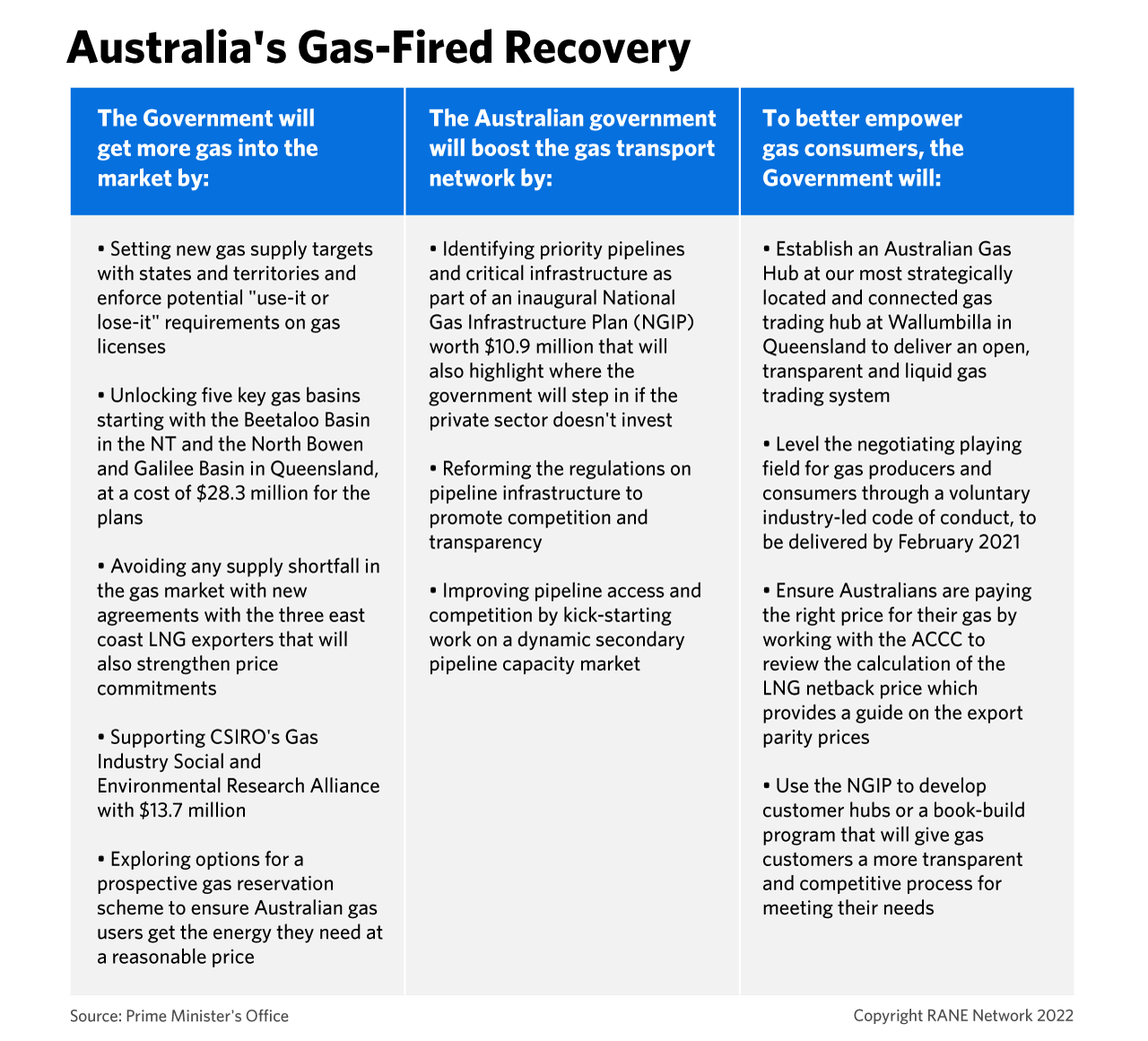
Beyond this winter, the crisis will play an instrumental role in how Albanese’s new government looks at natural gas and coal as a part of the country’s energy security. The governing Labor Party will put energy security at the front of its policy agenda in the coming years, especially after defeating the pro-coal and pro-gas Liberal Party in the May 21 general election. However, the Albanese administration will likely continue to rely on natural gas and increased domestic coal and gas consumption to ensure generation capacity, at least in the short term. Indeed, the Labor Party notably did not pledge to strictly abandon the “Gas-Fired Recovery” plan introduced by the previous government amid the height of the global COVID-19 crisis in 2020 (the Albanese administration, for example, supports developing the Beetaloo shale basin, which is one of the measures outlined in that plan). Still, the Labor Party is concerned about the issue of energy security, and has in the past taken a more active stance than the Liberal Party on ensuring natural gas and coal producers set aside higher volumes of coal and natural gas for the domestic market. One consequence of the gas crisis could be revisiting the Heads of Agreement with LNG producers and potentially restructuring the Australian Domestic Gas Security Mechanism in a way that grants regulators more tools to divert natural gas to the domestic market. In addition to the short-term boost in natural gas infrastructure and capacity, Albanese’s government will probably emphasize renewable energy as a faster alternative in the medium term to natural gas (and other energy sources), putting more of an onus on renewables in Australia’s energy strategy.
The crisis will also factor heavily into Albanese’s pledge to make Australia a “renewable energy superpower,” which could potentially be reflected in a new national energy transition plan. On June 8, Australia’s federal and state energy ministers agreed on an 11-point plan to address the energy crisis. The plan includes a “capacity mechanism” that provides payments for energy producers that have energy available at any time in hopes of driving up investment into energy storage, which will support more investment into the renewable sector. The ministers also agreed on finally developing a national energy transition plan, which will likely serve as the blueprint to achieve Albanese’s promise to cut carbon emissions by 43% by 2030 from 2005 levels (compared with the current 26-28% target). Natural gas is likely to be a key part of this strategy in the medium term as it can be a bridge fuel to reduce the country’s energy reliance on more emissions-intensive coal-fired power. Ultimately, however, the importance of the LNG and coal export sectors (and iron ore) will constrain some of Albanese’s ability to achieve its more progressive energy goals and adopt policies as aggressive as those in Western Europe. This is similar to the issues facing Canada’s current government, where the ruling center-left Canadian Liberal Party is also trying to balance the energy transition with the sheer economic requirements of maintaining oil, coal and natural gas production for export purposes.
- The Labor Party’s “Powering Australia” plan entails $76 billion in investment, boosting renewable capacity to 82% of the National Electricity Market’s generation by 2030, and developing a National Electric Vehicle Strategy to reach 89% of new vehicle sales being electric vehicles by 2030.
- Australia has not yet developed a national plan for transitioning to renewable energy. This is because of the powerful authority states and territories have over the energy sector and the previous Liberal Party’s government’s desire to let them take the lead on the energy transition in lieu of a more aggressive approach at the federal level.
