
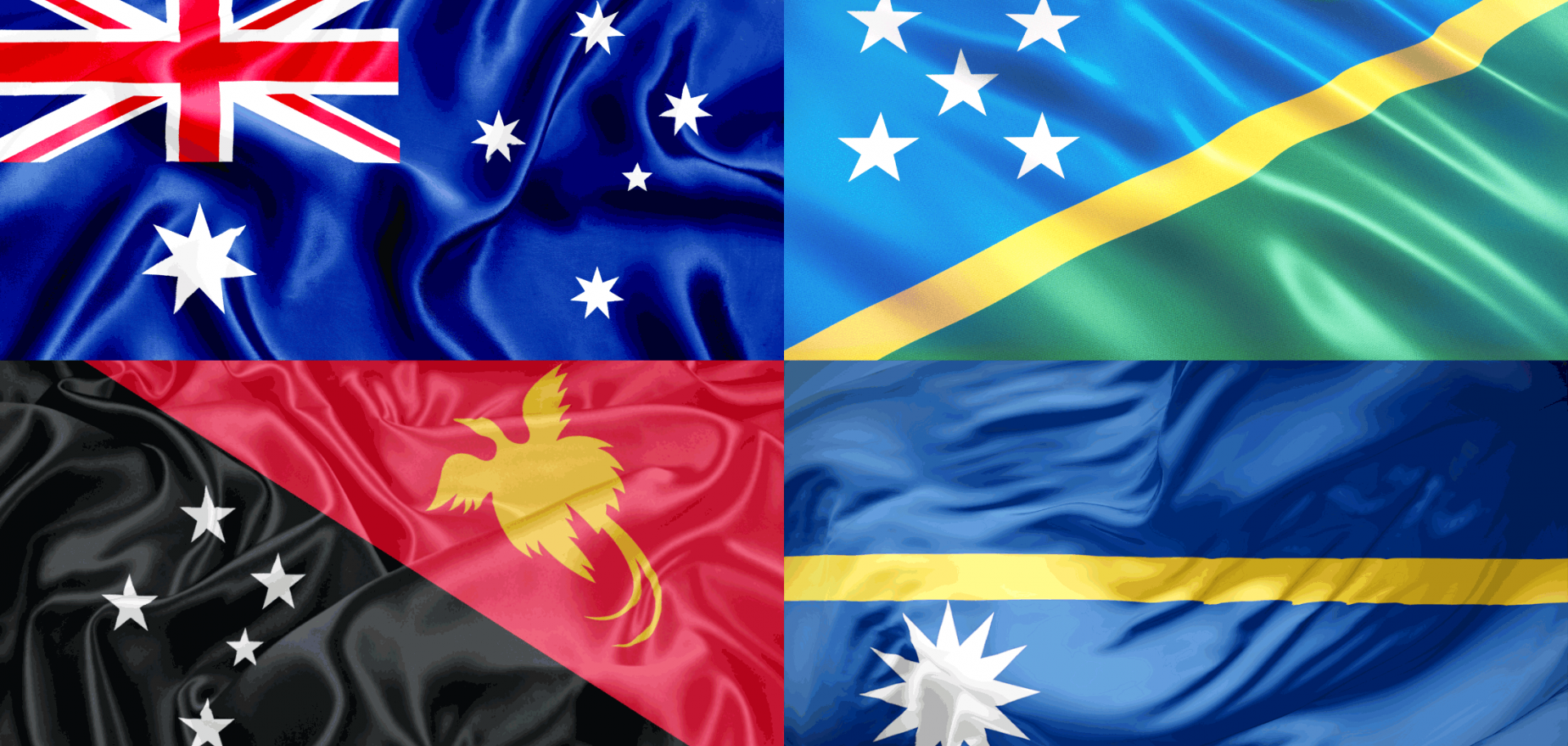
Australia expects three recent security agreements with Pacific Island countries will expand its influence in the region, though Canberra will have to fulfill its commitments to keep Beijing's influence at bay as island countries play the two sides off each other. Australia finalized three security agreements with Pacific Island states in December through a series of bilateral and multilateral negotiations. On Dec. 7, Canberra inked a security partnership with Papua New Guinea to enhance the two countries' military interoperability, provide training for PNG's Defense Force and establish joint operations for maritime security, including combating illegal fishing and transnational crime. On Dec. 9, Australia secured a strategic agreement with Nauru to establish a regional monitoring hub for maritime security, focusing on illegal fishing and environmental protection. And on Dec. 20, Canberra signed a policing agreement with the Solomon Islands, which extends Australia's support for the Royal Solomon Islands Police Force and includes funding, training and operational support to bolster local law enforcement capacity and address internal and external security threats.
- Australia and PNG entered a legally binding treaty Dec. 12, updating preexisting arrangements.
- The pact with Nauru grants Australia veto power over Nauru's potential agreements with third countries, including China, covering sectors such as security, banking and telecommunications. In return, Australia pledged $88 million over five years, comprising $62 million in direct budget support and $26 million for policing and security infrastructure. The deal also provides for the establishment of a Commonwealth Bank branch in Nauru for financial services aimed at bolstering Nauru's economy. Australia also pledged support for Nauru's infrastructure to improve resilience to external security risks.
- The Solomon Islands Security Agreement commits $119 million over four years.
Australia's security focus in the Pacific reflects an intensifying contest in which Canberra aims to maintain its status as the premier security provider in the region amid challenges from Beijing. The Pacific's vast importance to maritime trade and security make it a venue where major powers including China and the United States vie for influence with the nations of Oceania despite their minimal economic and political clout. The three new agreements underscore Australia's prioritization of security collaboration with its Pacific neighbors in the context of growing competition with China for regional influence and Beijing's expanding investments in infrastructure and security partnerships, most controversially its 2022 security pact with the Solomon Islands. Illegal fishing, human trafficking and transnational crime have meanwhile emerged as major concerns for Pacific nations. These countries argue they necessitate coordinated regional responses, and the new deals aim to demonstrate Australia's commitment to addressing Pacific Island security priorities, particularly given China's willingness to offer more targeted deals based on the wishes of its partner countries.
- Following political unrest in the Solomon Islands in 2021 and 2023, Australia's increased policing support aims to stabilize the Solomon Islands and preempt further Chinese inroads there. The 2021 riots were driven by tensions between the country's various islands, economic disparities and anger over the central government's 2019 shift from recognizing Taipei to recognizing Beijing, seen by detractors as a sign of corruption and foreign interference. The 2023 unrest meanwhile stemmed from frustration over delayed elections, economic challenges and allegations of officials' unduly benefiting from China-linked deals, exacerbating distrust of Beijing's growing influence. Such grievances vary by island and locality, highlighting social rifts and political polarization in the country.
- The next Pacific Island Forum leaders' meeting is scheduled for February 2025 in Suva, Fiji, and will focus on regional security and climate resilience. Australia is preparing to showcase the three new agreements there to bolster the credibility of its commitment to Pacific Island country-led regional priorities. The discussions will also address reforms to regional governance structures and the implementation of the 2050 Strategy for the Blue Pacific Continent, further shaping Australia's strategic engagement in the bloc.
- Various PIF countries are part of Beijing's Belt and Road Initiative. China has also made various separate deals for the construction of infrastructure, and has made multiple broader targeted deals, with Pacific Island countries. The latter include a 2022 deal for Huawei to build out the Solomon Islands' telecommunications capacities, a 2024 deal to construct a new government complex in Vanuatu and a 2024 trade deal eliminating all tariffs for several PIF countries. Beijing has also reached police training agreements with the Solomon Islands, Fiji, Tonga and PNG. In 2022, Beijing proposed a multilateral security agreement with all of the PIF, but the bloc rejected the deal.
Australia's agreements with PNG, Nauru and the Solomon Islands will deepen defense and policing collaboration in the Pacific but will require faithfully fulfilling such commitments over the long term if Beijing is to be countered. Enhanced maritime security and law enforcement capacity will reduce immediate risks like illegal fishing and civil unrest while aiming to deter Pacific Island countries' perceptions of a need for deeper Chinese assistance and embedding in Chinese-led security apparatuses, which Canberra (like Washington) fears will evolve into Chinese naval-basing deals. Policing and military support to the Solomon Islands and PNG will meanwhile contribute to a more stable security environment in these countries. By addressing internal vulnerabilities, Australia reduces the risk of China enhancing its influence by taking advantage of periodic political, social or economic instability so that Beijing can provide security assistance in the wake of unrest, financial assistance during periods of economic instability and infrastructure assistance after natural disasters. Meanwhile, a regional monitoring hub in Nauru will strengthen Australia's ability to oversee and protect Pacific waters. Success for Australia will depend on its ability to align its objectives with local priorities as China has done without seeking undue influence — as China is often accused of doing. The new Australian measures will require sustained funding and capacity building to ensure their durability. This is particularly true because Pacific Island nations will likely look to reap maximum benefits from the competition and will remain open to investments, particularly in infrastructure and policing, from China.
- These initiatives also reinforce Australia's role as the leading security partner for smaller island nations in the Pacific, ensuring they have the resources to address shared challenges such as the impacts of climate change, illegal fishing and Chinese encroachment.
- Australia's veto power over Nauru's engagements with third countries gives Canberra the most influence of any of the three deals.
- China, like the United States, has observer status in PIF.
- After a historic pact in 2022, U.S. support for PIF countries in recent years has often been perceived as underwhelming despite Biden administration efforts to alter this perception. U.S. economic assistance has proved limited, and where it has been promised, it has failed to arrive quickly — failing to match the scale and promptness of Chinese aid and the region's pressing climate and development needs.
- The United States did reach a key security agreement with PNG in May 2023 that allows the United States access to PNG ports and airports. Biden failed to show up to personally sign the deal despite promising to do so, however, somewhat undermining its impact.
Australia's 2025 election will shape the specifics of its Pacific strategy. But regardless of the outcome, Canberra will remain broadly focused on strategic competition with China, strengthening defense partnerships and offering alternatives to Chinese investment. Australia is due to hold general elections by September 2025. A victory for the opposition Liberal-National Coalition, which is currently polling ahead, would bring a deeper emphasis on countering China through stronger defense ties, trade-driven economic policies and continued engagement on climate issues given Pacific nations' prioritization of the issue. A win for the incumbent Labor government would meanwhile portend continuity in terms of more robust climate leadership, regional integration and expanded labor mobility programs while continuing to address China's influence through infrastructure and aid, with less of a security or military focus. Given that the strategic impetus to counter China will persist, Canberra will have a strong motivation for sustained engagement with Pacific Island nations no matter who wins the vote.
