
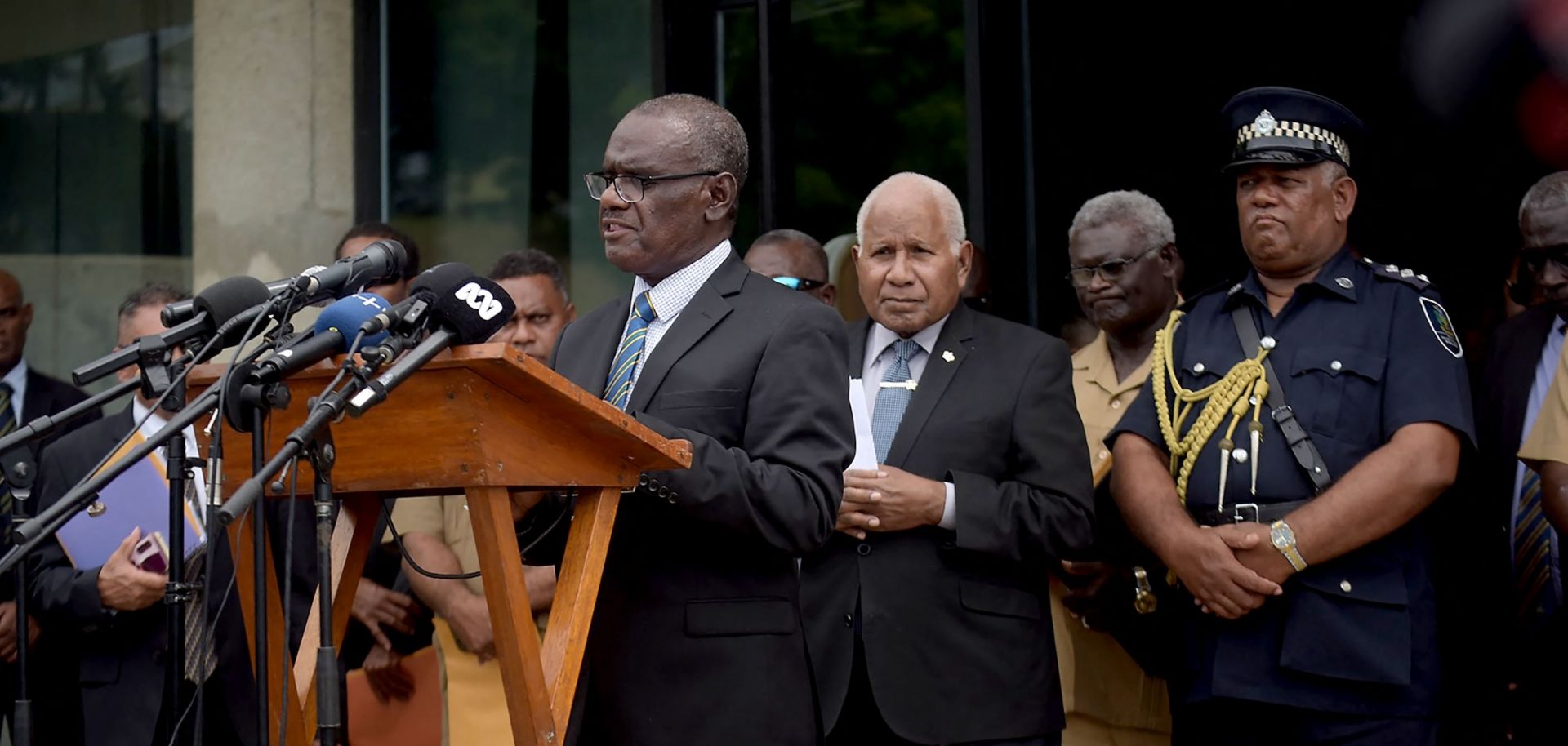
A leadership change in the Solomon Islands will lock the strategic Pacific Island nation into its recently established pro-China bent for at least the next parliamentary term, though the country will continue to play China against Australia and the United States to extract maximum benefits from the great power competition. Securing the support of 31 of 50 lawmakers, former Solomon Islands Foreign Minister Jeremiah Manele was sworn in as the country's new prime minister on May 2, replacing outgoing Prime Minister Manasseh Sogavare, both of the incumbent Ownership, Unity and Responsibility (Our) Party. The Our Party severely underperformed in the country's April 17 election relative to its 2019 electoral showing, winning only 15 of the parliament's 50 seats compared with the 30 it won five years ago. This forced Our Party to reach a coalition deal with smaller parties and independents to appoint Manele while avoiding an opposition victory that would have portended potentially transformative foreign policy changes.
- The Our Party's relatively poor performance is attributable to three main factors: widespread dissatisfaction with the economy (for example, Sogavare opted to build a $71 million national stadium when much of the country lacks basic infrastructure like roads and water sanitation); controversial foreign policy decisions that polarized society; and popular perceptions that Sogavare's dealings with China in recent years have personally enriched him.
- Sogavare (who has served as prime minister four times since 2000) gave a surprise, last-minute announcement in late April that he would not again seek the premiership, following his party's weak performance in the election. Given the controversy surrounding him, Sogavare may have been sidelined by his own party in favor of the less divisive Manele, though Sogavare will keep his parliamentary seat and likely remain active in shaping policy.
Manele's ascent to the premiership comes amid deepening security ties between the Solomon Islands and China. The Solomon Islands' geography renders it strategically important for several reasons: its location along major maritime routes crucial for shipping between Asia, Oceania and the Americas; its potential for strategic military positioning for naval bases, surveillance and intelligence gathering throughout the Pacific region; its close proximity to Australia; and, most recently, it represents China's first foray into the broader region beyond the first island chain within which the United States would like to contain Beijing's growing maritime power. The April 17 election was the first in the Solomon Islands since the Sogavare government controversially switched diplomatic recognition from Taiwan to the People's Republic of China in 2019. The decision was largely motivated by the potential for substantial Chinese investment and loans, as well as the Solomon Islands' inclusion in China's Belt and Road Initiative, which provides infrastructure to the country. It was also the result of Beijing's sustained outreach and charm campaign to the region, which began in the 2000s, and China's growing wealth and power relative to Taiwan. Sogavare then followed up on this change by signing a secret security pact with Beijing, a draft portion of which leaked to the press in 2022 that detailed an incoming Chinese police presence and a maritime access agreement, along with the potential for a permanent Chinese military base in the country. Despite consistent denials by both parties regarding the rumored military base, the full text of the agreement has never been publicly released. As such, Australia — which has longstanding security ties with the Solomon Islands and has long considered the nearby island nation within its sphere of influence — was alarmed at the potential implication of Chinese encroachment in its geographic backyard, as was the United States given the broader implication of potentially altering the balance of power in the Pacific in China's favor at the expense of the West.
- The known details of the Solomon Islands' security pact with China include collaboration in humanitarian aid, disaster relief and upholding social stability via police cooperation. A provision of the deal allows China to conduct ship visits, logistical replenishments and stopovers in the Solomon Islands, as well as deploy Chinese forces to safeguard the security of Chinese personnel and key projects. This provision has raised concern in Australia and the United States, which fear the potential deployment of Chinese troops and the establishment of a lasting military presence in the Solomon Islands, situated less than 1,500 km (around 930 miles) from Australia, versus 5,400 km (around 3,400 miles) from China.
- Deadly anti-government and anti-China riots in 2021 in the Solomon Islands engrained the necessity of Chinese police forces in the country from Sogavare's perspective.
- Australia has a similar policing and security pact with the Solomon Islands per the two countries' 2017 Bilateral Security Treaty, which replaced Australia's 2003 Regional Assistance Mission to the Solomon Islands. The 2017 treaty also offers institutional support via the Australia-Solomon Islands Partnership in Justice, which aims to enhance the effectiveness of the Solomon Islands' judicial system, legislative capabilities, accessibility to legal recourse, and correctional facilities.
As prime minister, Manele will maintain his predecessor's foreign policy by sustaining friendly ties with Australia and the United States while continuing to enhance economic and policing ties with China (though this likely will not evolve into a permanent military-basing situation in the upcoming term). Manele served in Sogavare's government as foreign minister from April 2019 to May 2024. During this period, he oversaw the Solomon Islands' various dealings with China, Australia and the United States, optimally positioning his incoming government for strong foreign policy continuity. Opposition candidates ran on platforms of downsizing relations with China, up to and including reversing Sogavare's foreign policy decisions, such as restoring the country's diplomatic recognition of Taiwan, reevaluating the 2022 security pact with China, and adopting a more overtly pro-Western bent amid the great power competition for influence over the island nation and the broader Pacific Islands region. But with the ruling Our Party remaining at the helm under Prime Minister Manele, such a dramatic foreign policy pivot is extremely unlikely. The Solomon Islands will instead continue to turn to China as the country's primary infrastructure provider (such as building out its telecoms sector). Meanwhile, parallel internal security and policing agreements with both China and Australia will remain in place and could also expand. Nonetheless, following his Our Party's relatively poor performance in the April election, Manele's government may be hesitant to pursue controversial foreign policy decisions (such as deeper and more controversial security collaboration with China in the form of a permanent military basing agreement) for fear of exacerbating domestic political backlash. This could see his government focus on maintaining the status quo established circa 2019-2022 and conducting friendly outreach to all concerned outside powers (China, Australia, the United States) in its upcoming term.
- Manele is a less controversial figure than outgoing Prime Minister Sogavare, whose divisive foreign policy decisions helped spark riots in 2021. Sogavare was also, at times, personally combative with Australia and the United States (going so far as to suggest Western democracy leads to moral decay), while conversely offering consistently glowing takes on China and its system.
The Solomon Islands will remain a point of contention between China and the West, with broader implications for the regional balance of power in the Pacific. In addition to domestic political constraints, one reason the Solomon Islands will not stray entirely into a pro-China camp is that playing great powers against each other reaps benefits for the country. Since the Solomon Islands switched its diplomatic recognition from Taiwan to China, China has become the country's top infrastructure provider, as well as its top trade partner — particularly by buying the island nation's timber. At the same time, Australia also has deep business ties to the Solomon Islands and offers Solomon Islanders work, career and migration opportunities (which help fill Australia's unskilled labor needs as well). Following the election of a new government in Honiara, Canberra will likely step up these business, institutional and people-to-people initiatives to forestall additional inroads by Chinese interests. The United States, too, has actively sought to woo the Solomon Islands in recent years, including by reopening its embassy there in 2023 (after closing it in 1993 in the context of Cold War tensions winding down). The United States also facilitated the country's inclusion in Google-constructed trans-Pacific subsea internet cables that are aimed to provide an alternative to Chinese telecommunications systems. In addition, the U.S. government began hosting an annual summit with Pacific Island leaders in 2022.
- The Solomon Islands is home to Guadalcanal, the site of one of the more pivotal battles in World War II. The U.S. victory there and the war more broadly proved the Solomon Islands' strategic importance by rendering the South Pacific ''an American lake,'' to quote then-U.S. President Dwight Eisenhower in 1954 — a status quo Washington is not keen to see eroded.
- The Solomon Islands is among the largest countries in the region in terms of area and population. It thus plays an important role in the Pacific Islands Forum, a regional and multilateral consensus-building body that carries policy implications for the region's many other small island nations.
The contest for influence in the Solomon Islands also holds broader regional implications, as the United States and Australia try to counter China's rising influence in a growing number of countries across the Pacific. The Solomon Islands became the first Pacific Island country to forge a security pact with China in 2022. This has since fueled fears in the United States and Australia that other nearby countries — such as Fiji, Vanuatu and Papua New Guinea — may soon follow suit, which would erode Western dominance over the massive maritime region as China's inroads into the broader Pacific could enable it to project influence beyond the first island chain. To keep this scenario from materializing, Australia and the United States will seek to counter China's advances by deepening economic ties and forming their own security pacts with regional countries. But while this power struggle will continue, it is unlikely to swing even more sharply in China's favor in the form of military basing in the Solomon Islands during Prime Minister Manele's upcoming term. However, internal security arrangements between Honiara and Beijing will likely continue to deepen in the form of police agreements.
- The United States signed a defense cooperation agreement with Papua New Guinea signed in August 2023 that enhances external security. Papua New Guinea is also currently negotiating a police training agreement with China but will not go the extra step in terms of external defense, thus providing a case study for broader Pacific islands competition beyond Honiara. In addition, the United States renewed three Compacts of Free Association with Palau, the Marshall Islands and Micronesia between late 2023 and early 2024 that grant Washington exclusive naval access to these countries' waters, which collectively form an area around the size of the continental United States.
- On May 8, Australia announced it would quadruple financial assistance to Tuvalu, mostly to counter climate change and construct an undersea cable, in a bid to counter growing Chinese influence there.
