
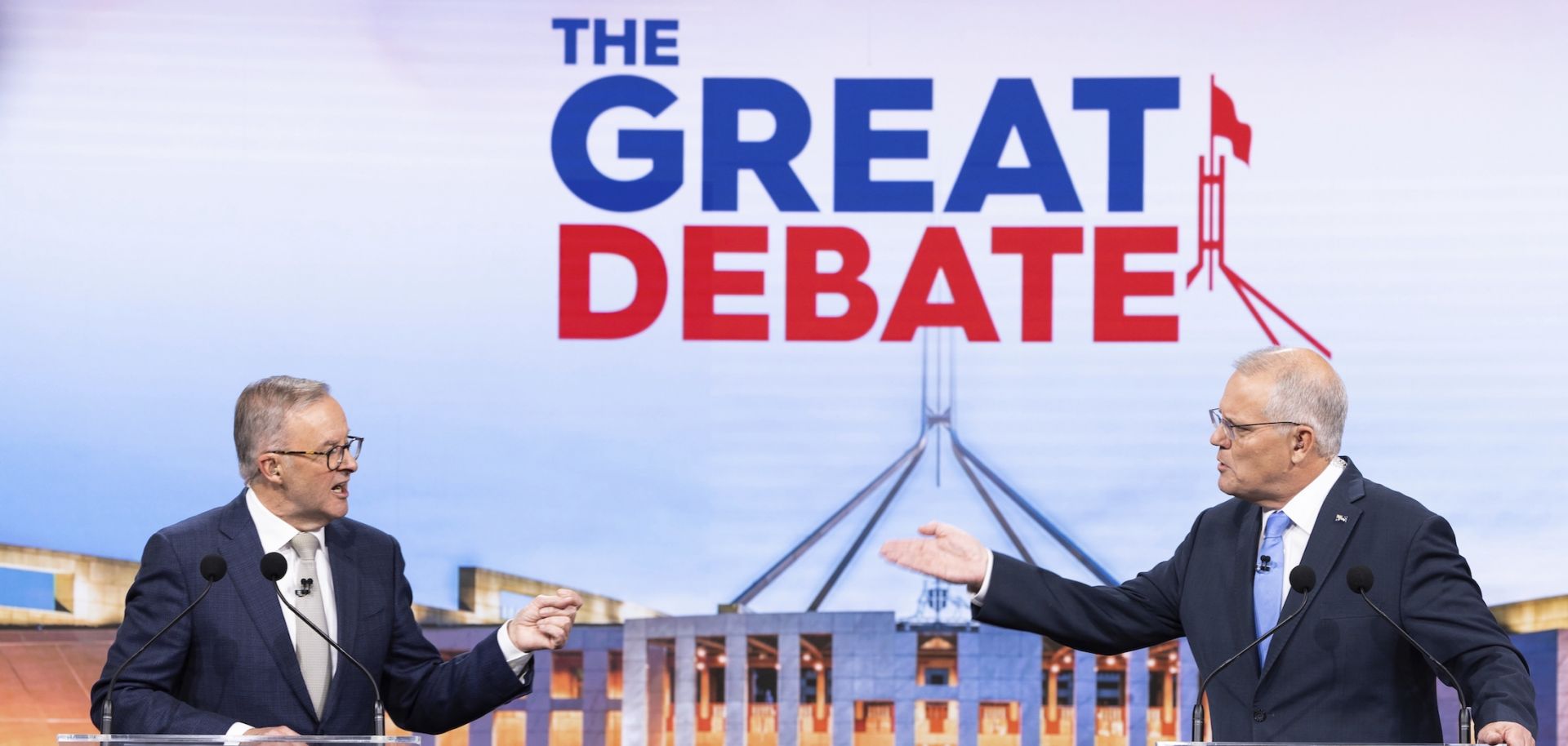
Australian opposition leader Anthony Albanese and Australian Prime Minister Scott Morrison (R) debate on live TV ahead of the federal election on May 8, 2022, in Sydney.
A victory by the opposition in the upcoming Australian election would likely result in a faster transition to greener energy sources, and perhaps to a softer tone regarding China, while Prime Minister Scott Morrison's reelection would see domestic and foreign policy continuity. Early voting began May 9 for the May 21 Australian federal election, which will decide who holds all 151 seats in the lower house of parliament and 38 of the 56 Senate seats. The leading contenders, Prime Minister Scott Morrison's center-right Liberal-National Coalition and the opposition center-left Australian Labor Party (ALP) led by Anthony Albanese, are locked in a tight race. The main campaign issues include housing prices, stagnant wages, increasing inflation, the rising cost of living and the country's relationship with China. While energy policy has not been a major topic, it will nonetheless be impacted by the results of the vote given the parties' differing views on the issue.
- According to May 10-13 Newspoll and YouGov poll, support for the ALP stands at 38%, followed by the Liberal-National Coalition at 35% and the Green Party at 11%.
Though a victory by the ALP would likely result in a faster shift to renewable energy and probably a softening of Canberra's anti-Beijing language, it would not lead to drastic policy changes. The ALP argues that an increased use of renewable energy will offset income lost from the decreased use of fossil fuels by creating new industries and options for investment. Given its interest in promoting the energy transition, an expansion of oil and gas projects is less likely under the ALP, although current projects or projects already approved will not likely be affected. Albanese may attempt to steer Australia's foreign policy towards greater economic and climate change cooperation with other regional nations. While Albanese has been accused of being "soft on China" by his opponents, he was critical of the recent security agreement between the Solomon Islands and China. His statements after the deal suggest that the ALP could soften the tone against China without necessarily introducing a drastic change of policy. For example, Albanese has expressed support for the AUKUS trilateral security pact between Australia, the U.S. and the U.K.; and the Quadrilateral Security Dialogue (Quad), the strategic security dialogue between Australia, the United States, India and Japan.
- The ALP has pledged to create over 600,000 new jobs by shifting heavily into renewables, generating average savings of $275 million per year on household electricity bills.
- In a May 6 interview, Albanese stressed that his administration would seek to improve regional aid and outreach with Australia's neighbors on issues such as climate change and repairing relations with France damaged when Australia pulled out of a diesel submarine deal. To that end, the ALP announced it would increase foreign aid to the Pacific by $525 million over four years.
- Following Australian calls for an investigation into the origins of COVID-19, China in 2020 raised tariffs on Australian beef, wheat, wine, lobsters and other goods. The loss of a major market harmed many Australian producers, many of whom have expressed discontent with the Australian leadership.
By contrast, a victory by the conservatives would likely see policy continuity regarding domestic energy, and regarding Australia's hawkish foreign policy toward China and warm military ties with the United States. Morrison has cited Australia's significant economic gains from exporting liquefied natural gas and coal as reason not to accelerate the transition to renewable energy. Still, his party promises a 35% reduction in carbon dioxide emissions from 2005 levels by 2030, above the 28%-30% reduction target initially proposed. Therefore, large-scale natural gas exploration and coal exports are likely to continue and may increase in the short term under his administration. Morrison is unlikely to change his hawkish stance on China, meaning that relationship would remain rather icy, likely prolonging China's trade war against Australia. Morrison may step up his anti-Chinese rhetoric following the political backlash from Beijing's security agreement with the Solomon Islands, which critics say the Morrison government should have seen coming, and prevented. Morrison on April 26 said Australia and the United States share the same red line concerning the Chinese security agreement with the Solomon Islands. He did not specify what that line entailed; intentionally leaving the red line vague gives his administration more political leeway in responding to the Chinese action.
- The Liberal-National coalition expects a $20 billion investment in new green technology over the next 10 years to result in $80 billion in total private and public investment, including clean hydrogen and carbon capture and storage. Over the past three years, many oil and gas companies have invested heavily into natural gas exploration and extraction, such as the $12 billion Woodside Petroleum project in Scarborough off the western coast of Australia.
