
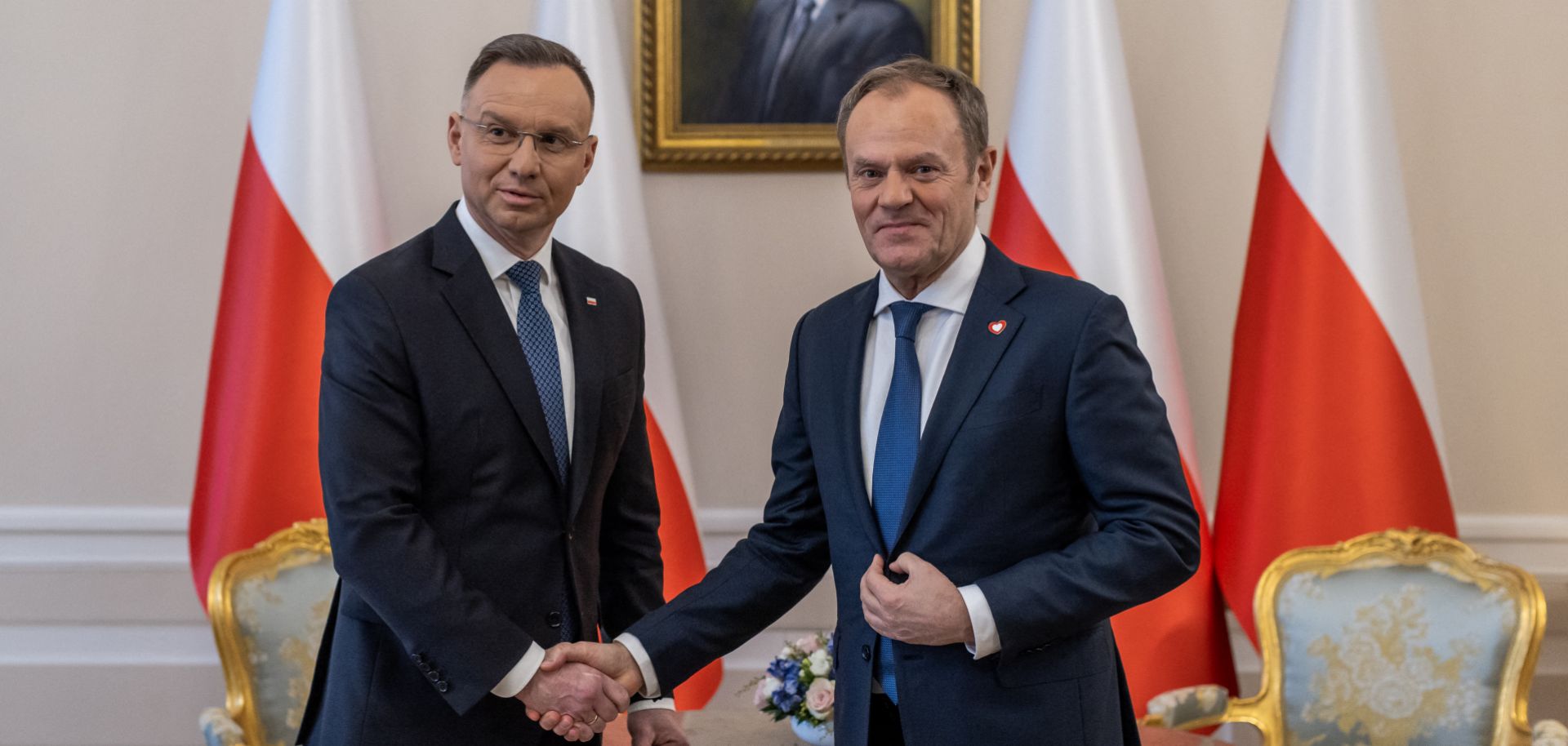
Growing tensions between the new Polish government and some of the country's key institutions that are still loyal to the former administration will fuel political instability in Poland and threaten Warsaw's plans to unlock billions of euros in frozen EU funds. Since Poland's new centrist, pro-EU government coalition took office last December, the country has been experiencing growing levels of political and institutional turbulence. The new administration led by Prime Minister Donald Tusk has begun work to dismantle its predecessor Law and Justice (PiS) party's deeply embedded influence over the country's economy, media and courts following eight years of rule, including by removing PiS loyalists from key institutions and state-owned organizations and by enacting reforms to restore the independence of the judiciary. But these efforts have quickly run into a series of roadblocks posed by the now opposition PiS in the form of resistance from PiS ally President Andrzej Duda, legal challenges and mass demonstrations.
- Tensions first emerged in the final days of 2023, when Tusk sought to implement an overhaul of state media, including changes in the management of state-owned broadcasters. The proposed overhaul triggered an outcry from the opposition and prompted Duda to veto the government's budget bill that included funding for the newly reshuffled broadcasters. In response, Tusk put government-run media outlets into a state of pending liquidation, leading to tens of thousands of people to take to the streets of the capital Warsaw on Jan. 11 in an anti-government march organized by the PiS.
- Tensions escalated again on Jan. 9 when the police entered the Presidential Palace to arrest two PiS lawmakers who had found protection under Duda after being given a two-year prison sentence for abuse of power. On Jan. 11, President Duda announced he would pardon the two lawmakers.
- On Jan. 10, Poland's constitutional tribunal, dominated by PiS-nominated judges, barred lawmakers from investigating Poland's central bank governor Adam Glapinski, whom the new government accused of politicizing monetary policy in favor of the previous administration following a sudden rate cut in September 2023 right ahead of the general elections. Commenting on the ruling on Jan. 12, Tusk said his government had ''other ways'' to pursue Glapinski.
- On Jan. 12, Poland's justice minister Adam Bodnar dismissed Dariusz Barski as head of the National Public Prosecutor's Office, the second-most-senior position in Poland's prosecutorial system. Duda condemned the move to oust Barski, who was appointed by the PiS in 2022, while the constitutional tribunal issued a ruling suspending the government's nomination of Barski's replacement, which the government ignored.
The Polish government is seeking to strengthen the rule of law in the country and repair ties with the European Union following eight years of populist, eurosceptic rule. Between 2015 and 2023, successive PiS-led governments sought to consolidate power by both adopting extensive welfare programs that cemented popular support, and by enacting controversial reforms that increased government control over the country's media and judiciary. This further polarized political divisions in Poland and put the party on a collision course with the European Union, which accused Warsaw of undermining basic democratic values and the rule of law in the country. The dispute with Brussels saw the European Commission impose record fines on Poland and withhold billions of euros in post-pandemic recovery funds and cohesion funds earmarked for the country. Against this backdrop, Tusk's new government has pledged to reduce the previous administration's deeply embedded influence over Polish institutions and media, strengthen the rule of law in the country, and unlock EU funds.
- Between 2015 and 2019, the PiS adopted reforms to the National Council of the Judiciary, the body that appoints judges in Poland, that made it so judges would be appointed by parliament rather than peers. Over the years, the party appointed more than 2,000 judges to different courts.
- In 2018, Poland created a controversial disciplinary chamber to supervise the work of judges and prosecutors, which the European Union argued undermined the independence of the country's judiciary. Poland's refusal to comply with a 2021 European Court of Justice order to abolish the chamber resulted in Brussels imposing hefty daily fines against Warsaw.
- As Poland has yet to pay such fines and comply with the required changes, Brussels decided to withhold about 35 billion euros worth of COVID-19 recovery funds destined for the country, as well as the transfer of 76.5 billion euros worth of funding included in the 2021-27 EU budget.
However, the government faces significant institutional constraints in its goal of dismantling its predecessor's hold on the country's economy, media and courts. The PiS's actions in recent weeks offer a preview of the tactics it will use in the coming years to disrupt the Tusk administration — namely, leveraging the institutional power the party built up during its eight-year reign and rallying Poles by positioning itself as the guardian of Polish sovereignty and democracy. In addition, the Tusk administration lacks the three-fifths parliamentary majority needed to overturn a presidential veto, which means any of its legislative proposals will be under constant threat of being blocked by Duda until at least the next presidential election in August 2025 (and potentially for longer if another PiS-allied candidate wins the presidency). Tusk will also face ongoing legal challenges and appeals to courts and regulatory bodies dominated by PiS-appointed judges, further demonstrating the many institutional and political constraints faced by the new government.
- The majority of judges on Poland's Tribunal Court were appointed by PiS, with their terms set to expire between 2024 and 2031. This will serve as another major obstacle for the new government as it tries to undo PiS reforms, as the court can block legislation passed by the ruling majority.
While significant progress on institutional reforms in Poland is unlikely over the coming months amid opposition from the PiS-aligned president and courts, Brussels and Warsaw will still seek to find a compromise to unfreeze Poland's share of EU funds. Given these constraints, the new Polish government will struggle to implement legislation to comply with the European Commission's many reform requests. The Tusk administration will seek to adopt alternative steps to get around presidential vetoes and court rulings, such as executive orders to show at least some progress on reinstating the independence of the judiciary. Moreover, a considerable political will in both Brussels and Warsaw to improve ties following eight years of souring relations under the PiS means the two sides are likely to seek a compromise to unlock at least part of the EU funds until Tusk's government is able to circumvent the presidential veto. Such a compromise could see the European Union renegotiate parts of the recovery plan and start unfreezing funds related to Poland's progress on reforms in non-judicial areas.
- Payments of EU pandemic recovery funds are conditional on Poland meeting so-called ''super milestones,'' which include reforms to increase the independence of its judiciary.
- On Jan. 12, Justice Minister Bodnar presented a reform to the National Council of the Judiciary, a step considered essential to restore judicial independence and Brussels made a prerequisite for Poland to unfreeze its share of COVID-19 recovery funds. Poland's parliament, where Tusk's government enjoys a comfortable majority, will likely approve the draft bill, but President Duda will probably refuse to sign it into law.
- On Jan. 11, the Financial Times reported that EU Justice Commissioner Didier Reynders will be in Warsaw the week starting Jan. 15 to begin negotiations over how to unlock frozen EU funds for Poland. The newspaper also cited an EU official saying the European Commission would need ''something that doesn't require presidential approval but that is as binding as possible.'' Should the two sides find a way forward, the next transfer of funds may already occur in late March or early April, following a formal review by the European Commission.
- Article 21 of the Recovery and Resilience Facility's (RRF) regulation — which sets out the rules and criteria for EU member states to receive post-pandemic recovery funds — allows for a renegotiation of national recovery plans when ''relevant milestones and targets are no longer achievable, either partially or totally'' due to ''objective circumstances.'' In Poland's case, both Warsaw and Brussels could argue the constraints faced by Tusk's new government create such objective circumstances.
Should the new government itself bend the rule of law to overcome political and institutional constraints, it could jeopardize relations with Brussels and further fuel political instability in the country. Brussels will likely remain accommodative toward Warsaw when evaluating progress toward promised reforms. However, a lingering threat to Poland's ability to access its share of EU funds may come from the Tusk administration itself bending the rules to overcome institutional and political constraints, something that was already visible in some of its recent moves. Indeed, the new government has attracted criticism regarding the legality of its recent media reshuffle, including among non-PiS-allied political groups in Poland, as well as international and non-partisan observers like the Helsinki Foundation for Human Rights. Should the government abuse its power as it finds workarounds to remove PiS allies from key institutions and avoid presidential vetoes against its reforms, it would inevitably open up the Tusk administration to the same accusations it has launched against its predecessor. This, in turn, would fuel political tensions in Poland and may eventually derail efforts to convince Brussels to disburse frozen EU funds. Finally, if those tensions continue to escalate and devolve into a prolonged political crisis, the subsequent uncertainty may hurt investors' confidence in the country even if relations between Warsaw and Brussels aren't compromised.
- Poland's currency (the zloty), stocks and bonds have all rallied in the months following the PiS's surprise electoral defeat in October. According to figures cited by Bloomberg, the zloty has gained roughly 4% against the euro and 9% against the U.S. dollar since the country's Oct. 15 parliamentary election. The Warsaw Stock Exchange WIG 20 index, meanwhile, has gained about 14%, while the yield on Poland's 10-year government bonds has dropped about 75 basis points. A prolonged period of political instability in Poland may undermine this renewed investor confidence and lead to a sell-off in Polish assets that could create financial instability and negatively impact the country's overall economic performance.
