
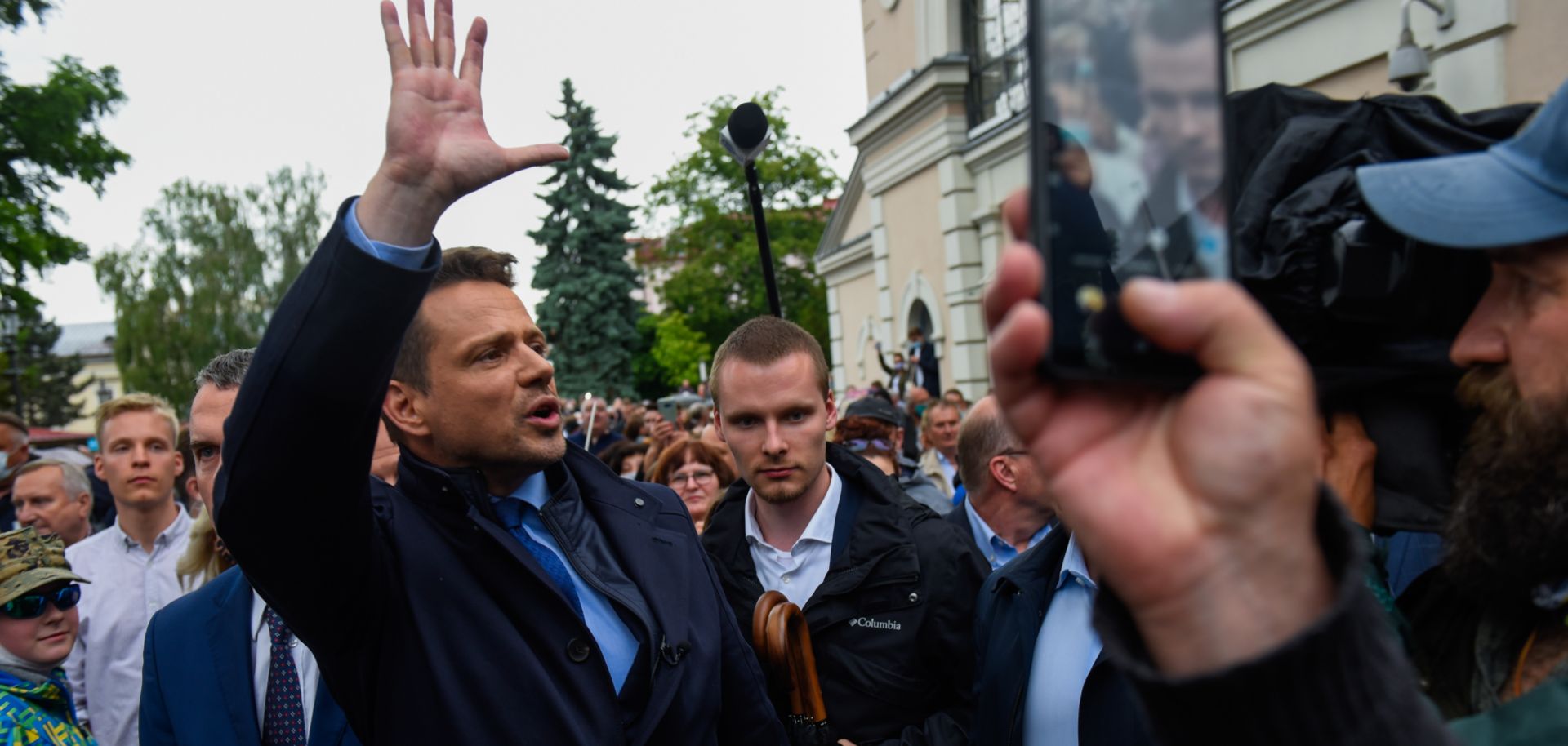
Warsaw Mayor Rafal Trzaskowski, one of the main opposition candidates running in Poland's 2020 presidential election, greets locals and supporters in Wieliczka, Poland, during a campaign event on June 5, 2020.
What’s at Stake
President Andrzej Duda's re-election would preserve the alignment between the presidency and Poland's Euroskeptic government, thus resulting in political continuity and reducing the probability of vetoes on legislation. Despite being an otherwise largely ceremonial role, the president does have the power to veto legislation and refer it to Poland's Constitutional Court. Duda, while formally independent, is an ally to the governing right-wing Law and Justice (PiS) party, which means he would be unlikely to use this power to disrupt the legislative process upon securing another term in office.
A victory by an opposition candidate, however, would disrupt the legislative process and increase the probability of an early general election. Compared with the Euroskeptic PiS government, the main opposition candidates — Rafał Trzaskowski and Szymon Hołownia — are both more supportive of closer cooperation between Poland and the European Union, and are critical of PiS moves to increase political control over institutions such as the judiciary. As president, Trzaskowski or Hołownia could use his veto power to block or at least delay government policies. The PiS and its allies control a majority of seats in the lower chamber of the Polish parliament. But the less influential upper house is controlled by opposition parties, which already slows down the legislative process. The combination of an opposition-controlled presidency and upper house would further reduce the government’s effectiveness to pass policy. Frustration over this gridlock could lead to PiS calling an early general election to try to obtain the three-fifths majority in parliament that is required to overturn a presidential veto.
Post-Election Political and Economic Risks
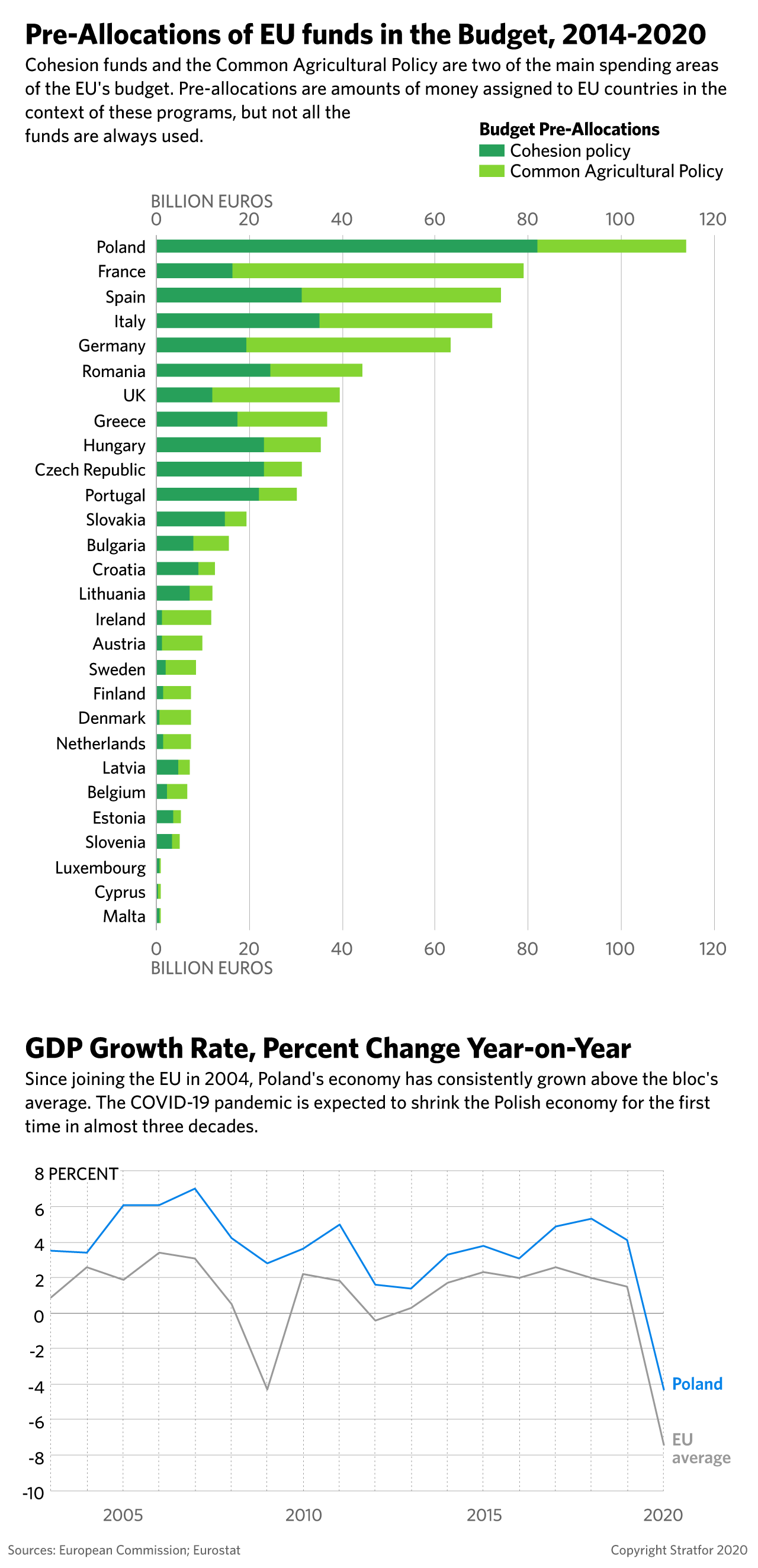
Regardless of who wins the presidency, Poland will still have to deal with the economic fallout from the COVID-19 crisis. As lockdowns depress domestic consumption and recessions across Europe weaken export demand, Eurostat expects Poland’s GDP to contract by 4.3 percent in 2020, ending almost three decades of continued growth. Eurostat expects Poland to recover in 2021, but growth that year will still not compensate for the losses of 2020. A more complex decision-making process if an opposition candidate becomes president would make it even harder for Warsaw to react to the pandemic’s negative effects on the economy.
Poland will probably become more protective of domestic companies under threat of foreign takeovers. Warsaw recently announced a plan to require investors from outside the European Union to notify the Polish government if they intend to take over a Polish company. The goal is to protect companies in strategic sectors that have been weakened by the recession from potential takeovers by non-EU investors. The government said it is particularly interested in protecting companies in sectors such as energy, pharmaceutics, food, transportation logistics and telecommunications. Poland’s position is in line with similar moves by other EU governments to avoid companies from countries in relatively stronger economic positions, such as China, from taking advantage of the recession in Europe.
The potential reduction of EU funds presents a significant risk to the Polish economy. Poland is a net receiver of EU cohesion funds and agricultural subsidies: For the 2014-2020 EU budget period, Warsaw was allocated around 115 billion euros ($130 billion) in both programs. Poland’s access to these funds will be at risk during the upcoming negotiations to approve the EU budget for 2021-2027. Countries in Northern Europe will push to cut spending in cohesion and agricultural funds, and redirect the money to programs such as the transition to greener forms of energy and the digital economy. Countries in Western Europe will push to make the disbursement of EU money conditional on the status of the rule of law in the receiving country. The European Commission has accused PiS of weakening the rule of law in Poland through policies such as increasing government oversight of the judiciary, which means that Warsaw will be targeted if a strict connection between EU money and the rule of law is established.
The PiS government may temporarily refrain from direct clashes with Brussels to secure its access to EU funds. While Poland won’t be able to prevent the introduction of a rule of law clause in the next EU budget, Warsaw will threaten to use its veto power on the budget to at least soften it. The PiS government may also refrain from introducing domestic reforms that could irritate Brussels during EU budget negotiations. The victory of an opposition candidate in the upcoming election may help Poland in this regard because it could convince the European that the rivalry between the government and the president will result in stronger checks on the government’s domestic actions.
A worsening deficit could damage the Polish government’s popularity by constraining its welfare policies. Part of PiS’s support is based on its generous welfare policies, including a popular child benefit program. But the government’s stimulus measures to deal with the recession, which include tax reliefs and cheap loans to businesses, will worsen the country’s fiscal deficit. According to Eurostat, Poland’s deficit will skyrocket from 0.7 percent of GDP in 2019 to 9.5 percent in 2020, making it the third-highest deficit in the European Union after Italy and Spain. Poland has relatively low levels of public debt (a projected 58.5 percent of GDP, almost half the EU average), which means that it can increase borrowing to continue paying for its welfare programs. Warsaw, however, will eventually have to cut spending and increase state revenue. The Polish government may have to abandon campaign promises, such as raising the minimum wage, lowering the retirement age and introducing new subsidies for farmers. These decisions will probably have a negative impact on PiS’s popularity and reduce its chances of re-election in 2023. A victory by a pro-EU party in the next general election would improve ties between Warsaw and Brussels.
An Undisrupted Foreign Policy
Regardless of the election outcome, Poland’s foreign policy will remain largely unchanged. Given Poland’s lack of clear borders and history of invasions and partitions, one of the pillars of Warsaw’s foreign policy is to develop as many international alliances as possible to reduce the risk of external aggression. As a result, the PiS government will continue to resist attempts to federalize the European Union and will selectively challenge proposals from Brussels to deepen integration of the bloc, but not to the point of threatening its membership in the European Union, which Warsaw sees as a key political, economic and security partner. Similarly, Poland will continue to see NATO — and the United States in particular — as the ultimate protector against potential Russian aggression. Poland will keep looking for ways to reduce its dependence on Russian energy and to diversify its natural gas suppliers through the use of liquefied natural gas. Finally, Poland will preserve its cooperation with regional allies, such as the Visegrad Group (which also includes Hungary, Czechia and Slovakia), and will continue to participate in regional partnerships such as the Three Seas Initiative, which seeks to develop infrastructure projects in countries in the Baltic, Adriatic and Black seas.
