
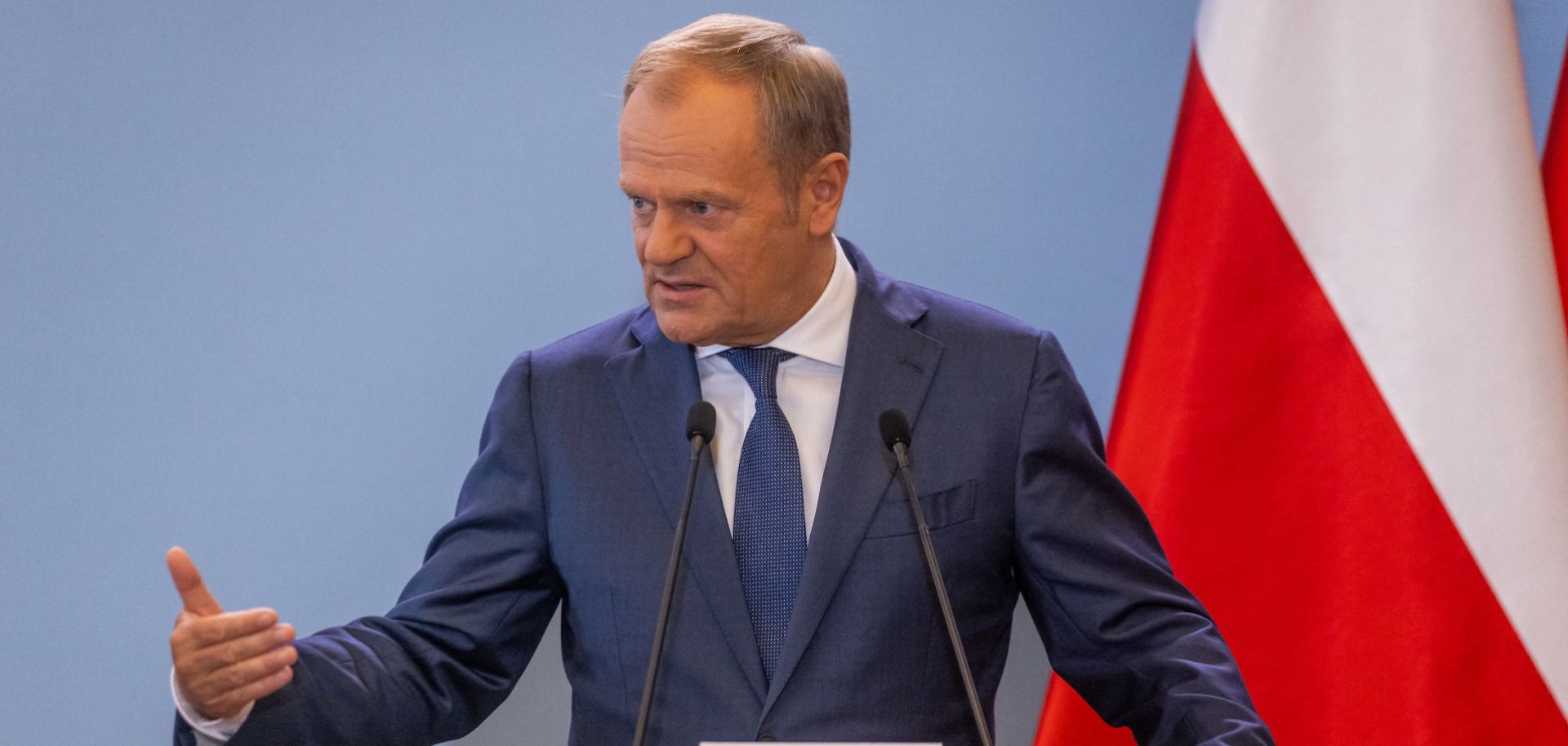
Poland's ongoing political volatility will continue to create policy and economic uncertainty leading up to the presidential election in mid-2025. If this persists after the election, it could have long-term negative effects on the country's appeal to investors. On Aug. 9, Polish Prime Minister Donald Tusk said that six months of investigations had revealed widespread financial abuse by the previous government, led by the right-wing Law and Justice, or PiS, party. According to Tusk, investigators have found that about 100 billion zloty (about $25 billion) of expenditure between 2016 and 2023 may have been "spent illegally" and promised to "catch all those who abused power and robbed the Polish state." The next day, PiS leader Jaroslaw Kaczynski announced the launch of a website that allows people to anonymously report cases of Tusk's government violating the law. These two events underscore the deep polarization of Polish politics — a trend that will likely continue in the coming months as the country's presidential election, which must take place by May 2025, approaches.
- The PiS governed Poland between 2015 and 2023. The party won the October 2023 general elections with 35.4% of the vote (down from 43.6% in the previous general election in 2019). Tusk's Civic Platform, which came in second place with 30.7%, formed a three-party coalition government with smaller center-right and center-left parties.
- Since taking office, Tusk's government has made moves to remove PiS influence from Polish public institutions. This has involved controversial actions, such as replacing the management of Poland's major public media outlets and placing them into liquidation, removing judges and prosecutors with close ties with PiS, and pushing to remove Polish central bank Gov. (and PiS ally) Adam Glapinski from his post. In the meantime, Tusk's ideologically heterogeneous coalition has struggled to find common ground on reforms, including on high-profile and socially sensitive issues such as abortion, climate policy and the country's housing crisis.
- The June 2024 elections for the European Parliament confirmed Poland's political polarization, as the vote resulted in a virtual tie between Civic Platform (37.1%) and the PiS-led United Right (36.2%).
Political turbulence and policy uncertainty will continue ahead of next year's presidential election, delaying policy implementation and forcing Warsaw to delay measures to reduce its fiscal deficit. Polish presidents can veto legislation passed by the Polish parliament, which can only override presidential vetoes with a three-fifths majority, which the Civic Platform and its allies lack. This means that the current president, Andrzej Duda (who is formally an independent but is ideologically close to PiS), will likely continue to selectively block legislation to obstruct the government's reform agenda and weaken the Civic Platform ahead of the presidential election. This is likely to hinder significant reforms, at least until the presidential election in mid-2025, and to lead to continued policy uncertainty as households and businesses will struggle to have a clear picture of which policies will be passed and which will be vetoed. In the meantime, the Polish government is unlikely to take unpopular measures to reduce Poland's fiscal deficit (which, according to the European Commission, will reach 5.4% of gross domestic product this year) ahead of the election. This means that the country will have to implement spending cuts after the election that may slow economic growth and increase social discontent. Warsaw increased public sector salaries, social benefits and the minimum wage ahead of European Parliament elections, and similar policies are likely ahead of the presidential election. Finally, the country's continued polarization means that Civic Platform is likely to take additional politically motivated measures in the coming months to purge PiS members and sympathizers from public institutions, which would prolong concerns about the status of the rule of law in the country.
- The Polish government has promised to implement reforms to make the economy more competitive, including legislation to enhance the business environment, attract foreign investments, reduce bureaucratic hurdles and improve transparency. Warsaw is also committed to reducing Poland's dependence on fossil fuels by promoting investment in renewable energy sources and aligning the country with EU climate goals. The combination of intracoalition disputes, the threat of presidential vetoes and electoral calculations will likely slow down or even prevent the implementation of these policies.
- In May, credit ratings agency Fitch warned about Poland's worsening fiscal deficit, uncertain fiscal trajectory and political turbulence. In July, the European Commission included Poland on a list of seven EU member states that need to lower their fiscal deficits to comply with EU rules.
If the Civic Platform wins the presidency, the decision-making process will become more streamlined, positioning Warsaw to implement reforms more effectively. Conversely, a PiS victory could perpetuate or even escalate the current turbulence and uncertainty, potentially causing the investment climate to deteriorate. After serving two terms, Duda is ineligible for reelection, which means that PiS and its allies will need to find a new candidate to represent them, as will the Civic Platform. Polish presidential elections take place in two rounds, with several candidates participating in the first round and the two most popular candidates qualifying for the runoff election. The results of the 2023 general election and the 2024 EU Parliament election suggest that the PiS and the Civic Platform candidates will make it to the runoff vote. The victory of Civic Platform, or a Civic Platform-aligned independent, would remove the current threat of a presidential veto over the government's policies, streamlining the policymaking process and removing a significant source of policy uncertainty. But even in this scenario, the ideological discrepancies between the Civic Platform and its junior allies would produce some degree of intracoalition disputes that would result in watered-down and delayed reforms. On the contrary, the victory of a PiS candidate or a PiS-aligned independent would extend the current political turbulence and policy uncertainty, increasing the risk of an ineffective government that struggles to pass legislation and bring certainty to businesses, households and investors. Poland's economy is well-diversified, with strong manufacturing, services, agriculture and technology sectors, while its central location in Europe makes it a key logistics and trade hub. It also has a well-educated, skilled and relatively low-cost labor force. This explains why Poland has, for decades, grown at high rates and attracted significant levels of foreign direct investment. While none of these factors driving economic growth and foreign investment are at risk in the short to medium term, prolonged political turbulence and persistent policy uncertainty could, over time, undermine Poland's attractiveness for investment and hold back the country's economy.
- In early July, Duda threatened to veto a bill softening the country's strict abortion laws that Tusk's government proposed after months of intracoalition disputes. In mid-July, the lower chamber of Poland's parliament rejected the bill, as members of the Polish People's Party (which is a part of Tusk's coalition) sided with the opposition and voted against it. This episode underscores the current issues with the Tusk government, as legislation could be disrupted by either the president or members of Tusk's coalition.
- In December, Duda threatened to veto the government's budget for 2024 and propose his own budget. After the parliament approved the government's version of the budget in January, Duda signed it but referred it to the Constitutional Tribunal due to concerns about the parliamentary process during its adoption. Tusk in turn threatened to hold an early general election if the budget was rejected. While the budget will remain in place unless the Constitutional Tribunal deems it unconstitutional — a ruling is expected in the coming months — a negative ruling would force parliament to urgently approve a new budget. The uncertainties surrounding the future of the budget and Tusk's threat of an early general election underscore the prevailing state of policy uncertainty in Poland.
- Despite the ongoing political and policy uncertainty, Poland is expected to see robust economic growth in 2024 and 2025. According to the European Union, Poland's economy will expand by 2.8% in 2024 and 3.4% in 2025, driven by strong public and private consumption. The International Monetary Fund is more optimistic, projecting 3.1% growth in 2024 and 3.7% in 2025, also driven by consumption and robust EU funding.
