
Editor's Note: For significant elections, RANE publishes a series of scenario analyses focused on different outcomes of major elections, describing how an election outcome might unfold with implications for each potential outcome. In 2025 so far, we have profiled Germany, Canada, Australia and Poland. We now profile South Korea.
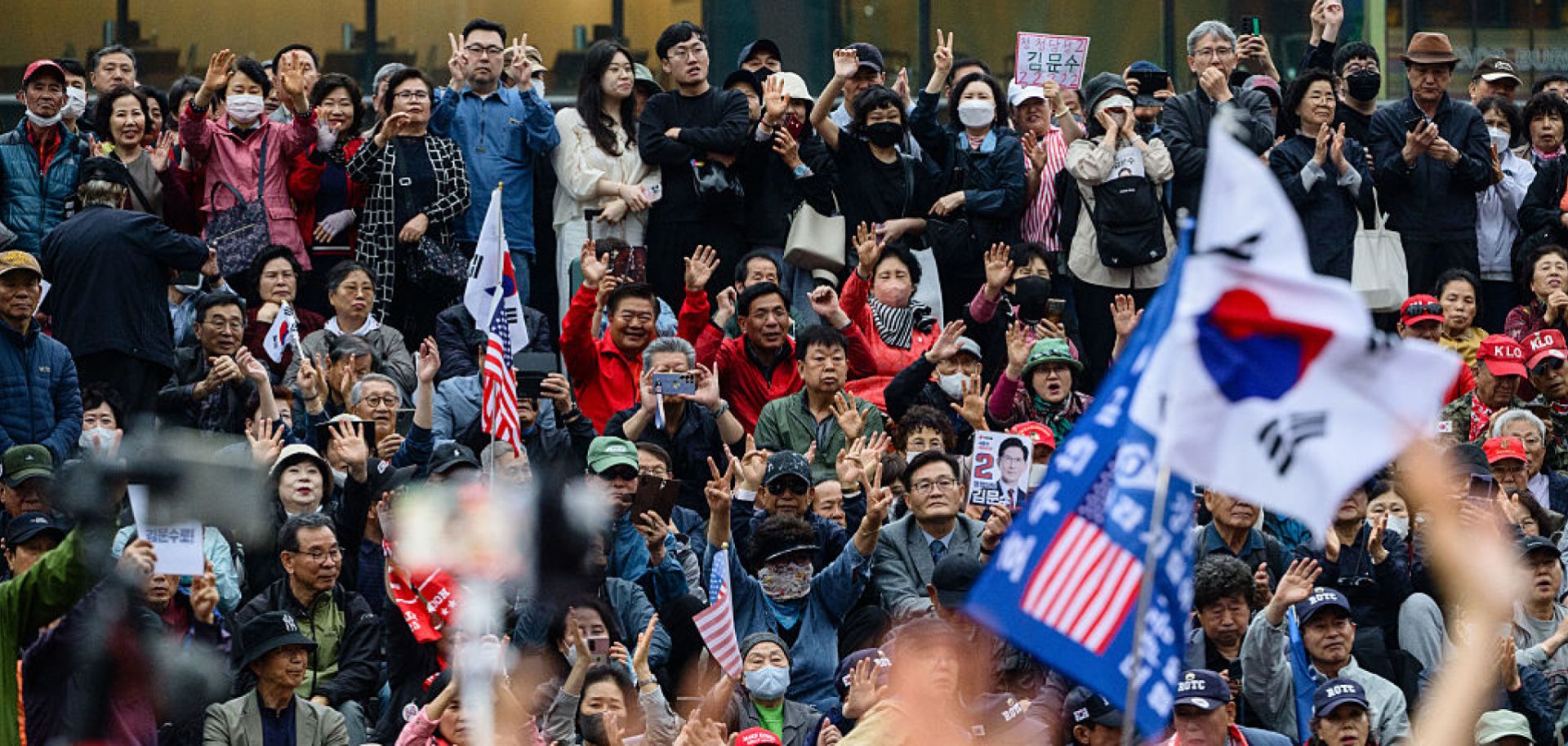
South Korea will hold an early presidential election on June 3 following the April impeachment of President Yoon Suk Yeol over his martial law declaration in December. The ruling People Power Party, or PPP, will fight to hold the presidency despite the martial law legacy left by Yoon, while the opposition Democratic Party, or DPK, will seek to take advantage of the early election and low support for the PPP, driven by Yoon's martial law gambit, to assume the presidency for the first time since 2022. The winner will have a five-year term and will not be eligible for reelection. Due to Yoon's impeachment, the new president will take office immediately after the election.
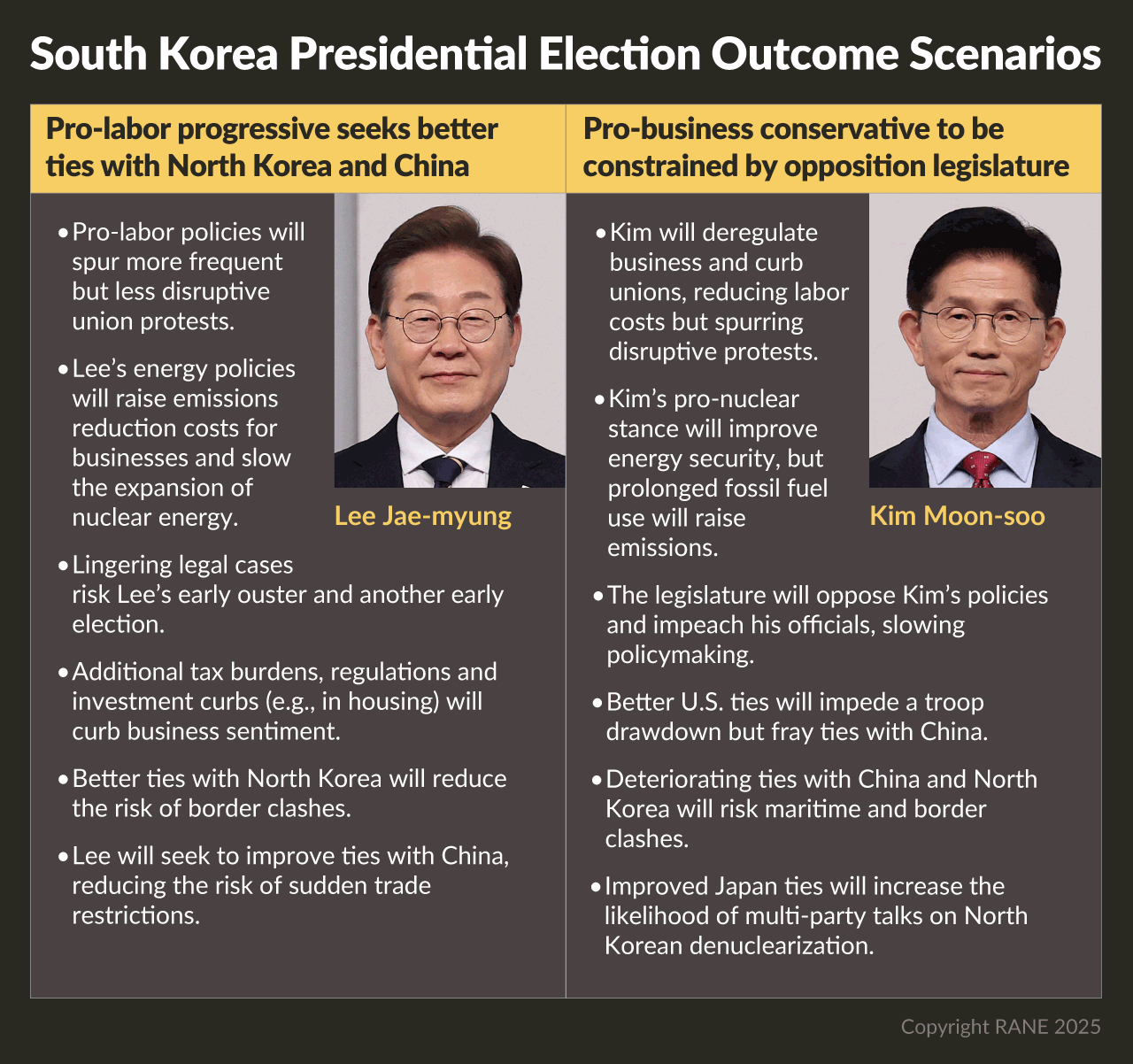
If the DPK candidate Lee Jae-myung wins, the government will focus on improving economic equity, while its legislative majority would facilitate fast policymaking. Lee's administration would bolster economic equity via greater labor protections, expanded social services, and greater tax burdens and regulations for businesses. He would also expand state funding for strategic industries, such as support packages for the domestic expansion of manufacturing capacity and research for advanced chips, electric vehicles and AI infrastructure. Lee's administration would also adopt pro-renewable energy policies and aim to strengthen environmental and emissions regulations and restrictions on nuclear and fossil fuels. On foreign policy, Lee would seek economic and diplomatic engagement with North Korea and economic cooperation with China while limiting the expansion of U.S.-South Korea military cooperation. Pending legal cases against him could oust Lee from office and trigger another early presidential election, prolonging political instability.
If the PPP candidate Kim Moon Soo wins, his administration would continue Yoon's pro-business policies. Kim's administration would curb welfare spending and take a market-based approach toward problems like housing affordability. Yoon's anti-union stance would also persist under Kim, maintaining a high risk of labor unrest. As president, Kim would have to overcome the opposition-run legislature, suggesting slow and arduous policymaking and greater political instability stemming from the DPK's efforts to impeach his cabinet members. On foreign policy, a conservative South Korean president would deepen military and economic security cooperation with the United States, raising the risk of clashes with North Korea. Third-party candidate Lee Jun-seok is all but guaranteed to lose, due to his high single-digit support rate and that his voter appeal is mostly limited to young, conservative men, but he could still steal votes from Kim.
Regardless of who wins, South Korea's next president will need to work with the DPK's legislative majority. Reaching a trade deal to remove U.S. tariffs on South Korean exports will top the new president's list of priorities, given South Korea's trade dependence on the United States, which purchased $128 billion worth of Korean exports in 2024.
DPK Candidate Lee Jae-myung Wins
As president, Lee Jae-myung would focus on economic equity at home, as well as reconciliation with North Korea and improving diplomatic and economic ties with China Russia, and other non-U.S. partners. Lee's policy framework of "economic democratization" would generally aim to rebalance the economy in favor of labor and households. This would involve expanding labor unions' bargaining power over corporate boardrooms and a light-handed treatment of union-led strikes (which are common in South Korea), as well as expanding workers' rights, like reducing hours, raising wages and requiring contracts for workers. Lee is also more likely to pursue tax redistribution, with lower taxes for households and higher ones for businesses, and expand social services. Lee's DPK would increase the funding and scope of industrial policy, including for high-tech sectors like artificial intelligence and semiconductors. Lee would also expand regulation for industries with higher impacts on household living standards, e.g., by reducing the scope or raising the costs of institutional investment in housing. Lee would ardently pursue the green transition, including industrial transformation policies that help South Korea meet its carbon emission reduction goals, but he would likely increase oversight of nuclear energy at home and curb his predecessor's policy of promoting nuclear reactor exports in diplomatic meetings. Lee would seek to resolve trade tensions with the United States as soon as possible but also bolster economic engagement with China and moderate U.S.-South Korea security cooperation in favor of expanded diplomacy with China and North Korea. Lee's reputation for dictatorial party leadership in the DPK and bending the rules of governing would likely deepen political rifts in society as the DPK eschews bipartisan policy consultation in favor of rapid, unilateral policymaking. However, this would also pose legal challenges to some of Lee's policies, particularly his efforts to rebalance institutional power (like curbing the judiciary's ability to check executive and legislative policymaking), exacerbating foreign concerns about South Korea's political stability. Pending legal cases against Lee could also result in his removal from office and another early presidential election, worsening political and market instability concerns.
Implications
- Lee and the DPK pursue economic equity policies, including tax hikes for corporations and tighter labor laws. These increase operating costs for businesses and reduce profitability, at least in the near term, relatively reducing South Korea's attractiveness as a manufacturing and business destination.
- The DPK's pro-labor policies embolden unions to more frequently engage in strike action, particularly in Seoul, due to less fear of a central government crackdown and greater legal protections. But these strikes are more likely to be resolved quickly (in favor of unions), reducing the production and supply chain disruptions from strikes, even as the outcome of the strikes is likely to raise labor costs for businesses.
- The DPK focuses on expanding renewable energy while curtailing fossil fuels and (to a lesser extent) the expansion of nuclear energy. In contrast to Yoon, Lee does not use foreign diplomatic meetings to push for nuclear reactor sales, impeding South Korea's ability to innovate in nuclear reactor technologies (e.g. small modular reactors). This will also keep nuclear power construction costs high in places like Europe, as South Korea will remain less of a competitor to Western nuclear power companies.
- The DPK likely expands government funding for public housing, and may also promulgate new regulations easing household credit constraints and curbing discriminatory or excessive housing contract terms aimed at renters and mortgage-buyers, while curbing institutional investment in housing. This could hurt real estate portfolio profitability, but is unlikely to significantly slow the growth of home prices or curb household debt levels in South Korea, a persistent constraint on consumption.
- Early economic policy will likely be mostly reactive, including economic support measures like adjustments to interest rates, taxes and subsidies to support households impacted by U.S. tariffs. Any economic reform plans that would initially impose economic costs (e.g., pension reform or curbing the market dominance of chaebols) are thus likely to be delayed until after U.S. tariffs on South Korea are reduced or lifted.
- If Lee's government cannot reach a deal with the United States to reduce or lift tariffs, it will accelerate efforts to expand exports to China and other major non-U.S. economies. The lack of a deal would increase the prevalence of South Korean chip and automobile firms expanding manufacturing operations in non-U.S. markets, bolstering employment and technological cooperation opportunities for China and Southeast Asia.
- The DPK seeks to deepen diplomatic and economic engagement with North Korea and reduce military deployments along the North Korean border, reducing the risk of a border clash and increasing cross-border trade and humanitarian aid opportunities, even if modest.
- Due to its dovish stance toward North Korea, the DPK is more supportive of U.S. efforts to revive talks between U.S. President Donald Trump and North Korean President Kim Jong-un. But if South Korea is cut out of North Korea nuclear talks, it will hurt Seoul's diplomatic ties with Washington, increasing the chance that Lee's government pursues greater economic ties with regional partners like China and Russia.
- The longer trade tensions with Washington linger, the more likely the DPK is to seek deepened trade with China — and Russia, particularly once the Ukraine war ends — eroding the efficacy of U.S. efforts to cooperate on industrial supply chain security and reduce exposure to Chinese economic coercion.
- Lee's efforts to slow U.S. military cooperation and expand trade ties with China potentially fray broader U.S.-South Korea ties, increasing the likelihood that a mercurial Trump administration curbs or revokes exemptions for South Korean chip producers to sell their products to China.
- During his term, Lee is more likely, compared with Yoon, to curb or scrap altogether trilateral security engagement with Japan and the United States (e.g., on monitoring North Korean missile threats) by reviving wartime historical grievances and related court cases against Japan. This may result in occasional economic spats that slow new trade or investment talks or even spur retaliatory trade action, and would also prompt Japan to accelerate its military development in the face of a growing North Korean threat.
- With a friendly president in office, the DPK-led legislature halts its rapid-fire impeachments of cabinet officials, leaving Lee with a more stable cabinet (relative to Yoon) that reduces the likelihood of cabinet-level policy reversals.
- Under a DPK government, revived negotiations with the Trump administration about cost-sharing for U.S. forces stationed in South Korea are likely contentious, increasing the likelihood that the U.S. military downsizes its assets and/or personnel in the country for redeployment to other, more strategically important locations like Japan. This relocation would reduce South Korea's deterrent against North Korea and increase the chance of brazen military activity by Pyongyang, including border clashes, should a conservative South Korean government retake power in the future.
- High-level political instability persists, as Lee could be removed from office due to pending criminal cases against him. If this happens, there will be another early presidential election within 60 days of his removal. This would revive domestic and foreign concerns about political and market instability and may revive dueling street protests by pro-Lee and anti-Lee groups in Seoul, disrupting traffic and risking isolated, violent clashes between rival protesters or with the police.
- The DPK seeks to bolster innovative industries (e.g., artificial intelligence, quantum computing, electric vehicles and their batteries) via industrial policy, including large-scale spending programs and light regulatory incentives (e.g., modest tax cuts). But these support measures likely include stipulations, like requiring companies to accelerate emissions reduction plans to access state funding.
- A DPK government is more likely to seek amendments to the Martial Law Act to reduce the power of future conservative presidents to conduct a reprise of Yoon's Dec. 2024 martial law bid. This amendment would increase foreign perceptions of political stability in South Korea in the short term, but in the long term, a DPK government is just as likely to attempt to abuse its power to counter its political enemies and revive foreign concerns about political and market instability.
- Lee is less likely to take aggressive action to counter China's installation of research facilities in disputed maritime areas of the Yellow Sea. Instead, he focuses on dialogue and monitoring measures that would facilitate China's expanding presence but also would minimize tensions, preserving room for deepening economic ties between Seoul and Beijing.
- Compared with his conservative predecessor, Lee is less likely to have close personal and ideological ties with Trump, impeding efforts to remove South Korea from the U.S. Department of Energy's Sensitive Country List, which slows the approval process for research collaboration on certain projects, including nuclear energy.
- In line with South Korea's plan to be a top-five space power by 2045, Lee is more likely to focus policy on developing civilian and commercial applications of space technologies and the integration of AI in space, but will be less interested in military applications of space technologies, opening South Korea up to collaboration with more international partners and potentially accelerating its commercial space industry development.
PPP Candidate Kim Moon Soo Wins
As president, Kim Moon Soo would pursue pro-business policies but contend with weaker public support and significant legislative opposition. He would be a widely pro-business president, supporting deregulation and employment flexibility as a means of stimulating innovative industries while seeking to curtail the powerful unions, inviting more intense but less frequent union demonstrations, some industrially disruptive. Kim would seek to expand nuclear energy domestically through facilitative regulations on new plant construction and research, as well as support the nuclear export industry in diplomatic meetings while slow-rolling the elimination of fossil fuels. However, the DPK-dominated legislature would limit his domestic policy agenda, constraining budgetary changes and leading Kim to focus on executive action, risking legal challenges and policy discontinuity. On foreign policy, Kim would expand cooperation with the United States on military exercises and supply chain security efforts as a deterrent against North Korean border activity, as well as Chinese maritime brinkmanship and economic coercion. However, greater U.S. military cooperation may be constrained if Kim cannot quickly resolve U.S. trade tensions. On all policy fronts, Kim's cabinet would be sensitive to heavy public skepticism of conservative policies following Yoon's martial law bid, presaging frequent policy reversals. This public skepticism, along with a hostile legislature, would sometimes lead to short-sighted or short-lived economic policies that are more likely to be expensive and ineffective, e.g., consumer tax breaks and subsidy programs or housing affordability measures.
Implications
- Kim's pro-business stance drives him to minimize government intervention and accelerate deregulation. This reduces costs for businesses, but it also potentially increases their exposure to reputational risks if the Kim administration curbs workers' rights and anti-monopoly laws, among other legal protections.
- Kim's government limits legal protections for strikers and for unions relative to employers. This reduces labor costs and the frequency of strikes, but it also increases the disruptive potential of strikes that do occur for transportation and industry, given the greater stakes for labor and fewer alternatives for redress.
- Kim supports nuclear and renewable energy, but is more likely to miss milestones for curbing fossil fuels in line with the country's 2050 net-zero carbon emissions goal, providing a longer transition period for industries reliant on coal and gas. This ensures greater energy security for businesses and helps bolster nuclear reactor exports, which provide more funding for South Korea's nuclear energy research and development and more options for other countries' energy diversification, security and transition.
- Kim likely adopts a relatively market-based and deregulatory approach to addressing South Korea's housing affordability problem, for example, by curbing taxes or clearing regulatory hurdles for construction companies to boost housing supply. He also avoids constraining institutional investor activity aside from minor measures, like increasing the time required to hold a unit before it can be resold. These measures maintain profitability for investor portfolios but do little to slow rising housing costs.
- Kim likely delays pension reform and other painful economic policy changes until after a trade deal is signed with the United States and the economic damage of tariffs on South Korea's export industries (e.g., electronics, chips, and automobiles) is subdued. In the interim, the government likely focuses on economic support measures like tax and interest rate cuts, but Kim's PPP will be more hesitant than the DPK to engage in cash handouts to Korean citizens, limiting consumption stimulus effects.
- The Kim administration deepens trilateral security engagement with Japan and the United States, particularly regarding North Korean missile threat monitoring, and will not revive World War II-era grievances with Japan, facilitating a steady expansion of already strong economic ties and budding security ties. This increases the chance of multi-party talks (e.g., involving South Korea and Japan) to address North Korea's arms drawdown if Trump revives one-on-one talks with Kim Jong-un.
- Kim likely seeks to steadily expand U.S.-South Korea military cooperation via joint exercises and port visits of strategic assets, including ballistic missile submarines. This raises the risk of escalatory behavior by North Korea, such as land or maritime border incursions, and the concomitant risk of isolated border clashes. However, the threat of North Korean aggression will not be as high as it was under Yoon.
- Under Kim, South Korea adopts a more confrontational stance in response to Chinese efforts to expand territorial claims in the disputed Yellow Sea, risking retaliatory Chinese economic coercion (e.g., a revival of the import bans of 2017) in the event of a face-off at sea.
- Like Yoon, Kim has a highly unstable cabinet due to the DPK-led legislature's ongoing efforts to oust PPP officials via frequent impeachment votes. This leads to discontinuity in executive policy implementation, including in some foreign-facing issues (like diplomacy and defense), and perpetuates business concerns about market instability.
- Kim frequently vetoes policies passed by the DPK-led legislature, leading to a slow pace of policymaking on all but the most widely supported issues, like supplementary budgets to fund economic support measures amid U.S. tariffs and those that fall within the remit of executive (not legislative) power.
- Though still unlikely, another PPP government is more inclined than a DPK government to join U.S. joint freedom of navigation operations around Taiwan or in disputed areas of the South China Sea, which would spur Chinese economic coercion (such as trade restrictions) against South Korea.
- Kim seeks to bolster South Korea's place in global innovative technologies, such as artificial intelligence, quantum computing and electric vehicles, via deregulation (e.g., tax cuts and efforts to reduce barriers to research and commercialization), as well as some modest funding for priority industries.
- Revived negotiations with the Trump administration about cost-sharing for U.S. forces stationed in South Korea are more amicable than they would be under a DPK government, increasing the likelihood that Seoul raises its defense spending while decreasing the likelihood that the U.S. military downsizes its assets and/or personnel in South Korea for redeployment. But with more U.S. assets on the Korean Peninsula, including missile defense assets, economic tensions with China may also increase, raising the risk of Chinese trade restrictions similar to those imposed after South Korea's 2017 THAAD deployment.
- Kim's administration is more likely to cooperate with the United States on shipbuilding for commercial and naval vessels, strengthening bilateral military supply chain integration and accelerating the U.S. Navy's ability to maintain a strong deterrent against Chinese aggression toward Taiwan.
- Kim is less likely to be successful in amending the Martial Law Act to reduce the power of South Korean presidents to impose martial law. The PPP and DPK would likely be unable to agree on the terms of the amendment, and with the DPK's legislative majority and the PPP's presidential veto power, this would stall the amendment process, perpetuating the risk of future martial law bids and related political instability.
- Lee's closer ideological alignment with Trump moderately facilitates efforts to remove South Korea from the U.S. Department of Energy's Sensitive Country List, which would accelerate the approval process for research collaboration on certain projects, including nuclear energy.
- In line with South Korea's plan to be a top-five space power by 2045, Kim is more likely to focus on the defense-related (in addition to commercial) applications of space technologies, including AI-powered surveillance and command capabilities, to deter North Korea. This military focus may entail greater space cooperation with the United States, but will slow cooperation with other partners like China and Russia.
- The DPK, discontented with Yoon's martial law legacy and with Kim's presidential victory, drives large street protests in central Seoul involving average citizens and union members, with some of these protests disrupting road traffic or resulting in clashes with police.
